
U.S. Freight Class: 4 Steps to Avoid Reclass Fees Under 2026 Rules
Freight class is the National Motor Freight Classification (NMFC) rating, from class 50 to class 500, that carriers use to price and handle less-than-truckload shipments. Before you book a shipment, measure your handling unit, calculate its density in pounds per cubic foot, then confirm that figure against the current NMFC entry so your bill of lading matches what actually ships.
TL;DR:
- Measure each pallet, including packaging, convert cubic inches to cubic feet by dividing by 1,728, then divide its weight by volume to calculate density.
- Match the density to the current scale with 13 subprovisions, then verify the specific NMFC item because commodity notes can change the assigned class.
- Under Shipment Rule 640, a mixed pallet with unitemized commodities may receive the highest class on the pallet, even when most freight is dense.
- If a carrier inspection finds a mismatch, charges may reflect the actual classification; keep measurements, density calculations, and shipment photos to support disputes.
Table of Contents
- What freight class is and why it matters to U.S. LTL shippers
- The four factors that set a freight class, and why density leads
- How to measure, calculate density, and pick the right NMFC class
- Common mistakes, carrier enforcement, and bill of lading practicalities
- Using NMFTA and ClassIT+ to confirm your class before you ship
- How freight class affects shipping times and carrier selection
- How freight class disputes get resolved when carriers challenge a shipment
- How freight classification has changed and what to watch going forward
- How professional logistics providers handle classification for shippers
- Where Universal Shipping fits when you want classification handled for you
- FAQ
- Sources
What freight class is and why it matters to U.S. LTL shippers
NMFC freight class sorts commodities into 18 classes on a 50 to 500 scale, with class 50 covering dense, easy-to-handle freight and class 500 covering light, high-risk, or hard-to-stow items. Carriers use this number, along with other shipment details, to help set your LTL rate and decide how a pallet gets loaded.
Getting the class wrong has real consequences. A quote based on an incorrect class may change after inspection. If a carrier inspects a shipment and finds that its contents do not match the bill of lading, charges may be assessed based on the actual classification. The National Motor Freight Traffic Association maintains the NMFC standard and is the authoritative source shippers should check before tendering, rather than relying on habit or a carrier’s quick estimate.
The four factors that set a freight class, and why density leads
Every NMFC class comes from four characteristics: density, stowability, handling, and liability. For most general palletized freight, density, measured in pounds per cubic foot, drives the classification, though the other three factors can affect the classification of specific commodities. The NMFTA’s classification standard describes this as a precise process rather than a single calculation, and shippers who treat density as the only variable often end up with a class that gets disputed at the dock.
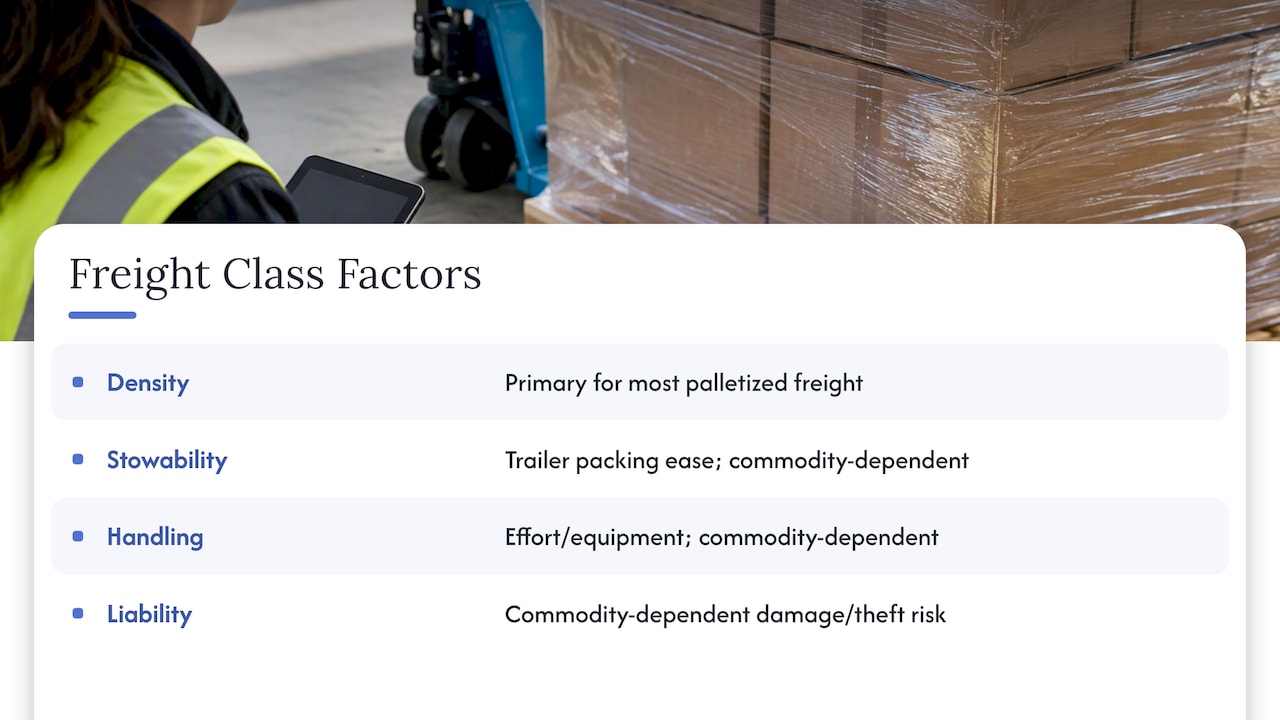
Stowability asks how easily your freight packs into a trailer alongside other shipments. Handling measures how much effort and special equipment a shipment demands. Liability reflects the risk of damage, theft, or spoilage tied to the commodity itself. Since July 19, 2025, the industry has used a 13-subprovision density scale to translate measured density into a class:
These density breaks come from NMFTA’s 2025 classification update, which replaced an older 11-sub scale. Read the full NMFC item entry rather than relying on the class number alone, and consult an interpretation service if the description seems ambiguous.
How to measure, calculate density, and pick the right NMFC class
Getting density right starts with accurate measurement, and the process is the same whether you ship one pallet or twenty.
- Measure the handling unit’s length, width, and height, including the pallet and packaging.
- Multiply length by width by height in inches to get cubic inches, then divide by 1,728 to convert to cubic feet.
- Divide the total weight in pounds by the cubic feet to get density in pounds per cubic foot.
- Match that pcf figure to the current density sub-provision to find the likely class, then verify it against the specific NMFC item for your commodity.
A worked example: a pallet measuring 48 inches by 40 inches by 36 inches works out to 69,120 cubic inches, or 40 cubic feet after dividing by 1,728. If that pallet weighs 320 pounds, its density is 8 pounds per cubic foot, landing it in Sub 6 at class 100 under the density calculation method NMFTA outlines. Calculate density for each handling unit, since the classification may differ across a mixed shipment. Our guide to palletizing freight for LTL covers packaging choices that keep dimensions and density consistent from the dock to delivery.
Pro Tip: Measure the handling unit’s full dimensions, including the pallet and packaging, and verify any measurement rules that apply to the shipment.
Common mistakes, carrier enforcement, and bill of lading practicalities
Misclassification usually comes from guessing a class instead of calculating density, or from describing a mixed pallet too vaguely. Under federal shipping regulations, the bill of lading functions as the legal contract of carriage, and if a carrier inspects a shipment and finds it does not match the declared description or class, the carrier is required to assess and collect charges based on the actual classification.
Mixed pallets carry their own risk. Under Shipment Rule 640, a pallet with multiple commodities that are not itemized separately can be classed at the highest-class item on that pallet, even if most of the freight is dense and low-class. A checklist can help keep your paperwork clear:
- Record the handling unit dimensions, including pallet height, for each piece in the shipment.
- Record the weight for each handling unit.
- Note the specific NMFC item number or declared class for each commodity when known.
- Include declared value where the commodity or carrier requires it for liability purposes.
Using NMFTA and ClassIT+ to confirm your class before you ship
Checking your item before the shipment leaves your dock can help reduce reclassification risk. ClassIT+ gives shippers NMFC data, smart search, item histories, and change notifications.
A pre-shipment routine can help:
- Search ClassIT+ for the NMFC item that matches your commodity description, not just a generic category.
- Read the item’s Notes in full, since many entries carry density subprovisions or handling exceptions that change the default class.
- Confirm which density sub-provision applies to your calculated pcf before finalizing the bill of lading.
- Use change notifications for frequently shipped items, since NMFC item numbers and class assignments can be revised.
NMFTA also publishes disposition bulletins documenting specific docket decisions and item reclassifications, which is the official record when you need to verify exactly what changed and when.
How freight class affects shipping times and carrier selection
A shipment’s class can affect more than price. Density and stowability may affect how carriers plan trailer space and routing, and a low-density shipment taking up substantial space may be harder to fit into a load. A dense, easy-to-stack shipment may be simpler for a carrier to fit into an existing load.
Handling requirements tied to class also affect carrier choice. Freight that needs special equipment, extra care, or liftgate service at delivery may affect which carriers can handle it and the rates they offer. For awkward or high-value freight, compare carrier capabilities and quotes.
Because class interacts with the lane and carrier network, the same commodity can see different transit expectations depending on who picks it up. Checking estimated ZIP-to-ZIP LTL transit times alongside your freight class before booking can help you plan a delivery window. Transit expectations may vary by carrier and lane.
How freight class disputes get resolved when carriers challenge a shipment
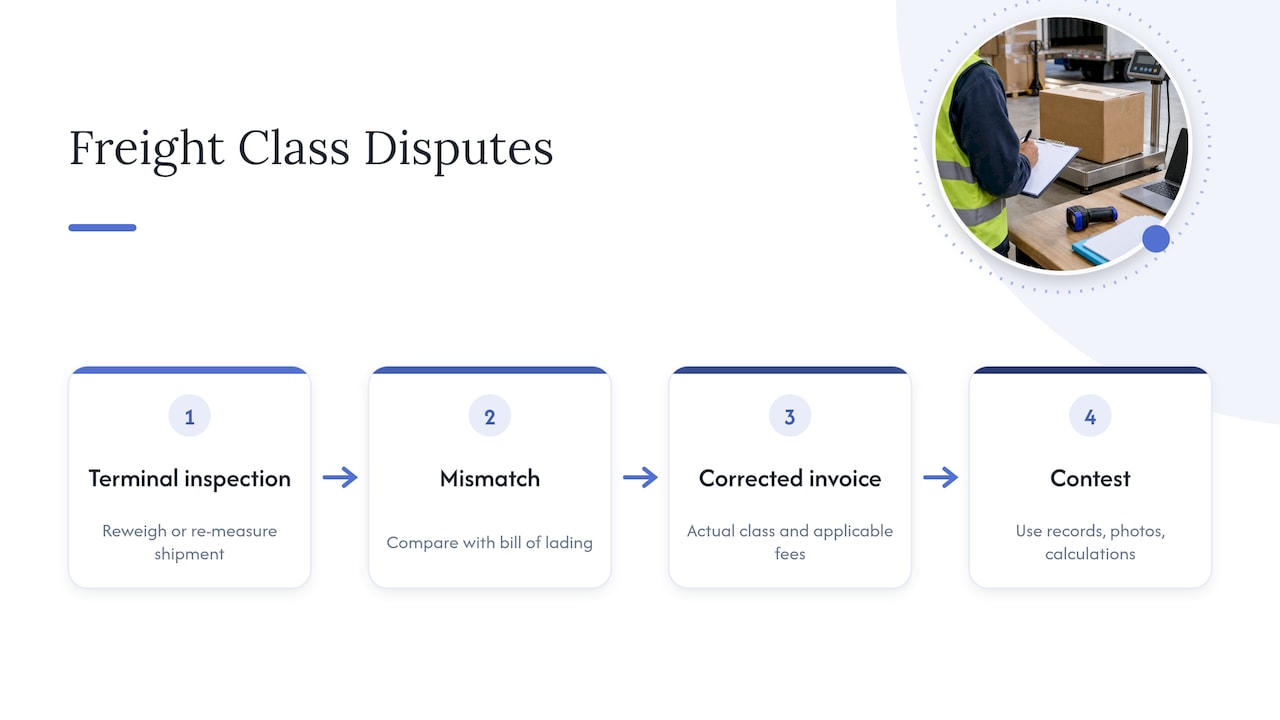
Most classification disputes start the same way: a carrier inspects, reweighs, or re-measures a shipment at a terminal and finds a mismatch with the bill of lading. If the carrier finds a classification mismatch, it may issue a corrected invoice based on the actual classification and any applicable fees.
Shippers who disagree with a carrier’s reclassification can ask how to contest it and what supporting documentation is needed. That means keeping your own measurement records, photos of the palletized freight, and density calculations on file before the shipment leaves your dock, so you can show the carrier’s inspection used different dimensions or an inapplicable NMFC item. Keep documentation that can help support a dispute, such as measurement records and photos of the shipment.
Confirming your class through NMFC references and tools like ClassIT+ before tendering, and keeping the bill of lading description precise and itemized for mixed pallets, can help reduce the risk of reclassification.
How freight classification has changed and what to watch going forward
Freight classification is not static. The most significant recent shift took effect July 19, 2025, when the NMFC moved from an 11-subprovision density scale to the current 13-subprovision scale, reclassifying thousands of items and pushing many commodities toward classification based purely on measured density rather than a fixed, commodity-specific class. ClassIT+ provides tools to help shippers and carriers check NMFC information and track changes.
These updates happen through a docket and disposition process, where proposed changes are reviewed and then published in bulletins documenting exactly which NMFC items were affected. Shippers who move the same commodities repeatedly can check those bulletins for changes to an item’s density sub-provision or description. Verifying your NMFC class for each shipment, rather than relying on a memorized classification, can help account for changes to the system.
How professional logistics providers handle classification for shippers
Experienced freight providers build classification verification into the shipping process itself: measuring handling units at receiving, cross-checking density against current NMFC entries, and itemizing mixed pallets before they ever reach a bill of lading. That routine can be particularly useful for shippers moving varied SKUs, mixed-commodity pallets, or high volumes, where classification errors may lead to reclassification fees.
— Akbar
Where Universal Shipping fits when you want classification handled for you
We apply NMFC classification knowledge to our freight forwarding work. Our specialty freight packing services address the stowability and handling side of classification, so awkward or fragile shipments can be packaged appropriately.
If you ship mixed pallets, oversized items, or high volumes and want help with freight forwarding, learn more through our freight forwarding services page.
FAQ
What are the different classes of freight?
NMFC freight class ranges from class 50 to class 500, with lower classes generally associated with denser freight and higher classes with less-dense freight. Classification considers density, stowability, handling, and liability, and density is a primary factor for many general palletized commodities.
How do I determine my freight class?
Measure your handling unit’s length, width, and height, convert cubic inches to cubic feet by dividing by 1,728, then divide the weight in pounds by the cubic-foot figure to get density in pounds per cubic foot. Match that density to the current 13-sub density scale and confirm the result against the specific NMFC item using a tool like ClassIT+.
What is class 70 for freight?
Under the current NMFC density scale, class 70 corresponds to a density between 15 and under 22.5 pounds per cubic foot. Whether a commodity uses this class depends on its NMFC item and applicable classification provisions.
What is a class 55 freight?
Under the 13-sub density scale, class 55 corresponds to a density between 35 and under 50 pounds per cubic foot. Whether a particular commodity falls into this range depends on its NMFC item and applicable classification provisions.
How can I calculate cubic feet accurately before I ship?
Measure the handling unit’s dimensions in inches, including the pallet, multiply length by width by height, then divide by 1,728 to get cubic feet. A moving industry guide to cubic feet calculation walks through the same core measurement approach shippers use for freight density work.