
5 Steps to Palletize Freight That Passes LTL for U.S. Warehouses
Palletizing freight means arranging, stacking, and securing goods onto a pallet so they move as one stable unit through handling and transit. The core best practice is straightforward: pick a pallet rated for the load, balance and interlock the stack, then secure it with wrap, strapping, or both. Follow OSHA’s stability requirements and NMFTA’s packing guidance, and most damage claims and freight rejections disappear before the truck ever leaves the dock.
TL;DR:
- Use pallets rated for the load, ensure proper stacking patterns, and secure with both wrap and strapping for maximum stability.
- Always select pallets with clear capacity ratings, avoid overhangs, and check for damage or defects before loading.
- Combine securing methods, such as stretch wrap and strapping, especially for tall or heavy loads, to prevent shifting and damage.
- Label pallets on two sides with weather-resistant labels, including all shipment details, and verify height and weight limits pre-shipment.
- Follow OSHA and NFPA safety guidelines for stacking height and stability, training operators regularly, and inspecting pallets before use.
Table of Contents
- How Do You Palletize Freight Step by Step?
- What Pallet Type and Size Should You Use?
- Which Materials Best Secure a Palletized Load?
- How Should You Label Palletized Freight?
- What OSHA and NFPA Rules Apply to Pallet Stacking?
- When Does Palletizing Make Financial Sense?
- What Are the Most Common Palletizing Mistakes?
- What Do Warehouse Operators Get Wrong About Palletizing?
- Let Usiship Handle Your Palletizing and Warehousing
- Where to Verify Palletizing Standards
- Sources
How Do You Palletize Freight Step by Step?
Getting from loose cartons to a shippable unit load takes five deliberate stages, not a rush job with a wrap gun.
- Inspect and choose the pallet. Check for splintered boards, protruding nails, and broken stringers. Match the pallet’s rated capacity to your total load weight, not just the heaviest box. A standard 48×40 wood pallet handles most general freight, but heavier or export-bound loads may need a reinforced or plastic option.
- Plan the stack pattern. Put heaviest cartons on the bottom, distribute weight evenly across the footprint, and alternate column stacking with interlocking brick patterns between layers for lateral strength. Never let boxes overhang the pallet edges. Overhang catches on rack beams and dock doors, and it is one of the most cited reasons carriers refuse freight.
- Add layer sheets and void fill. Slip sheets between layers keep boxes from telescoping into each other during transit. Fill gaps with airbags, foam blocks, or dunnage so nothing shifts when the trailer brakes hard.
- Strap and wrap from the base up. Start stretch wrap at the pallet deck, overlap each pass by roughly 50%, and work upward in a spiral before capping the top. NMFTA’s own loading guidance recommends this base-to-top approach because it locks the bottom layer to the pallet itself, not just to the boxes above it. Add strapping or corner boards on tall or heavy loads.
- Do a final check. Confirm total weight and height, snap a photo of the finished pallet, verify labels are visible, and attach the bill of lading before the freight leaves the staging area.
Pro Tip: Photograph every palletized load from two angles before it leaves your dock. That single habit resolves more freight damage disputes than any insurance policy line item.
What Pallet Type and Size Should You Use?
The 48×40 GMA pallet is the default in North American distribution for a reason: it matches standard trailer widths and warehouse rack spacing, and carriers built their handling equipment around it. Straying from that footprint without a reason tends to invite oversize fees or slower dock processing.
- Wood pallets cost the least and are widely available, but international shipments require ISPM-15 heat-treated stamps to clear customs.
- Plastic pallets cost more upfront, last through hundreds of trips, and never harbor pests, making them a better fit for closed-loop or reusable pallet programs.
- Metal pallets handle extreme weight and repeated forklift abuse, useful for heavy machinery or metal stock, but they add significant tare weight to every shipment.
- Specialty skids (winged, reversible, or custom-built) solve odd load shapes or export crating needs where a standard footprint just does not fit.
Always check the stenciled or stamped capacity rating on the deck boards before loading. A pallet rated for 2,500 pounds carrying a 3,000 pound machine part is a failure waiting to happen on the first fork lift.
Which Materials Best Secure a Palletized Load?
Stretch wrap and strapping solve different problems, and mixing them up is where most secured-load failures start.
Hand-applied stretch wrap works fine for lighter, lower loads shipped short distances. Machine-applied stretch wrap delivers more consistent tension across taller or heavier pallets, which matters over long-haul LTL routes with multiple transfers. Shrink wrap, which uses heat to shrink tight around a load, suits irregular shapes better than stretch film but requires equipment most docks do not keep on hand.
- PET strapping handles moderate tension and resists UV exposure, making it common for outdoor or covered-yard storage.
- Steel strapping carries far higher tension and suits dense, heavy loads like stacked lumber or metal coils, though it demands careful tensioning to avoid cutting into packaging.
- Corner boards and edge protectors stop strap tension from crushing carton corners, especially on tall stacks.
- Void-fill dunnage (airbags, foam, kraft paper) keeps drums, barrels, and irregular machinery from rocking inside the wrap.
For genuinely mixed loads, one securing method rarely suffices. Combining stretch wrap with strapping or corner boards is the standard approach for anything tall, heavy, or top-heavy, since a single method only holds up on short, low-center-of-gravity shipments.
Pro Tip: For fragile cartons stacked near heavier drums, wrap the fragile layer separately with its own light-tension pass before wrapping the full pallet. Double-wrapping the whole stack under one heavy pass is what crushes the boxes on the bottom.
Odd-shaped freight, like furniture or disassembled fixtures, often needs a securing plan built around the item rather than the pallet. Usiship’s furniture shipping guidance covers how that kind of load gets braced differently from standard cartons.
How Should You Label Palletized Freight?
Labels need to survive handling, weather, and multiple carrier scans, not just look good on the shrink wrap at the dock.
- Place labels on at least two adjacent sides so a scanner or dockworker can read them regardless of how the pallet sits on the rack.
- Use weather-resistant label stock or laminate for anything spending time on an open trailer or outdoor yard.
- Include pallet count (e.g., “1 of 3”), a contents description, the bill of lading reference number, and any special handling marks like “fragile” or “this side up.”
- Confirm the carrier’s footprint and max stack height limits before tendering, since LTL carriers frequently reject pallets that exceed their dock door clearance.
- Keep a photo and a one-page manifest checklist on file for every shipment. It speeds up claims review if freight arrives damaged.
What OSHA and NFPA Rules Apply to Pallet Stacking?
Federal rules do not set one universal maximum stack height, but they do set the conditions that determine a safe one. OSHA’s stability requirement under 29 CFR 1910.176(b) mandates that stacked materials be blocked, interlocked, or otherwise secured to prevent sliding or collapse. Separately, 29 CFR 1910.159©(10) requires 18 inches of clear space below sprinkler heads, a rule warehouses routinely violate by stacking too close to the ceiling.
NFPA guidance adds a practical benchmark: idle pallet stacks generally should not exceed 15 feet unless the facility’s fire protection system is specifically designed for greater heights. Facility layout, sprinkler design, and pallet condition all factor into what counts as safe beyond that baseline.
- Reject any pallet with cracked stringers, protruding fasteners, or missing deck boards before it gets loaded.
- Train forklift operators under OSHA 1910.178 and recertify regularly, since operator error causes a large share of warehouse stacking incidents.
- Mark clearance planes on the floor near sprinkler zones so stacking height stays visible at a glance, not just on paper.
- Give dock supervisors explicit stop-work authority to halt loading when a stack looks unstable.
CHEP’s safety research also recommends keeping uniform pallet types together and avoiding manual stacking above several pallets high should be avoided as this helps prevent tip-over injuries on the warehouse floor.
When Does Palletizing Make Financial Sense?
Palletizing costs money in pallets, wrap, strapping, and labor, and those costs need to buy real damage protection or handling speed, not just tradition.
- Pallet and material costs run from a few dollars for a basic wood pallet to $30 or more for reinforced plastic, plus wrap and strapping.
- LTL pricing climbs with pallet footprint and density, and freight priced in the $75 to $500-plus range is common depending on weight, distance, and service level.
- Skip palletizing for very small parcel counts or items where the cube-to-weight ratio makes a pallet mostly empty space.
- Weigh damage risk against cost. If a single damaged unit costs more than the pallet and wrap combined, palletizing almost always wins.
Businesses running frequent LTL volume often find outsourcing the whole decision to a managed provider cheaper than building this expertise in-house. Usiship’s breakdown of 3PL versus in-house shipping walks through that trade-off in more detail.
What Are the Most Common Palletizing Mistakes?
- Letting boxes overhang the pallet edge, which snags racking and voids carrier acceptance.
- Mixing pallet sizes or types within a single shipment, creating uneven stack heights.
- Under-wrapping tall or heavy loads with a single light pass of stretch film.
- Loading freight onto a cracked, splintered, or otherwise damaged pallet.
- Placing labels where they get covered by wrap or face the wrong direction on the rack.
Before tendering, a supervisor should confirm weight and height, check wrap and strap tension, verify labels are visible from two sides, and attach the manifest. Skipping that last five-minute check is where most claims originate.
What Do Warehouse Operators Get Wrong About Palletizing?
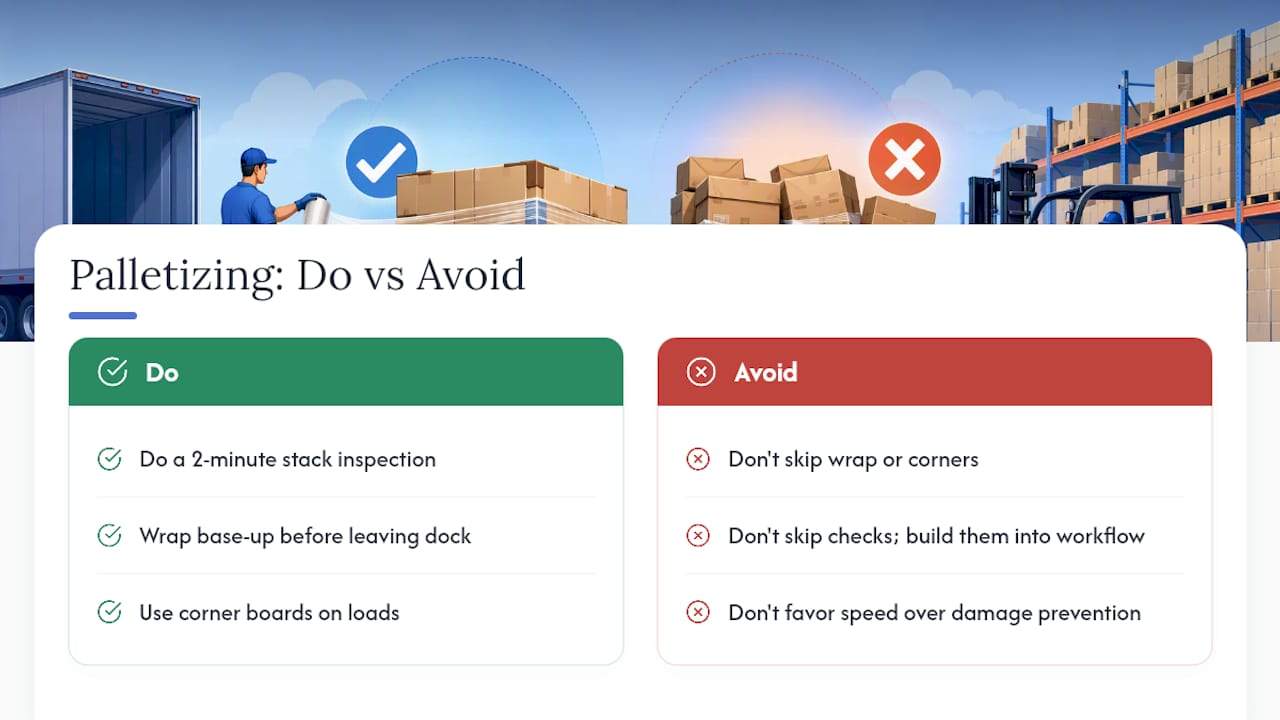
Most damage claims trace back to speed, not ignorance. Crews know the stability rules; they skip the base-up wrap pass or the corner board because the truck is already backed up to the dock. Universal Shipping Inc. runs warehousing, fulfillment, and pallet-handling operations across the country, and the priority that shows up again and again is dock turn time balanced against damage prevention, not one traded off for the other.
The stack pattern matters less than the discipline of checking it before the wrap goes on. Facilities that build a two-minute inspection into the workflow, rather than trusting memory, cut damage claims more than any single piece of equipment ever will.
— Akbar
Let Usiship Handle Your Palletizing and Warehousing
Building a compliant palletizing workflow in-house takes training, equipment, and floor space many growing businesses would rather not manage themselves. Usiship gives you a managed alternative: a warehousing and fulfillment team that already runs optimized warehouse operations built around the same stability and safety standards covered above, without you having to hire and train that expertise from scratch.
If your business handles unpredictable volume surges, ships oversized or irregular freight, or needs customs clearance on top of domestic transport, a managed provider usually beats in-house handling on both cost and consistency. Usiship’s logistics and transportation services cover FTL and LTL freight, while custom crating and furniture handling address the odd-shaped loads standard palletizing guides skip. For businesses moving into fulfillment at scale, the ecommerce fulfillment services page covers pick, pack, and pallet-ready shipping in one workflow. Warehouses moving heavy pallets by hand can also look at a manual pallet stacker to speed up floor moves without a full forklift fleet.
Get a quote on Usiship and see whether a managed warehousing and transport setup fits your next shipment better than doing it in-house.
Where to Verify Palletizing Standards
- OSHA stacking and sprinkler clearance rules: the regulatory baseline for stack stability and safety.
- NMFTA palletizing guidance: step-by-step packing and standard pallet footprints.
- CHEP pallet stacking safety tips: practical warehouse-floor stacking practices.
- UPS palletization definition: industry-standard terminology reference.
Sources
- How to Palletize a Shipment: Packing & Loading Tips
- Tips to efficiently and safely stack pallets every time | CHEP USA
- Palletization Definition | UPS Supply Chain Solutions