
Estimate U.S. ZIP to ZIP LTL Transit Times and When to Pad 1–2 Days
Most LTL shipments generally move within a range of business days depending on distance, with regional lanes under 500 miles typically delivering faster than longer cross-country lanes. The fastest way to pin down your actual number is a carrier transit-time calculator or published route map for your specific ZIP pair. Build in slack anyway: industry analysis puts average LTL on-time performance around 71%, with delays sometimes exceeding the published estimate by multiple days.
TL;DR:
- Transit time estimates vary significantly based on distance, with regional lanes under 500 miles generally delivering faster than longer cross-country routes.
- Carriers’ published transit days are scheduled business days, not guarantees, and real delays often exceed these estimates by multiple days, especially at busy times or with operational delays.
- Running multiple carrier calculators and cross-checking against service-center maps helps refine the estimated window, but buffers are necessary for factors like holidays, appointments, and accessorials.
- Expedited LTL services can reduce standard transit times by one to three days, but for long-distance moves, the savings are often minimal, making FTL more cost-effective in some cases.
- Maintaining historical lane performance data and using integrated logistics platforms can improve predictability and reduce the hours spent managing transit risks manually.
Table of Contents
- Where to Get a Fast LTL Transit Time Estimate
- Typical LTL Transit Times by Distance and Lane
- What Actually Changes LTL Transit Times
- How Carriers Publish Transit Times and What the Maps Actually Mean
- How to Estimate Transit Time for a Specific Shipment
- When to Pad the Schedule, Go Expedited, or Switch to FTL
- How Universal Shipping Thinks About Transit Predictability
- Let Universal Shipping Manage Your LTL Transit Risk
- Sources
- FAQ
Where to Get a Fast LTL Transit Time Estimate
Every major carrier publishes a transit-time calculator on its website, and these tools are your first stop for any LTL shipping timeline question. Type in an origin and destination ZIP code, pick a service level, and most calculators return a scheduled number of transit days instantly. Some require a login or account number to unlock accessorial pricing alongside the estimate, so keep a carrier account handy if you shop rates the same way.
A single calculator result is a starting point, not gospel. Run the same lane through two or three carrier tools and compare the spread; a tight cluster of results is a good sign, while a wide range signals a lane with real variability.
- Cross-check the quoted transit days against the carrier’s printed service-center route map to confirm the lane is direct rather than routed through an extra terminal.
- Enter your actual pickup date, not “today,” since weekend and holiday pickups shift the delivery window without changing the displayed transit-day count.
- Note whether the tool quotes business days or calendar days. Nearly all LTL carriers quote business days.
Typical LTL Transit Times by Distance and Lane
Distance is the single biggest lever on any LTL freight transit speed estimate, and the ranges hold up fairly consistently across carriers according to ParcelPath’s freight shipping guide.
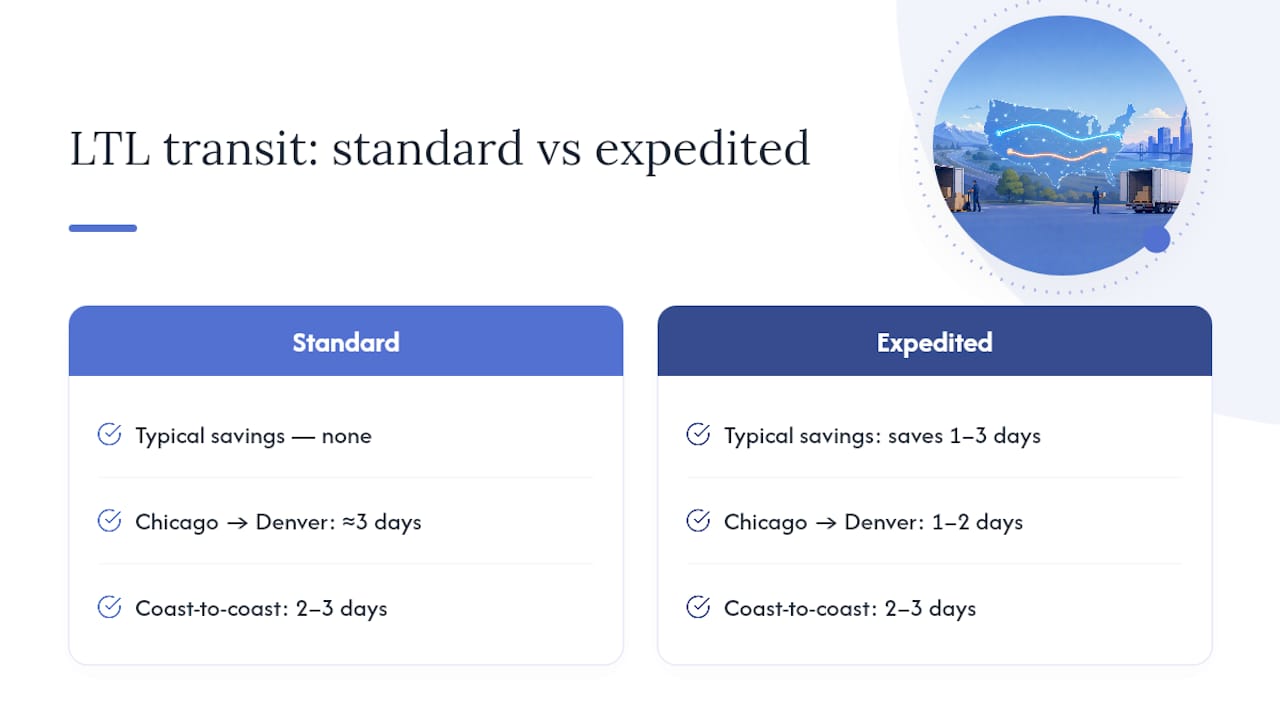
Expedited LTL service typically shaves 1 to 3 days off the standard timeline for the same lane, but it comes at a meaningfully higher rate per hundredweight. A Chicago-to-Denver shipment quoted at 3 standard days might drop to 1 or 2 with expedited service, while a coast-to-coast move rarely compresses below 2 to 3 days no matter what you pay. Treat these ranges as a sanity check against whatever a carrier calculator returns for your specific ZIP pair, not a replacement for it.
What Actually Changes LTL Transit Times
Distance sets the baseline, but a handful of operational and external factors determine whether you land inside that window or blow past it.
- Terminal density and handoffs. A shipment that moves through three or four service centers before final delivery carries more opportunity for delay than one that runs a direct lane between two hubs.
- Accessorials and appointments. Delivery appointments, liftgate requests, and inside delivery all add handling steps, and shipments with scheduled appointments show measurably higher lateness risk when something goes wrong.
- Residential and limited-access delivery. Narrow streets, no loading dock, and oversized pallets slow down the final mile more than any other single factor, as detailed in long-distance moving challenges.
- Seasonality and weather. Winter storms, port congestion, and peak retail season all strain carrier networks at the same time freight volume spikes.
- Driver hours-of-service limits. FMCSA rules cap how many hours a driver can operate per day, which caps how many miles a truck covers before it has to stop for a mandatory rest period, regardless of how urgent the freight is.
It’s the documented industry norm for LTL freight nationwide, so build your customer-facing delivery promise around the worst case, not the calculator’s best case.*
How Carriers Publish Transit Times and What the Maps Actually Mean
A “published transit time” is the number of business days a carrier’s network is scheduled to take between two service centers. It is not a guarantee and it is not a delivery window with a time attached. Guaranteed service is a separate, paid add-on that carries a money-back promise if the freight misses the date.
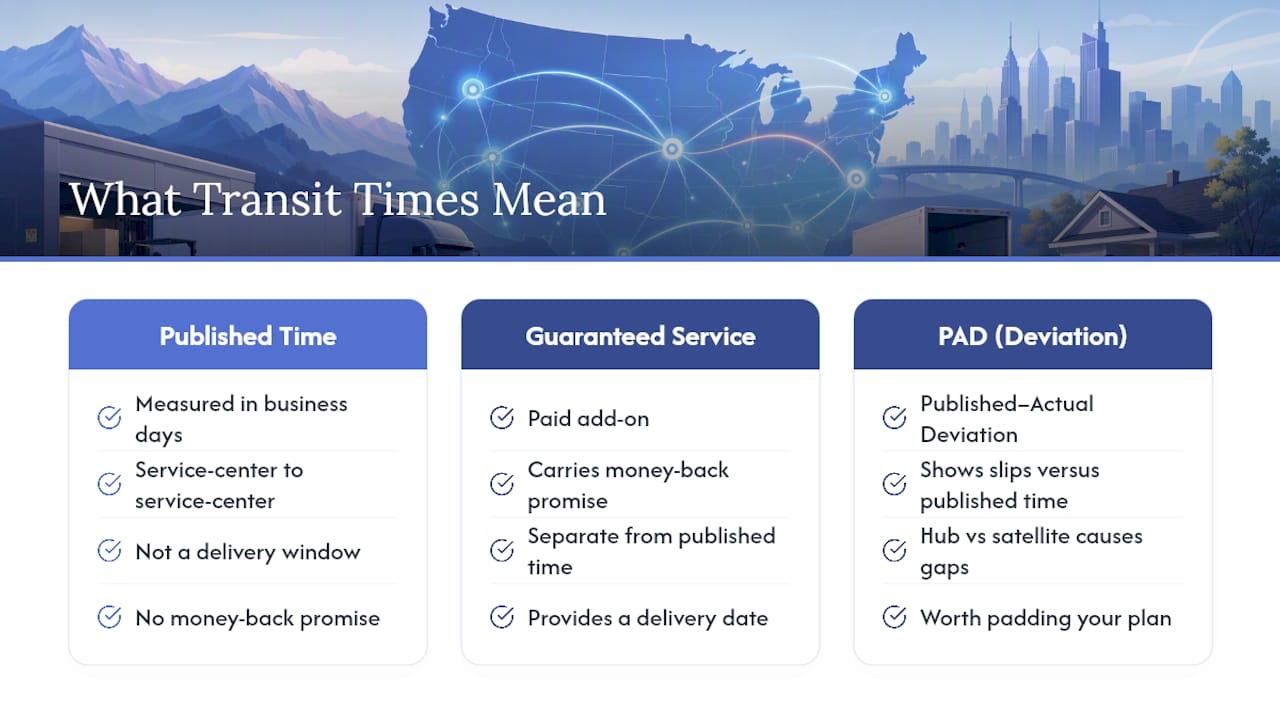
Route maps and calculators work off service-center-to-service-center mapping, so a ZIP code near a major hub often gets a faster quoted time than one served by a smaller satellite terminal even at similar mileage. This gap between the printed schedule and what actually happens on the road has a name in the industry: Published-Actual Deviation, or PAD. A lane with a published time of 2 days but a PAD pattern of frequent 1-day slips is a lane worth padding in your own planning, even though the calculator never shows that history.
How to Estimate Transit Time for a Specific Shipment
- Collect the shipment attributes. Origin and destination ZIP codes, NMFC class or weight break, dimensions, any accessorials, and your intended pickup date. Freight classification affects handling speed, so check NMFC coding before you quote if you’re unsure of the class.
- Run the carrier’s transit calculator and cross-check the route map. Confirm the lane routes directly rather than through a secondary terminal.
- Adjust for service tier and add a buffer. Add a day for any residential delivery, liftgate, or appointment requirement, since these consistently push shipments past the printed estimate.
- Check recent lane performance if you have it. Internal shipment history on a specific lane is more reliable than any published number, because it reflects actual PAD rather than the carrier’s scheduled target.
- Document the estimate and communicate the window, not the date. Tell customers “3 to 5 business days,” not “Thursday.” That range absorbs normal variability without breaking your commitment.
Pro Tip: Keep a simple spreadsheet of quoted versus actual transit days for your top 10 lanes. After a quarter, you’ll have your own PAD data, which is more accurate for your freight than any generic carrier average.
When to Pad the Schedule, Go Expedited, or Switch to FTL
A same-day-urgent order on a cross-country lane is exactly when expedited LTL earns its higher cost. But if a shipment fills more than half a trailer or the lane is notoriously unreliable, FTL often ends up cheaper and faster once you account for the accessorials an LTL shipment would rack up.
- Add a 1-day buffer for regional lanes with any accessorial; add 2 days for mid-range or long-haul lanes with appointments.
- Reach for expedited LTL when a customer deadline is fixed and the standard transit estimate leaves no margin.
- Move to FTL when weight approaches 10,000 to 15,000 pounds or when a lane’s PAD history shows chronic slippage.
- Document why you chose the mode you did. It saves the argument later when a customer asks why the invoice looks different than last time.
How Universal Shipping Thinks About Transit Predictability
Universal Shipping runs end-to-end freight forwarding and supply chain management across air, ocean, and land, including LTL and FTL shipping alongside warehousing, fulfillment, and customs clearance. That breadth matters here because transit prediction gets better when you can see the whole chain, not just one leg of it.
In practice, that means combining published carrier calculators with a running record of actual lane performance, watching how appointment requirements affect specific routes over time, and keeping a real-time tracking layer that flags a shipment the moment it drifts off its expected schedule rather than waiting for a customer to ask. Some platforms tie transportation and warehousing data together across many states, which lets a logistics manager see a lane’s real PAD pattern instead of just its printed transit days.
— Akbar
Let Universal Shipping Manage Your LTL Transit Risk
Chasing lane estimates across three carrier calculators, tracking appointment slippage by hand, and padding every schedule yourself eats hours a busy shipping desk doesn’t have. Some logistics providers combine those functions into one platform instead of leaving them scattered across carrier logins.

- Integrated LTL and FTL routing with real-time tracking so a delayed shipment surfaces before your customer notices.
- Warehousing and fulfillment tied to the same transportation network, cutting the handoffs that usually cause the biggest transit slippage.
- Control tower visibility that lets you see historical lane performance instead of relying on a single published estimate.
If a shipment’s timeline is critical to your operation, get a quote through Usiship and have a shipping specialist map the actual transit risk on your specific lane before you commit a delivery date to your customer.
Sources
- Drivers of Less-than-Truckload (LTL) Carrier On-Time Performance
- Summary of Hours of Service Regulations — FMCSA
- LTL services: your complete guide to freight shipping — ParcelPath
FAQ
Do LTL Transit Times Include Weekends?
No. Published LTL transit times are quoted in business days, so a “2-day” estimate given on a Friday typically means delivery the following Tuesday, not Sunday.
How Long Does LTL Freight Normally Take?
Most LTL shipments typically take a few business days depending on the lane distance: shorter distances generally take fewer days while longer cross-country lanes take more.
What Is Freight Transit Time?
Freight transit time is the number of business days a carrier’s network schedules between pickup and delivery for a given lane, based on service-center routing rather than a guaranteed clock.
What Is the Transit Time for R&L Carriers Freight?
Regional carriers like R&L typically post transit times in line with general industry ranges. Actual transit for any specific lane depends on ZIP-to-ZIP distance and terminal routing, so checking the carrier’s own transit calculator for that exact pair is the most reliable way to confirm it.