
14 Packing List Requirements U.S. Shippers Must Include to Avoid Holds
A packing list must itemize every package (box, crate, or pallet) with package-level descriptions, counts, net, tare, and gross weights, dimensions, and package marks so customs and carriers can verify contents without unloading a container. Meeting these packing list requirements consistently is what separates a shipment that clears in hours from one held for days of inspection and added demurrage charges.
TL;DR:
- A detailed packing list must include package weights, dimensions, descriptions, and marks to avoid delays caused by customs inspection holds.
- It must explicitly match the commercial invoice and bill of lading in package counts, marks, and descriptions to prevent discrepancies.
- Automated templates that extract data from warehouse management systems streamline accurate, consistent packing list creation.
- Proper labeling, palletization, and placement of packing list copies inside and outside packages significantly reduce inspection time.
- Ensuring all documentation is cross-checked and aligned before shipment prevents last-minute delays and demurrage charges.
Table of Contents
- What a Packing List Is and Who Relies on It
- Required Packing List Elements: The Detailed Checklist
- Packing List vs. Commercial Invoice: What Goes Where
- Packing, Marking, and Palletization Practices That Speed Inspections
- Practical Packing List Template and Sample Checklist
- Operational Checklist From a Logistics Provider Perspective
- Why Rigorous Packing Lists Matter
- How We Help With Packing Lists and Customs Clearance
- FAQ
- Sources
What a Packing List Is and Who Relies on It
A packing list is a shipment-level document that itemizes exactly what is inside each box, crate, or pallet rather than what the goods cost. According to International Trade Administration guidance, an export packing list should name the seller, buyer, and shipper, the invoice number, shipment date, mode of transport and carrier, total package count, and a description and quantity for each package. It is not a substitute for the commercial invoice, which carries pricing and payment terms.
Several parties depend on this document for different reasons:
- Customs officers use it to verify contents against declared goods without opening every package.
- Freight forwarders use it to prepare the bill of lading and calculate required space.
- Carriers reference it to confirm weights and dimensions match the manifest.
- Banks may request it as supporting documentation under letters of credit.
Required Packing List Elements: The Detailed Checklist
A compliant packing list needs more than a basic box count. These are the fields that customs, carriers, and your own warehouse team will expect to see:
- Seller or shipper name and address.
- Buyer or consignee name and address.
- Commercial invoice number for cross-reference.
- Shipment date and mode of transport (air, ocean, land).
- Carrier name and booking or voyage reference.
- Total number of packages in the shipment.
- Package identifier for each unit, such as “box 1 of 10.”
- Description of contents per package.
- Quantity of each item per package.
- Net, tare, and gross weight per package.
- Dimensions per package, ideally shown in both U.S. and metric units, as recommended by ITA export guidance.
- Package marks and numbers matching the invoice.
- HS classification number where the shipment or commodity requires it.
- Special handling or hazardous materials notes.
Pricing information generally stays off the packing list and belongs on the commercial invoice instead, since the packing list’s job is physical verification, not valuation. Package numbers should align exactly with the line items on your invoice so an inspector can move between the two documents without confusion. For international shipments, correct HS code classification on supporting paperwork also reduces the chance of a tariff dispute holding up the entire entry.
Pro Tip: Build your packing list template so that package numbers, weights, and marks populate automatically from your warehouse management system rather than being retyped by hand for every shipment.
Packing List vs. Commercial Invoice: What Goes Where
The two documents serve distinct purposes, and mixing their content is one of the fastest ways to trigger a customs hold. Keep the division clean:
- The commercial invoice carries pricing, payment terms, and the total transaction value.
- The packing list carries package-level quantities, weights, dimensions, and marks.
- Both documents must show matching invoice numbers, shipper and consignee names, and item descriptions.
- The bill of lading should reference the same package count and marks as the packing list.
CBP’s importer guidance notes that inconsistencies between the packing list, commercial invoice, and bill of lading are a common cause of delay. Before a shipment leaves the dock, cross-check all three documents against each other, and keep a version-controlled file so a last-minute revision to one document does not leave the others out of date.
Packing, Marking, and Palletization Practices That Speed Inspections
How you pack and label a shipment often matters as much as the paperwork itself. A few practices consistently reduce inspection time:
- Mark and number each package to match the packing list and invoice exactly.
- Use coded marks rather than brand names on the exterior to reduce pilferage risk.
- Palletize cargo wherever feasible and leave access aisles inside containers.
- Place a waterproof packing list copy inside each carton and attach another securely outside.
- Weigh and measure each package carefully, recording net, tare, and gross figures with units.
- Use seals and straps, and avoid writing full product descriptions on exterior surfaces.
Palletized freight can be unloaded with a forklift in minutes rather than hours of manual unpacking, which is exactly the kind of efficiency that lets an inspector access a targeted unit without delaying the whole container, as ITA guidance points out. For a step-by-step approach to building pallets that pass inspection and LTL carrier requirements, see our palletizing freight guide. Clear, consistent labeling also borrows from general packing and labeling practices used across moving and freight industries, where mismatched labels are a routine cause of lost or misdirected items.
Pro Tip: Attach the exterior packing list pouch near the shipping label, not on a side panel, so warehouse staff and inspectors find it on the first pass.
Practical Packing List Template and Sample Checklist
A usable template keeps the required fields in one place and lets your team fill it out the same way every time:
- Header block: shipper, consignee, invoice number, shipment date, carrier, mode of transport.
- Package table: package ID, description, quantity, net weight, tare weight, gross weight, dimensions, marks.
- Footer block: total packages, total gross weight, special handling notes.
A sample line might read: “Box 1 of 3, SKU 4521 ceramic mugs, 24 units, net weight 9.1 kg, gross weight 10.4 kg, dimensions 40 x 30 x 25 cm, marked ABC-01.”
| Mode | Adjustment needed |
|---|---|
| Air | Piece counts and pallet dimensions per unit load device |
| Ocean | Container number and pallet count per container |
| Land (LTL) | Pallet count with NMFC class notation |
Save your template as a locked format so field order stays consistent across shipments, and always reconcile the final version against the commercial invoice before it leaves your office. Businesses consolidating multiple smaller shipments benefit from the same discipline, as outlined in our freight consolidation checklist.
Operational Checklist From a Logistics Provider Perspective
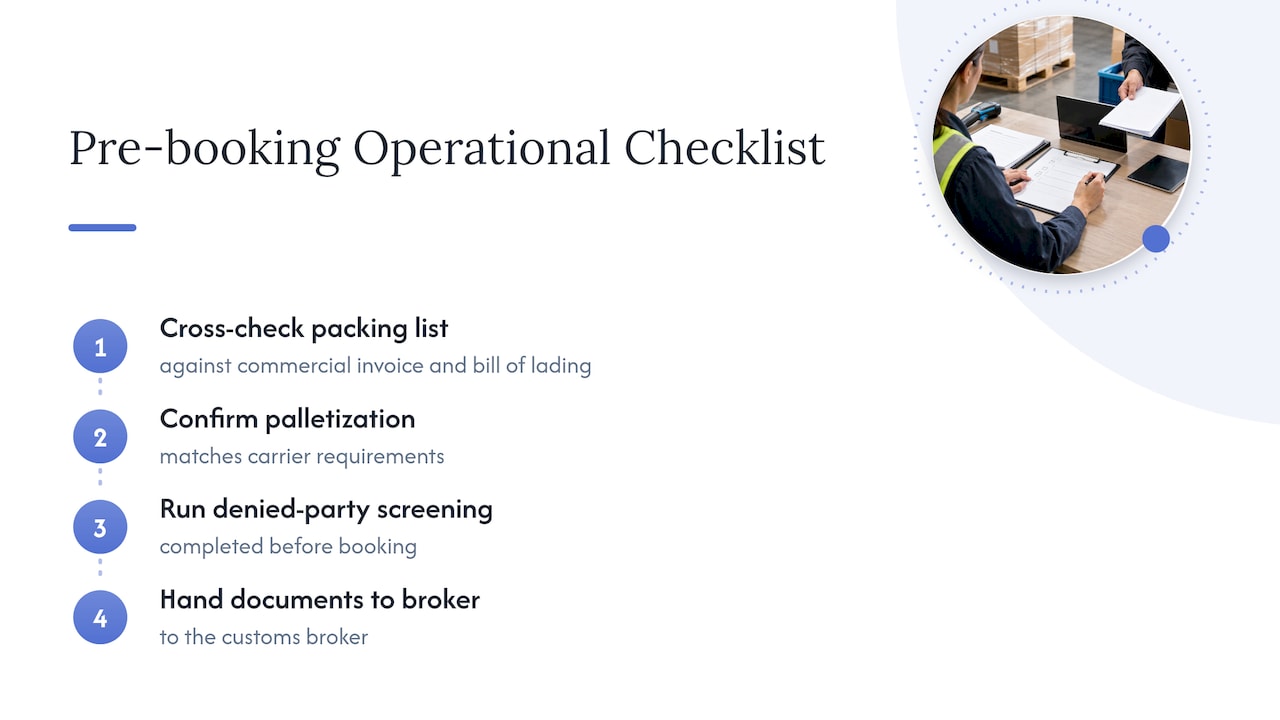
Before booking, we cross-check the packing list against the commercial invoice and bill of lading, confirm palletization matches carrier requirements, run denied-party screening, and hand a complete document set to the customs broker. Coordinating these steps early with your forwarder and broker is what prevents last-minute holds and the demurrage charges that follow.
Why Rigorous Packing Lists Matter
A packing list is often treated as paperwork, but it is closer to insurance against delay. Every field filled out correctly is one less reason for an inspector to open a container, and that adds up across a year of shipments into fewer holds and less demurrage. Teams that standardize their templates and cross-checks tend to spend far less time firefighting customs issues.
— Akbar
How We Help With Packing Lists and Customs Clearance
Getting packing list requirements right on paper is only half the job, matching physical packaging to that paperwork is the other half, and that is where many shipments actually break down. We review documentation for consistency, handle palletizing and specialty freight packing, and manage customs brokerage so your packing list, invoice, and bill of lading agree before a container ever reaches a port.

- Document review to catch mismatches between packing list, invoice, and bill of lading before filing.
- Specialty freight packing and palletizing services built around carrier and customs requirements.
- Licensed customs brokerage to handle entry filing once documentation is confirmed.
If you want a team to check your documents and handle the packing itself, explore our pricing and service tiers to find the right fit for your shipment volume.
FAQ
What should be included in a packing list?
A packing list should include the seller and buyer, invoice number, shipment date, carrier, total package count, a description and quantity per package, net, tare, and gross weights, dimensions, and package marks, according to ITA export guidance. Pricing information is generally left off and reserved for the commercial invoice.
What is the 5 4 3 2 1 packing list?
This term is not a recognized customs or logistics standard, and our sources do not define it as such; it appears in casual travel-packing content rather than international trade documentation. For business shipments, follow the standard fields outlined in export packing list guidance instead.
What are the packing requirements?
Packing requirements generally call for accurate marking and numbering of each package to match the invoice and packing list, careful net, tare, and gross weighing, and palletization where feasible to speed inspection, as described in CBP’s importer guide. Certain government shipments also follow specific federal contracting clauses for packing list content.
Is packing list mandatory?
For most commercial exports there is no single universal law forcing a packing list, but customs authorities and carriers expect one, and its absence routinely causes inspection delays. For U.S. government shipments, a packing list is a mandatory contractual requirement under 48 CFR 552.211-77, specifying consignor and consignee details, order numbers, and container numbers.
Sources
- Export Packing List | BETA – International Trade Administration
- Importing into the United States: A Guide for Commercial Importers (CBP)
- 48 CFR 552.211-77 Packing List (Electronic Code of Federal Regulations)