
SMB Shippers’ 60–90 Day Freight Consolidation Pilot Checklist
Freight consolidation combines multiple smaller shipments into a single container or truckload, cutting per-unit shipping cost and emissions by maximizing capacity on every trip. For most shippers moving less than a full truckload regularly, it lowers freight spend, reduces damage, and improves tracking. It also adds lead time and demands tighter vendor discipline, both covered below.
TL;DR:
- Freight consolidation is most effective when shipment volume and frequency are consistent, predictable, and involve non-urgent, uniform, and non-hazardous goods.
- A successful pilot requires strict origin control, defined vendor delivery windows, real-time shipment visibility, and standardized packaging to ensure vendor compliance.
- Lead times increase with consolidation, typically adding several days beyond standard LTL transit, which must be factored into purchase order cycles.
- Using a transportation management system integrated with warehouse systems and visibility tools is essential to scale consolidation programs without errors or delays.
- Consolidation offers meaningful cost and emission savings primarily for routine, high-volume lanes, but is less suitable for time-sensitive or irregular shipments.
Table of Contents
- What Is Freight Consolidation and What Are Its Main Types?
- What Are the Benefits of Freight Consolidation?
- What Are the Risks and Limits of Freight Consolidation?
- How Does the Consolidation Process Actually Work?
- When Should You Use Freight Consolidation?
- What Operational Controls Make Consolidation Programs Succeed?
- How Does Consolidation Support Sustainability Goals?
- Impact of Freight Consolidation on Delivery Times and Customer Service Levels
- What Technology Supports a Freight Consolidation Program?
- What Do Successful Freight Consolidation Programs Look Like in Practice?
- A Practitioner’s Take on What Actually Breaks Consolidation Programs
- Ready to Pilot a Consolidation Lane?
- Sources
What Is Freight Consolidation and What Are Its Main Types?
Freight consolidation means combining shipments from multiple suppliers, orders, or locations into one container or trailer instead of shipping each partially full. The goal is simple: fewer half-empty trucks, more freight moving per trip, and a lower cost per unit shipped. DHL’s logistics glossary frames it as maximizing capacity utilization, and that framing holds across every variation of the model.
The main formats differ mainly by where and how the freight comes together:
- LCL (less-than-container-load): Ocean freight from multiple shippers shares a single container, common for importers who don’t yet fill a 20 or 40 foot box.
- LTL-to-FTL consolidation: Several less-than-truckload shipments headed the same direction get combined into one full truckload domestically.
- Pool distribution: A carrier consolidates shipments bound for a regional area, then breaks them down for final delivery closer to the destination.
- On-site vs. off-shore consolidation: On-site happens near the point of origin or a domestic hub; off-shore consolidation happens overseas before goods cross a border, which is common with China sourcing.
Retailers and manufacturers running frequent, smaller-volume shipments to similar regions tend to lean on LTL-to-FTL and pool distribution. Importers usually start with LCL.
What Are the Benefits of Freight Consolidation?
The financial case is the easiest to see first. Combining shipments spreads fixed carrier costs, like fuel surcharges and minimum charges, across more freight, which typically brings per-unit shipping cost below what standalone LTL shipments would cost. SPS Commerce notes shippers gain access to bulk rates they couldn’t reach alone, and fewer touchpoints between origin and destination mean fewer chances for freight to get mishandled.
Consolidation delivers value across several dimensions at once:
- Lower cost per unit by sharing truckload or container capacity instead of paying LTL minimums repeatedly.
- Reduced damage rates, since freight changes hands fewer times between pickup and delivery.
- Simpler billing, with one consolidated invoice instead of a stack of separate LTL bills.
- Improved visibility, because shipments route through fewer nodes and are easier to track end to end.
- Lower emissions per unit shipped, since fuller trucks and containers mean fewer total trips.
Fewer Trips, Lower Emissions: Transportation is one of the largest sources of greenhouse gas emissions in the United States, and the EPA identifies cutting vehicle miles traveled as central to lowering that number. Consolidation directly reduces the miles needed to move the same volume of freight.
Track cost per unit shipped, on-time-in-full (OTIF) rate, and damage rate before and after a consolidation pilot. Those three numbers tell you almost everything you need to know about whether the program is working.
What Are the Risks and Limits of Freight Consolidation?
Consolidation isn’t free of trade-offs, and the biggest one is time. Waiting for a container or trailer to fill before it ships adds lead time that standalone shipments don’t carry, which means purchase order cycles need to build in that buffer or service levels slip.
Some freight simply isn’t a good fit. Hazardous materials, temperature-controlled goods, and highly fragile or oversized items often need dedicated handling that consolidation complicates rather than simplifies. A few other risks show up consistently in practice:
- Mislabeling and vendor noncompliance create retailer chargebacks and delays at the consolidation center, not just at final delivery.
- Detention and terminal handling delays can erase the savings consolidation was supposed to deliver; FMCSA research documents how detention time drives up cost and hurts service reliability across the industry.
- Scheduling rigidity means one late vendor delivery can hold up an entire consolidated load.
None of this rules consolidation out. It just means the fit depends on your SKU mix and how tightly you can control vendor timing.
How Does the Consolidation Process Actually Work?
A consolidation program runs on a repeatable sequence, and most failures trace back to skipping a step rather than the concept itself failing.
- Suppliers pick a delivery window. Each vendor gets an assigned time slot to drop freight at the consolidation center, not an open-ended “sometime this week” arrangement.
- Freight arrives and gets checked in. Inbound goods are inspected against purchase orders and packing lists before they’re accepted.
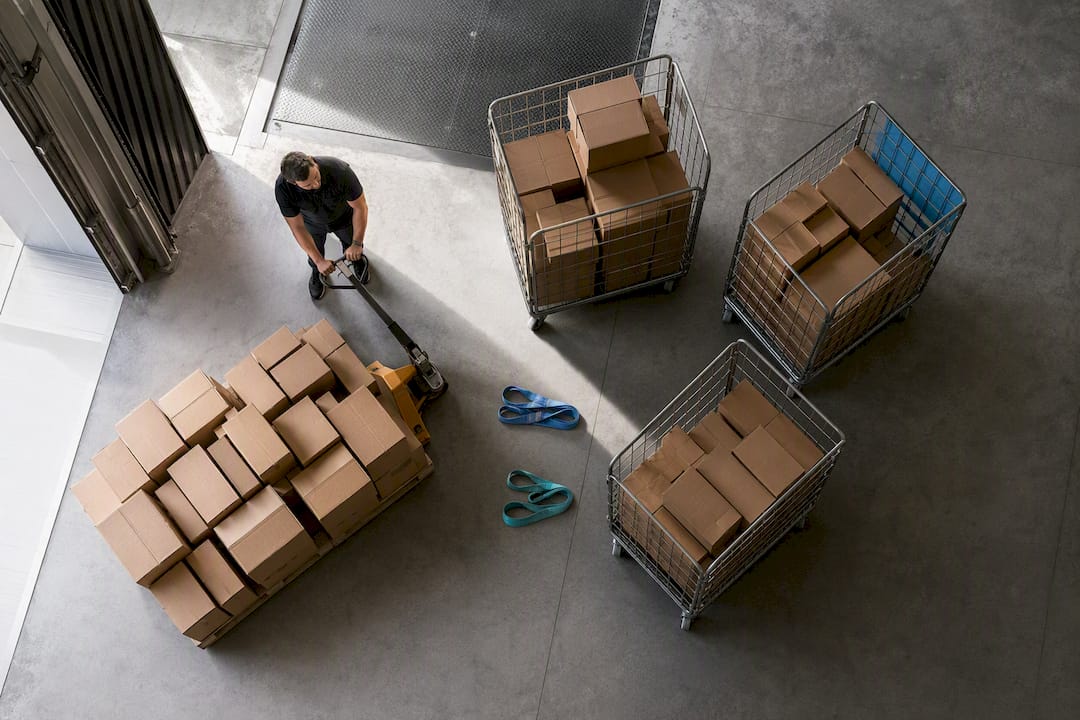
- Palletization and labeling happen at the consolidation center. Standardized pallet dimensions, weight limits, and barcode labels get applied so nothing downstream requires guesswork.
- Freight gets loaded into a shared container or trailer. The consolidator builds the load to maximize cube utilization while respecting weight limits and stacking rules.
- The consolidated shipment moves via ocean, rail, or over-the-road transport.
- At destination, the load undergoes breakbulk. Freight is sorted back out by final destination or order.
- Last-mile delivery completes the cycle to the retailer, distribution center, or end customer.
Build lead time into your PO cycle from day one. If standalone LTL takes 3 to 5 days, expect consolidated freight to add several more days for the fill window, plus transit. Track fill rate (how full each load runs), cost per unit, and OTIF from the first pilot lane onward.
Pro Tip: Require vendors to submit ASN (advance shipping notice) data before freight arrives at the consolidation center. It sounds like paperwork overhead, but it’s the single biggest lever for catching labeling errors before they turn into chargebacks.
When Should You Use Freight Consolidation?
Not every shipping pattern benefits from consolidation, and the decision comes down to a handful of concrete signals rather than gut instinct.
Look at shipment density and frequency first. If you’re moving multiple partial LTL shipments to the same region every week, that’s a strong consolidation candidate. If shipments are one-off, sporadic, or headed to scattered destinations, the fill-time wait usually isn’t worth it. SKU attributes matter just as much as volume: uniform, stackable, non-hazardous goods consolidate cleanly, while irregular or sensitive freight often doesn’t.
A useful way to test the idea without betting the whole operation on it:
- Pick one or two lanes with consistent volume and similar destinations.
- Run a 60 to 90 day pilot rather than committing to a full program upfront.
- Measure cost per unit, OTIF, and damage rate against your current LTL baseline.
- Compare vendor compliance rates before and after introducing delivery windows.
If the pilot lane shows meaningful cost reduction without a service-level hit, scaling to additional lanes is usually the right next move.
What Operational Controls Make Consolidation Programs Succeed?
The single biggest factor separating consolidation programs that save money from ones that quietly bleed it is origin control, taking physical and contractual command of freight at the point where it enters the consolidation flow. MOL Logistics describes this as the difference between managing supplier timing proactively and reacting to whatever shows up whenever it shows up. Without it, one late or noncompliant vendor can delay an entire consolidated load.
A working setup includes:
- Assigned vendor delivery windows, enforced rather than suggested.
- Standardized documentation workflows so packing lists, ASNs, and labels arrive in a consistent format every time.
- Control-tower visibility across every shipment in the consolidation pipeline, not just the ones running late. Usiship’s control tower logistics approach is built around exactly this kind of end-to-end monitoring.
- A short setup checklist: define vendor windows, confirm labeling standards, set palletization specs, and establish exception-handling rules before the first shipment arrives.
Pro Tip: Warehouse orchestration platforms like Lully can automate slot-time enforcement at the consolidation center, cutting the manual follow-up that usually eats up a coordinator’s week.
How Does Consolidation Support Sustainability Goals?
Fewer, fuller trucks mean fewer total trips to move the same volume of freight, and that’s the direct mechanism behind consolidation’s emissions benefit. The EPA points to vehicle miles traveled as a central driver of transportation-sector greenhouse gas emissions, so any strategy that reduces those miles per unit shipped moves the needle.
Freight pooling extends this idea into urban logistics, where multiple shippers share capacity on the same last-mile routes instead of each running separate, partially loaded trucks. A ScienceDirect study on freight pooling found real potential to cut empty miles in cities, but the paper is clear that the actual benefit depends on geospatial scenario modeling specific to each network, not a universal number.
Emissions Trade-Off: Pooled and consolidated freight often takes longer to reach its destination than a direct shipment, so sustainability gains come paired with a service-time cost that businesses need to weigh against their delivery commitments.
For companies with formal emissions targets, consolidation is one of the more accessible levers available since it requires operational changes rather than fleet electrification or new infrastructure.
Impact of Freight Consolidation on Delivery Times and Customer Service Levels
Consolidation changes the shape of your delivery timeline rather than simply making it faster or slower. The wait for a container or trailer to fill adds some additional time on the front end, but the freight often moves more predictably once it ships, since it travels as a single controlled unit instead of getting shuffled between multiple LTL carriers and terminals.
Customer-facing service levels depend heavily on how well that front-end lead time gets communicated. Retail partners and customers can tolerate a longer but consistent transit window far better than an unpredictable one. That’s why OTIF (on-time-in-full) tends to hold steady or even improve under consolidation, even though the total cycle time from order to delivery may stretch slightly compared to a rushed standalone LTL shipment.
The risk runs the other direction when consolidation gets forced onto freight that needs speed. Rush orders, replenishment for fast-moving SKUs, or time-sensitive retail launches usually don’t belong in a consolidated flow, since the fill-time wait works directly against the service level those shipments require. Smart programs segment freight by urgency: routine replenishment and non-urgent restocking go through consolidation, while anything time-critical ships direct.
Damage rates factor into customer service too. Fewer handling touchpoints between origin and destination generally means fewer damaged units reaching the customer, which reduces returns, chargebacks, and the service disruptions that come with them. The net effect for most shippers running the right freight through consolidation: slightly longer but far more reliable delivery windows, and fewer customer complaints tied to damaged or incomplete shipments.
What Technology Supports a Freight Consolidation Program?
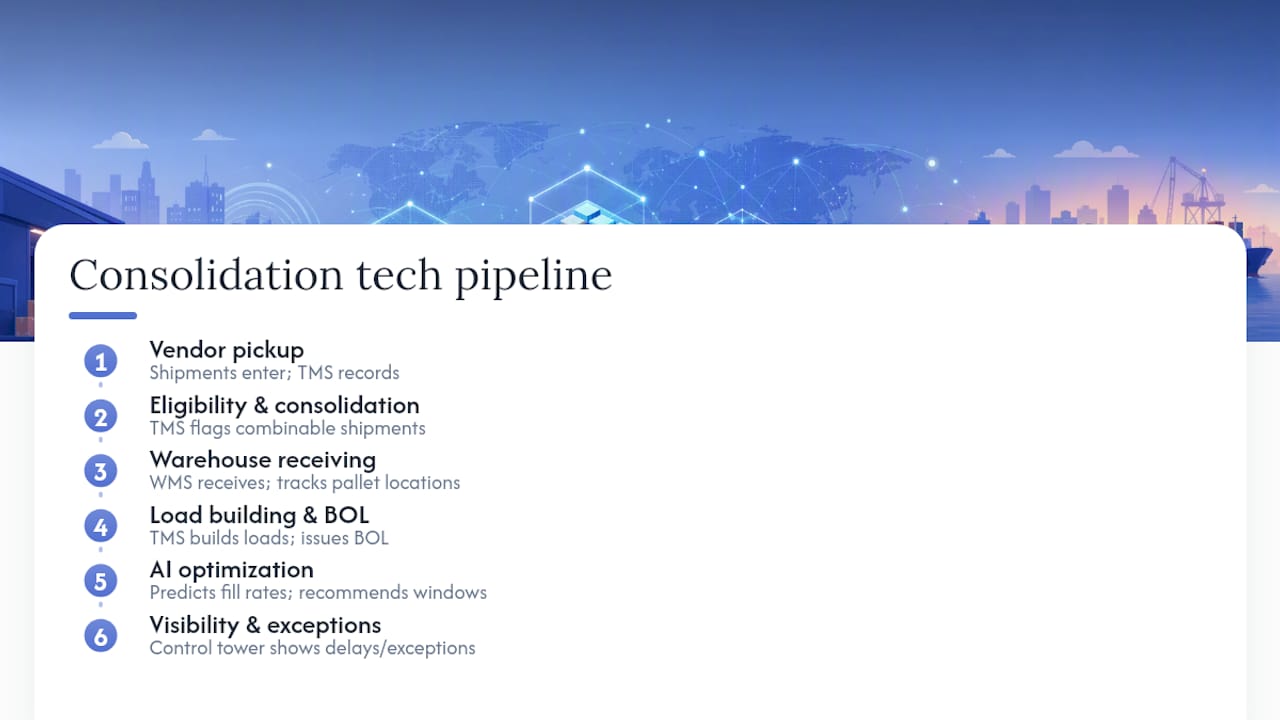
A transportation management system (TMS) is the backbone of most consolidation programs, since it’s the tool that tracks which shipments are eligible for combining, monitors fill rates in real time, and generates the consolidated bill of lading once a load is built. Without a TMS, consolidation decisions tend to happen on spreadsheets and phone calls, which doesn’t scale past a handful of lanes.
Warehouse management systems (WMS) handle the physical side: receiving inbound freight against purchase orders, managing pallet locations inside the consolidation center, and coordinating the breakbulk process at destination. Where TMS and WMS platforms integrate, data flows automatically between them instead of requiring manual re-entry at every handoff.
AI-driven optimization tools are the newer layer on top of this stack. These systems analyze historical shipment patterns to predict fill rates, recommend optimal consolidation windows, and flag vendors whose delivery timing consistently threatens load schedules. Warehouse orchestration platforms extend this further by automating slot-time enforcement at the consolidation center itself, reducing the manual coordination that otherwise falls on a warehouse team.
Real-time visibility platforms, often called control towers, tie the whole system together by giving shippers a single view across every shipment in the consolidation pipeline, from vendor pickup through final delivery. This matters more for consolidated freight than standalone shipments, since one delayed input can affect an entire combined load rather than just itself. The combination of TMS, WMS, and visibility tooling is what turns consolidation from a manual, error-prone process into a repeatable operation that scales across dozens of lanes without a proportional increase in headcount.
What Do Successful Freight Consolidation Programs Look Like in Practice?
The clearest illustration of consolidation’s mechanics comes from LCL ocean freight, where importers who can’t yet fill a 40-foot container share space with other shippers moving cargo through the same origin port. This model, described in DHL’s consolidation glossary, lets small and mid-sized importers access ocean freight rates that would otherwise require far more volume to justify.
On the domestic side, LTL-to-FTL consolidation shows up most often among retailers and manufacturers shipping to the same regional distribution centers from multiple suppliers. Instead of five separate LTL shipments arriving on five different trucks with five separate invoices, those shipments combine into one full truckload, and SupplyChain247 points to reduced handling and simplified tracking as the direct result of cutting down the number of touchpoints each shipment passes through.
Pool distribution offers a third pattern worth understanding: a carrier consolidates freight bound for a broad geographic region, then breaks it down closer to final delivery points. Retailers replenishing multiple store locations across a state or region often use this model to avoid running separate LTL shipments to each store individually.
What connects all three examples isn’t the shipping mode. It’s that each one starts with a predictable, repeatable freight pattern, consistent volume, similar destinations, non-urgent timing, and builds a consolidation process around that predictability rather than trying to force irregular freight into a consolidated flow. That’s the pattern worth borrowing regardless of which model fits your specific lanes.
A Practitioner’s Take on What Actually Breaks Consolidation Programs
The teams that struggle with consolidation almost always trace it back to one of three mistakes: skipping origin control and letting vendor timing stay unmanaged, underestimating lead time and promising customers a delivery window the fill process can’t support, or treating packaging and labeling standards as optional guidelines instead of firm requirements. Fix origin control first. Everything else gets easier once vendor timing is predictable.
— Akbar
Ready to Pilot a Consolidation Lane?
Running a consolidation pilot well depends on the same fundamentals covered above: origin control, disciplined vendor windows, and real visibility into every shipment moving through the pipeline. Certain logistics providers build their consolidation, warehousing, and control-tower services around exactly that combination, rather than treating consolidation as a bolt-on to standard LTL freight. That means your pilot lane gets the same origin-level coordination and end-to-end tracking that a mature program relies on, from day one instead of after months of trial and error.
If you’re weighing whether a lane is ready for consolidation, a feasibility review is the fastest way to find out without committing to a full rollout. Request a consolidation assessment through Usiship and get a clear read on fill-time expectations, cost-per-unit projections, and which of your current shipments are the strongest candidates to start with.
Sources
- Consolidation | DHL Freight Connections
- Understanding freight consolidation | SPS Commerce
- Fast facts: Transportation greenhouse gas emissions | EPA
- Integrating freight pooling and shared logistics in cities: A geospatial data-driven perspective | ScienceDirect