
6 Digit HS Subheading: U.S. Workflow for HS Code Classification
An HS classification is the standardized 6-digit code that identifies your product for customs authorities worldwide. Start by nailing down that 6-digit subheading using the legal rules built into the system, then map it to a U.S. 10-digit HTS number for imports or a Schedule B number for exports. Everything else, duty rates, filing accuracy, avoiding penalties, flows from getting that first step right.
TL;DR:
- Accurate HS classification relies on applying the General Rules of Interpretation in order and prioritizing section and chapter notes over heading text to avoid misclassification.
- Thorough documentation of the GIR path, product specs, and relevant rulings is essential for defending your code during audits and preventing penalties.
- Using multiple tools like WCO Trade Tools, HTS search, Schedule B search, and CROSS helps verify codes but does not replace the importance of expert review and a solid decision record.
- Misfiling between HTSUS and Schedule B or providing incomplete 10-digit codes is a common source of delays and penalties in U.S. customs processing.
- Professional classification review, such as through licensed brokers, can reduce the risk of overpayment, shipment holds, or audits, especially for complex or high-value products.
Table of Contents
- What Is HS Code Classification and Why Does It Matter?
- How Does HS Classification Actually Work?
- What Are the Steps to Find the Right HS Code?
- HTSUS vs. Schedule B: What U.S. Filers Need to Know
- Which Tools Should You Use to Verify a Classification?
- How Logistics Teams Document and Escalate Classification Decisions
- The Workflow Most Companies Get Backward
- Get Your HS Classification Reviewed Before It Costs You
- Sources
- FAQ
What Is HS Code Classification and Why Does It Matter?
The Harmonized System is a global product nomenclature covering more than 5,000 commodity groups, each tagged with a standardized 6-digit code. Customs agencies in over 200 countries use this same 6-digit backbone to assess duties, track trade statistics, and enforce import or export controls. The World Customs Organization maintains the system and updates it on a set cycle, with a new edition scheduled to take effect in 2028. Codes migrate, split, or get retired between editions, so a subheading that was correct three years ago might not exist anymore.
Getting this wrong is not a paperwork inconvenience. Misclassification can trigger:
- Overpaid or underpaid duties, the latter of which invites penalties and retroactive assessments
- Shipment holds while customs officers request clarification or documentation
- Denied preferential trade treatment under agreements that hinge on exact tariff lines
- Repeated errors flagging your company for increased scrutiny on future entries
None of this is theoretical for anyone moving freight across borders regularly. A single wrong digit in a 6-digit subheading can shift a product into a completely different duty bracket, and customs brokers see this happen most often with composite or multi-material goods that do not fit neatly into one category.
How Does HS Classification Actually Work?
Classification is not guesswork, and it is not supposed to involve picking whichever code carries the lowest duty. The system runs on a legal hierarchy called the General Rules of Interpretation, or GIRs, and you apply them in strict order until one resolves your classification.
- GIR 1: Classify according to the terms of the headings and any relevant section or chapter notes. Most products get resolved right here.
- GIR 2: Covers incomplete, unfinished, or unassembled goods, and mixtures or combinations of materials.
- GIR 3: Applies when a product could fit under two or more headings. It uses the most specific description, the essential character test for composite goods, or, as a last resort, whichever valid heading appears last numerically.
- GIR 4: A catch-all for goods that resist classification under the first three rules, classified under the heading most akin to them.
- GIR 5 and 6: Handle packaging and the classification of subheadings within an already-determined heading.
Section and chapter notes carry legal weight, not suggestion. They can override what a heading’s plain text seems to say, which trips up a lot of first-time classifiers who read only the heading language. Beyond the notes themselves, the WCO’s Explanatory Notes and its Compendium of Classification Opinions serve as the interpretive backbone, spelling out how ambiguous or borderline products have been resolved in practice.
Pro Tip: When section notes and heading text seem to conflict, the notes win almost every time. Read the chapter notes before you read the heading, not after.
If you have worked through the GIRs and still cannot land on a confident answer, particularly for a genuinely novel product or a material blend with no clean precedent, that is the signal to request a binding ruling rather than guess.
What Are the Steps to Find the Right HS Code?
Classification gets easier once you treat it as a repeatable process instead of a one-off lookup.
- Write a classification-ready product description. Note the predominant material by weight, the primary function, the form (assembled, unassembled, raw, finished), and any secondary materials or components.
- Search for the 6-digit HS subheading using WCO Trade Tools or a comparable international database, starting broad at the chapter level and narrowing down.
- Map that 6-digit code to your U.S. filing requirement. Search the Harmonized Tariff Schedule through USITC for imports, or the Schedule B search tool from the Census Bureau for exports.
- Check CROSS for prior CBP rulings on identical or comparable products. If someone has already litigated your exact classification question, you want to know before you file, not after.
- Document your reasoning. Save the product spec, the GIR path you followed, and any ruling precedent you relied on.
A few things worth flagging along the way:
- Predominant material by weight or function often decides the outcome for textiles and composite goods, so get that measurement right before you search.
- Two products that look identical on a shelf can classify differently if their construction or intended use differs.
- When a product is high-value, high-volume, or genuinely ambiguous, requesting a formal binding ruling or looping in a licensed customs broker costs far less than an audit correction later.
HTSUS vs. Schedule B: What U.S. Filers Need to Know
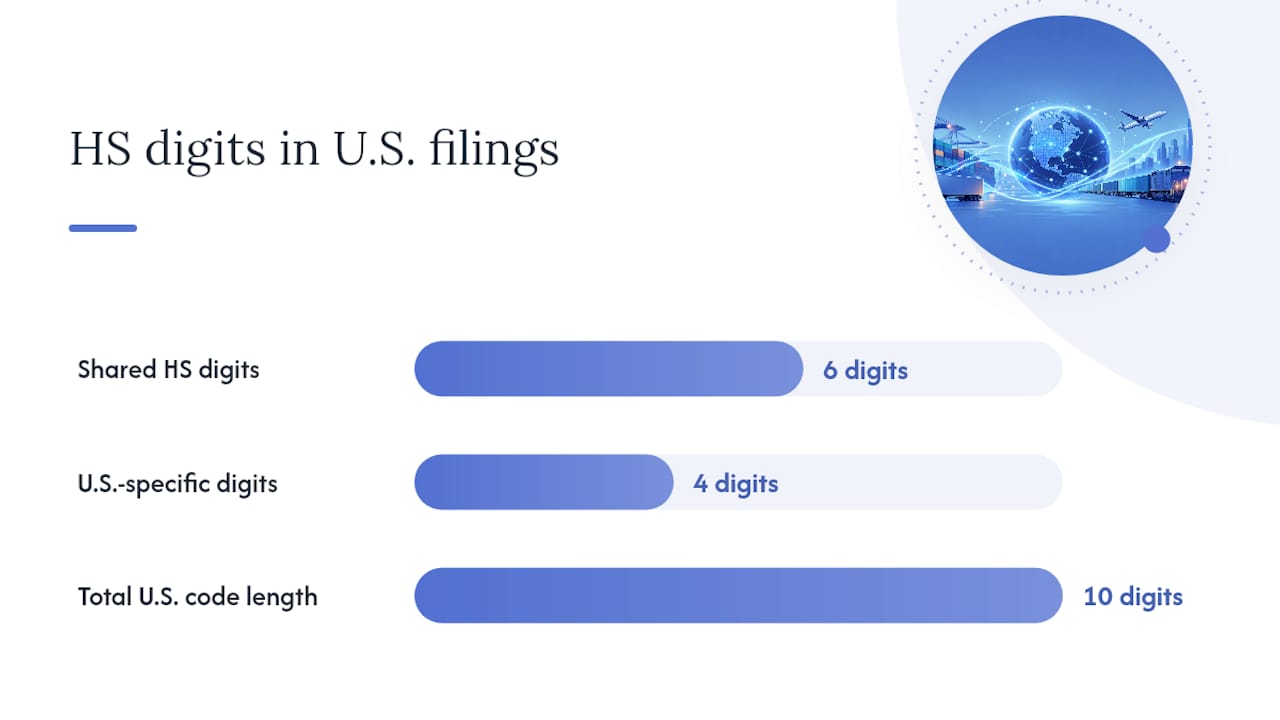
The 6-digit HS code is universal, but the United States extends it to 10 digits for domestic filing purposes, and which schedule you use depends on the direction of the shipment. The Harmonized Tariff Schedule of the United States governs imports and sets duty rates. Schedule B governs exports and feeds U.S. trade statistics. Both schedules share the same first six digits; they only diverge in the final four.
This distinction matters operationally because Importer Security Filing rules, filed through the Automated Manifest System ahead of ocean shipments, require commodity HTSUS numbers to at least the 6-digit level, and CBP’s Automated Commercial Environment can request the number to a full 10 digits depending on the entry type. Getting this number wrong, or filing it late, is one of the more common triggers for ISF penalties and cargo holds at the port.
A few mistakes show up constantly in customs clearance reviews:
- Filing an HTSUS number for what should have been a Schedule B code, or vice versa
- Submitting only 6 digits when the entry type requires the full 10
- Reusing a classification from a prior shipment without checking whether the product specs changed
Practitioners who consult CROSS rulings before filing tend to catch these errors before they become penalties rather than after.
Which Tools Should You Use to Verify a Classification?
No single database answers every classification question, which is why experienced compliance teams cross-check across a handful of sources rather than trusting one lookup tool blindly.
| Tool | Best used for | Maintained by |
|---|---|---|
| WCO Trade Tools | Finding the international 6-digit HS subheading and Explanatory Notes | World Customs Organization |
| HTS search | Confirming the 10-digit U.S. import code and duty rate | USITC |
| Schedule B search | Confirming the 10-digit U.S. export code | U.S. Census Bureau |
| CROSS | Checking prior CBP rulings on comparable products | U.S. Customs and Border Protection |
| Trade.gov HS guide | General orientation on how HS, HTSUS, and Schedule B relate | International Trade Administration |
None of these tools carry legal force on their own. Online lookup databases are useful starting points, but final responsibility for the classification rests with the importer or exporter of record, not with the tool. That is exactly why CROSS rulings matter so much: they are the closest thing to enforceable precedent that a U.S. importer can point to if a classification gets challenged later. For disputed or unusual cases, the WCO’s own Compendium of Classification Opinions works the same way at the international level, documenting how member countries have resolved specific classification disagreements.
How Logistics Teams Document and Escalate Classification Decisions
Keep the paper trail: spec sheets, product photos, lab reports for composite materials, and a written decision log showing which GIR resolved the call. Escalate to a licensed broker when materials are disputed, when a product blends categories with no clean precedent, or when the technology is new enough that no CROSS ruling covers it yet. An integrated logistics provider that handles brokerage in-house can shorten that escalation loop considerably.

The Workflow Most Companies Get Backward
Most guidance on this topic treats HS classification like a lookup problem: type your product into a database, copy the code, move on. That is backward. The database search is the easy part. The hard part, and the part that actually protects you from a penalty notice, is the documentation trail showing why you landed on that code.
Companies that get burned on classification almost never get burned because they picked an unreasonable code. They get burned because they cannot reconstruct their reasoning eighteen months later when CBP asks. A decision log tied to the specific GIR you applied, saved alongside the product spec you used at the time, is worth more than any premium database subscription.
The other place conventional advice falls short: treating HTSUS and Schedule B as interchangeable once you have the 6-digit code can lead to costly errors without proper importer haulage compliance. They are not interchangeable, and conflating them is one of the most common ISF filing errors logistics teams see. If you take one thing from this article, prioritize building a repeatable documentation habit before you worry about which tool has the slickest search interface. The tools change. Your decision log is what survives an audit.
— Akbar
Get Your HS Classification Reviewed Before It Costs You
Usiship gives shippers a faster path to a defensible classification than working through GIRs and CROSS rulings alone. Our customs clearance services are handled by licensed brokers who classify products daily and know exactly which HTSUS or Schedule B pitfalls trip up specific product categories, from composite materials to multi-component goods.
Instead of guessing your way through Chapter Notes and Explanatory Notes on your own, you get a second set of expert eyes on your classification before it ever hits an entry filing. That matters most for companies moving unusual, high-value, or newly sourced products where a wrong code means an overpaid duty bill or a held shipment. Request a classification review or a brokerage quote through our customs clearance page and get your next shipment filed with a number you can actually defend.
Sources
- Trade
- Harmonized Tariff Schedule (HTS) — USITC
- Customs Rulings Online Search System (CROSS) — U.S. Customs and Border Protection
- Importer Security Filing (ISF or “10+2”) — CBP
FAQ
How Do I Classify a Product Under an HS Code?
Work through the General Rules of Interpretation in order, starting with the heading text and any section or chapter notes, then confirm your answer against WCO Explanatory Notes or a comparable CBP ruling in CROSS.
How Do I Determine My HS Code?
Identify your product’s predominant material or primary function first, then search that description in WCO Trade Tools to find the 6-digit subheading before mapping it to a 10-digit HTSUS or Schedule B number.
How Can I Find My HS Code?
Use the USITC’s HTS search for imports or the Census Bureau’s Schedule B tool for exports, both of which build on the same universal 6-digit HS code.
What Is HS Classification?
HS classification is the process of assigning a product the correct 6-digit Harmonized System code, the international standard used by customs authorities to assess duties and track trade statistics.
What Is the Difference Between HTS and Schedule B?
HTSUS applies to imports and sets U.S. duty rates, while Schedule B applies to exports and feeds U.S. trade statistics. Both share the same 6-digit HS core and only differ in their final four digits.