
Pilot Milk Run Logistics in 60 to 90 Days for Operations Teams
A milk run is a scheduled multi-stop route that consolidates small shipments from multiple suppliers or destinations into one vehicle cycle to raise fill rates and cut transport cost. This guide covers how the routing works, the measurable benefits, when it fits your network, and the implementation steps a logistics team needs to pilot and scale one.
TL;DR:
- Track cost per unit shipped, fill rate, and miles per stop from the pilot’s first week, and monitor OTIF separately.
- Choose lanes with nearby stops, frequent small shipments, predictable demand, and compatible containers; irregular freight, variable volumes, or unreliable supplier timing can disrupt the loop.
- Run a pilot for 60 to 90 days on one supplier cluster or product family, then add lanes only after results prove stable.
- Test routing software with real routes, dock time windows, truck limits, and clean supplier data before relying on automated schedules or adding more stops.
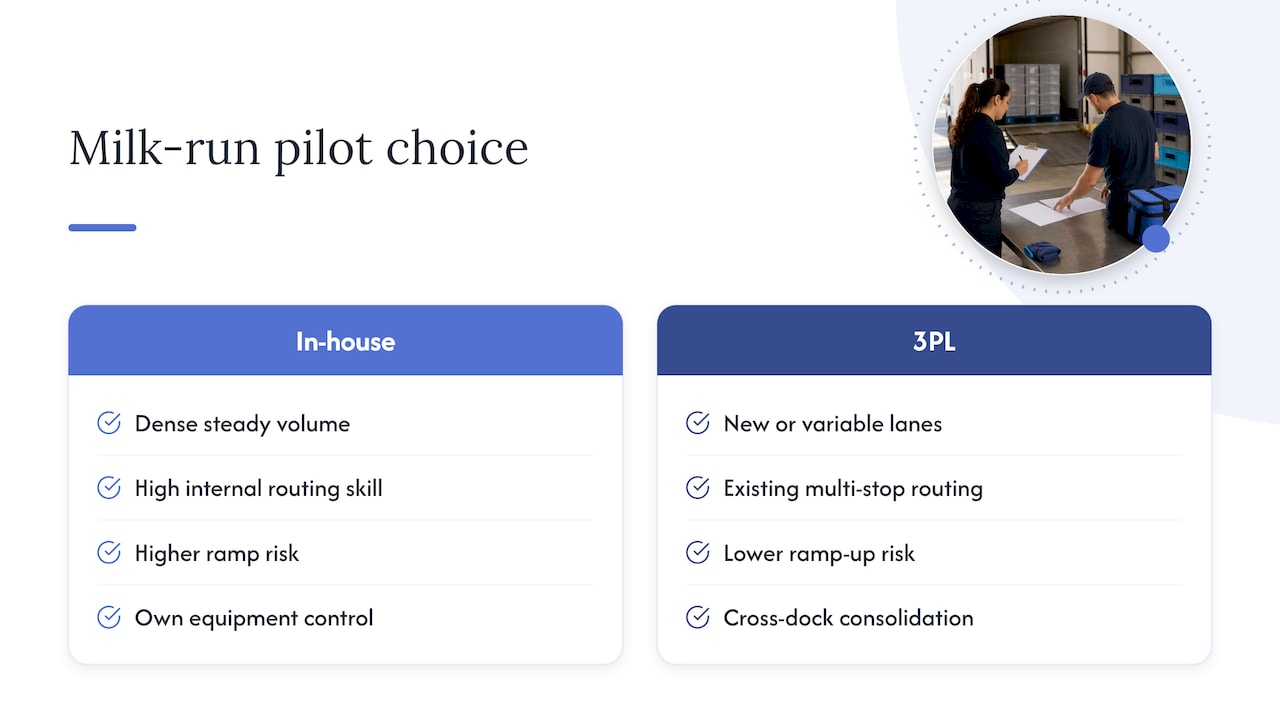
- Dense, steady lanes may justify dedicated in house equipment, while new or variable routes can benefit from a third party logistics provider during the pilot.
Table of Contents
- What Milk Run Logistics Is and How It Works
- Benefits of Milk Runs: What Improves and How to Measure It
- When to Use Milk Runs: Suitability Checklist and Industry Use Cases
- Step-by-Step Implementation Playbook: Plan, Pilot, Operate, Scale
- Challenges and Mitigation: Real Risks and How Practitioners Address Them
- Technology and Tools That Enable Milk Runs
- Publisher Notes: Capability for Milk-Run Pilots
- Where Milk Runs Fit in a Broader Consolidation Strategy
- How Universal Shipping Can Help You Pilot a Milk Run
- FAQ
- Sources
What Milk Run Logistics Is and How It Works
A milk run replaces several separate point-to-point trips with a single looped route that visits multiple stops on a repeating schedule. Instead of sending a half-empty truck to each supplier, one vehicle collects smaller loads from several locations and brings them back together, or delivers to several customers from one depot in sequence. The term comes from old dairy delivery routes, where one truck picked up milk from many farms on a fixed loop rather than each farm arranging its own transport.
There are two common patterns:
- Pick-up milk run: a truck visits several suppliers in sequence and returns to a factory or distribution center with a consolidated load.
- Delivery milk run: a truck leaves a depot loaded with goods for several customers and drops partial loads at each stop along a fixed loop.
Picture three component suppliers clustered within a 40-mile radius of an assembly plant. The cycle repeats on a set cadence, often tied to the plant’s replenishment schedule and relies on standardized containers so loads stack and fit predictably at each stop.
Benefits of Milk Runs: What Improves and How to Measure It
Consolidation is the lever behind every benefit a milk run delivers. When several partial loads combine into one trip, the truck’s fill rate rises and the cost of moving each unit drops, since the fixed cost of the trip spreads across more product.
- Vehicle fill rate climbs because empty space from one supplier’s load gets filled by another’s.
- Miles per pick fall since one loop covers several stops that would otherwise need separate trips.
- Inventory levels can drop because frequent, smaller, predictable deliveries reduce the safety stock needed to buffer against infrequent large shipments.
- Emissions per unit shipped decrease as fewer trucks make fewer total miles for the same freight volume.
One qualitative pattern shows up across industry analyses of multi-stop routing: the core economic driver of a milk run is raising vehicle fill rates by combining several low-capacity point-to-point trips into a single consolidated route, which is the mechanism behind most of the cost and emissions gains above.
Pro Tip: Track cost per unit shipped, fill rate percentage, and miles per stop from week one of a pilot; these three numbers tell you faster than any other metric whether the loop is working.
The tradeoff to watch is service level. Consolidating shipments into a fixed loop can delay an individual delivery slightly compared to a dedicated truck, so OTIF (on-time-in-full) performance needs its own tracking alongside cost metrics.
When to Use Milk Runs: Suitability Checklist and Industry Use Cases
Milk runs work best under specific conditions. Before committing a lane to this model, check it against a short list of fit signals.
- Supplier or customer density: multiple locations sit within a reasonably tight radius, so one loop can visit several without excessive backtracking.
- Shipment frequency: deliveries happen often and in small volumes, the opposite of infrequent full-truckload moves.
- Demand predictability: volumes and timing are stable enough to plan a fixed loop and cadence.
- Container compatibility: goods fit standardized totes, pallets, or bins that load and unload quickly at each stop.
Flags that a lane is a poor fit include highly variable order sizes, oversized or irregular freight that complicates load sequencing, and suppliers with unpredictable ready times that disrupt the loop’s timing.
Common use cases include automotive feeder networks moving parts between tiered suppliers and assembly plants, retail and CPG replenishment cycles feeding distribution centers from regional suppliers, and micro-fulfillment operations consolidating small e-commerce orders across a dense urban zone.
Step-by-Step Implementation Playbook: Plan, Pilot, Operate, Scale
Running a milk run well starts narrow and expands once the numbers hold up.
- Define goals and KPIs. Set targets for cost per unit, fill rate, and OTIF before touching a route map.
- Gather supplier and demand data. Pull order history, lead times, and container dimensions for every candidate stop.
- Choose a pilot geography. Pick one product family or supplier cluster to limit variability while you test the model.
- Design the route. Cluster stops geographically, assign time windows, and sequence loading so the first-off items sit last-in.
- Select containers. Standardize on totes or pallets that fit the truck’s dimensions and each stop’s dock equipment.
- Model fill rates. Simulate loads against the planned route before committing a vehicle and driver to the cycle.
- Run the pilot. Confirm dock appointments, build exception-handling rules for late suppliers, and log every deviation.
- Measure results. Compare actual cost per unit and fill rate against the pilot’s targets after a full cycle of data.
- Scale deliberately. Add stops or lanes only after the pilot proves stable, and revisit staffing, contract terms, and SLA language as volume grows.
- Build a continuous optimization loop. Revisit routes quarterly as supplier mix, volume, or demand patterns shift.
A pilot checklist for freight consolidation projects can help structure the scope, timeline, and KPIs for a 60 to 90 day test before committing to a permanent lane.
Pro Tip: Scope the first pilot to a single product family or supplier cluster. Limiting variables makes it far easier to isolate whether a problem comes from routing, scheduling, or supplier behavior.
Challenges and Mitigation: Real Risks and How Practitioners Address Them
Milk runs fail more often from operational friction than from bad route math.
- Supplier lateness and variability: build buffer time into the schedule, keep an express-capacity budget for exceptions, and set contractual “ready-by” windows so late loads do not break the whole loop. An expedited freight decision matrix helps teams decide when an express run is worth the premium versus waiting for the next cycle.
- Packaging and container mismatch: enforce standardized containers across every supplier on the loop; inconsistent pallet sizes or packaging slows loading and wastes trailer space. Guidance on palletizing freight correctly covers the pack rules that keep loads passing inspection at each stop.
- Complex loading constraints: use constraint-based load planning and 3D load simulation so the sequence of pickups matches the sequence of drop-offs without re-handling freight mid-route.
- Dock and labor coordination: schedule firm dock appointments at every stop, and consider incentive or penalty terms in supplier contracts for missed windows, since one late dock can cascade delays through the entire loop.
Technology and Tools That Enable Milk Runs
Route software and real-time tracking turn a milk run from a static schedule into a system that adjusts as conditions change. Research on IoT-enabled milk-run routing systems describes how real-time pick-up confirmations support dynamic rerouting in high-frequency, small-batch collection setups, which matters once a loop has more than two or three stops. The underlying routing and scheduling methods behind that approach were developed specifically for manufacturing environments running just-in-time collection.
Core capabilities to look for:
- Multi-stop route optimization that sequences pickups and drop-offs automatically rather than relying on manual planning.
- Time-window handling that respects each supplier’s or customer’s dock availability.
- Truck constraint modeling covering height, weight, and restricted-route rules, along with driver hours-of-service limits.
- IoT and telematics integration for live pickup confirmations, dynamic rerouting, and shared ETAs with every stop on the loop.
- TMS, WMS, and yard management integration so route data, inventory status, and dock scheduling stay synchronized.
| Evaluation step | What it tests |
|---|---|
| Demo with real routes | Whether the system handles your actual stop count and geography |
| Constraint modeling test | Whether truck restrictions and time windows produce usable schedules |
| Data quality check | Whether supplier and inventory data feeds are clean enough to trust |
| Scalability review | Whether the system holds up as stops or lanes are added |
Vendors that build dedicated multi-stop optimization software emphasize constraint modeling during demos as the most realistic test of whether a tool fits a real network rather than a simplified one.
Publisher Notes: Capability for Milk-Run Pilots
We run logistics transportation services covering full truckload and less-than-truckload freight across all 50 states, along with warehousing, fulfillment, and customs brokerage under one platform. That combination matters for a milk-run pilot because the same provider can handle multi-stop pickup routing, consolidation at a cross-dock, and onward distribution without handing the freight to a second carrier mid-cycle.
Whether a milk run makes sense in-house or through a third-party logistics partner usually comes down to volume and internal routing expertise: a dense, high-frequency lane with steady volume often justifies dedicated in-house equipment, while a new or variable lane benefits from outsourcing the pilot to a 3PL that already runs multi-stop networks and absorbs the ramp-up risk.
Where Milk Runs Fit in a Broader Consolidation Strategy
A milk run is a tactical tool: it solves fill rate and cost problems on specific lanes. It becomes strategic when connected to a control tower view that coordinates multiple milk runs, shared carrier networks, and cross-dock timing across an entire supply chain. Tie pilot-level KPIs like fill rate and cost per stop to enterprise metrics such as total transportation cost per unit shipped, and a successful lane-level pilot turns into a template other lanes can copy.
— Akbar
How Universal Shipping Can Help You Pilot a Milk Run
We bring the pieces a milk-run pilot needs under one roof: multi-stop routing through our freight forwarding services, consolidation and storage through warehousing and fulfillment solutions, and dock-level coordination through our 3PL fulfillment services.
A typical pilot runs 60 to 90 days on a single supplier cluster or product family, tracking cost per unit, fill rate, and OTIF before any decision to scale. Preventive fleet maintenance also factors into cost control on a fixed loop; practical tactics for reducing fleet fuel costs and bulk maintenance discounts for fleets are worth reviewing alongside routing changes. Check our pricing page for service packages, or reach out to scope a pilot lane.
FAQ
What is the milk run theory in logistics?
The milk run theory holds that consolidating multiple small, frequent pickups or deliveries into one scheduled loop raises vehicle fill rates and lowers transport cost per unit compared to running separate point-to-point trips. It originated from dairy collection routes and is now applied widely in manufacturing and retail replenishment.
What is milk run delivery?
Milk run delivery is a routing pattern where one vehicle drops partial loads at several customer or store locations in a single trip, following a fixed loop and schedule rather than dedicating a separate truck to each destination. It is common in retail and CPG replenishment where order volumes per stop are too small to justify a dedicated truck.
Is milk run logistics legitimate for small and mid-sized shippers?
Yes, milk run logistics is a standard, widely used consolidation method, not a niche or questionable practice. It works best for shippers with multiple suppliers or customers in a dense geographic area and frequent, predictable, smaller-volume shipments.
How do I know if my network is a good fit for a milk run?
Check for supplier or customer density within a workable radius, frequent small shipments, and reasonably predictable demand and container sizes. If shipment volumes vary widely or freight is oversized and irregular, a dedicated or direct shipping model usually performs better.
Sources
- Internet-of-Things-based just-in-time milk-run logistics routing system (IEEE)
- Internet-of-Things-based just-in-time milk-run logistics routing system (DOI record)