
Kitting and Assembly: Pilot Before Outsourcing for Manufacturers and Brands
Kitting is preparing a verified set of components for a job, and assembly is joining those components into a finished item. Together they cut line-side searching and speed up fulfillment, which is why so many manufacturers and ecommerce brands outsource one or both once order volume or product complexity outgrows an in-house team.
TL;DR:
- Internal kitting suits steady volume and frequent bill of materials changes; outsourcing fits seasonal spikes, while partners may offer same day or next day turnaround.
- A typical internal station needs one to two dedicated staff and ERP integration; industry analysis places payback at 6 to 12 months when kitting is core work.
- For production ready kits, retain the bill of materials revision, part identity, lot and date codes, inspection status, and required moisture or electrostatic handling records.
- Before signing, request written accuracy, on time staging, and shortage metrics, then test a comparable product line in a two week pilot.
Table of Contents
- What kitting and assembly are and how they differ
- Common use cases and kit formats
- The typical kitting and assembly workflow from receiving to shipping
- Choosing between in-house and outsourced kitting
- Quality controls and traceability that keep kits reliable
- How to evaluate and choose a kitting and assembly partner
- How we run kitting and assembly reliably
- Get a kitting and assembly quote or pilot from us
- FAQ
- Sources
What kitting and assembly are and how they differ
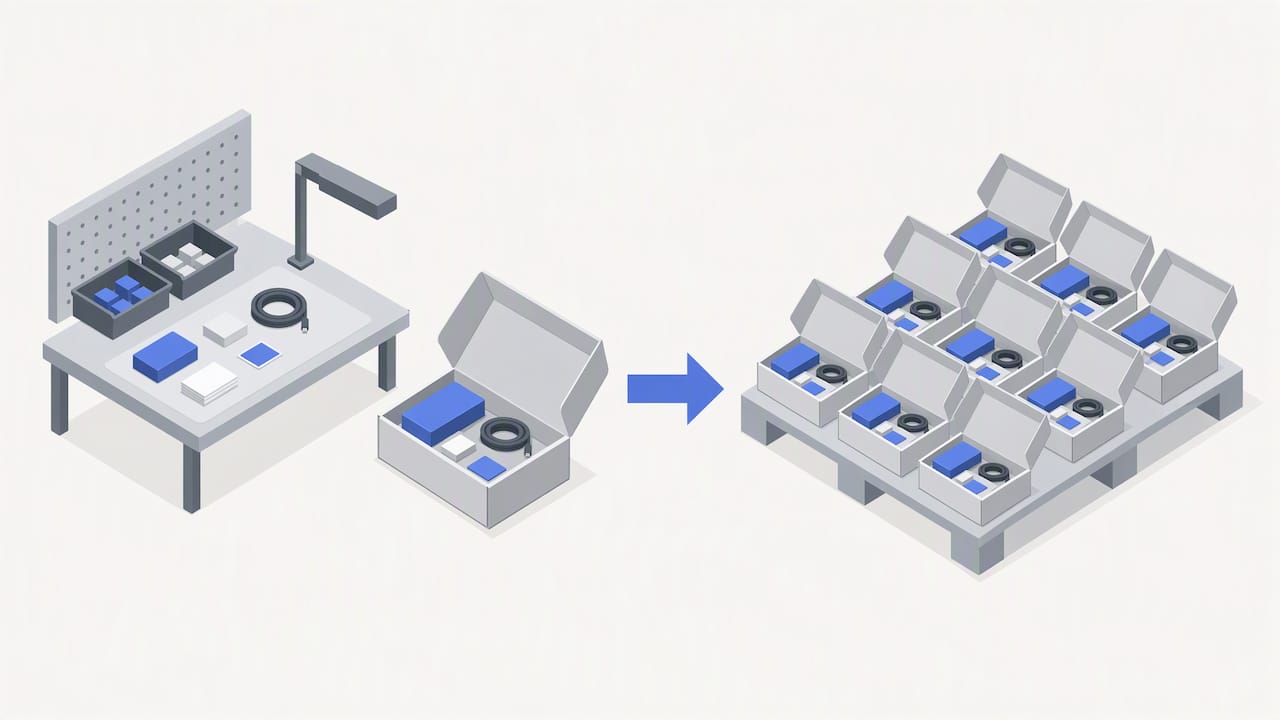
Kitting groups components into a defined set, tied to a bill of materials (BOM) and a specific work order, so a picker or assembler has everything needed without searching the warehouse floor. Assembly is the next step: joining those parts into a new or finished stock keeping unit (SKU), whether that is a consumer multipack or a mechanical subassembly on a production line.
The two activities overlap more than most people expect. A kit can be built ahead of demand and held in inventory, or it can be assembled only after an order arrives, known as kit-to-order. Keeping the vocabulary straight matters because the right delivery model depends on which activity, or which blend, your product actually needs.
- Kitting: pre-sorted components linked to a BOM and work order, no permanent joining.
- Assembly: physically joining or combining kitted parts into a new SKU or subassembly.
- Pre-assembly: building kits in advance of demand to speed later production.
- Kit-to-order: building the kit only when an order triggers it, which lowers inventory risk.
Common use cases and kit formats
Kitting shows up anywhere components need to travel and ship together rather than one at a time. Ecommerce sellers use it for multipacks and Amazon FBA prep, bundling items into a single sellable unit before they hit a fulfillment center. Subscription and promotional programs lean on kitting during seasonal peaks, when packaging and inserts change monthly and timing is tight. Manufacturers use production kits to feed mixed-model assembly lines, where each operation along the routing gets its own kit of parts rather than a bulk bin.
- Ecommerce multipacks and FBA prep bundles for marketplace compliance.
- Subscription boxes and seasonal promotional kits with rotating packaging.
- Retail point-of-sale sets combining multiple SKUs into one offer.
- Production kits staged per routing step for mixed-model assembly lines.
The typical kitting and assembly workflow from receiving to shipping
A reliable kitting operation follows a fairly consistent sequence, whether it runs in-house or through a third-party logistics partner.
- Receive and inspect incoming components against the purchase order and packing list.
- Reconcile quantities and part numbers against the current BOM revision.
- Define the kit: which parts, what quantities, and which carrier or tote will hold them.
- Choose a pick strategy: cluster picking for several kits at once, batch picking for repeat orders, or kit-to-order for build-at-time-of-order flexibility.
- Build the kit at a verification station using barcode scanning, weight checks, or vision systems to catch shortages before release.
- Stage, package, and label the finished kit for shipment, including any FBA-specific prep requirements.
Design choices made at step three carry more weight than most teams expect. Research on manual kit preparation found that man-hour efficiency depends heavily on picking density, the picking information system, and the kit carrier layout, not just how fast a person moves. Poorly designed carriers and cluttered pick zones slow every build that follows, according to Chalmers University research on kit preparation efficiency.
Pro Tip: Run a timed pilot on your highest-volume kit before scaling the whole catalog; a two-week test surfaces layout and labeling problems faster than a quarterly review ever will.
Choosing between in-house and outsourced kitting
The decision usually comes down to four factors: how predictable your volume is, how often your BOM changes, how fast you need kits turned around, and what the work truly costs once every expense is counted.
- Volume predictability: steady, forecastable batches favor in-house; spiky or seasonal volume favors outsourcing.
- BOM change frequency: frequent engineering changes favor in-house control, since outsourced partners may hold pre-built kits that become obsolete when a BOM revises, a risk flagged in research on kit quality and preparation design.
- Lead time and responsiveness: same-day or next-day kit turnaround is easier to guarantee with a dedicated outsourced team built for it.
- True cost: a fair comparison includes exception handling, BOM administration, and inventory carrying costs, not just the hourly labor rate.
A basic in-house kitting station typically needs one to two dedicated staff plus integration with your ERP and handheld scanning, and industry cost-benefit analysis suggests ROI often lands within 6 to 12 months when kitting is a core part of the operation. Outside that window, or outside that core focus, outsourcing tends to make more financial sense. Our comparison of 3PL services versus in-house shipping walks through the same trade-offs from a fulfillment angle.
Quality controls and traceability that keep kits reliable
A kit is only as good as the record behind it. Production-ready kits, especially for electronics, need the BOM revision, part identity, lot and date codes, inspection status, and any moisture-sensitive-level (MSL) or electrostatic-discharge (ESD) handling tied directly to the kit’s release record, according to guidance on electronic component kitting quality controls. Without that link, a kit cannot be called production-ready, and a recall cannot be traced back to a specific batch.
- Manifest and release records tied to the current BOM revision and work order.
- Lot and date code tracking, with MSL/ESD handling where the components require it.
- Verification at build: barcode scanning, weight checks, or vision inspection before release.
- Reverse lot traceability so a shortage or defect can be traced to the exact kits affected.
Many kit errors trace back to simple design flaws, such as storing similar hardware next to each other or giving pickers unclear instructions, according to Industrial Monitor Direct’s analysis of kitting errors. Color-coded bins and clearer picking instructions resolve most of these issues before any automation spend is justified. Our inventory reconciliation control loop outlines the kind of checklist and KPI structure that catches shortages before they reach a customer.
How to evaluate and choose a kitting and assembly partner
A good evaluation starts with the proposal itself, not the sales call.
- Confirm operational capabilities: per-order or per-kit billing, current kit volumes handled, and integration options with your order management system.
- Request KPIs in writing: kit accuracy rate, on-time staging percentage, and exception or shortage rate.
- Review commercial terms: pilot pricing, per-kit versus per-order fees, and how BOM changes get priced and communicated.
- Ask for a walkthrough of one released kit from manifest to shipment, including proof of lot traceability.
Pro Tip: Ask any prospective partner for pilot metrics from a comparable product line before signing a longer contract; a short test run reveals more than a glossy capabilities deck. Our own Two Week Pick and Pack Pilot is built around exactly this kind of short, measurable test. For brands evaluating 3PL offer structures more broadly, Envio 3PL’s kitting and assembly service description is a useful reference point for how other providers scope the work.
How we run kitting and assembly reliably
We built kitting and assembly on top of an integrated transportation, warehousing, and fulfillment platform, so a kit never has to pass between disconnected systems to get from receiving to a labeled, shipment-ready box. Our Two Week Pick and Pack Pilot lets a new client test build accuracy and exception rates before committing to volume, and our inventory reconciliation control loop keeps kit counts honest from receipt through release. That integration matters most when a brand runs FBA prep alongside direct-to-consumer orders from the same SKU pool.
— Akbar
Get a kitting and assembly quote or pilot from us
We run kitting and assembly as part of one connected operation, not a bolted-on add-on, which means your kits move through the same warehouse, the same inventory system, and the same team handling your FBA prep and last-mile orders. That reduces handoffs and the errors that come with them.
Our 3PL Fulfillment Services cover kitting, order processing, and packaging with per-order billing options, and our Warehousing & Fulfillment Solutions page outlines how storage and kitting work together under one roof. If you want to see the numbers before committing, our pricing page lists current rates for storage, order processing, and additional services, and you can request a Two Week Pick and Pack Pilot to test accuracy on your own product line before scaling up.
FAQ
What is kitting and assembly?
Kitting is grouping components into a defined set tied to a work order, so everything needed for a build or shipment is ready at once. Assembly is the step of physically joining those components into a finished or new SKU, and the two are often run as one continuous process in a warehouse or production line.
Can you give me an example of kitting?
A common example is an ecommerce multipack: a seller combines three individually packaged items into one bundled SKU before sending it to a fulfillment center for sale. Another example is a production kit on a factory floor, where all the fasteners, brackets, and wiring needed for one assembly step are pre-sorted into a single tote.
What does “kitting” mean?
Kitting means preparing a matched, pre-counted set of parts or products so they can be picked, assembled, or shipped as one unit instead of searching for each item separately. It is typically tied to a bill of materials and a specific work order or customer order.
What is assembly in a warehouse?
In a warehouse, assembly means combining multiple components or products into one finished item ready for sale or shipment, such as building a gift set or attaching an accessory to a main product. It usually happens right after kitting, at a dedicated build or verification station where the finished unit gets a final quality check before it ships.
Sources
- Manufacturing kitting: In-house vs outsourced decision guide – Industrial Monitor Direct
- Man-hour efficiency of manual kit preparation in the materials supply to mass-customised assembly
- Links between kit quality and kit preparation design (Journal article)
- Electronic component kitting services: lot, MSL, and BOM completeness controls – SupplyICs