
Control Loop for Inventory Reconciliation: Checklist and KPIs for Ops and Finance
Inventory reconciliation is the controlled process of comparing physical stock to system records, investigating differences, and posting documented adjustments so your records and financials are accurate. Run it on a cycle count schedule, at month-end close, or the moment an exception fires. Operations owns the counting, finance owns the posting, and both sign off before a number changes.
TL;DR:
- Proper inventory reconciliation requires verifying that physical counts match system records, tracing variances to specific transactional or process errors, and posting documented adjustments.
- Conducting layered checks—physical-to-system, transaction-to-balance, and inventory-to-general ledger—prevents hidden errors and ensures audit compliance.
- Automation tools like barcode validation and real-time system updates significantly improve accuracy, especially when embedded in disciplined workflows.
- Implementing strict physical controls at receiving, location, and adjustment points helps prevent most upstream errors that cause discrepancies.
- Focusing on key KPIs such as count completion rate, variance rate, and repeat discrepancy rate helps monitor ongoing reconciliation health.
Table of Contents
- What Is the Inventory Reconciliation Process?
- How Do You Reconcile Inventory Step by Step?
- Which Counting Method Fits Your Operation?
- Why Did the Inventory Numbers Not Match?
- What Are the Three Layers of Inventory Reconciliation?
- How Does Automation Improve Inventory Accuracy?
- What Controls Keep Inventory Accuracy From Drifting?
- Which KPIs Prove Your Reconciliation Is Working?
- How Do Real Workflows Apply These Steps?
- Reconciliation Is a Control Loop, Not a Cleanup Job
- Where Usiship Fits Into Your Reconciliation Controls
- Sources
- FAQ
What Is the Inventory Reconciliation Process?
The inventory reconciliation process is a structured comparison between what your system says you have and what actually sits on the shelf. It doesn’t stop at counting. A real reconciliation traces every variance back to a cause, whether that’s a missed receipt, a mis-keyed transfer, or plain shrinkage, and only then posts an adjustment.
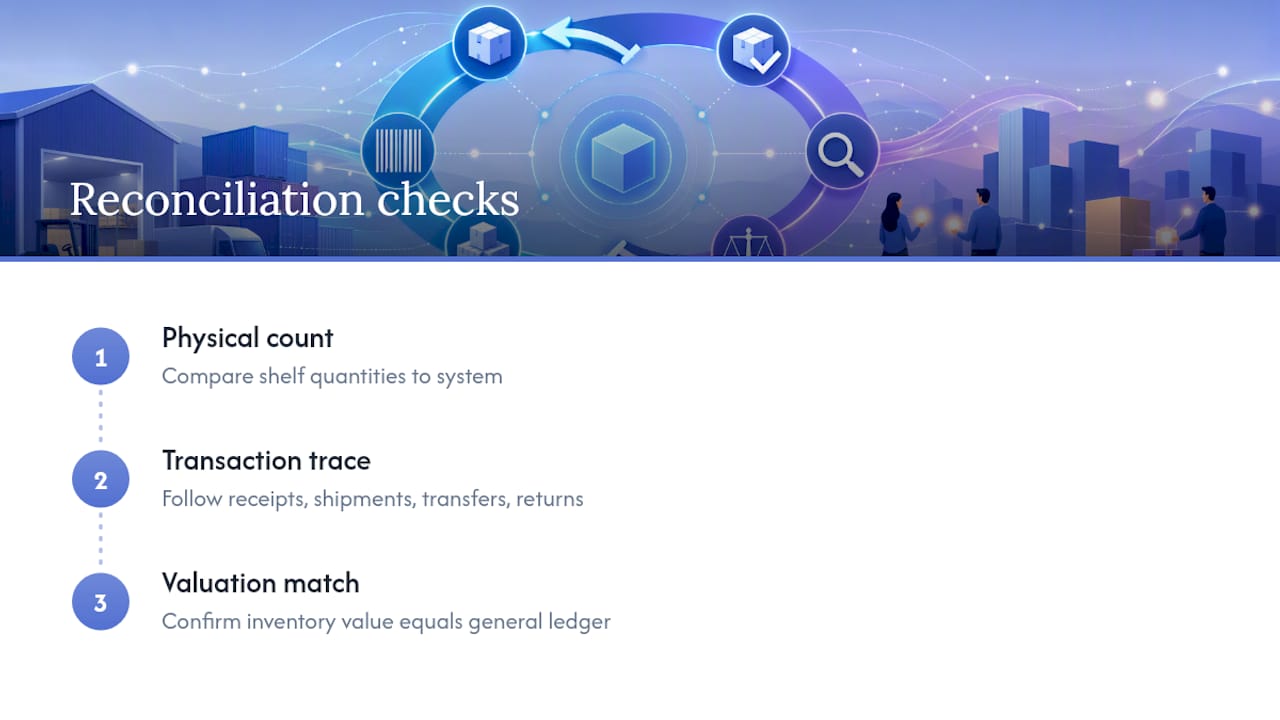
Most operations run three connected checks, not one. The first matches physical counts to system quantities. The second traces the transactions (receipts, shipments, transfers, returns) that built each balance. The third confirms that the valued inventory on your books matches the general ledger. Skip any layer and you get a number that looks clean but can’t survive an audit.
The trigger matters as much as the method. Cycle counts catch drift before it compounds. Month-end close catches what daily counts miss. An exception, like a customer complaint about a shipped item that was never in stock, forces an unscheduled reconciliation regardless of where you are in the calendar.
How Do You Reconcile Inventory Step by Step?
A reconciliation that skips steps produces a number nobody trusts. Here’s the sequence that holds up under audit and actually finds the root cause instead of just papering over it.
- Define scope and tolerance. Decide which SKUs, locations, or warehouses are in scope, set your cut-off date and time, and agree on a materiality threshold (a $50 variance on a $2 item doesn’t need the same scrutiny as a $50 variance on a $2,000 item).
- Capture the system snapshot. Freeze transaction posting or record a hard cut-off time so nothing moves in or out of the system after your count begins. Any receiving, picking, or transfer during the count window has to be logged separately and reconciled afterward.
- Control movement during the count. Lock down the physical area if you can. If operations can’t fully stop, log every movement with a timestamp so you can back it out of the comparison later.
- Count. Decide whether counters see the system quantity beforehand (a “revealed” count) or count blind. Set a recount trigger, commonly any variance over your tolerance threshold, and assign counts to someone who doesn’t normally handle that SKU to avoid bias.
- Compare counted quantity to the system snapshot. Apply your tolerance rule. Variances under threshold get logged and monitored; anything over threshold gets a mandatory recount before you touch the records.
- Investigate variances that survive the recount. Trace the difference to receipts, shipments, transfers, returns, or production consumption that might explain it. This is where most of the real work happens, and skipping it is the single biggest reason discrepancies repeat month after month.
- Route for approval. No adjustment posts without a reason code, supporting evidence, and sign-off from someone other than the counter. Documented adjustments should capture SKU, location, prior quantity, counted quantity, variance, unit cost, financial impact, reason code, counter, approver, and posting date.
- Reconcile inventory value to the general ledger. Confirm your subledger total, after adjustments, matches what’s booked in the GL. A quantity fix that never gets valued and posted to the GL isn’t finished.
Pro Tip: Set your recount threshold as a percentage of unit value, not a flat unit count. A five-unit variance on $3 washers is noise; a five-unit variance on $400 motors is a real problem.
Which Counting Method Fits Your Operation?
Not every SKU deserves the same counting effort, and treating them all identically wastes labor on low-value items while under-checking the ones that actually move your balance sheet.
- Cycle counting by ABC class. Count your highest-value or highest-velocity A items weekly or biweekly, B items monthly, and C items quarterly or on a rotating schedule tied to your headcount capacity.
- Blind counts hide the system quantity from the counter, which produces better audit quality because nobody can subconsciously count toward the number they expect. Revealed counts move faster but invite confirmation bias.
- Transaction-triggered counts fire automatically after specific events, a large shipment discrepancy, a return spike, a new SKU launch, rather than waiting for the next scheduled cycle.
- Full annual counts still have a place for GL certification and insurance audits, but they freeze operations for days and tend to surface problems too late to trace their origin cleanly.
Why Did the Inventory Numbers Not Match?
A variance without a cause is just a guess dressed up as a number. Work through these steps in order before you post anything permanent.
- Recount and check units of measure. A surprising share of “discrepancies” are just cases counted as eaches, or a bin scanned twice.
- Verify SKU and part numbers. Similar part numbers or bundled kits get miscounted more often than people expect.
- Search adjacent and overflow locations. Product wanders. Check the aisle over, the returns cage, and any staging area before assuming it’s actually gone.
- Check for unrecorded or late-posted transactions, receipts that hit the dock before the system cut-off but weren’t scanned in, shipments that left before their pick ticket closed, or transfers between locations that only one side logged.
- Review scrap, consignment, and backflushing records. Manufacturing environments especially lose accuracy here when component consumption is backflushed against a bill of materials that doesn’t match what actually happened on the floor.
- Assign a reason code and run a traceback. A practical workflow is to trigger a blind recount by a different counter, search alternate locations, then trace the transaction history before any permanent adjustment posts. Ask “why” until you hit a process failure, not just a symptom.
- Decide: accept, adjust, or escalate. Variances inside your materiality threshold get logged and monitored. Anything above it needs documented evidence, an assigned owner for the corrective action, and sign-off up the chain.
Discrepancies rarely originate at the count itself. A control framework covering receiving, location, transfer, reservation, picking, and adjustment shows that most errors are seeded upstream of the count, which is exactly why fixing the count process alone never solves a chronic accuracy problem.
What Are the Three Layers of Inventory Reconciliation?
A reconciliation that only checks physical counts against the system is doing a third of the job. A complete reconciliation runs three connected layers, and each one has a different owner and a different failure mode.
- Physical-to-system. Warehouse or operations staff count the shelf and compare it to the system snapshot. Common failures: uncontrolled movement during the count, uncounted overflow locations, and counting errors from rushed staff.
- Transaction-to-balance. Finance or inventory control traces the receipts, shipments, transfers, and adjustments that built the current system balance. This layer catches late postings and duplicate transactions that a simple physical count would never expose.
- Inventory-to-general ledger. Finance confirms the valued inventory subledger matches what’s booked in the GL, checking that unit costs, standard cost updates, and adjustment postings all mapped correctly to the right accounts.
All three layers matter because they catch different failure types. A quantity can be physically correct while the valuation on the books is wrong, or a transaction history can be accurate while a posting error corrupts the GL tie-out. Skip a layer and your financial statements carry a hidden error nobody will find until an auditor does.
How Does Automation Improve Inventory Accuracy?
Barcode and RFID validation at receiving catches an error while it’s still isolated to one transaction, before it has a chance to corrupt every count and shipment that touches that SKU afterward. That single control point does more for accuracy than almost anything else in the workflow.
- Scan validation at receiving stops errors before they enter the system rather than catching them weeks later during a cycle count.
- Real-time ERP/WMS integration replaces batch-updated spreadsheets with a live snapshot, which prevents the late-posting errors that make cut-off dates unreliable.
- Tolerance-based exception routing automatically flags variances over threshold for recount instead of relying on someone to notice.
- Automated recount assignment routes flagged SKUs to a different counter than the original, preserving the audit integrity of a blind recount without manual scheduling.
Vendor case reviews suggest barcode validation applied at transaction points can push accuracy toward the high 90s, a meaningful jump from manual paper counts. That number only holds, though, when the underlying process is disciplined. Automation amplifies whatever process you already have: a scanner on a broken receiving workflow just produces bad data faster.
What Controls Keep Inventory Accuracy From Drifting?
Discipline at a handful of checkpoints prevents most of the variances that eat up investigation time later.
- Gate receiving with mandatory scan validation before anything gets put away. Nothing enters the system on a verbal count or a handwritten packing slip.
- Enforce location discipline. Every movement gets scanned at both origin and destination; no verbal or unlogged transfers between bins.
- Separate counting from approval. The person who counts should never be the person who approves the resulting adjustment.
- Require a reason code and supporting evidence on every adjustment, no exceptions, regardless of dollar size.
- Build escalation rules with named ownership. Every corrective action gets an assigned owner and a due date, and repeat discrepancies on the same SKU or location trigger a process review, not just another adjustment.
Pro Tip: Track which locations generate repeat adjustments over a rolling 90 days. A single SKU with three “one-time” corrections in a quarter isn’t a coincidence, it’s a process gap wearing a disguise.
Warehouse controls like these are exactly where optimized warehouse workflows earn their keep, since a clean receiving gate upstream removes the majority of downstream investigation work.
Which KPIs Prove Your Reconciliation Is Working?
Track a short list, not a dashboard nobody checks. A focused KPI set beats a wall of vanity metrics because it makes repeat patterns visible instead of burying them in noise.
- Count completion rate: percentage of scheduled counts actually performed on time.
- Absolute variance rate: total variance dollars divided by total inventory value, tracked by ABC class.
- Adjustment dollar value and recount rate: how much you’re correcting, and how often a first count needed a second look.
- Repeat discrepancy rate: the same SKU or location showing up again within 90 days.
- Percent of receipts validated at dock and average exception aging (how long a flagged variance sits before resolution).
A reasonable short-term target for a mid-size operation is something like 98% location accuracy on A-class SKUs, reviewed monthly with operations and finance both in the room.
How Do Real Workflows Apply These Steps?
The SMB Shippers’ 60-90 Day Freight Consolidation Pilot Checklist and the Send to Amazon workflow both build reconciliation checkpoints directly into receiving, rather than treating them as a separate audit step tacked on afterward.
- Receiving scan gate: every inbound unit gets scanned against the purchase order before put-away, closing the transaction-to-balance loop at the earliest possible point.
- Container receiving flow: pallet counts get verified against the bill of lading at the dock, not after the container’s contents are already scattered across the warehouse.
- FBA prep verification: labeling and packaging get checked against Amazon’s inbound requirements before the shipment leaves, catching mismatches while they’re still cheap to fix.
Pro Tip: Copy these three checkpoints into your own receiving SOP even if you never touch a 3PL. The gate matters more than who’s standing at it.
Reconciliation Is a Control Loop, Not a Cleanup Job
Treat reconciliation as protection for cash and service levels, not a chore before the books close. “Trueing up” a number without investigating it just hides the same problem until next month, when it costs more to unwind. The real value shows up when every adjustment feeds a corrective action, and operations and finance own that loop together, permanently.
— Akbar
Where Usiship Fits Into Your Reconciliation Controls
If your variances keep tracing back to the same upstream failure, receiving that isn’t scanned, locations that aren’t enforced, snapshots that lag reality, the fix usually isn’t a better spreadsheet. It’s tighter physical controls at the point where inventory actually enters your system.

Usiship’s 3PL fulfillment services and warehousing and fulfillment solutions build the receiving gate, location discipline, and real-time system snapshot into the custody chain itself, so the transaction-to-balance layer stays clean before it ever reaches your reconciliation team. That matters most for growing ecommerce sellers and importers who are trying to run FBA prep, container receiving, and multi-location storage without adding headcount to chase variances every month. Storage pricing varies depending on the unit type, with additional fees for container receiving and other services; current details are available on the pricing page. If receiving validation and system visibility are where your reconciliation keeps breaking down, request a consultation on the 3PL fulfillment page and walk through your current receiving flow with the team.
Sources
- How do I reconcile inventory? — AccountingTools
- Inventory reconciliation best practices — Xorosoft
- Inventory accuracy across your supply chain — Oracle
FAQ
What Are the Five Stages of the Inventory Management Process?
Most frameworks describe receiving, storage, tracking (counting and reconciliation), order fulfillment, and reporting/analysis as the five stages. Reconciliation sits inside the tracking stage, but its output, accurate records, feeds directly into fulfillment accuracy and financial reporting.
What Are the Four Stages of Inventory?
Inventory typically moves through raw materials, work-in-progress, finished goods, and goods in transit or at point of sale. Reconciliation applies at each stage, though the counting method and tolerance thresholds usually differ between raw materials and finished goods.
How Often Should You Run an Inventory Reconciliation Process?
Cadence depends on SKU value: A-class items typically get counted weekly or biweekly, B-class monthly, and C-class quarterly, layered on top of a full reconciliation at month-end close. Exception-triggered counts run outside that schedule whenever a shipment error or customer complaint flags a possible discrepancy.
What Causes Most Inventory Discrepancies?
Most discrepancies trace back to upstream process failures, unscanned receiving, unlogged transfers, or late-posted transactions, rather than the physical count itself. That’s why a reproducible investigation checklist matters more than simply recounting more often.
Can a 3PL Help With Inventory Reconciliation?
Yes. A 3PL that enforces scan validation at receiving and maintains a real-time system snapshot removes many of the upstream errors that cause reconciliation headaches. Usiship’s warehousing and fulfillment solutions build those controls into the custody chain rather than leaving them to a monthly audit.