
2026 USPS Divisor Change Raises Dimensional Weight for Small Shippers
Dimensional weight is the shipping weight carriers calculate from a box’s volume instead of its scale weight, and most carriers bill you on whichever number is higher. If you ship anything bulky but light, there’s a good chance dimensional weight, not the number on your bathroom scale, is setting your postage. Measure your box and run the math before you buy a label, because that single step prevents most billing surprises.
TL;DR:
- Dimensional weight charges apply mainly to bulky, lightweight parcels exceeding about 1,728 cubic inches, potentially increasing costs significantly.
- Calculating dimensional weight involves measuring in inches, multiplying dimensions, dividing by the correct divisor (139 or 166), and rounding up to the next pound.
- USPS changed its divisor to 139 and adjusted rounding rules for 2026, making it essential to verify current carrier policies before estimating costs.
- Proper packaging—such as right-sizing boxes and minimizing void fill—can prevent shipments from entering higher billable weight brackets.
- Maintaining accurate records of package dimensions, divisor used, and effective date is crucial to avoiding billing disputes with carriers.
Table of Contents
- What dimensional weight is and why carriers use it
- How to calculate dimensional weight (formula and worked examples)
- Carrier rules at a glance: USPS, FedEx, UPS, and freight differences
- Measuring, rounding, and documentation to avoid billing surprises
- How DIM weight affects costs and ways to lower DIM charges
- When to call a 3PL
- Our take on dimensional weight rules
- A simple next step for shippers dealing with DIM charges
- FAQ
- Sources
What dimensional weight is and why carriers use it
Dimensional weight, often called volumetric weight or cubed weight, is a formula carriers use to estimate how much space a package takes up relative to its actual weight. Carriers charge for the greater of the two because a truck or plane has limited cubic space, not just a weight limit. A box that weighs 3 pounds but takes up the space of a 15-pound box costs the carrier money in wasted capacity, so dimensional pricing closes that gap.
This matters most for specific shipment types:
- Lightweight, bulky items like pillows, lampshades, and stuffed toys
- Products shipped in oversized boxes with excess void fill
- Apparel, electronics accessories, and anything packed with extra cushioning
If your packaging is efficient, actual weight usually wins and dimensional weight never comes into play.
How to calculate dimensional weight (formula and worked examples)
The standard formula is straightforward:
- Measure length, width, and height in inches, rounding each dimension up to the nearest whole inch.
- Multiply length times width times height to get cubic inches.
- Divide that number by the carrier’s DIM divisor.
- Round the result up to the next whole pound. That final number is your dimensional weight.
The divisor is the variable that changes the outcome. According to Wikipedia’s dimensional weight entry, common divisors are 139 for many commercial and daily rates and 166 for retail or some legacy rules, and carriers round up rather than down.
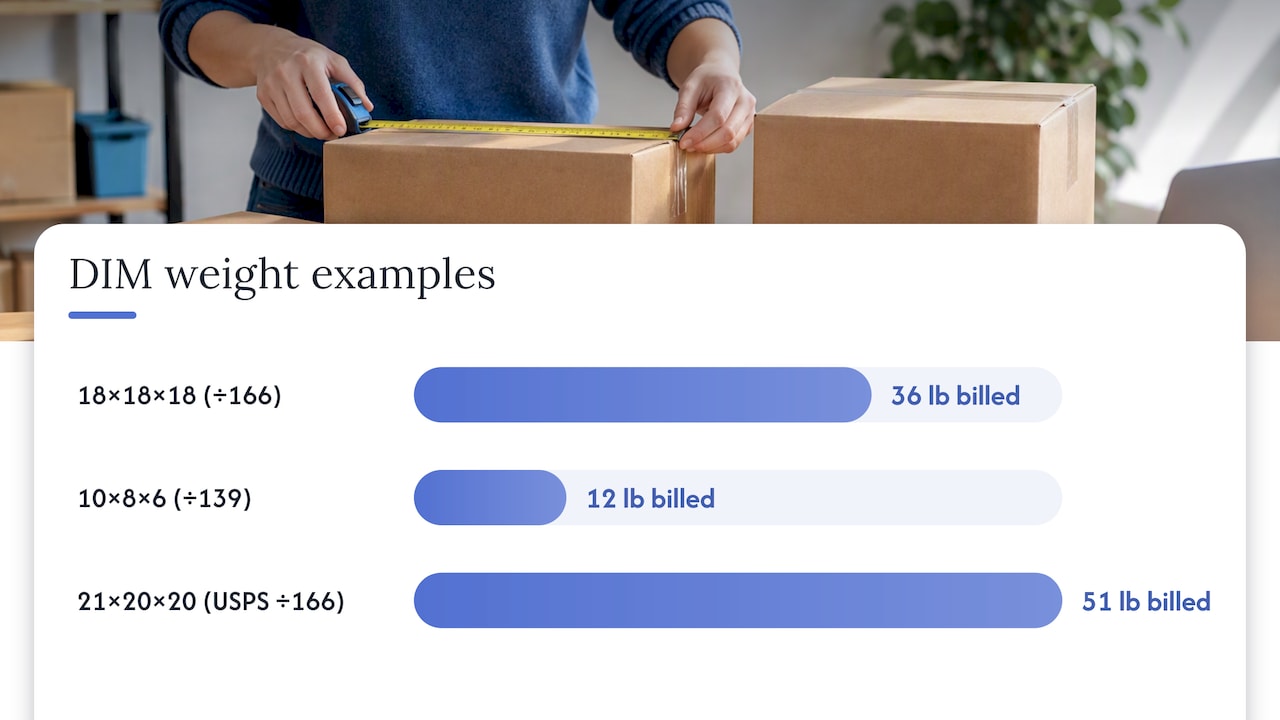
Example 1, DIM weight wins: A box measuring 18 x 18 x 18 inches has a volume of 5,832 cubic inches. Divided by 166, that yields a dimensional weight figure of about 35, rounded up appropriately, as explained in Shopify’s dimensional weight guide. If the actual item weighs only 4 pounds, you’re billed for 36.
Example 2, actual weight wins: A dense 10 x 8 x 6 inch box of tools weighs 12 pounds. Its volume is 480 cubic inches, divided by 139 comes to 3.45, rounded up to 4 pounds. Since 12 is greater than 4, you pay for 12 pounds of actual weight.
Statistic callout: USPS’s own Priority Mail example shows a 21 x 20 x 20 inch parcel calculating to 8,400 cubic inches, divided by 166 for about 50.6, rounded up to approximately 51 pounds, illustrating how dimensional weight can exceed actual weight for an oversized box.
Keep a short checklist on hand: measure in inches, round each dimension up first, multiply, divide by the right divisor, then round the quotient up again.
Carrier rules at a glance: USPS, FedEx, UPS, and freight differences
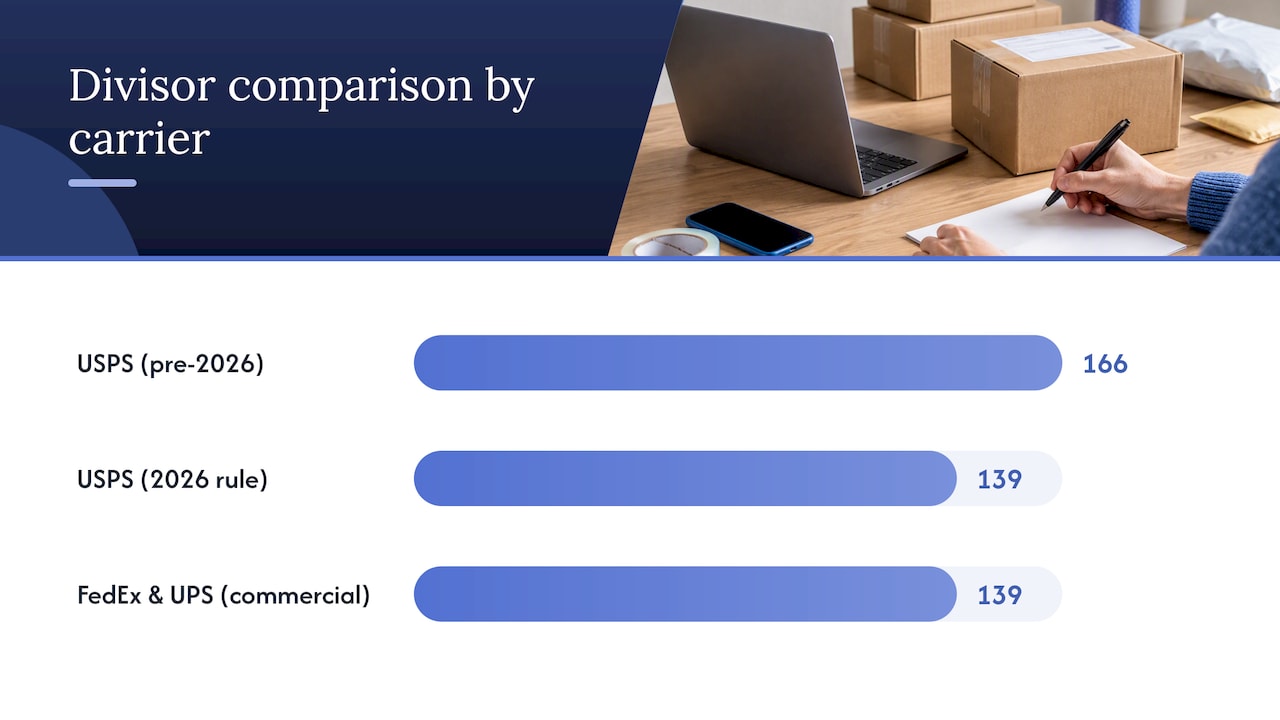
Carrier rules differ enough that a box priced correctly at one carrier can come in higher at another. USPS applies dimensional pricing to domestic Priority Mail and Priority Mail Express parcels that exceed a threshold volume of about one cubic foot, as noted in the USPS Quick Service Guide. A 2026 USPS rulemaking revised the divisor for certain competitive products and services to 139 and changed piece-dimension rounding to round each dimension up to the nearest whole inch, aligning USPS more closely with FedEx and UPS practice.
FedEx and UPS generally use a 139 divisor for commercial accounts, though retail counter rates can differ from negotiated commercial rates, a distinction noted in ShipScience’s dimensional weight guide. Freight and LTL shipments work differently altogether: carriers classify pallets by density-based freight class rather than a parcel DIM formula, so palletizing freight correctly matters more than any single divisor.
| Carrier type | DIM divisor | Where it applies |
|---|---|---|
| USPS (Priority Mail, competitive products) | 166 or 139 depending on product and date | Parcels over 1,728 cubic inches |
| FedEx and UPS commercial | 139 | Most domestic ground and express |
| FedEx and UPS retail | 139 (rate varies by account type) | Counter and non-negotiated rates |
| LTL freight | Not DIM-based | Freight class by density |
A few things to keep in mind when comparing quotes:
- USPS size also triggers separate length and cubic fees outside of DIM pricing
- Freight carriers care about density per cubic foot, not a single divisor
- Always confirm the effective date of the rule you’re using, since divisors change
Measuring, rounding, and documentation to avoid billing surprises
Precision in measuring is what separates an accurate quote from a billing dispute. Measure the longest point of each side with a rigid tape, then round each individual dimension up to the next whole inch before multiplying, a rounding convention both USPS and most commercial carriers now share. For nonrectangular items, measure the furthest points as if the package were boxed.
A few operational points to track:
- Record the carrier, divisor, and effective date used for every quote
- USPS requires parcel dimensions in shipping manifests for certain products, per notes in the USPS Postal Bulletin
- Missing or inaccurate manifest dimensions can trigger a separate noncompliance fee
- Carriers increasingly use fixed or handheld dimensioning equipment that may read slightly differently than your tape measure, a point raised in Freight Figures’ explainer
If an invoice shows a package measuring larger than what you recorded, request a billing audit rather than accepting the charge.
Pro Tip: Photograph your package next to a tape measure before it ships, so you have proof of dimensions if a carrier’s invoice disagrees with your own.
How DIM weight affects costs and ways to lower DIM charges
Dimensional pricing turns packaging choices into direct cost decisions. A box that’s two inches bigger on each side than it needs to be can push a shipment into a higher billable weight bracket, even when the product inside hasn’t changed.
Nine practical fixes:
- Right-size boxes to the product instead of using one standard size for everything
- Switch flat or soft items into poly mailers instead of boxes
- Cut void fill to the minimum needed for protection
- Use corrugated inserts instead of bulky air pillows
- Consolidate multiple small items into one box when a customer orders several products
- Split oversized orders only when splitting lowers total cubic volume shipped
- Compare carrier flat-rate boxes against your DIM-calculated rate for dense, heavy items
- Negotiate commercial rates once volume justifies it
- Outsource packing and fulfillment to a 3PL that already runs right-sizing programs
Beyond packaging, structural choices matter too:
- Review your top 10 shipped SKUs quarterly for box-size mismatches
- Track DIM versus actual weight on invoices to catch drift over time
When to call a 3PL
A few signs suggest it’s time to bring in outside help: dimensional surprises on a growing share of invoices, multiple carriers and service levels to track, or manifesting rules that keep changing underneath you. A 3PL can run structured right-sizing programs, apply negotiated commercial rates, consolidate manifests, and audit dimensional charges on your behalf. Before signing on, ask any provider how they measure packages, which carriers they have negotiated rates with, and how often they review box sizing for your top products.
Our take on dimensional weight rules
The most common mistake small shippers make isn’t ignorance of the formula, it’s assuming the divisor they learned once still applies. USPS has revised its divisor and rounding rules for 2026, and FedEx and UPS periodically adjust retail versus commercial treatment too. Treating dimensional weight as a fixed fact rather than a moving policy is where margins quietly disappear.
Conventional advice tends to stop at “measure your box and use the formula,” which is correct but incomplete. The bigger lever for most small sellers is packaging discipline: a box chosen to fit the product, not the shelf you happened to have. That single habit prevents more overcharges than any amount of rate-shopping between carriers.
If we had to prioritize one thing, it would be this: build a habit of recording the divisor, carrier, and date behind every quote. Rules change, and the shippers who get surprised are usually the ones relying on a number they memorized years ago instead of the one in effect today.
— Akbar
A simple next step for shippers dealing with DIM charges
If dimensional weight keeps eating into your margins, the fastest fix usually isn’t a new formula, it’s handing the packing and measuring to a team that does it daily. Our 3PL fulfillment services include right-sizing programs, consolidated manifests, and packaging optimization built specifically to keep your billable weight as close to actual weight as possible.

For sellers with bulkier or international flows, our freight forwarding and air freight services handle the routing decisions where DIM rules and freight class overlap. An initial engagement typically starts with a quote and a short dimensional audit of your current packaging, so you know exactly where the savings are before committing to anything larger.
What we offer:
- 3PL fulfillment with packing and right-sizing built in
- Freight forwarding for larger or international shipments
- Warehousing and storage options when consolidation makes sense
- A straightforward quote process through our pricing page
Start with a quote on our pricing page to see where your current packaging stands.
FAQ
What is a dimensional weight?
Dimensional weight is a shipping weight calculated from a package’s volume rather than its scale weight, found by dividing length times width times height by a carrier’s DIM divisor. Carriers bill the greater of actual weight or dimensional weight, which is why a light but bulky box can cost more than expected.
How to calculate dimensional weight for USPS?
For Priority Mail and Priority Mail Express parcels over 1,728 cubic inches, measure in inches, multiply length by width by height, then divide by 166 or 139 depending on the product and current rule, per USPS’s own guide. Round the result up to the next whole pound, and USPS bills whichever is greater, actual or dimensional weight.
How do I calculate the dimensional weight for a package?
Measure length, width, and height in inches, rounding each up to the nearest whole inch, then multiply those three numbers together to get cubic inches. Divide that figure by your carrier’s divisor, commonly 139 or 166 as noted in Wikipedia’s explanation, and round the result up to the next whole pound.
How to calculate dimensional weight in pounds?
The calculation already produces a result in pounds once you divide cubic inches by the carrier’s divisor. Round that final number up to the next whole pound, and compare it against the actual scale weight, since the carrier charges whichever number is higher.
Does dimensional weight always apply to USPS packages?
No, USPS dimensional pricing depends on the service, size, and zone, so a blanket assumption that it always applies can lead to inaccurate cost estimates. Check the specific product and current rule before assuming a package qualifies.
Sources
- 110 Quick Service Guide | Postal Explorer
- Dimensional weight (Shopify blog)
- Dimensional weight — Wikipedia