
U.S. Importers: 3 Customs POA Compliance Checks to Avoid Port Holds
Yes, you need a customs power of attorney to let a licensed customs broker transact customs business on your behalf. It authorizes the broker to file entries, pay duties, and represent you before U.S. Customs and Border Protection, and under 19 CFR Part 141, modernization rules now require the broker to execute that POA directly with you, not through an intermediary.
TL;DR:
- A customs power of attorney must be executed directly with the broker and include exact legal business name, EIN, and IOR number to avoid rejection.
- Validating a POA involves verifying the signer’s government-issued ID, matching records in ACE, and conducting denied-party screening before acceptance.
- Common delays arise from name mismatches, unregistered DBAs, incorrect EINs, or third-party signing, which can be fixed with proper data checks beforehand.
- Partnerships have a two-year POA expiration, but corporations and LLCs usually do not, though regular review is recommended to prevent outdated authorizations.
- Universal Shipping performs direct POA execution, validation, and recordkeeping to ensure swift customs clearance and compliance.
Table of Contents
- What a Customs Power of Attorney Is and Its Legal Basis
- When a POA Is Required and Who Can Sign It
- How to Complete and Execute a Customs POA
- Validating a POA and Electronic Signature Rules
- Common Pitfalls That Delay Clearance
- Duration, Revocation, and Recordkeeping Obligations
- How Universal Shipping Inc. Handles POAs and Customs Clearance
- A Quick Action Checklist Before You Sign Anything
- Customs Brokerage That Handles the Paperwork Correctly
- FAQ
- Sources
What a Customs Power of Attorney Is and Its Legal Basis
A customs power of attorney is a legal document that lets a principal, typically the importer of record or a drawback claimant, name an agent, usually a licensed customs broker, to act on their behalf in dealings with CBP. The regulatory framework sits in 19 CFR Part 141 Subpart C, which spells out acceptable form language, nonresident requirements, and how ports and centers determine validity.
Two standard forms cover most situations:
- Customs Form 5291 is the general POA form, built on sample language found in the regulation itself.
- CBP Form 5297 applies specifically to corporate surety authority, used when a power of attorney relates to surety obligations.
A business does not have to use these exact forms, but any substitute must be equivalent in scope and properly executed.
When a POA Is Required and Who Can Sign It
A POA is required any time a broker files a brokered entry or submits a drawback claim for you. Without one, the broker has no legal authority to transact customs business on your company’s behalf, and CBP will not treat the filing as valid.
The document needs to carry data that matches your official records exactly:
- Your legal business name as registered, not a trade name or informal DBA.
- Your legal designation, meaning corporation, partnership, LLC, or sole proprietorship.
- Your EIN or SSN, plus your Importer of Record number when one has been assigned.
- The signer’s title and authority to bind the business.
Who qualifies to sign depends on entity type. A corporate officer can sign for a corporation, a general partner for a partnership, and a managing member for an LLC. Sole proprietors sign personally. Nonresident corporations that have not qualified to do business in the state where the customs district sits face an extra hurdle: 19 CFR §141.37 requires additional documentation proving the signatory’s authority before the POA is accepted.
How to Complete and Execute a Customs POA
Getting a POA accepted on the first try comes down to following a consistent sequence rather than rushing the signature page.
- Collect entity data first: legal name, EIN, IOR number, and business structure, pulled straight from state registration documents.
- Match that data to ACE records before anyone signs anything, since a mismatch here is the single most common cause of rejection.
- Confirm signatory authority in writing, whether that is a corporate resolution, partnership agreement, or operating agreement excerpt.
- Execute the POA directly with your broker, in person, by mail, or electronically, rather than through a freight forwarder or other third party.
- Retain a signed copy on both sides, along with whatever identity verification was used during signing.
Electronic execution is acceptable, but the broker should capture identity evidence and keep an audit trail showing who signed, when, and how. Notarization is not always required, but a photo ID check at signing time gives both parties a clean record to point to later.
Pro Tip: Keep a single digital folder per importer account with the executed POA, the EIN verification, and the ID check, so a CBP audit request takes minutes instead of days.
Validating a POA and Electronic Signature Rules
CBP treats POA validation as a national security control, not paperwork for paperwork’s sake, because a POA authorizes the movement of merchandise across the border. CBP’s guidance on validating powers of attorney lists the steps brokers are expected to follow before accepting one.
- Verify a government-issued photo ID for the signer.
- Match the POA name and EIN against ACE records.
- Check the business against state registration databases.
- Run denied-party screening on the principal before filing.
CBP requires brokers to verify government photo ID, match EIN and legal name to ACE, and check state business registrations as part of accepting a POA. This is the baseline a broker must clear, not an optional best practice.
On electronic signatures, CBP’s modernization guidance requires direct broker-client execution under 19 CFR 111.36©(3). POAs executed before December 19, 2022 had to be affirmed or re-executed with direct communication within the provided transition period, closing the door on POAs signed through freight forwarders acting as middlemen.
Common Pitfalls That Delay Clearance
Most POA rejections trace back to a handful of recurring errors, and nearly all of them are preventable with a quick data check before signing.
- Name mismatches, where the POA lists a trade name instead of the legal entity name on file with the state.
- Unregistered DBAs used as the business name when the EIN is registered under a different legal entity.
- EIN or IOR number errors, often a transposed digit that fails ACE matching.
- Third-party execution, where a forwarder signs or facilitates signing instead of the broker dealing directly with the importer.
Fixing these usually means re-executing the POA with corrected data, submitting a certified copy of the business registration, and contacting the broker or port director if a filing is already stuck. When onboarding a new broker, ask directly whether they run ACE matching and denied-party screening before filing, rather than assuming it happens automatically.
Pro Tip: Pull your own ACE entity record before signing a new POA, so any mismatch gets caught on your end instead of at the port.
Duration, Revocation, and Recordkeeping Obligations
POA duration rules differ by entity type. Partnerships face a two-year limit before a new POA is needed, while corporations and other entities generally do not carry that same expiration, though brokers often set internal renewal schedules anyway.
- Revoking a POA requires written notice to the broker and, in most cases, notification to the relevant port or center so the broker’s authority is formally terminated.
- Brokers must retain POAs, including revoked ones, for a defined period after revocation or after the client account goes inactive.
- Best practice is to review every active POA against current entity data at least once a year, catching name changes or EIN updates before they cause a rejection.
How Universal Shipping Inc. Handles POAs and Customs Clearance
We execute every power of attorney directly with the importer, in line with the direct-execution standard CBP’s modernization rule set. We do not rely on a forwarder intermediary to collect signatures on our behalf.
Our validation process before any entry is filed includes identity verification, ACE and EIN matching against the legal entity name on the POA, denied-party screening of the principal before the shipment moves, and document retention in a system so a signed POA and its validation trail are retrievable on request.
If your business needs a customs brokerage partner that handles POA execution and validation as part of clearance rather than as an afterthought, that process is where we start.
A Quick Action Checklist Before You Sign Anything
If you only do three things before executing a customs POA, confirm your legal name, EIN, and Importer of Record number match your state registration and ACE records, execute the POA directly with your broker rather than through a forwarder, and keep a copy of the signed document along with proof of the validation steps taken.
Involve legal counsel when a nonresident corporation needs to establish signatory authority, when a drawback claim is contested, or when a protest is involved. And if your POA predates December 19, 2022, check it now. The modernization window closed in February 2023, and an unaffirmed legacy POA is a liability waiting to surface during an audit.
— Akbar
Customs Brokerage That Handles the Paperwork Correctly
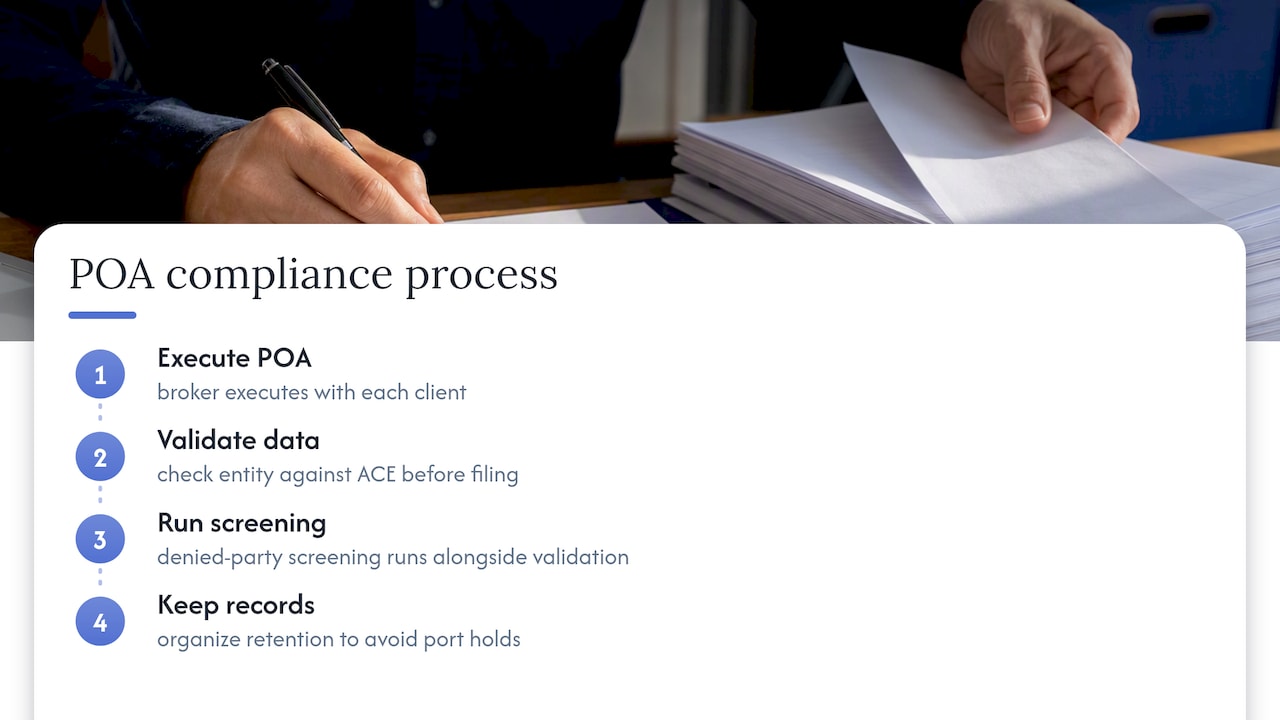
A power of attorney is only as good as the process behind it, and most delays we see trace back to a document executed quickly without the data checks it needed. Our customs brokerage team executes POAs directly with each client, validates entity data against ACE before filing, and keeps records organized so nothing stalls at the port.
If you also need denied-party screening built into onboarding, our screening service runs alongside POA validation rather than as a separate step. For businesses with specialized cargo, including yacht and vessel owners who face their own registration and compliance requirements, getting the paperwork right the first time matters just as much. Check our pricing page to see which service tier fits your shipment volume, or reach out to start a managed customs clearance relationship built around direct, compliant POA execution.
This article is general information, not a substitute for advice from a qualified lawyer. Consult a qualified legal professional about your own circumstances before acting on anything here.
FAQ
How do I complete a customs power of attorney?
Collect your legal business name, EIN, entity type, and Importer of Record number, then confirm the signer has documented authority to bind the business. Execute the form, typically Customs Form 5291 or an equivalent, directly with your broker, and retain a signed copy along with identity verification.
Why is a POA needed for customs?
A broker cannot legally file entries, pay duties, or represent you before CBP without one. The requirement exists because a POA authorizes the movement of merchandise, which CBP treats as a national security control that brokers must verify carefully.
Who signs a customs power of attorney?
The signer must have legal authority to bind the business: a corporate officer for a corporation, a general partner for a partnership, a managing member for an LLC, or the individual for a sole proprietorship. Nonresident corporations face additional documentation requirements under 19 CFR §141.37 if they have not qualified to do business in the relevant state.
Is an importer’s power of attorney required for every shipment?
A POA is required whenever a licensed broker files a brokered entry or drawback claim on an importer’s behalf, and it generally covers an ongoing account rather than needing re-execution for each shipment. Partnerships are the exception, since their POAs expire after two years under 19 CFR Part 141 and need to be renewed.
What does Universal Shipping charge for customs brokerage?
Pricing depends on shipment volume and service scope, and current details are listed on our pricing page. Our customs brokerage service includes direct POA execution and validation as part of the clearance process.
Sources
- Validating the Power of Attorney and Electronic Signatures | U.S. Customs and Border Protection
- 19 CFR Part 141 Subpart C – Powers of Attorney