
Stop Shipment Holds with Denied Party Screening for U.S. Logistics
Denied party screening is the practice of checking a customer, supplier, or shipment counterparty against U.S. government restricted party lists, primarily the Consolidated Screening List (CSL), the OFAC SDN List, and the BIS Entity, Denied Persons, and Unverified lists, before you transact with them. The single action that matters most: screen at every transaction point, not just at onboarding, and keep a documented audit trail for every check, hit or no hit.
TL;DR:
- Screening should be conducted at every transaction point, including onboarding, pre-payment, pre-shipment, and ongoing for long-term partners.
- Maintaining detailed documentation of each screening, including list versions, match results, and reviewer actions, is essential for regulatory compliance.
- Automated systems with API integration, audit logs, and real-time blocking capabilities improve detection and response accuracy for high-volume trade.
- Multiple lists, especially the Consolidated Screening List, cover most U.S. restricted parties, but foreign sanctions and PEPs may require additional sources.
- Handling hits involves verifying identifiers, confirming list versions, and escalating confirmed matches to legal review before proceeding.
Table of Contents
- Which U.S. Lists and Agencies Actually Matter Here
- When Should You Screen, and How Often?
- How to Actually Run a Screening Check
- Choosing Automation: Feeds, APIs, and System Integration
- What to Do When You Get a Hit
- What Regulators Expect You to Keep on File
- How Freight Forwarders and Brokers Operationalize This
- What Compliance Teams Should Prioritize in the Next 90 Days
- How Universal Shipping Fits Into Your Screening Program
- Where to Verify Screening Rules Directly
- Sources
Which U.S. Lists and Agencies Actually Matter Here
Nine separate federal lists cover restricted parties, but you don’t need to query nine separate databases. The Consolidated Screening List, maintained by the International Trade Administration, aggregates most of them into one searchable file, which is why it’s the starting point for nearly every screening program in the country.
Here’s what you’re actually checking against and what a match means:
- OFAC SDN List: Names individuals and entities blocked under U.S. sanctions programs. A true hit means you generally cannot transact at all, and the 50% Rule extends that block to any entity owned 50% or more, in aggregate, by blocked parties, even if the entity itself never appears on the list.
- BIS Entity List: Names organizations subject to specific license requirements for exports, often tied to national security or nonproliferation concerns.
- BIS Denied Persons List: Parties whose export privileges have been formally revoked under the Export Administration Regulations. No license can fix this. It’s a flat denial.
- BIS Unverified List: Not a prohibition by itself, but a red flag that BIS couldn’t complete an end-use check at that address. It should trigger enhanced due diligence, not automatic blocking.
- DDTC/ITAR debarred parties: Covers defense articles and services, and debarment under ITAR carries its own escalation path, separate from BIS or OFAC.
- SAM.gov and LEIE: Relevant if you sell into federal procurement or healthcare supply chains, where excluded-party status can void a contract or trigger False Claims Act exposure.
When Should You Screen, and How Often?
Screening once at onboarding and calling it done is the most common gap auditors find. Sanctions lists change constantly, and a clean partner in January can be a blocked one by June.
- At onboarding, before the first purchase order, contract, or shipment is booked, for every new customer, vendor, and freight counterparty.
- Pre-payment and pre-shipment, immediately before funds move or goods leave the dock, since this is the checkpoint closest to actual legal exposure.
- Pre-clearance, when customs paperwork is filed, catching any party changes that slipped in after booking.
- Periodically for standing relationships. Long-term partners need scheduled rescreens, and high-volume trade lanes typically warrant daily or near-daily refreshes against updated list data.
- On any material change, including ownership shifts, a new destination country, a changed end use, or a fresh regulatory designation. Any of these should force an immediate rescreen regardless of where you are in the normal cycle.
The list refresh cadence matters as much as your own screening frequency. If your vendor’s data feed lags OFAC’s actual updates by even a few days, you’re screening against a stale list and don’t know it.
How to Actually Run a Screening Check
Good screening starts with data quality, not software. If you feed a system a bare company name with no address or registration number, you’ll get either a wall of false positives or a missed real hit, and neither helps you.
Collect these identifiers at minimum for every counterparty:
- Full legal name and all known aliases or trading names
- Complete physical address, including any prior known addresses
- Business registration or tax ID number where lawfully collectible
- Date of birth and national ID for individual counterparties, where relevant and legal to capture
- Country of citizenship or incorporation
Names get transliterated differently across databases, so document your normalization rules (how you handle diacritics, name order, and romanization) and your fuzzy-matching threshold settings. A match algorithm set too loose buries reviewers in noise; set too tight, it lets real hits slide through.
For the OFAC 50% Rule, ownership checks require going past the counterparty itself into its beneficial ownership structure. Corporate registries, shareholder filings, or a compliance vendor’s ownership-mapping module can surface this, but someone still has to interpret aggregate ownership percentages across multiple blocked parties, which software alone won’t reliably catch.
Pro Tip: Build a standing folder template for hit resolution before you need it, with fields for the list source, match score, supporting documents, and reviewer sign-off. Scrambling to invent that structure during an actual investigation wastes the hours you need for the review itself.
Choosing Automation: Feeds, APIs, and System Integration
You can query the CSL manually through its web search interface, download the raw files, or connect via API for automated checks inside your own systems. Manual search works fine for a business processing a handful of new counterparties a month. It falls apart fast once you’re screening hundreds of transactions weekly.
Vendor screening platforms typically add:
- Automated fuzzy matching tuned across multiple government lists simultaneously
- Case management workflows that route hits to the right reviewer automatically
- Audit logs that timestamp every search, match, and disposition without manual entry
- Real-time blocking that halts an order or shipment before it processes, rather than flagging it after the fact
The integration points that matter most sit inside your ERP, order management system, transportation management system, and customs brokerage platform. Screening bolted onto only one of those leaves gaps everywhere else a restricted party could slip through.
Government feeds alone have a real limit: they’re comprehensive on U.S. lists but don’t include foreign sanctions regimes, adverse media, or PEP data that many businesses also want checked. That’s why most serious compliance vendors layer additional sources on top of the CSL rather than relying on it alone.
What to Do When You Get a Hit
A returned match is not a verdict. Most flagged names turn out to be false positives, but you have to prove that, not just assume it.
- Identify the source list and capture a snapshot of the exact entry, including the date and version of the list you queried, before anything changes upstream.
- Compare full identifiers, not just the name, against the flagged entry, gathering corroborating documents like registration filings or address verification.
- Escalate confirmed true positives to legal review immediately, and place a hold on any transaction, shipment, or payment involving a genuinely prohibited party until that review clears it.
- Document the resolution with the reviewer’s identity, the evidence reviewed, and the specific rationale for clearing or blocking. For anything touching ITAR-controlled items, escalate to DDTC directly rather than resolving internally.
A screening run isn’t finished when the system says “no matches.” It’s finished when every potential match, cleared or confirmed, has a documented rationale attached to it.
What Regulators Expect You to Keep on File
Enforcement actions rarely hinge on whether you screened. They hinge on whether you can prove it. A “we definitely checked” claim with no paper trail behind it carries almost no weight in an actual investigation.
Save this metadata for every single run:
- Date and time of the screening
- Which specific lists were queried, including version or snapshot reference
- The exact search criteria and matching parameters used
- The disposition (cleared, escalated, blocked) and supporting rationale
- The identity of the reviewer who made the call
BIS export recordkeeping obligations generally call for multi-year retention of transaction records, and screening documentation should follow the same retention discipline as your broader export files. Gaps in that documentation don’t just look bad. They actively weaken your defense if a bad transaction later surfaces, because regulators tend to read missing records as evidence of a missing process, not just sloppy filing.
Quick audit-readiness check: Can you pull, for any transaction in the last two years, the exact list version queried, the match disposition, and the reviewer’s name in under five minutes? If not, your recordkeeping needs work before your screening process does.
How Freight Forwarders and Brokers Operationalize This
Screening rules attach to the party, not the shipment, which is critical in managing inbound textile shipments as detailed in Cross-Border Textile Import: A Logistics Guide. That means a forwarder or broker has to screen every counterparty in a transaction, not just the buyer.
The counterparties that need checking on nearly every file include the buyer, the consignee, the notify party, and any intermediate freight forwarder involved in the routing. The logical points to hold a shipment are before booking confirmation, before customs filing, and before final release, since releasing goods to a screened-but-unresolved party defeats the purpose of screening at all.
- Screen buyer, consignee, notify party, and any co-loading forwarder
- Hold at booking, at customs filing, and before final release
- Attach the screening snapshot and disposition to the shipment file itself, not a separate compliance folder disconnected from the actual paperwork
A forwarder’s customs clearance workflow is often the last practical checkpoint before goods physically move, which makes it one of the highest-value places to enforce a hold.
What Compliance Teams Should Prioritize in the Next 90 Days
Map who you actually screen today, then add pre-shipment and pre-payment checks wherever onboarding was the only checkpoint. Fix recordkeeping gaps next, and set a written match-resolution SLA.
— Akbar
How Universal Shipping Fits Into Your Screening Program
Screening is only half the job. Enforcing the hold at the exact moment goods are about to move is the harder half, and that’s where a logistics partner earns its keep.
Universal Shipping handles freight forwarding, licensed customs clearance, warehousing, and fulfillment for businesses shipping across all 50 states, which puts pre-shipment and pre-clearance screening checkpoints directly inside the same workflow instead of scattered across separate systems. A logistics partner that centralizes documentation, holds, and clearance under one roof cuts down the handoff gaps where a flagged counterparty can slip through unnoticed.
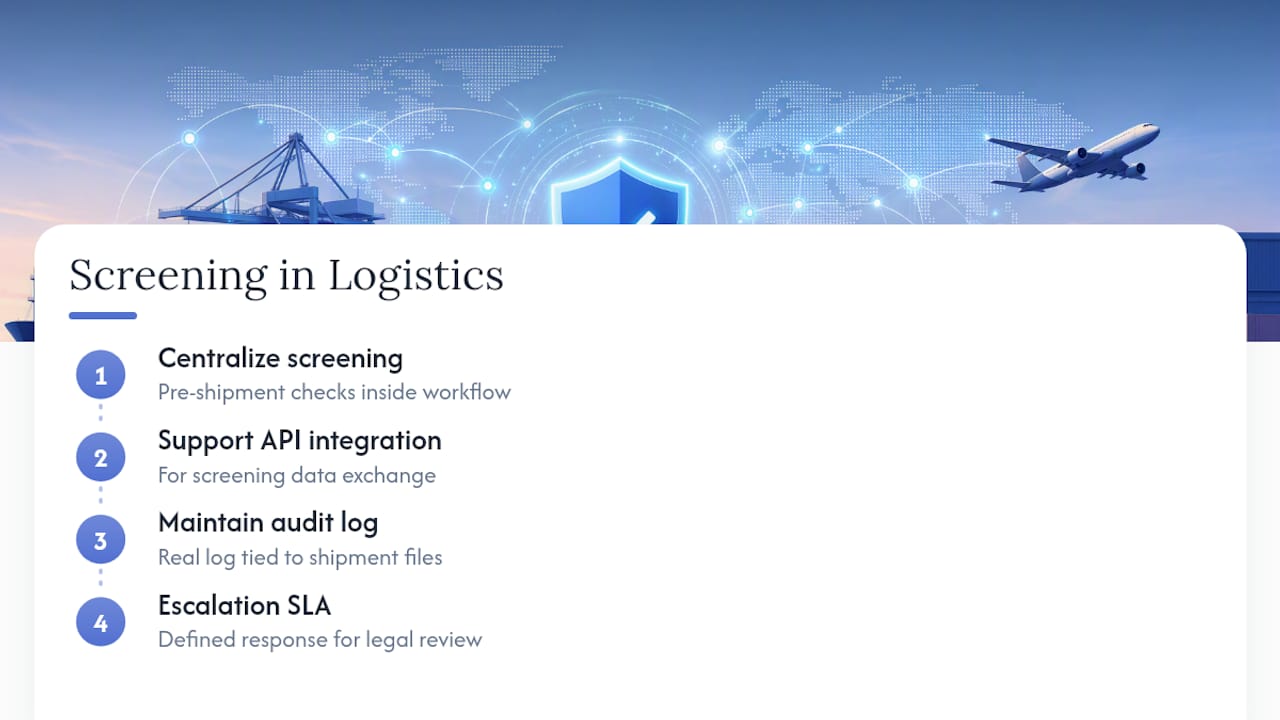
Before you sign with any logistics or brokerage provider, ask three things: do they support API integration for screening data, do they maintain a real audit log tied to shipment files, and what’s their actual escalation SLA when a hit needs legal review before release. If you’re evaluating how logistics and transportation services should fit into your compliance stack, reach out to Universal Shipping to walk through your current shipment lifecycle and find out where the gaps actually are.
Where to Verify Screening Rules Directly
Always confirm current list status against the primary source, not a secondhand summary:
- Consolidated Screening List: the aggregated CSL search tool
- OFAC SDN List: sanctions designations and the 50% Rule
- BIS Denied Persons List: export-privilege denials and contacts
- DDTC guidance: ITAR debarment procedures
- Stopfakes.gov: cross-agency illicit trade resources