
Advanced Shipping Notice: 4 Data Levels Behind Single Scan Receiving
An advance shipping notice (ASN) is an electronic pre-notification of a shipment, most commonly sent as an EDI 856 or GS1 DESADV message, that reaches the receiver before the truck does. It lets receiving systems pre-populate tasks, schedule dock labor, and flag mismatches between what was ordered and what shipped before anyone unloads a pallet. Built on X12 and GS1 standards, it turns receiving from a reactive scramble into a planned workflow.
TL;DR:
- X12 856 is common in North American retail and manufacturing, while GS1 DESADV serves GS1 aligned networks; neither replaces the bill of lading’s legal role.
- Map order identifiers, SSCCs, item quantities, dimensions, carrier, and arrival time; a scannable SSCC label can retrieve pallet contents with one dock scan.
- An EDI 997 confirms receipt and valid syntax, not accurate shipment data, so compare ASN contents with the purchase order before scheduling receipt.
- Industry sources report roughly 40% lower receiving costs with ASN processes; pilot one lane and compare labor minutes and discrepancies after 30 to 60 days.
- Send the ASN after physical departure within the partner’s required window; obscured SSCC barcodes can defeat scanning, while late or inaccurate notices may incur chargebacks.
Table of Contents
- ASN standards and how they differ from a bill of lading
- ASN data elements: hierarchy, SSCC, and the fields to map
- How ASNs move: EDI, APIs, and system integration
- Measuring ASN impact at the dock and in inventory
- Rolling out or improving ASN workflows
- Why ASN discipline is the real fix for freight and fulfillment friction
- How we help you put ASN discipline into practice
- FAQ
- Sources
ASN standards and how they differ from a bill of lading
Two standards dominate ASN messaging. In North America, the X12 856 ship notice is the common format for retail and manufacturing trading partners. In GS1-aligned supply chains, particularly in Europe and in global retail networks, the DESADV (Despatch Advice) message carries the equivalent information under GS1 EANCOM conventions.
An ASN is a data document, not a legal one. A bill of lading is the legal contract of carriage between shipper and carrier, governing liability and proof of shipment. The ASN simply tells the receiver what to expect, down to the carton level, so the two documents serve different purposes even though they often describe the same shipment.
The X12 856 structure uses hierarchical loops (HL segments) to organize data:
- Shipment level: carrier, bill of lading number, ship date, total weight
- Order level: purchase order number, order date, ship-to location
- Pack level: carton or pallet identifiers, including SSCC codes
- Item level: SKU, quantity, lot or serial data where applicable
Each loop nests inside the one above it, which is what lets receiving software match a scanned pallet back to its order and shipment in one pass.
ASN data elements: hierarchy, SSCC, and the fields to map
A usable ASN needs more than a shipment number. At minimum, map these fields when configuring an outbound or inbound ASN feed:
- Shipment and purchase order identifiers tying the notice to a specific order
- Serial Shipping Container Code (SSCC) at the pallet or carton level
- GTIN or internal SKU with expected quantities per line item
- Weight and dimensions, especially for freight class verification
- Carrier identity and expected arrival date and time
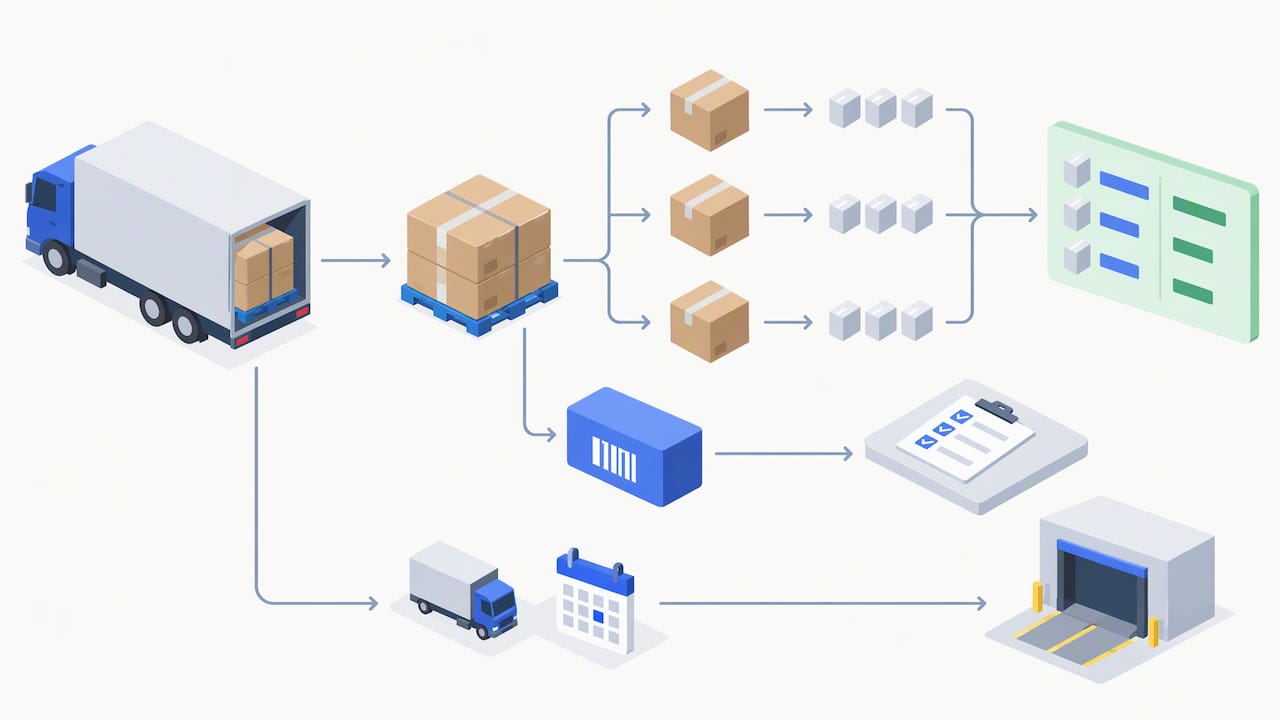
The SSCC is the detail that makes single-scan receiving possible. GS1 guidance recommends placing the SSCC and related GS1 Application Identifiers, such as ship-to postal code, weight, and dimensions, in a 2D barcode on the transport label. When that barcode matches the SSCC already referenced in the ASN’s pack-level HL loop, a single scan at the dock door pulls up the entire carton or pallet contents instead of requiring line-by-line verification.
Industry data points to roughly 40% lower receiving costs when ASN-based processes replace manual verification, driven by faster labor throughput and fewer manual checks, according to industry literature on ASN adoption.
For WMS mapping, the practical rule is: pack-level SSCC maps to the receiving task identifier, item-level quantities map to expected-versus-received variance checks, and shipment-level carrier and date fields map to dock scheduling slots.
How ASNs move: EDI, APIs, and system integration
ASNs typically travel one of two ways. Batch EDI 856 transmissions, often sent via AS2 or a value-added network, remain standard for large retail and manufacturing partners. Newer trading relationships increasingly layer API or JSON-based feeds on top of or instead of batch EDI, particularly for smaller suppliers or real-time fulfillment networks. Many operations run both in parallel, translating API data into 856 format for partners who require it.
Functional acknowledgements, the EDI 997 transaction, confirm that a transmitted ASN was received and syntactically valid. That acknowledgement does not confirm the data is accurate, only that it arrived and parsed, so a separate validation step against expected order data still matters.
Once an ASN lands, a WMS or TMS should act on it automatically:
- Create a pre-receive record that reserves a dock door and labor slot
- Pre-print putaway or compliance labels ahead of arrival
- Generate a receiving task tied to the expected SSCC list
- Flag any order or quantity mismatch for review before the truck checks in
Measuring ASN impact at the dock and in inventory
ASN discipline is only valuable if someone tracks what changes. The KPIs worth watching are receiving cycle time (dock arrival to putaway), dock-to-stock latency, discrepancy rate between ASN and received quantities, and labor minutes per pallet or carton.
ASN-based receiving can reduce receiving costs substantially through better labor productivity, according to industry sources tracking ASN adoption. That gain tends to come less from any single change and more from compounding smaller ones: less time spent counting, fewer put-backs for miscoded items, and fewer emergency recounts.
A 2026 inventory accuracy study recommends triggering opportunity-based cycle counts whenever an ASN discrepancy appears, with priority given to fast-moving SKUs. That approach concentrates counting effort where errors are most likely to recur rather than spreading it evenly across the warehouse.
To measure impact honestly:
- Baseline current cycle time and discrepancy rate before changing anything
- Pilot ASN-driven receiving on one lane or supplier
- Compare labor minutes per pallet and discrepancy rate after 30 to 60 days
- Expand only after the pilot shows a repeatable gain
Rolling out or improving ASN workflows
Timing is the first thing to get right. An ASN should go out after the shipment physically departs and typically within a partner-defined SLA window, since many retailers charge back for late or inaccurate notices.
A practical rollout sequence:
- Confirm SSCC allocation at packing, generating a unique code per pallet or carton before labeling.
- Print GS1-compliant labels with 2D barcodes encoding the SSCC and key transport data for single-scan validation.
- Map HL loop fields to WMS receiving tasks, matching shipment, order, pack, and item levels.
- Test the full cycle with one trading partner, confirming 997 acknowledgements and data accuracy before go-live.
- Define discrepancy and chargeback workflows, including what triggers quarantine and who resolves mismatches.
- Start with a single lane or customer, measure the KPIs above, then expand once the numbers hold.
Label placement deserves its own attention: a barcode that’s folded, wrapped around a corner, or obscured by stretch wrap defeats the entire point of single-scan receiving, a failure mode covered in detail in this guide to attaching shipping labels so they scan correctly.
Pro Tip: Run SSCC and ASN mapping as a joint project between your warehouse team and whoever owns EDI, not as a one-sided IT task, since receiving exceptions usually trace back to a mismatch between what the floor expects and what the message actually sends.
Why ASN discipline is the real fix for freight and fulfillment friction
Most receiving delays aren’t caused by bad carriers or slow labor. They come from a shipment arriving with no advance data, forcing the dock to reconstruct what should have been known hours earlier. Consistent ASN use closes that gap, and it does more for on-time putaway than almost any dock-side process change.
The payoff shows up most clearly at the handoff points: between carrier and warehouse, and between warehouse and the systems that depend on accurate inventory, the same handoff points covered in our notes on denied party screening as another control that prevents downstream shipment holds.
— Akbar
How we help you put ASN discipline into practice
We build ASN and WMS integration into receiving workflows for clients to help ensure pallets arrive with SSCC labels and system records matched before the truck checks in. Whether that means auditing an existing EDI 856 mapping or setting up receiving from scratch, our warehousing and fulfillment solutions are built around exactly this kind of pre-receive accuracy.

- Request a scoped review of your current ASN and receiving setup
- Pilot ASN-driven receiving on one lane through our 3PL fulfillment services
- Check current engagement options on our pricing page
Reach out to scope a pilot before your next peak season volume hits the dock.
FAQ
What is an ASN advance shipping notice?
An ASN is an electronic message sent before a shipment arrives, giving the receiver order, quantity, and packaging details in advance. It’s most commonly transmitted as an EDI 856 or GS1 DESADV message, and it lets receiving teams prepare labor and dock space before the truck shows up.
How long does expedited shipping take?
Expedited shipping timeframes depend on the carrier, service level, and distance, and vary widely by mode and lane, so there’s no single figure that applies across shipments. Logistics teams typically compare expedited options against standard service transit times for their specific lanes before committing to a premium service.
What does “shipment notice” mean?
“Shipment notice” generally refers to the same concept as an advance shipping notice, an electronic alert sent ahead of a physical delivery that details what’s being shipped and when it’s expected. It’s used interchangeably with “ASN” and “shipping notification” in most supply chain contexts.
What does ASN stand for in the context of procurement?
In procurement, ASN stands for advance shipping notice, the document a supplier sends after goods ship but before they arrive at the buyer’s dock. It gives procurement and receiving teams the order, quantity, and packaging data needed to verify a delivery against the original purchase order.
Sources
- Advance ship notice — Wikipedia
- Encoding transport process information — GS1
- X12 856 ship notice (ASN): format and example | ediFabric Docs
- Improving Inventory Accuracy — Zenodo (2026 study)