
Zone Skipping Shipping: How It Works and When It Pays
Zone skipping means you gather parcels bound for the same region, move them in bulk on a truck to a carrier facility near the destination, and hand them to the parcel carrier there. The carrier then prices and delivers each package as a short-distance shipment. You pay for one truckload or LTL (less-than-truckload) move instead of hundreds of long-zone parcel rates. It saves money only when you have enough volume going to the same region to fill that truck. Below you will find what it is, the numbers behind it, where it breaks, and a way to test it on your own freight. Our freight, warehousing and fulfillment services cover the pieces it depends on.
TL;DR
- Zone skipping consolidates parcels headed to one region, trucks them in bulk to a carrier hub near the destination, and injects them there so each parcel is billed at a low zone.
- The saving is the gap between a long-zone parcel rate and a low-zone rate, minus the cost of the shared truck, so density decides everything.
- It suits lightweight, high-volume ecommerce parcels and replenishment-type orders more than urgent or gift-driven ones.
- Injection timing and hold windows add transit time and can push volume back to standard rates in peak season, so model that before you commit.
- Run a 60 to 90 day pilot on one lane before changing your whole network.
Table of Contents
- What zone skipping means
- Why carrier zones make long-distance parcels expensive
- How zone skipping works, step by step
- What zone skipping does to cost and transit time
- Who zone skipping fits
- Where zone skipping goes wrong
- Zone skipping compared with the alternatives
- How to test it on your own freight
- Where we fit
- Our view on zone skipping
- FAQ
- Sources
What zone skipping means
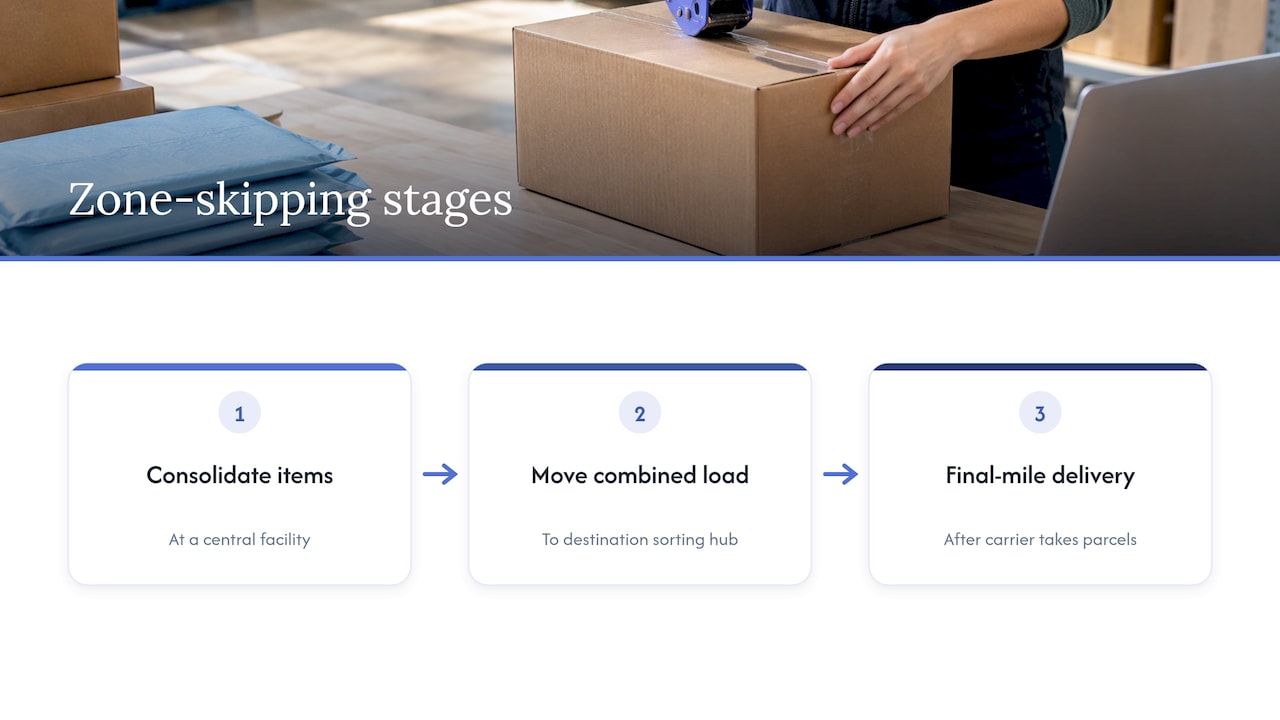
Zone skipping is a shipping tactic, not a carrier product you buy off a shelf. Instead of letting each parcel travel through the carrier’s long-haul network from your warehouse to the customer, you do the long haul yourself, in bulk. Shopify describes it in three stages: consolidating items at a central facility, moving the combined load directly to a sorting hub near the destination zone, and then final-mile delivery once the carrier takes the parcels in.
The tactic goes by other names. You will see “regional injection,” “destination entry,” or “line-haul and induct.” They describe the same idea from slightly different angles: you skip the carrier’s middle zones by paying for that stretch at freight prices.
The reader who benefits most is a business that already ships a steady flow of small parcels to customers spread across the country, usually from one or two origin points. If most of your freight is pallets, a different set of tools applies, and we cover that below.
Why carrier zones make long-distance parcels expensive
Parcel carriers price domestic shipments by zone. A zone is a group of ZIP codes measured by distance from the origin ZIP. Zone 1 or 2 is local or nearby. Zone 8 is the far side of the country. The higher the zone, the higher the rate for the same weight, because the carrier moves your parcel through more sorting hubs, more trucks and more handoffs.
That is why a 2 lb order from a warehouse in Chicago costs far more going to Los Angeles than going to Milwaukee, even though the box is identical. Zone skipping attacks that difference. If the parcel enters the carrier’s network in Los Angeles instead of Chicago, the carrier rates it as a local shipment.
The cost does not disappear. It moves from an expensive per-parcel charge to a shared freight charge. A truck carrying 2,000 parcels spreads its cost across 2,000 boxes. A truck carrying 200 spreads the same cost across a tenth as many.
How zone skipping works, step by step
- Order cutoff and pick. Orders for one destination region are picked and packed at your warehouse or fulfillment center. Packing quality matters here, because the parcels will be handled in bulk. Our guide to cargo damage prevention covers the basics of protecting freight in transit.
- Consolidation. Parcels bound for the same region are sorted together and loaded onto pallets or into trailers, either loose or palletized. Palletizing correctly keeps the load acceptable to the carrier. See our steps to palletize freight for LTL.
- Line-haul. The consolidated load moves by full truckload (FTL) or LTL to a carrier facility near the destination region. At this step you pay a freight rate, not a parcel rate.
- Injection. The load is tendered at the carrier’s destination facility on the carrier’s schedule. Missing the slot is the most common way the plan unravels.
- Final-mile delivery. The carrier sorts the parcels and delivers them as short-zone shipments with a normal tracking number.
We handle steps 1 to 3 as part of our work: warehousing and order fulfillment, plus FTL and LTL transportation to all 50 states. Our 3PL fulfillment services put picking, packing and outbound freight under one roof, which means the parcels and the truck are planned together rather than by two different vendors.
What zone skipping does to cost and transit time
The savings per parcel
Published figures give a sense of scale, but they come from specific programs and lanes, so treat them as examples, not promises. In one national fulfillment network’s 2026 program, a Chicago-to-Los Angeles parcel rated Zone 7 or 8 dropped to Zone 1 or 2 pricing, a difference of $1.80 to $4.20 per parcel depending on weight class. Early pilot data from 140 merchants showed average savings of $2.14 per shipment on standard ground.
Those are gross rate differences on the parcel side. What reaches your bottom line is smaller.
A worked example
Suppose you ship 3,000 parcels a month from one warehouse to a single distant region, and the parcel-rate gap is $2.14 each (the pilot average above, used here only as an illustration). The gross difference is $6,420 a month. If the truck, handling and injection fees to move those parcels to the regional hub cost $4,800, you keep $1,620, or about $0.54 a parcel. If you only have 1,000 parcels for that lane, the gross is $2,140, and a truck that is mostly empty may cost nearly as much as before. The result flips from a saving to a loss.
That is the point FreightWaves made in 2022: savings are not automatic. The combined regional-delivery charges and the shared middle-mile truckload cost have to come in below individual parcel charges, and you need enough volume density to fill the truck.
The time trade-off
Zone skipping can shorten transit because parcels skip several carrier hubs. Shopify notes it can lower costs, shorten transit and reduce the risk of delay or damage by pairing bulk freight with parcel-carrier reliability on the last leg.
The other side is the wait to consolidate. In one program, a 12 to 18 hour hold window meant an order placed Monday evening might not inject until Wednesday morning, adding a day versus a direct ground label. That is usually fine for replenishment items such as supplements or pantry goods. It can trigger complaints for gifts and occasion-driven products, where customers watch the date closely.
For the truck leg, plan realistic freight transit. Our guide to estimating ZIP-to-ZIP LTL transit times explains when to pad one to two days.
Who zone skipping fits
The business profile where it tends to work looks like this:
- Lightweight parcels. Guidance for high-volume ecommerce points to shipments under about 10 pounds, where the parcel zone charge is a large part of the total.
- Concentrated demand. A meaningful share of orders goes to the same few metro regions, so each regional truck fills quickly.
- Steady daily volume. Predictable flow lets you set a fixed cutoff and a fixed truck schedule.
- Tolerance for a slightly later injection. Replenishment and subscription goods fit better than urgent orders.
- Clean data. You know what is on each pallet before it arrives at the hub. Our guide to the advanced shipping notice shows the data levels that make receiving at the other end smooth.
Volume thresholds are falling at some large networks. The 2026 UPS-linked deal lowered the old 50,000-units-per-month enterprise floor, with merchants shipping as few as 2,000 units a month qualifying on eligible lanes. A separate program set a minimum of 500 fulfilled orders per day. These are program rules, not laws of physics. They show that the density question is real and that thresholds differ by program.
Where zone skipping goes wrong
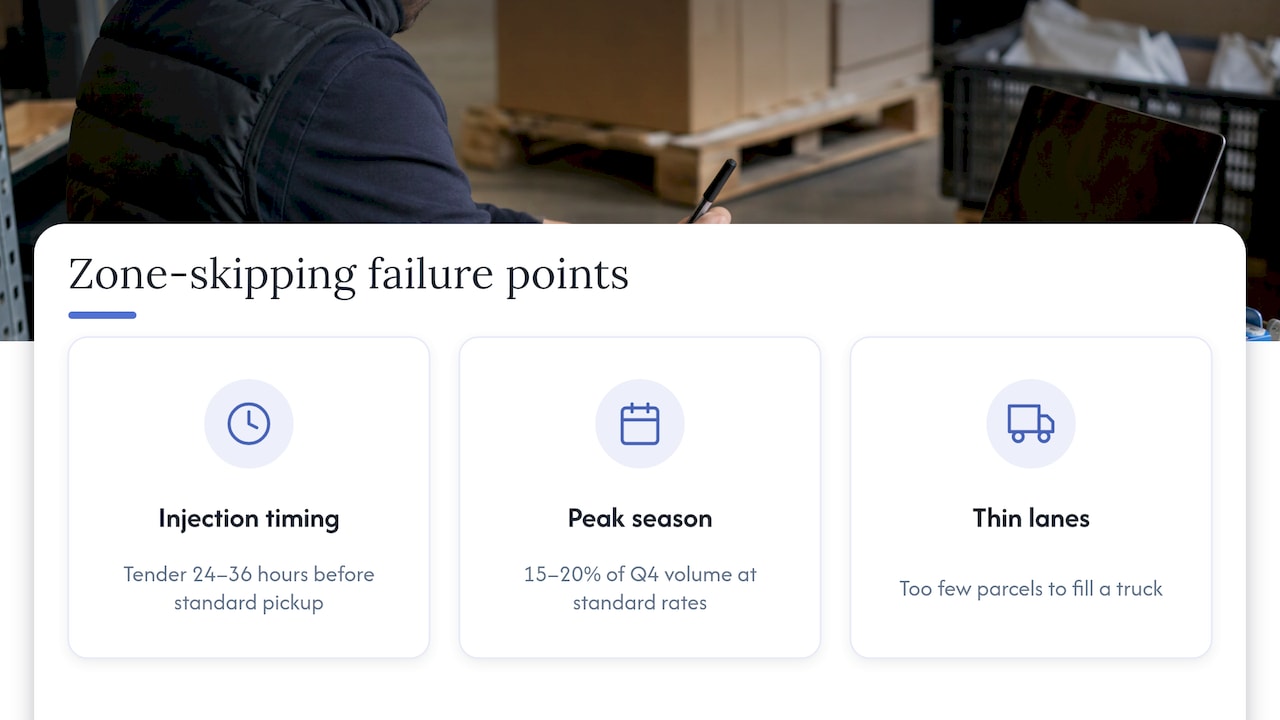
Knowing the failure points is how you make it work. Three come up most.
Injection timing. Parcels must reach the carrier’s injection point on a set schedule. In the UPS-linked deal, tender is required 24 to 36 hours before the standard pickup window, and eligibility depends on throughput commitments at the fulfillment center. A late truck or a slow pick line means the parcel rides at the standard rate.
Peak season. The same source advises merchants to model 15 to 20 percent of Q4 volume reverting to standard zone pricing. Build that into your budget rather than your best case.
Thin lanes. A lane with too few parcels per day either waits too long to fill a truck, which hurts delivery speed, or ships a half-empty truck, which hurts cost. Start only with the lanes where your own order history shows the density.
Two smaller issues also matter. Damage rises when parcels are loaded loose and handled in bulk, so packaging standards need to be firm. And visibility can dip while parcels are on the consolidated truck, because individual carrier scans start only at injection. Knowing why location data goes missing helps you set expectations; our piece on real-time shipment tracking covers it.
Zone skipping compared with the alternatives
Zone skipping is one answer to a single question: how do I stop paying for long-distance parcel zones? There are three other common answers.
| Approach | How it cuts zone cost | What it needs |
|---|---|---|
| Zone skipping / regional injection | Truck parcels in bulk to a carrier hub near the customer | Enough density per lane, a truck schedule, carrier injection access |
| Multiple fulfillment locations | Store inventory closer to customers so parcels ship short from the start | Inventory split across sites, which means more stock and tighter forecasting |
| Direct fulfillment from origin | Ship each parcel the full distance at the carrier’s rate | Nothing extra; simplest when volume is thin |
| Freight consolidation to a warehouse | Move pallets, not parcels, to a regional warehouse, then ship parcels locally | Pallet-level volume and a warehouse in the region |
The terminology gets blurred. Some providers use “zone skipping” and “regional injection” interchangeably. The practical difference is the starting point: zone skipping consolidates parcels that are already packed and labeled, while stocking a regional warehouse moves the inventory first and picks parcels there. The second is often easier to run if your volume to a region is steady, because the parcel is picked close to the customer and never needs a hold window.
For a business with pallet-level inbound volume, forward-positioning inventory is frequently the better-controlled path. Our freight consolidation pilot checklist shows how a small shipper can test consolidation over 60 to 90 days, and our transloading guide covers moving freight between modes at a regional point.
How to test it on your own freight
A pilot gives you real numbers before you reorganize. Follow these steps.
- Pull 90 days of orders. Group them by destination ZIP and zone. Mark the weight bands and the share going to Zones 5 to 8.
- Pick one lane. Choose the region with the most parcels and the highest zone charges. That is where density and savings overlap.
- Price both sides. Get your current per-parcel rate for that lane, then the low-zone rate you would pay at injection, then a freight quote for the truck. Our freight forwarding process walks through the stages from quote to delivery so you can see where each cost appears.
- Compute the break-even. Divide the truck and handling cost by the per-parcel gap. The result is the number of parcels you need per truck. If your lane regularly falls below it, stop here.
- Set cutoffs. Decide when orders close, when the truck leaves and when the carrier accepts tender. Write them down and share them with everyone who touches the freight.
- Run 60 to 90 days. Track cost per parcel, delivery days, damage claims and the share of parcels that missed injection.
- Decide with data. Expand to the next lane, adjust cutoffs or return to direct shipping on the thin lanes.
For first-mile coordination at the origin, see our 30/90/180 first-mile rollout.
Where we fit
Zone skipping depends on three things working together: fulfillment that produces consistent, well-packed parcels, freight that moves on a schedule, and visibility along the way. We offer warehousing, order fulfillment, FTL and LTL shipping, cross-docking, transloading and inventory management across all 50 states, plus real-time tracking, so these pieces can sit with one provider.
Our published warehouse storage rates are $5 to $6 per month per bin and $17 to $19 per month per pallet, and additional services are billed at $37 per hour. The full fee structure is on our pricing page. If you want to see how a regional hold-and-ship plan would work with your own volume, start with our warehousing and fulfillment solutions.
Our view on zone skipping
Most shippers who ask about zone skipping are really asking whether they have enough freight moving the same way. That is the right question, and it is a logistics question before it is a carrier question.
The savings come from filling trucks and keeping cutoffs. Both depend on how your warehouse, your outbound freight and your inventory are run together. When the pick line, the dock and the truck schedule are planned as one flow, a consolidated lane is much easier to hold steady.
That is how we approach it. We bring transportation, warehousing and fulfillment onto one platform, with real-time tracking and personalized service, so a pilot on one lane does not require three vendors to agree on a schedule. Our focus is reliable execution across all 50 states, and a lane test is a sensible way to prove the numbers before scaling.
Start with one lane, one truck schedule and a hard break-even number. If the lane clears it, add the next.
Akbar
FAQ
What does zone skipping mean in shipping?
It means bypassing the carrier’s middle zones by trucking consolidated parcels to a facility near the destination and injecting them there. The carrier then bills each parcel at a low-zone rate. You pay freight prices for the long stretch instead of parcel prices.
Is zone skipping the same as regional injection?
The two terms are used for nearly the same practice, and many providers treat them as synonyms. Both move bulk freight to a carrier entry point close to the customer. Stocking inventory in a regional warehouse and picking parcels there is a related but separate approach.
How much volume do I need for zone skipping to pay off?
It depends on your lane, the truck cost and the rate gap per parcel. Recent large-network programs have set minimums such as 500 orders per day or as few as 2,000 units a month on eligible lanes. Calculate your own break-even by dividing the truck and handling cost by the per-parcel saving.
Does zone skipping slow delivery?
It can go either way. Skipping hubs removes stops, but a consolidation hold and the injection schedule can add up to a day. Replenishment orders tolerate that well, while gift and date-driven orders may not.
What are shipping zones in the U.S.?
Carriers group ZIP codes by distance from the origin into zones numbered 1 to 8 for the continental U.S. Higher numbers mean longer distance and a higher rate for the same package weight.
Sources
- Shopify: Zone Skipping Freight: How It Works and Alternatives
- Ecommerce Times: New zone-skipping program is splitting its merchant base
- FreightWaves: Will new coast-to-coast parcel service strike a shipper chord