
What Is FTL? Full Truckload Shipping Explained
In freight, FTL stands for full truckload. One shipper’s cargo fills, or is paid to fill, an entire trailer, and the truck drives it from pickup to delivery without sharing space with anyone else’s freight. If you searched the term and landed on spaceships, you were not alone: the acronym has several other meanings, covered below. This guide sticks to trucking and shows how FTL works, what drives its price, and how to decide between FTL, LTL and parcel.
TL;DR
- FTL (full truckload) dedicates a whole trailer to one shipper and moves it directly from origin to destination.
- It usually makes sense when your freight fills roughly half a trailer or more, is fragile or high value, or has to arrive on a firm date.
- LTL (less-than-truckload) shares a trailer and routes through terminals. It is cheaper for small loads but involves more handling and more variable transit times.
- Parcel is for boxes, LTL is for pallets, FTL is for loads big enough to justify a truck of their own.
- Price FTL by lane, equipment and timing, then compare quotes on what is covered, not only the rate.
Table of Contents
- What FTL means in shipping
- How an FTL shipment works
- How much fits in a full truckload
- FTL vs. LTL: a choice between networks
- Parcel vs. freight: where the line sits
- When FTL is the right call
- What drives FTL pricing
- Practical tips for shipping FTL
- Our perspective on FTL
- Ship your next load with Universal Shipping
- FAQ
- Sources
What FTL means in shipping
FTL is a freight method in which an entire trailer is dedicated to a single shipper’s cargo and runs directly from origin to destination with minimal or no stops. The goods stay in the same vehicle the whole way. That is the whole idea, and it explains most of FTL’s strengths: fewer touches, a more predictable schedule and less exposure to damage.
“Full” does not always mean the trailer is physically packed. You may fill it by volume (floor space), by weight, or simply because the freight cannot share a trailer for safety, security or timing reasons. You pay for the truck either way.
FTL is a different thing from LTL, where businesses share space with others instead of dedicating a trailer to one shipment.
Other things FTL can mean
If you arrived here by accident, the same letters stand for a lot else. In science fiction, FTL is shorthand for faster than light, the reason a well-known indie space game shares the name. In computing it can mean Flash Translation Layer, the software that manages flash storage, and in biology it is a gene that encodes the ferritin light chain. Context settles it. In a bill of lading, a rate quote or a carrier conversation, FTL always means full truckload.
How an FTL shipment works
The process is simpler than LTL because there are fewer moving parts.
- Request a quote. You give origin and destination, commodity, weight, dimensions or pallet count, pickup and delivery dates, and any accessorial needs such as a liftgate or appointment delivery.
- Equipment is matched. A carrier assigns a truck and trailer type: dry van, refrigerated, flatbed or another type that suits the freight.
- Pickup and loading. The driver arrives at your dock within the pickup window. Your team, or the driver, loads and secures the freight. A bill of lading is signed.
- Direct transit. The truck drives to the consignee. Drivers are limited by hours-of-service rules, so long lanes take multiple driving days, but the freight is not unloaded at terminals.
- Delivery and proof. The consignee receives the load, checks it against the paperwork and signs. Any shortage or damage should be noted on the delivery receipt at that moment.
Because nothing is consolidated, a shipment moving coast to coast is not waiting for other freight to fill a trailer. Delays come from weather, driver hours, dock wait times and traffic, not from terminal sorting.
How much fits in a full truckload
The most common trailer for FTL in the US is the 53-foot dry van. According to a trailer dimensions guide, the interior is about 52 ft 4 in long, 98.7 in wide and 110 in high, holds 26 standard US pallets (48 x 40 in) loaded straight, and carries up to roughly 44,000 lbs of payload within the 80,000 lb federal gross weight limit.
Those are planning numbers, not promises. Actual capacity depends on pallet size, stacking height, axle weight distribution and the specific trailer. Dense freight such as tile or machinery usually hits the weight limit before it fills the space. Light, bulky freight such as consumer goods fills the space first.
| Shipment | Typical fit |
|---|---|
| 1 to a few pallets | LTL or parcel, depending on packaging |
| Roughly half a trailer | Often the crossover zone: compare LTL, partial and FTL quotes |
| 20+ pallets or near the weight limit | FTL |
| Any size, but fragile, high value or on a hard deadline | Consider FTL |
FTL vs. LTL: a choice between networks
The real difference is not truck size. It is the network the freight travels through. LTL carriers move freight through shared terminals with extensive handling, unloading and reloading your pallets along the way. FTL goes direct to the consignee.
| Factor | FTL | LTL |
|---|---|---|
| Trailer | Yours alone | Shared with other shippers |
| Route | Direct, origin to destination | Through terminals and hubs |
| Handling | Loaded once, unloaded once | Multiple touches |
| Transit time | More predictable | Longer and more variable |
| Best for | Large, fragile, high value or time-critical | Smaller pallet shipments |
| Pricing basis | Per truck, by lane and miles | By weight, freight class, distance and accessorials |
That handling difference matters. For fragile items, the higher cost of FTL is often an investment in risk reduction, since it removes the loading and unloading touchpoints built into LTL terminals. For a deeper look at the LTL side, see our guide to estimating ZIP-to-ZIP LTL transit times, and if you are weighing LTL, learn how freight class affects what you are billed.
The crossover point
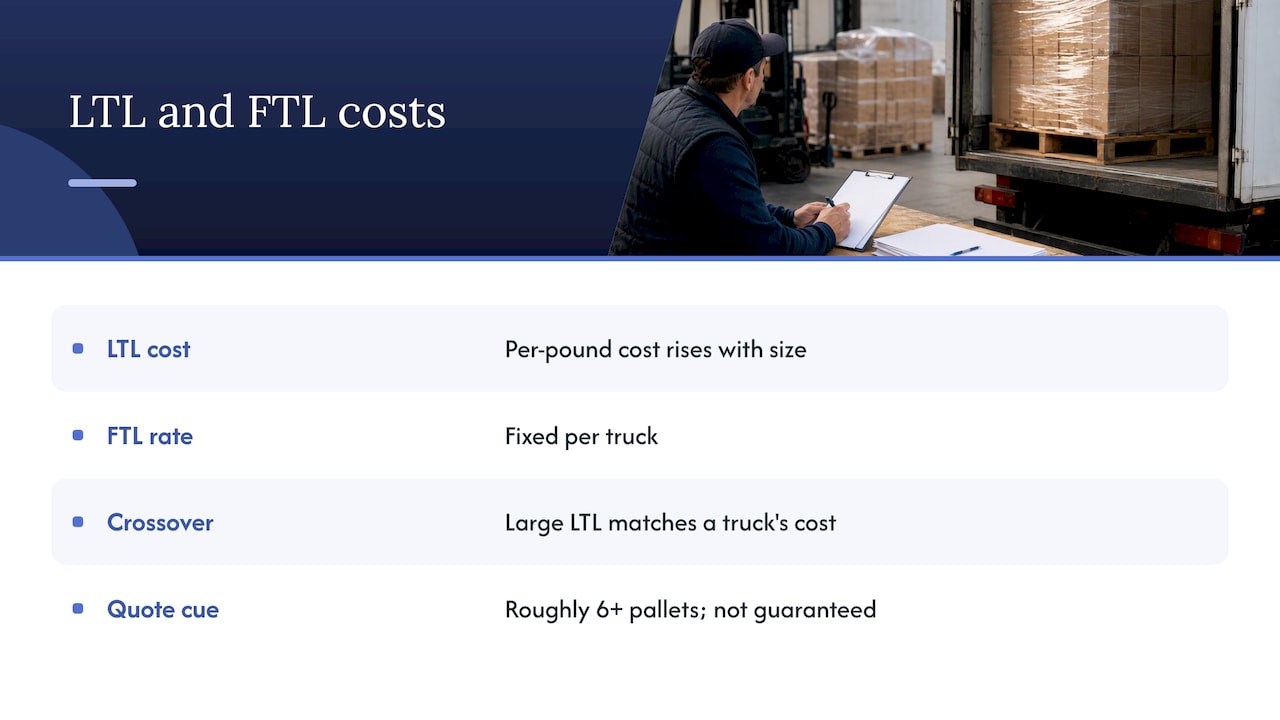
There is no single magic pallet count. As a rule, LTL gets more expensive per pound as the shipment grows, while an FTL rate is fixed per truck. At some point the lines cross, and a larger LTL shipment costs as much as a truck of its own. That is why it is worth quoting both modes when you are at roughly six or more pallets, or several thousand pounds, on a long lane. Often the FTL quote is close enough that faster, safer delivery tips the decision.
Parcel vs. freight: where the line sits
Shippers often ask where parcel ends and freight begins. Parcel networks are built for individual boxes moving through sorting facilities. LTL accommodates large, heavy shipments that do not need a full trailer. Practical signals that you have outgrown parcel:
- Your shipment is on pallets, or heavy enough that per-box charges stack up.
- You are sending many cartons to one destination on the same day.
- Parcel dimensional weight and surcharges make the per-unit cost climb.
Small parcel versus LTL comes down to the same question. A handful of boxes under about 150 lbs usually ships best as parcel. Once the freight is palletized and heavy, LTL is typically the better tool. Pallets need proper packing either way, so see our steps to palletize freight so it passes LTL. And when the load grows past what LTL handles economically, FTL takes over.
When FTL is the right call
Choose FTL when one or more of these is true:
- Volume. The freight fills most of a trailer by space or weight.
- Fragility or value. Fewer touches mean fewer chances for damage or loss. Electronics, glass, furniture and display goods are common examples.
- Time sensitivity. A direct run gives you a delivery window you can plan around, which matters for retail replenishment and production lines. If speed is the real driver, our expedited freight decision matrix helps weigh options.
- Special equipment. Temperature control, flatbeds or oversized dimensions often require a dedicated truck. For loads beyond standard dimensions, read about oversized freight shipping.
- Single destination. A full load going to one distribution center, store or customer is the classic fit.
FTL is a weaker fit for small, scattered shipments to many addresses. There you are paying for empty space.
What drives FTL pricing
FTL is typically quoted as a flat rate for the truck or as a rate per mile. These factors move the number:
- Lane and distance. Miles matter, but so does direction. Trucks leaving a market with few return loads cost more to book.
- Equipment type. Reefers and flatbeds cost more than dry vans.
- Timing and season. Capacity tightens at quarter-end, around peak retail season and during produce harvests.
- Fuel. Usually shown as a surcharge or built into the rate.
- Accessorials. Detention at the dock, liftgates, lumper fees, extra stops and tarps all add charges.
- Market conditions. Spot rates move with supply and demand, while contract rates give you stability.
We do not publish FTL rates, because they depend on lane, equipment and date. A quote is the only accurate number.
Comparing quotes properly
The lowest rate is not always the cheapest outcome. Compare what each quote includes: fuel, accessorials, detention terms, cargo liability limits and insurance. The same principle applies in any service category; this checklist on comparing moving quotes for coverage rather than just price is written for movers in Canada, but the habit of asking what is actually covered transfers well to freight. Ask every provider the same questions, in writing, so the quotes line up.
Practical tips for shipping FTL
- Be accurate about weight and pallet count. Wrong figures lead to re-quotes or a truck that cannot legally carry the load.
- Build loads that are ready. Packing, labeling and paperwork finished before the driver arrives keep you out of detention charges.
- Book early on busy lanes. Last-minute loads cost more.
- Plan the receiving end. Confirm appointment windows, dock hours and unloading equipment with the consignee.
- Consider hybrids. If a container arrives at the port and needs to move on a different trailer, transloading can cut turn time. For imports, our port-to-door timeline and entry checklist shows where a truckload leg fits.
Our perspective on FTL
Most shippers we talk to ask the wrong first question. They ask for the cheapest rate on a mode, when the better question is which mode gives them the lowest total cost once damage, delays and rework are counted. A truckload that arrives intact on Tuesday often beats an LTL shipment that arrives dented on Friday and starts a claim.
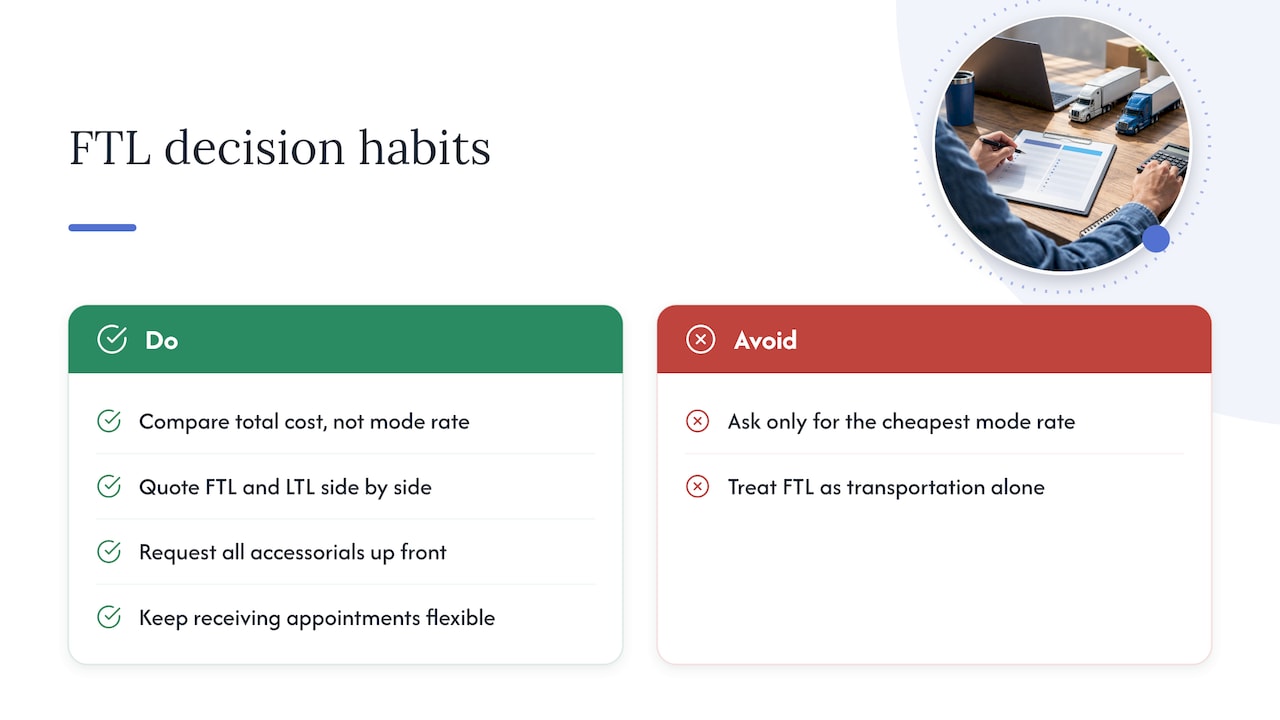
We also see FTL treated as a purely transportation decision. It is not. A full truckload has to be loaded from somewhere and unloaded into somewhere, and the freight is only as ready as the warehouse behind it. That is why we run transportation, warehousing and fulfillment as one connected service rather than three vendors. When pallets are built, labeled and staged ahead of pickup, trucks do not wait, and detention charges do not appear.
Our advice: quote FTL and LTL side by side any time a shipment passes a few pallets, ask for the full list of accessorials up front, and keep receiving appointments flexible. Small habits like these save more than most rate negotiations.
— Akbar
Ship your next load with Universal Shipping
Universal Shipping offers FTL and LTL transportation alongside warehousing, 3PL fulfillment, customs brokerage and last-mile delivery across all 50 states, with real-time tracking. If your freight needs to be stored, prepped or cross-docked before it ships, we can handle both ends. Warehouse storage is published at 5-6 USD per month per bin and 17-19 USD per month per pallet, and additional services are 37 USD per hour; see the full pricing page. For truckload, LTL, air or ocean quotes, start with our freight forwarding services.
FAQ
What does FTL stand for in shipping?
FTL stands for full truckload. It describes a shipment that uses an entire truck trailer for one shipper’s freight, delivered directly from pickup to destination. The freight is not combined with other customers’ goods.
How many pallets make an FTL shipment?
There is no fixed rule. A standard 53-foot trailer holds about 26 US pallets loaded straight, and shipments from roughly half a trailer upward are often quoted as FTL or partial loads. Weight also counts, since heavy freight can reach the trailer’s payload limit with far fewer pallets.
Is FTL cheaper than LTL?
Not for small shipments. LTL is usually cheaper when you ship a few pallets, because you pay only for your share of the trailer. As the load grows, the gap narrows, and for large or fragile freight FTL can match LTL on cost while offering faster, more direct delivery.
Is FTL faster than LTL?
Usually, yes. An FTL truck goes straight to the destination without passing through terminals, so transit is shorter and easier to predict. Driver hours-of-service limits still apply, so long lanes take several days.
What is the difference between parcel and freight?
Parcel moves individual boxes through sorting networks. Freight, meaning LTL and FTL, moves pallets and larger or heavier shipments through terminals or directly by truck. Palletized, heavy or multi-carton shipments generally belong in freight.
Sources
- Trucking Fleet and Operations, Federal Highway Administration
- Parcel vs. LTL Shipping: What’s the Difference? NMFTA
- Meaning of FTL in English, Cambridge Dictionary
- 53 foot trailer dimensions: inside size, weight and pallets