
40 to 80% Higher Warehouse Storage Fees in the U.S., 2026 Benchmarks
Expect typical rates near $20 to $30 per pallet per month for standard dry storage, or roughly $0.45 to $0.70 per cubic foot, but that number is rarely what lands on your invoice. Handling charges and account fees typically push your all-in cost 40% to 80% higher than the storage line alone. Before comparing any two quotes, confirm the billing model and ask for a sample invoice with every accessorial itemized.
TL;DR:
- Handling charges and account fees can increase actual storage costs by 40% to 80% over the base rate, so ask for itemized invoices before comparing quotes.
- Per-pallet billing simplifies budgeting but can lead to overpayment for short pallets, while per cubic foot billing fairly reflects irregularly shaped or low-height loads.
- Cold-chain and hazmat storage are significantly more expensive, adding between 25% and 60% to standard dry storage rates due to specialized utilities and safety measures.
- Volume discounts can reduce per-pallet costs by up to 50% at commitments over 500 pallets, but minimum monthly fees and long-term surcharges may still apply if volume drops.
- Request a detailed, all-in quote that includes every accessorial fee, surcharge trigger date, and sample invoice, especially when evaluating warehouse solutions or renegotiating contracts.
Table of Contents
- Warehouse Storage Fees: Per Pallet, Per Cubic Foot, or Per Square Foot?
- What Drives Warehouse Storage Costs Beyond the Base Rate
- How to Calculate Your All-In Monthly Warehouse Bill
- Storage Type Pricing: 2026 Benchmark Ranges
- Volume Discounts, Minimums, and Long-Term Storage Surcharges
- Practical Ways to Lower Your Storage Costs
- How Usiship Builds Transparent All-In Warehousing Quotes
- Why Most Warehousing Quotes Hide the Real Number
- Get an All-In Warehousing Estimate From Usiship
- Sources
Warehouse Storage Fees: Per Pallet, Per Cubic Foot, or Per Square Foot?
Providers bill storage four main ways, and the model shapes what you actually pay far more than the sticker rate does.
- Per pallet position charges a flat monthly fee per pallet slot, regardless of exact height, up to a defined limit. Simple to budget, but overpaying is easy if your pallets run short.
- Per cubic foot measures actual volume occupied, which rewards dense, well-stacked freight and penalizes air gaps.
- Per square foot applies mostly to bulk floor storage or long-term leases, where footprint matters more than height.
- Per bin fits small-parcel or ecommerce fulfillment, where SKUs sit in shelving rather than on pallets.
Measurement disputes are where budgets go sideways. A pallet stacked two inches over a facility’s 48 inch or 60 inch threshold often gets re-rated to the next height tier or billed as 1.5 pallet positions. Slip sheets, oddly shaped cartons, and non-stackable loads all reduce effective cube utilization and quietly raise your per-unit cost.
If your inventory mix is uniform and stackable, per-pallet billing is usually cleanest. If you run high-mix, low-volume SKUs with irregular dimensions, per-cubic-foot billing tends to reflect the real cost more fairly. Ask any warehouse pricing quote to specify which model applies before you compare it against another.
What Drives Warehouse Storage Costs Beyond the Base Rate
Location moves the needle first. Coastal import gateways like Los Angeles, Long Beach, and the Bay Area run 25% to 45% above inland baseline markets, while hubs like Memphis, Indianapolis, and Kansas City price lower because of cheaper land and easier trucking access. Industrial market reports from firms like Cushman & Wakefield track these regional swings quarter to quarter, which is worth checking before you lock into a multi-year rate.
Storage class adds the next layer of cost.
- Climate-controlled space runs higher due to HVAC load and humidity monitoring.
- Refrigerated and frozen storage carries the steepest premium, driven by compressor energy use and cold-chain compliance labor.
- Hazmat storage requires segregation, ventilation, and specialized permitting.
Cold-chain and hazmat compliance (training, segregation, inspection, and utility overhead) typically adds 25% to 60% to storage rates versus ambient dry storage.
Labor rates, security staffing, general liability insurance, and local property tax pass-throughs round out the difference between two quotes that look similar on paper but land far apart on the invoice.
How to Calculate Your All-In Monthly Warehouse Bill
Storage rate quotes are marketing numbers. The all-in cost is what actually hits your P&L, and it is built from several line items most shippers forget to ask about upfront.
- Base storage charge (per pallet, cu ft, sq ft, or bin)
- Inbound receiving fee (per pallet or per shipment)
- Pallet in/out handling fee
- Pick fee (per unit or per order line)
- Monthly account or administrative fee
- Any minimum monthly charge if volume falls short
- Long-term storage surcharge, if inventory ages past the threshold
The formula is straightforward: add every line item above, divide by total pallets stored, and you get your true all-in $/pallet.
Here’s a worked example for a 100-pallet mid-turn account, using benchmark inputs drawn from published 2026 3PL pricing:
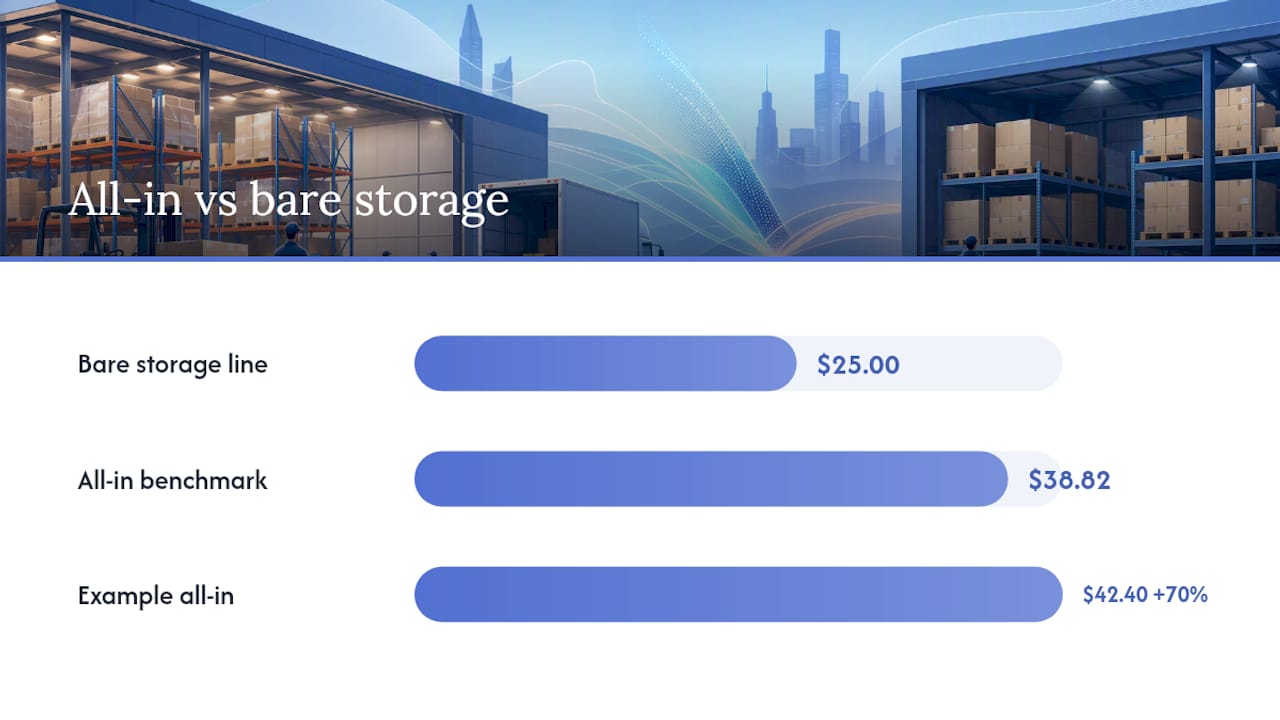
That $42.40 figure sits close to the $38.82 all-in benchmark reported by industry calculators for comparable mid-turn accounts, and it’s roughly 70% above the bare storage line of $25. That gap is the whole reason quote comparisons based on headline rate alone are unreliable.
Storage Type Pricing: 2026 Benchmark Ranges
Rates vary sharply by storage class, and the gap between ambient and cold-chain storage is often the single biggest line-item swing on a warehousing contract.
| Storage type | Per pallet/month | Per sq ft/month (approx.) |
|---|---|---|
| Floor/bulk | $12–$22 | $1.00–$2.50 |
| Dry rack | $20–$30 | $1.50–$3.00 |
| Climate-controlled | $28–$45 | $2.50–$4.50 |
| Refrigerated | $35–$55 | $3.50–$6.00 |
| Frozen | $45–$75 | $4.50–$8.00 |
These national mid-point ranges shift with regional rent multipliers and monthly volume commitments, so treat them as a starting benchmark rather than a quote. Square-foot equivalents also vary widely by market. Extra Space’s industry benchmarking puts general warehouse rent between $1 and $8 per square foot per month depending on climate control, unit size, and local taxes.
The frozen and refrigerated premiums exist because compressor runtime, insulated construction, and continuous temperature logging all cost real money to maintain around the clock, not just during business hours.
Volume Discounts, Minimums, and Long-Term Storage Surcharges
Volume is the single strongest lever you control. Shippers moving from under 25 pallets to 500 or more pallets in the same facility can cut their per-pallet rate by 30% to 50%, since fixed facility costs spread across far more units.
- Sub-25 pallet accounts often pay the full published rate with no discount.
- 100 to 250 pallet accounts typically see 10% to 20% reductions.
- 500-plus pallet commitments can unlock 30% to 50% off list rate, especially with a 12-month term.
Monthly minimums bite hardest for seasonal or slow-moving accounts. If your contract sets a $1,500 monthly floor and you only store $900 worth of pallets in a slow month, you still pay the $1,500.
Long-term storage surcharges are now standard practice. Roughly half of U.S. warehouses apply an aging surcharge, often 1.5 to 3 times the base rate, once inventory sits past 60 or 90 days.
Pro Tip: Ask for the exact aging clock start date in writing. Some providers count from receipt date, others from the first day of the following month, and that difference can add a full billing cycle of surcharge exposure you didn’t budget for.
Practical Ways to Lower Your Storage Costs
Cutting your warehousing bill starts with the freight itself, not the contract terms.
- Optimize cube utilization. Denser stacking and standardized pallet heights reduce the number of billable positions you need.
- Consolidate slow SKUs. Merging low-velocity items onto shared pallets cuts wasted positions.
- Improve slotting. Faster-moving SKUs near dock doors reduce pick labor, which often shows up as a separate line item.
- Reduce dwell time. Faster inventory turns mean less exposure to long-term storage surcharges.
- Push for capped accessorials. Negotiate a ceiling on pallet in/out and pick fees rather than accepting open-ended per-unit pricing.
- Lock in volume tiers with clear exit terms. A discount tied to volume should include a clause for what happens if your volume drops.
Before signing anything, request an RFP that specifies the exact billing unit, height thresholds before re-rating, the long-term storage surcharge trigger date, and a sample invoice showing every accessorial charged in a typical month.
Pro Tip: A tool like a shipping cost reduction guide can help you spot packaging and consolidation savings that reduce your billable footprint before you ever renegotiate a warehousing rate.
How Usiship Builds Transparent All-In Warehousing Quotes
Most warehousing disputes trace back to a quote that only showed the storage line. Usiship structures warehouse solutions to itemize receiving, handling, picking, and account fees upfront, so the number you approve is close to the number you’re billed. Real-time inventory visibility also flags aging stock before it crosses a long-term surcharge threshold, which matters given how common those surcharges have become across the industry.
For shippers weighing whether to lease their own space or outsource entirely, Usiship’s 3PL versus in-house comparison walks through the occupancy cost math side by side with per-unit storage pricing. If you want a benchmarked, all-in estimate for your specific pallet mix and volume, that’s a conversation worth having before your current contract renews.
Why Most Warehousing Quotes Hide the Real Number
The dirty secret of warehouse pricing is that the base rate is often the least important number on the page. I’ve seen shippers chase a $2 per pallet discount on storage while ignoring a picking fee structure that added $15 per pallet in effective cost. That’s backwards.
The real skill in evaluating a warehousing contract isn’t finding the lowest headline rate. It’s forcing every provider to quote in the same units, on the same sample volume, with every accessorial and surcharge trigger written into the number before you sign. Providers that resist showing you a full sample invoice are usually the ones whose accessorials do the most damage.
Volume commitments get oversold, too. The contract term that actually protects you is the exit clause, not the discount tier.
— Akbar
Get an All-In Warehousing Estimate From Usiship
Usiship gives you one place to see storage, handling, and fulfillment costs together instead of piecing together separate vendor quotes and hoping the numbers add up.
If you’re comparing 3PL quotes right now, the fastest way to catch a hidden accessorial is to request a sample invoice built around your actual pallet count and turn rate, not a generic rate sheet. Usiship’s warehouse solutions team builds that estimate using your real SKU mix, including specialized categories like furniture and oversized freight that often get mispriced under standard pallet formulas. Request a benchmarked, all-in quote today and find out whether your current storage bill is actually competitive or just familiar.