
Warehouse Slotting Strategies: How to Choose and Maintain One
Warehouse slotting is the practice of deciding which SKU lives in which storage location. The best strategy for most operations is a velocity-based ABC layout with a forward pick zone and a reserve zone. Add affinity grouping once your order data is clean, and review the plan every quarter. This guide shows how each approach works, when it fits, what data it needs and how to roll it out without stopping your floor.
TL;DR
- Start with ABC or velocity slotting: put the fastest-moving SKUs in the most accessible, lowest-travel locations and let slow movers sit farther away.
- Separate forward pick locations from bulk reserve storage so pickers walk less and replenishment happens on a schedule.
- Add affinity grouping and dynamic re-slotting only when your order-line data is accurate and your demand shifts often.
- Pilot one high-impact zone, measure travel and lines per hour before and after, then expand.
- Re-check the plan at least every 3 to 6 months, and sooner after a peak season, a big product launch or a layout change.
Table of Contents
- What slotting actually decides
- The main slotting strategies and when each fits
- Data you need before you move anything
- Step-by-step: build a slotting plan
- What results to expect
- Common slotting mistakes
- How often to re-slot
- Slotting and storage cost
- Perspective
- Let us handle slotting for you
- FAQ
- Sources
What slotting actually decides
Slotting assigns each SKU to a specific location based on how it moves, how big and heavy it is, and what the storage rules allow. One definition of slotting optimization describes it as weighing several cost elements together, not just picker travel, while still meeting service, safety and storage constraints.
That last point matters. A layout that cuts walking but creates ladder picks, congested aisles or constant replenishment has only moved the cost somewhere else. A good slotting plan treats travel, handling, replenishment, safety and space as one problem.
Slotting also differs from layout design. Layout decides where racks, aisles and docks go. Slotting decides what goes in them. If you are still deciding the building flow, read our guide on warehouse layout design first, then come back here.
The main slotting strategies and when each fits
Most operations combine two or three of these. The table summarizes them, and the sections below explain the trade-offs.
| Strategy | How it works | Best fit | Watch out for |
|---|---|---|---|
| ABC slotting | Rank SKUs by activity, give A items the best locations | Most warehouses with a clear 80/20 pattern | Rankings go stale as demand changes |
| Velocity-based | Place high-volume SKUs closest to packing or shipping | High-volume pick operations | Temporary spikes can distort placement |
| Affinity grouping | Store SKUs that appear on the same orders together | Orders with several lines, kits, bundles | Can create aisle congestion |
| Forward and reserve | Small pick quantities up front, bulk behind | Anything with replenishment from pallets | Needs disciplined replenishment |
| Static, random, dynamic | Fixed, open-slot or changing locations | Depends on SKU count and turnover | Static ages fast, random needs a WMS |
ABC slotting
ABC slotting ranks SKUs by how often they are picked. A items are the small share of SKUs that drive most activity, B items sit in the middle, and C items are the long tail. The basic rule from one operations consultancy is that the fastest movers go in the most accessible spots while slow movers can live somewhere less convenient.
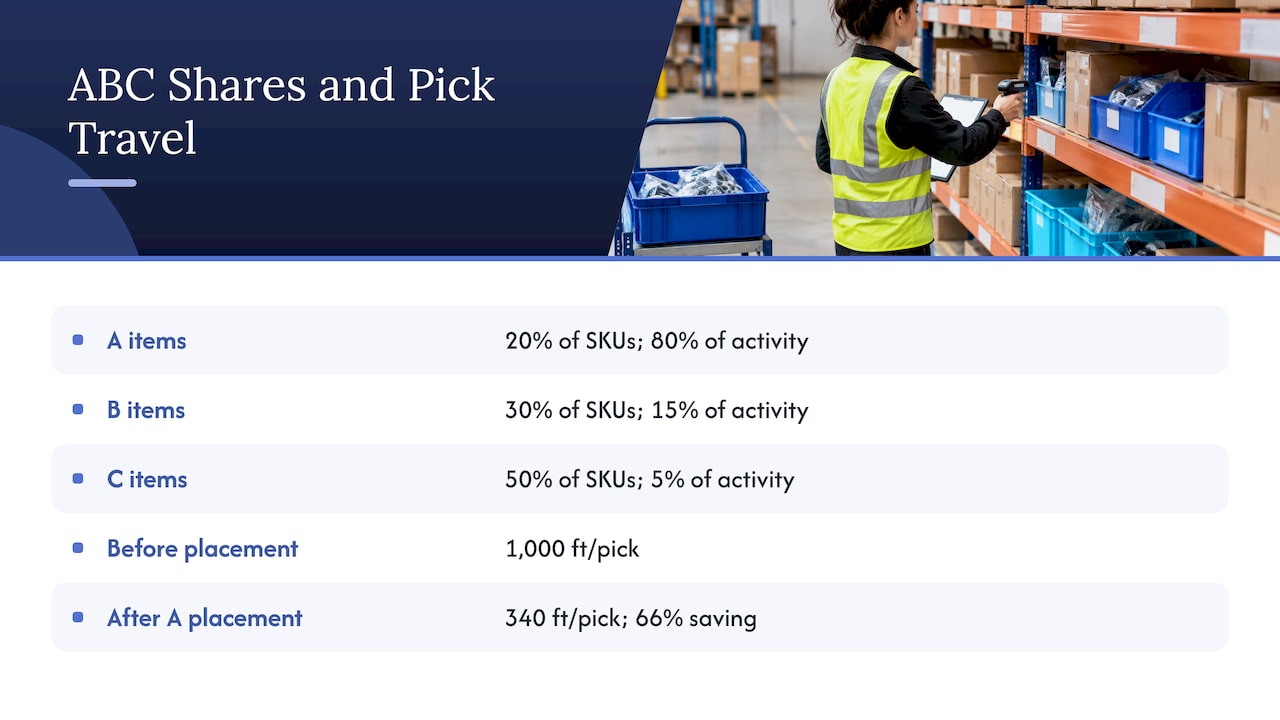
A worked example shows the effect. In one published ABC illustration, A items are 20% of SKUs and 80% of activity, B items 30% and 15%, and C items 50% and 5%. Placing the A items in premium locations cuts average pick travel from 1,000 feet to 340 feet per pick, a 66% saving. Treat that as an illustration of the logic, not a promise for your building, because your result depends on your layout and mix.
The weakness is age. ABC rankings can become outdated as demand changes, so the ranking needs a refresh schedule. Our piece on ABC inventory analysis for 3PL operations covers how each class needs different handling rules.
Velocity-based slotting
Velocity slotting is ABC with a finer grain. Instead of three buckets, you sort SKUs by picks per period and place the highest-volume ones in the most accessible locations, often near packing or shipping. The same guide notes that temporary demand spikes can distort placement, so use a window long enough to smooth out a one-week promotion.
A practical approach: use 90 days of order-line history for stable catalogs, and a shorter window plus a seasonal forecast for fast-changing ecommerce catalogs.
Affinity grouping
Affinity slotting places SKUs next to each other when they often appear on the same order. A phone case and a screen protector are the standard example. It shortens multi-line picks, but clustering can cause aisle congestion when several pickers want the same area at once. Spread high-volume SKUs across aisles even when they are related, and apply affinity mainly to mid-velocity items.
Forward and reserve slotting
This strategy splits storage by job. Forward locations hold small, accessible quantities of high-velocity SKUs for picking. Reserve areas hold bulk inventory in dense storage and feed the forward zone through replenishment. Hopstack’s overview describes this split as separating picking from replenishment.
Size the forward slot to the right quantity. Too small and replenishment trips multiply. Too large and you waste your best real estate on stock that could sit in reserve.
Static, random and dynamic slotting
St. Onge describes three types. Static slotting gives each product a permanent location and generally suits warehouses with few high-turnover products. Random slotting stores SKUs wherever space is open. Dynamic slotting lets locations change, with a WMS assigning temporary locations when demand for a SKU exceeds the space in its normal slot.
For a small catalog with stable demand, static slotting with a quarterly review is plenty. For thousands of SKUs and seasonal swings, you will want a WMS that supports dynamic moves.
Data you need before you move anything
Slotting without data is guessing with extra labor. The Synkrato guide lists the inputs a slotting analysis should cover:
- Order-line data: SKU, location, order ID, quantity and timestamp.
- Product data: dimensions, weight, stackability and handling class.
- Inventory: on-hand and reserve quantities, replenishment frequency and lead time.
- Demand: history, forecast and variability.
- Hard constraints: slot dimensions and usable cube, storage media limits, reach or handling method, and temperature, hazard or lot restrictions.
Pick-face capacity belongs on that list too. If a pick face is too small for the SKU’s demand, it triggers constant replenishment no matter how well it is placed.
Weight and handling rules are not optional. Heavy items belong at waist height, and pallet loads must be stacked within your rack and safety rules. Our checklist on pallet stacking rules for OSHA audits is a useful companion when you decide what can go where.
Step-by-step: build a slotting plan
- Set a baseline. Record travel distance per order, lines picked per hour, pick accuracy by zone and replenishments per week. One of the common mistakes is having no measurement baseline, which leaves you unable to prove the change worked.
- Clean the item master. Fix missing dimensions and weights. Bad master data produces confident but wrong recommendations.
- Rank your SKUs. Pull order lines for a representative period, rank by picks, and group SKUs into velocity bands.
- Divide the floor into zones by accessibility. The golden zone near packing and at easy reach height gets the A items. Warehouse Cubed outlines this same sequence: analyze velocity, order profiles, dimensions and weight, band the SKUs, then zone the floor by accessibility.
- Assign locations. Match each band to a zone, then apply constraints: weight, cube, hazard and pick-face capacity.
- Pilot one zone. Move only the top movers first. The same source on dynamic slotting mistakes warns against moving too many SKUs at once and suggests starting with the top 20% of velocity movers.
- Schedule moves off-peak. Moving stock during peak hours is another listed mistake. Do it on a slow shift or weekend.
- Update the WMS as items move. A physical move that is not recorded in the system creates inventory errors that cost more than the travel you saved.
- Compare against the baseline and expand to the next zone.
A two-week trial works well for this kind of change. Our guide to a two-week pick and pack pilot shows how to structure the measurement.
What results to expect
Results vary widely, and published figures come mostly from vendors and consultants, so use them as ranges for planning, not targets. Areté Inc. reports that previously unoptimized operations often see a 10 to 25% improvement in lines picked per labor hour after reslotting. The metrics it suggests tracking are travel distance per order, damaged goods rate by location, pick accuracy by zone and cycle count discrepancy by location.
The gains come from three places: fewer steps, fewer handling events that cause damage, and pickers finding products where they expect them. Those are the same reasons a team on the floor will feel the change within a week or two.
Common slotting mistakes
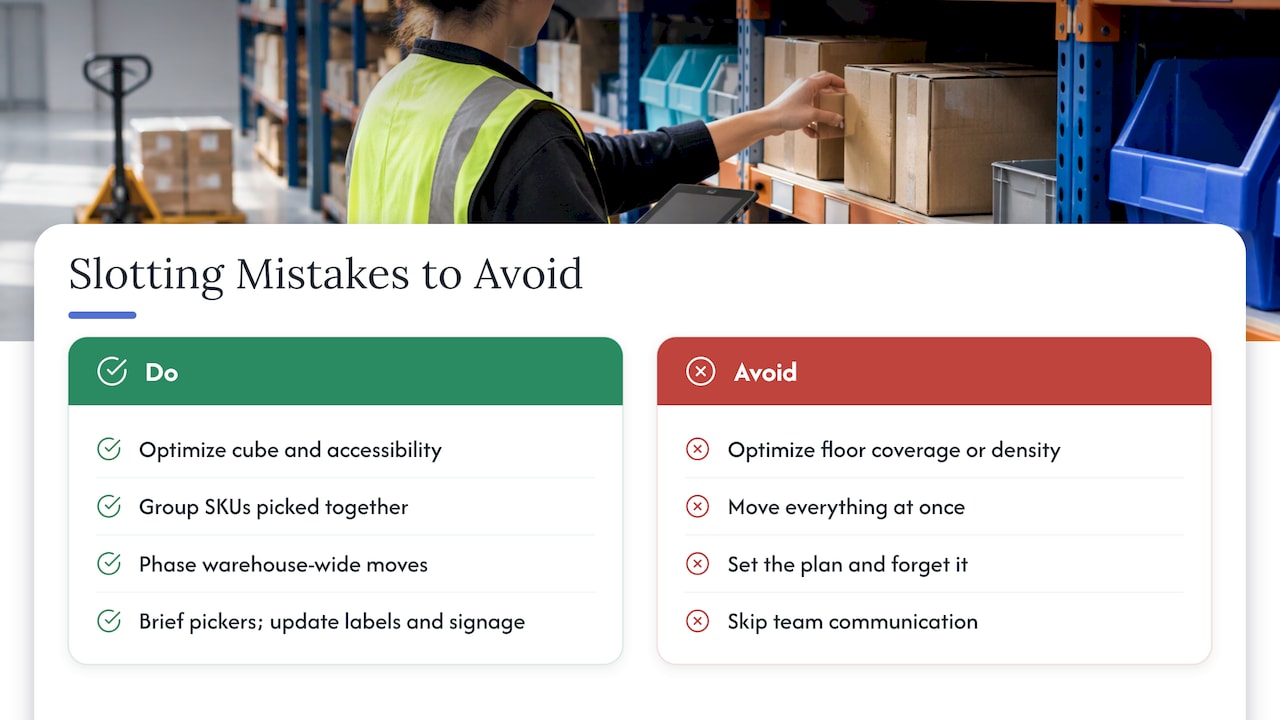
Measuring the wrong thing. Reynolds Business Systems warns about optimizing for floor coverage or density instead of cube and accessibility. The result is honeycombing, which means empty space that cannot be used. It also notes that forcing pickers into reserve storage, onto ladders or waiting for forklifts can add 25% or more to pick time.
Ignoring co-pick affinity. Two fast SKUs at opposite ends of the building can cancel out the benefit of putting each in a good spot.
Moving everything at once. A warehouse-wide big bang disrupts picking and hides what worked. Phase it.
Setting and forgetting. A plan built in January can drift by peak season, especially with static slotting. Which brings us to review frequency.
Skipping the people side. Pickers who were not told why the product moved will keep walking to the old spot. Brief the team, update labels and signage, and give a few days of support.
How often to re-slot
A sensible default is every 3 to 6 months. Apex Warehouse Systems recommends examining the slotting strategy at that interval at a minimum, using sales forecasts with historical data and seasonal expectations, and reviewing again after major warehouse events. It also suggests watching A and B mover pick-location availability monthly, or weekly if needed, and watching C and D pick hits monthly for possible promotion.
An EPG slotting white paper takes a similar view: update the dataset after up to six months, then repeat the assessment, and only implement bin-location changes when the gain outweighs the current setup.
A simple cadence for an ecommerce operation:
- Weekly: check that A-item pick faces are not empty.
- Monthly: scan C items for any that have started to move.
- Quarterly: rerun the full velocity ranking and decide on moves.
- After events: re-slot following peak season, a large product launch, a new client or a rack change.
Slotting and storage cost
Slotting also affects what storage costs you. Dense reserve storage uses cube efficiently, while forward pick locations trade density for speed. Knowing which pallets and bins really need to occupy premium space helps you control spend. For market context, see our analysis of US warehouse storage fees. If your inventory is spread across regions, distributed warehousing adds a second slotting question: which SKUs to stock where.
Perspective
Most slotting projects we see fail for a plain reason: the plan is sound but nobody owns it after the first month. Moves get made, the system is not updated, and the ranking quietly ages.
Our view is that slotting should be part of how a fulfillment operation runs, not a project. That is why we build it into the way we integrate transportation, warehousing and shipping on one platform. When receiving, storage, picking and outbound sit in the same system, the data you need for slotting is already there: order lines, velocity, dimensions and location history.
For a growing brand, we would start small. Pick the 20% of SKUs that drive most of your orders, give them the best locations, and measure for two weeks. If the numbers move, extend the approach. If you outsource fulfillment, ask how your provider reviews locations, and expect a quarterly rhythm with a faster check for seasonal peaks.
Our goal is to make that rhythm routine, so you get faster picks and cleaner inventory without running a slotting project yourself.
Akbar
Let us handle slotting for you
If you would rather not run slotting in-house, our warehousing and fulfillment solutions cover receiving, storage, picking, packing and returns across the US, backed by real-time tracking. Published storage rates start at $5 to $6 per bin per month and $17 to $19 per pallet per month, and additional services are $37 per hour. Other fulfillment fees are on our pricing page.
Tell us your SKU count, order profile and where your stock sits now, and we will show you how we would slot it.
FAQ
What is the easiest slotting strategy to start with?
ABC slotting. Rank your SKUs by pick frequency, put the top group in the most accessible locations near packing, and leave slow movers farther away. It needs only order history and basic item dimensions, and you can pilot it in a single zone in a couple of weeks.
How often should I re-slot my warehouse?
Review at least every 3 to 6 months, and after major events such as peak season or a large product launch. Fast-changing operations like ecommerce may check monthly for A and B item availability and rerun the full ranking each quarter.
What data do I need for slotting optimization?
Order-line history with SKU, quantity and timestamp, plus product dimensions, weight and handling class. Add on-hand and reserve inventory, replenishment lead times, demand forecasts and hard limits such as slot size, hazard or temperature rules.
What is the difference between forward and reserve slotting?
Forward locations hold small quantities of fast-moving SKUs within easy reach for picking. Reserve locations hold bulk stock in dense storage and replenish the forward zone. The split cuts walking for pickers and keeps your best locations for items that move.
Can a small warehouse benefit from slotting?
Yes. Even a modest layout benefits from putting top movers within easy reach and keeping related items close. Start with a spreadsheet of picks per SKU and one pilot zone, then add software when the catalog or order volume outgrows manual review.
Sources
- The Complete Guide to Warehouse Slotting Optimization
- The Case for Smarter Warehouse Slotting
- Know Your ABCs
- Warehouse Slotting Optimization with WMS
- Slotting to Optimize Warehouse Operations
- What is slotting optimization
- Dynamic Slotting in Warehouse Management
- Warehouse Storage Optimization: Best Practices Guide
- Strategic Warehouse Slotting
- Slotting white paper