
Fix ASN Errors First: Vendor Compliance Chargebacks for U.S. Vendors
A vendor compliance chargeback is a deduction a retailer takes from your invoice when a shipment violates its routing guide, whether that is a missing ASN, a mislabeled carton, or a late delivery window. It hits your margin immediately and follows you into future scorecards and order volume. If you have a PO open right now, stop and pull up its routing guide to confirm the ASN, appointment, and labeling requirements before you book the load.
TL;DR:
- Most chargebacks result from ASN errors, labeling violations, timing issues, or routing discrepancies, which can quickly escalate costs through automated deductions.
- Retailer portals and published standards require vendors to follow strict guidelines on documentation, labeling, palletization, and carrier selection, often changing without notice.
- Implementing ASN preflight validation and daily exception reporting significantly reduces the risk of automated chargebacks and improves compliance with routing guides.
- Disputing wrongful chargebacks effectively depends on timely evidence collection, clear documentation, and understanding each retailer’s specific dispute window conditions.
- Outsourcing logistics to integrated providers helps vendors meet compliance standards more consistently and limits failure points that cause costly deductions.
Table of Contents
- What routing guides and supplier standards actually require
- How a chargeback moves from shipment to remittance
- Major U.S. retailer programs and where their rules live
- The violations that generate most chargebacks
- Mapping your PO-to-chargeback process inside your own systems
- Preventive controls that cut chargebacks before they happen
- Disputing a chargeback and recovering the deduction
- How an integrated logistics partner removes common failure points
- What chronic chargebacks do to the retailer relationship
- Negotiating chargeback terms before you sign anything
- Software and systems that cut the manual chargeback workload
- What the data actually tells vendors to prioritize
- How Universal Shipping supports vendors managing compliance risk
- FAQ
- Sources
What routing guides and supplier standards actually require
A routing guide is the retailer’s rulebook for how freight must move from your dock to theirs. It specifies carriers, appointment windows, labeling formats, pallet dimensions, and electronic documents you must transmit before and after shipment. Most large U.S. retailers treat acceptance of a purchase order as acceptance of these standards. Walmart’s supplier requirements state plainly that accepting a PO or supplying merchandise means you have accepted the retailer’s published standards, chargebacks included.
These guides typically cover:
- EDI transaction sets and ASN accuracy, including carton counts, weights, and ship dates.
- Barcode and label placement, often tied to GS1 standards and UCC128 case labels.
- Pallet specifications: height limits, stacking patterns, and blocking or bracing rules.
- Appointment scheduling windows and the carriers you are authorized to use.
Retailers publish these rules on supplier portals. Walmart’s version lives inside Retail Link, where vendors can also research chargeback status after the fact. Foot Locker and most other national chains maintain similar vendor portals with compliance contacts listed directly in their vendor standards manuals. The practical lesson is that these documents change often, and the version you read during onboarding may not be the version enforced on your next shipment.
How a chargeback moves from shipment to remittance
Every chargeback follows a predictable chain of events, and understanding that chain is the fastest way to find where your process breaks down.
- The retailer issues a PO, which legally binds you to its routing guide the moment you accept it.
- You book the shipment, select a carrier, and schedule a delivery appointment according to the guide’s rules.
- You generate and transmit an ASN before the goods ship, matching carton counts, weights, and GTINs to the PO.
- The carrier delivers to the appointment window, and the retailer’s dock performs a receiving inspection.
- Any mismatch, whether in quantity, timing, labeling, or documentation, gets logged during that inspection or during a later audit.
- The retailer posts the chargeback against your remittance, usually visible in the vendor portal within days to a few weeks.
Large retailers automate most of this through EDI and portal rule engines, which means a single missing ASN field can trigger a deduction with no human review. Dispute windows are often tight, sometimes 30 to 90 days depending on the retailer’s own terms, so the clock starts the moment the chargeback posts.
Major U.S. retailer programs and where their rules live
Walmart and Foot Locker represent two different but instructive models for how retailers structure compliance enforcement, and both publish the specifics vendors need.
- Walmart ties chargeback research directly to Retail Link, and its supplier requirements page confirms that PO acceptance equals standards acceptance, with no separate signature required.
- Foot Locker’s Vendor Compliance Program publishes an actual chargeback code table inside its vendor standards manual, listing specific violations alongside dollar amounts.
- Most national retailers structure their portals around a scorecard, a routing guide, and a chargeback code lookup, so the same three-part structure repeats across chains even when the dollar figures differ.
Foot Locker’s published chargeback table lists per-occurrence fines such as $6.25 per carton or a $250 minimum for a missing UCC128 label, with per-unit barcode violations charged separately. That kind of granularity means small labeling mistakes compound fast across a large shipment.
The violations that generate most chargebacks
Most chargebacks trace back to a short list of recurring failures, and knowing them lets you build targeted checks instead of generic ones.
- Timing and OTIF violations: missing an appointment window or delivering outside the on-time, in-full standard, which many retailers now track as a scorecard metric rather than a one-off fine.
- Quantity and fill-rate shortages: shipping less than the PO specifies without a reconciled pick confirmation, which creates a mismatch the receiving dock will flag.
- ASN and EDI errors: a missing ASN, or one with incorrect carton counts, weights, or ship dates relative to the PO.
- Labeling and barcode errors: GS1-noncompliant UPCs or UCC128 case labels that scanners cannot read at receiving.
- Packaging and palletization violations: wrong carton counts per pallet, excessive pallet height, or inadequate blocking and bracing that shifts in transit.
- Routing and carrier violations: booking an unauthorized carrier or requesting a routing method the guide does not allow for that PO.
- Documentation errors: a missing packing slip, an incorrect bill of lading, or an invoice that does not match the ASN quantities.
Pro Tip: Build a single checklist that walks a shipment through ASN, label, pallet, and carrier checks in that order, since each stage depends on the one before it.
Mapping your PO-to-chargeback process inside your own systems
A practical way to find your weak points is to walk a single PO through your own ERP, WMS, and TMS and log where each handoff happens.
- Confirm pre-onboarding basics are current: your GS1 company prefix, item GTIN setup, and portal access with signed MSA or BTA acknowledgments on file.
- Run an order acceptance check that confirms routing instructions and any special handling notes attached to the PO.
- Verify carrier selection against the approved list and lock in the appointment according to the retailer’s scheduling rules.
- Create the ASN, validate it against the PO before transmission, and capture a timestamp along with final carton and pallet counts.
- Reconcile receiving results once the shipment lands, including proof of delivery, inbound audit notes, and any electronic receipt flags.
- After remittance, log every chargeback with a root cause and assign a corrective action so the same failure does not repeat on the next PO.
This sequence turns chargebacks from a surprise deduction into a traceable event you can audit and improve, PO by PO.
Preventive controls that cut chargebacks before they happen
Most of the fixes here are organizational, not technical, which makes them achievable even for smaller vendors without a large compliance team.
Start by assigning a single routing guide owner whose job is to monitor portal bulletins and version changes. Routing guides are living documents, and a vendor without a dedicated owner is the one who gets caught by a rule that changed two months ago. From there, build in EDI and ASN preflight validations that automatically reject an ASN when carton counts, pallet counts, or GTINs do not match the PO, which removes the single most common automated trigger for chargebacks.
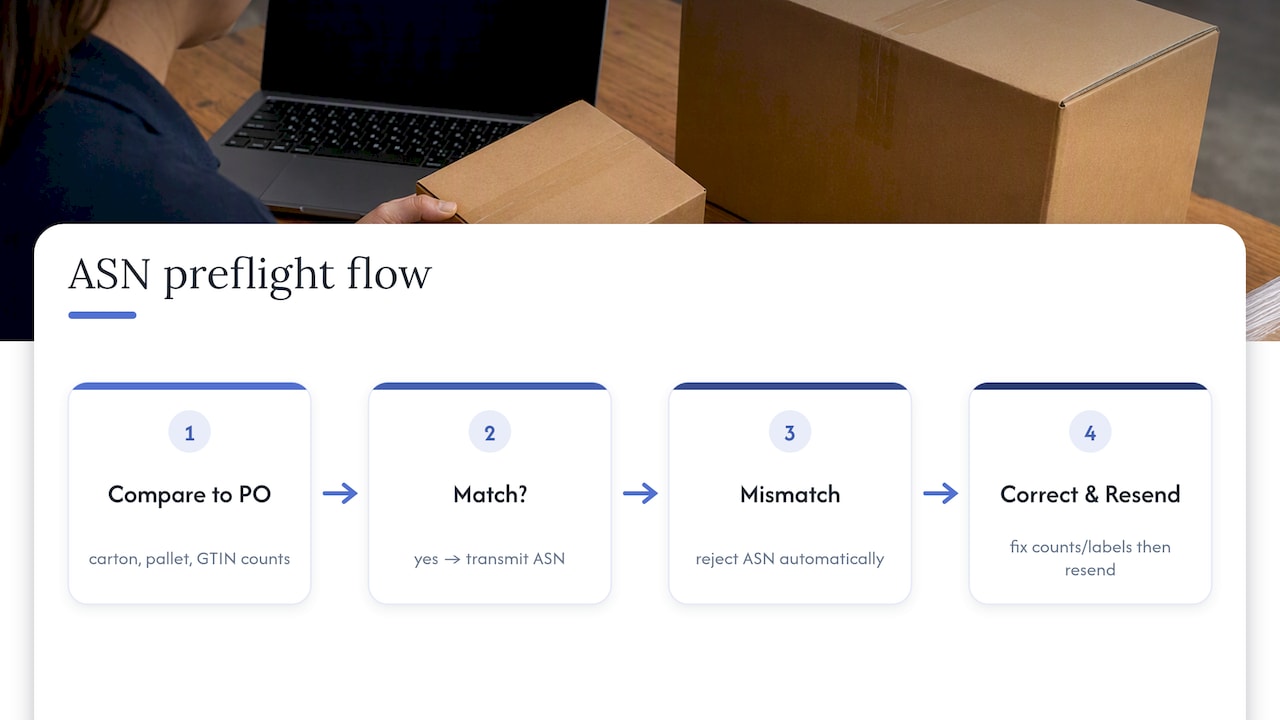
Add a labeling QC step at the pack station, including a barcode verification scanner and a sample scan on a percentage of cartons before they leave the floor. Pallet-level controls matter just as much: a standard palletization template with height limits, strapping checks, and a ramp inspection before the load leaves your dock catches the packaging violations that routing guides fine most heavily.
Carrier governance closes the loop. Keep an approved-carrier list tied to each retailer’s routing guide, with a confirmation window for appointment bookings and a clear internal penalty if a team books outside that list. Finally, run exception reports daily rather than monthly. A daily fail report that flags missed ASNs, late appointments, or label rejections lets you fix the cause within 24 hours instead of finding out at remittance.
Pro Tip: Review your chargeback log on a 30/60/90-day rhythm so the same root cause never shows up in two consecutive quarters.
Disputing a chargeback and recovering the deduction
Most retailers give vendors a defined window to dispute a chargeback, often stated in the portal’s terms rather than the routing guide itself, so check both before assuming you missed it.
- Pull the chargeback notice and confirm the claim ID, the PO number, and the exact code the retailer cited.
- Gather the evidence that actually supports your case: the ASN as transmitted, the bill of lading, proof of delivery, carrier booking confirmations, and the appointment confirmation.
- Write a short explanation that ties each piece of evidence to the disputed code, rather than a general objection.
- Submit through the retailer’s dispute portal with every document linked to the claim ID, not attached loosely.
- Escalate when a deduction is wrongful and repeats across multiple POs, or when the dollar amount is high enough to justify a formal review, and raise suspected uneven enforcement with reference to FTC guidance on proportional treatment if the pattern looks discriminatory.
Documentation discipline is the difference between a dispute that gets reviewed quickly and one that sits for weeks. A freight claims playbook built around linked evidence rather than scattered files shortens that review cycle considerably.
| Evidence type | What it proves | Where it comes from |
|---|---|---|
| ASN as transmitted | Shipment matched the PO before it left your dock | Your EDI system |
| Bill of lading | Carrier and routing used matched the guide | Carrier paperwork |
| Proof of delivery | Appointment was met and goods were received | Carrier or retailer dock |
| Receiving inspection notes | What the retailer actually found on arrival | Retailer portal |
How an integrated logistics partner removes common failure points
Vendors who outsource the operational layer tend to avoid the failures that generate most chargebacks simply because the process is standardized rather than improvised per shipment. An integrated logistics partner builds ASN and EDI transmission, palletization SOPs, and denied-party screening into the shipping workflow itself, rather than leaving each step to whoever is on the dock that day.
- ASN and EDI handling is built to match PO data before transmission, addressing a common automated chargeback trigger.
- Palletization follows a fixed SOP for carton counts, height, and bracing, addressing common chargeback causes.
- Denied-party screening on the front end helps prevent shipment holds that cascade into missed appointment windows.
- Proof-of-delivery and claims documentation are consolidated during transit, following the same evidence structure described in Universal Shipping’s freight claims playbook, so dispute packets assemble faster when something does go wrong.
What chronic chargebacks do to the retailer relationship
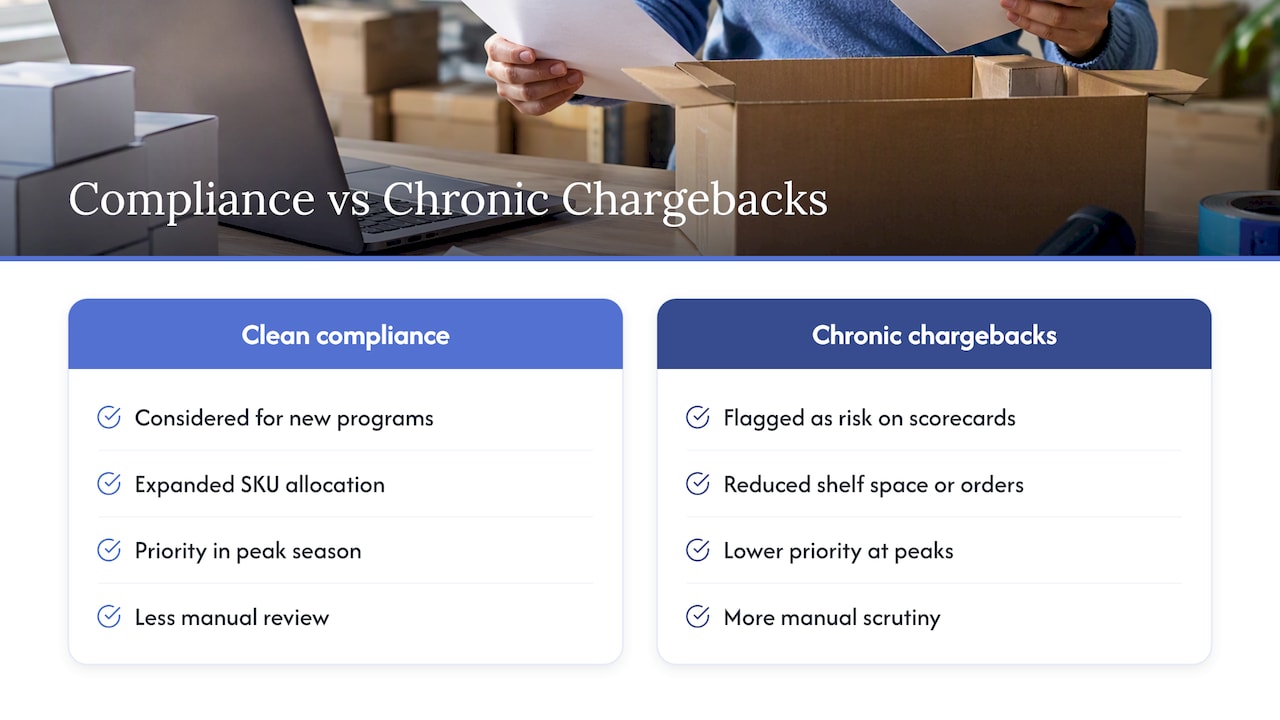
A single chargeback is a line-item cost. A pattern of them is a signal the retailer reads as risk, and that signal follows you well past the invoice. Most large retailers fold chargeback frequency directly into supplier scorecards, and a scorecard is what buyers reference when they decide how much shelf space or order volume to allocate next season.
The damage compounds quietly. A vendor with a clean compliance record gets considered for new programs, expanded SKU counts, or priority during peak season allocation. A vendor flagged for repeat ASN or labeling violations gets scrutinized harder on every future PO, sometimes before the goods even ship. Over time, that scrutiny itself becomes a cost: slower onboarding for new items, more manual review, less benefit of the doubt when a shipment runs into a genuine carrier delay outside your control.
There is also a trust dimension that does not show up on any invoice. Buyers manage dozens of vendors and tend to spend less time troubleshooting the ones who repeatedly need it. A vendor who consistently ships clean, on time, and fully documented becomes easier to deal with, and that ease translates into more favorable treatment on things that are never formally negotiated, like how quickly a dispute gets reviewed or how much latitude you get during a volume surge. Treating compliance as a relationship investment, not just a cost center, changes how a buyer thinks about your next proposal.
Negotiating chargeback terms before you sign anything
The best time to limit chargeback exposure is before you accept your first PO, not after the first deduction lands.
Review the routing guide and any vendor agreement before onboarding, and flag any chargeback category that seems disproportionate to the actual cost of the violation to the retailer. Some retailers will clarify or adjust minimum thresholds for small vendors, particularly on first-time violations, if you raise it during the relationship-setup conversation rather than after a fine.
Ask specifically about grace periods for new vendors, since several major chains apply a reduced enforcement period during the first few shipping cycles while your team gets familiar with the ASN and labeling requirements. Get that commitment in writing if it is offered verbally, because portal enforcement is automated and will not know to apply a grace period it was never configured with.
Where possible, negotiate a cap on same-root-cause penalties within a single shipment, so one labeling error does not generate a separate fine for every carton it appears on. Also clarify dispute windows in the agreement itself rather than assuming the routing guide’s version applies, since the two documents occasionally disagree. None of this requires leverage you do not have. It requires asking the questions during onboarding, when the retailer still has an incentive to make the relationship work smoothly.
Software and systems that cut the manual chargeback workload
Manual chargeback tracking in a spreadsheet works for a vendor shipping to one retailer. It breaks down fast once you are shipping to five or six chains, each with its own portal, code table, and dispute window.
EDI preflight validation is the highest-leverage tool available, since it catches ASN mismatches before transmission rather than after a retailer’s system has already flagged and fined them. Most modern WMS platforms can run this check automatically against the PO, comparing carton counts, weights, and GTINs before the ASN goes out the door.
Chargeback analytics tools, whether built into a TMS or run as a standalone dashboard, help you spot which violation category and which retailer account for most of your deductions. That visibility is what turns a chargeback log from a cost record into a diagnostic tool. A control tower approach to logistics visibility applies the same principle across your whole shipping operation rather than one retailer at a time, surfacing exceptions before they become fines.
Carrier and appointment scheduling software reduces OTIF violations directly by flagging bookings that fall outside a retailer’s approved window before the load ships. For vendors managing DOT compliance alongside retail routing rules, a fleet compliance reference is worth keeping on hand when carrier documentation becomes part of a dispute packet.
What the data actually tells vendors to prioritize
Most compliance advice treats every chargeback category as equally urgent, and that is the wrong read. The evidence points clearly toward ASN accuracy and labeling as the categories doing the most damage, both because they are the easiest for a retailer to detect automatically and the hardest for a vendor to catch manually once a shipment has left the dock.
The conventional advice, build a compliance manual and train the warehouse team, is not wrong, but it is incomplete. A manual does not stop a mismatched ASN from transmitting at 2 a.m. when nobody is reviewing it. The vendors who actually reduce chargebacks are the ones who put a validation step between their system and the retailer’s, so a mistake gets caught before it becomes a fine rather than after.
If you can only fix one thing this quarter, fix ASN preflight validation. It is the single control that prevents the largest share of automated deductions, and it is cheaper to build than most vendors assume. Dispute processes matter too, but a strong dispute workflow is a recovery tool. Prevention is the only lever that actually protects margin.
— Akbar
How Universal Shipping supports vendors managing compliance risk
Reducing chargebacks is mostly an execution problem, and execution is where some 3PL and freight forwarding services focus their efforts. The checklist in this article—clean ASNs, correct palletization, approved carriers, and fast dispute documentation—maps directly onto operational services often built into fulfillment workflows.
- 3PL fulfillment support handles picking, labeling, and ASN preparation so cartons match the PO before they ever reach a dock.
- Palletization follows a documented SOP designed to pass LTL and retailer pallet specifications without manual guesswork.
- Denied-party screening and carrier coordination through freight forwarding services help keep shipments on approved routes and inside appointment windows.
- Claims documentation practices built into the fulfillment process shorten the evidence-gathering step when a dispute does arise.
Vendors looking to tighten this process can review 3PL fulfillment services to see how the pieces fit together before the next PO ships.
FAQ
What is a compliance chargeback?
A compliance chargeback is a deduction a retailer takes from a vendor’s invoice for violating its routing guide or vendor standards, such as a missing ASN, a mislabeled carton, or a missed appointment. Walmart’s supplier requirements confirm that accepting a PO means accepting these standards, chargebacks included.
What are vendor compliance requirements?
Vendor compliance requirements are the rules a retailer publishes in its routing guide covering ASN and EDI accuracy, labeling and barcode formats, palletization specs, and approved carriers and appointment windows. These requirements are typically published on the retailer’s supplier portal and updated periodically.
What are the three types of chargebacks?
Chargebacks generally fall into three structures: a flat fee per violation, a per-unit or per-carton charge, and a percentage deduction based on the purchase order’s value. The structure and dollar amount vary by retailer, as shown in Foot Locker’s published chargeback code table.
Are retailers liable for wrongful chargebacks?
Retailers are expected to apply chargeback policies consistently across vendors, and promotional or allowance practices that treat suppliers unequally can raise concerns under FTC guidance on proportional treatment. A vendor who believes a deduction was applied incorrectly or unevenly should dispute it through the retailer’s portal with documented evidence.