
U.S. Importers’ USMCA Certificate: 9 Data Fields and Ready Wording
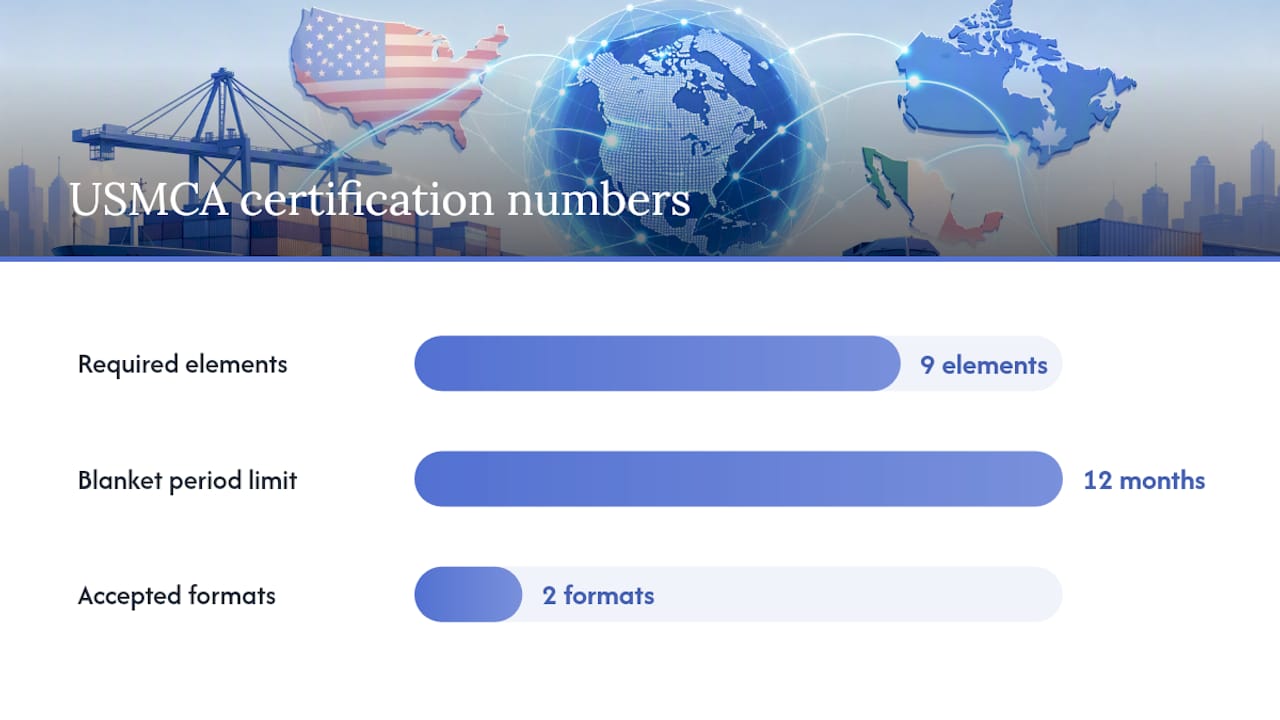
A USMCA certificate isn’t a form at all. U.S. Customs and Border Protection doesn’t issue or require a standard document. Instead, importers, exporters, or producers must include nine minimum data elements from USMCA Annex 5-A on an invoice, a commercial document, or a certificate, and hold supporting evidence behind every claim. Before you claim preferential tariff treatment on anything, check those nine elements line by line.
TL;DR:
- Proper USMCA certification requires including nine specific data elements on invoices or documents, with no formal CBP form mandated.
- Certifications can be completed by exporters, producers, or importers, but must be supported by accurate records and signed statements.
- Supporting evidence must be retained for five years, including bills of materials, supplier declarations, and shipping documents, especially when verifying origin claims.
- Errors such as missing data, incorrect HS codes, or unsigned certifications commonly lead to claim denials and should be carefully checked beforehand.
- External review by licensed brokers is recommended for high-volume shipments or complex rules to ensure compliance and prevent delays.
Table of Contents
- What Are the Nine USMCA Certificate Data Elements?
- Who Can Certify a Shipment, and When Is It Required?
- Where Can the Certification Appear, and What Should It Say?
- How Long Do You Need to Keep USMCA Records?
- What Mistakes Get USMCA Claims Denied?
- How Do You Prepare a USMCA Certification Step by Step?
- How Universal Shipping Helps With USMCA Documentation
- Get Your USMCA Paperwork Reviewed Before You Ship
- Sources
- FAQ
What Are the Nine USMCA Certificate Data Elements?
There’s no CBP Form 434 equivalent for USMCA. CBP’s own guidance confirms that any document works as long as it carries the nine required data points from Annex 5-A. Here’s each one, with what to actually type in the field.
- Certifier: State whether the certifier is the exporter, producer, or importer. This changes what documentation that party must retain.
- Certifier’s name, address, phone, and email: Full contact details, not just a company name. CBP needs to be able to reach the certifying party directly.
- Exporter’s name, address, phone, and email: Required unless the exporter is also the certifier, in which case you can note “same as certifier.”
- Producer’s name, address, phone, and email: If there are multiple producers, you can list “Various” and attach a list, or state that the information is available upon request. Confidential producer information can be handled the same way, so long as CBP or the importer can access it if asked.
- Importer’s name, address, phone, and email: Use “Unknown” if the importer isn’t known at the time of certification. This happens often with blanket certifications covering future shipments.
- Description and HS classification of the good: This is where most certifications fall apart. Describe the good clearly enough to match the invoice, and include the six-digit Harmonized Tariff Schedule (HTS) classification. You can check codes against the USITC’s HTS search tool before you commit to one.
- Origin criterion: Note which of the USMCA origin criteria (A through D) the good satisfies. This ties directly to the applicable rule of origin for that HTS classification.
- Blanket period (if applicable): For a blanket certification, state the start and end date, capped at 12 months.
- Authorized signature and date, with a certifying statement: The certifier signs, dates the document, and includes a statement affirming the good qualifies as originating under USMCA.
A compliant certifying statement should read something close to: “I certify that the goods described in this document qualify as originating and that the information contained in this document is true and accurate. I assume responsibility for proving such representations and agree to maintain and present upon request, or to make available during a verification visit, documentation necessary to support this certification.” That phrasing tracks what CBP recommends for certifying statements, and it’s worth keeping on file as boilerplate.
Who Can Certify a Shipment, and When Is It Required?
Exporters, producers, and importers can all complete a USMCA certification. That flexibility is new compared to NAFTA, which restricted certification authority more narrowly.
- Exporters and producers certify based on their own knowledge of production and sourcing, or on a producer’s written representation if they’re not the manufacturer.
- Importers can self-certify, but only when they have enough information to support the origin claim, whether from their own records or from supplier declarations.
- The importer of record must have the certification in its possession at the time preferential treatment is claimed. There’s no grace period to produce it later during a routine entry.
Two exceptions matter for smaller shippers. Non-commercial importations and shipments valued at $2,500 or less don’t require a formal certification, under longstanding U.S. de minimis practice for informal entries. But CBP watches for patterns: a series of shipments deliberately split to stay under that threshold invites the exact scrutiny you were trying to avoid. If you’re regularly shipping just under $2,500 to the same buyer, that’s a signal to certify properly rather than lean on the exception.
Where Can the Certification Appear, and What Should It Say?
CBP doesn’t care what the document is called or what it looks like, only that it contains the nine elements. That means a commercial invoice with the right language typed at the bottom satisfies the requirement just as well as a standalone certificate. CBP does offer an optional template if you’d rather start from something structured, but using it isn’t mandatory.
For a single shipment, sample invoice language might read: “This invoice covers goods described above which qualify as originating under USMCA. Origin criterion: B. HS classification: 8471.30. Certifier: Exporter. [Signature block, date, certifying statement].”
For a blanket certification, add a defined window: “This certification covers multiple shipments of identical goods described above, imported during the period January 1, 2026, through December 31, 2026.” A blanket period tops out at 12 months, and it only works when every shipment involves goods that are genuinely identical, not just similar.
A few practical notes worth building into your process:
- Reference the invoice number on the certification, or vice versa, so an auditor can match the two documents instantly.
- Electronic and digital signatures are accepted. CBP has never required a wet signature on USMCA paperwork.
- Keep a timestamped copy of whatever version you sent, since email systems and shared drives don’t always preserve edit history the way you’d want during a review three years later.
How Long Do You Need to Keep USMCA Records?
Retain every USMCA-related record for five years from the date of the import entry or the export, whichever applies to your role in the transaction. That’s the standard CBP applies to origin claims, and it’s longer than a lot of importers assume when they’re used to shorter retention windows on other paperwork.
What counts as supporting evidence:
- Bills of materials and production records showing where components came from.
- Bills of lading and commercial invoices tied to each shipment.
- Supplier declarations or affidavits, especially when you didn’t manufacture the good yourself.
- Cost and sourcing data used to calculate regional value content, if that’s the origin criterion you claimed.
If you certified based on a supplier’s written statement rather than your own production knowledge, that’s “reasonable reliance,” and it’s a recognized standard. But reasonable reliance only holds up if you kept the supplier statement itself, not just a summary of what someone told you over email. When a verification request lands, the first thing to do is pull the specific shipment file, confirm the certification on record matches the entry, and lay the supporting documents next to it before you respond to CBP.
What Mistakes Get USMCA Claims Denied?
Most denied claims trace back to the same handful of errors, and they’re avoidable. A missing data element, usually the origin criterion or the producer’s contact information, tops the list. Wrong or truncated HS classifications come next. Some companies still submit the old NAFTA Form 434, which CBP explicitly no longer accepts for USMCA claims. Unsigned certifications and mismatched product descriptions between the invoice and the certificate round out the common failure points.
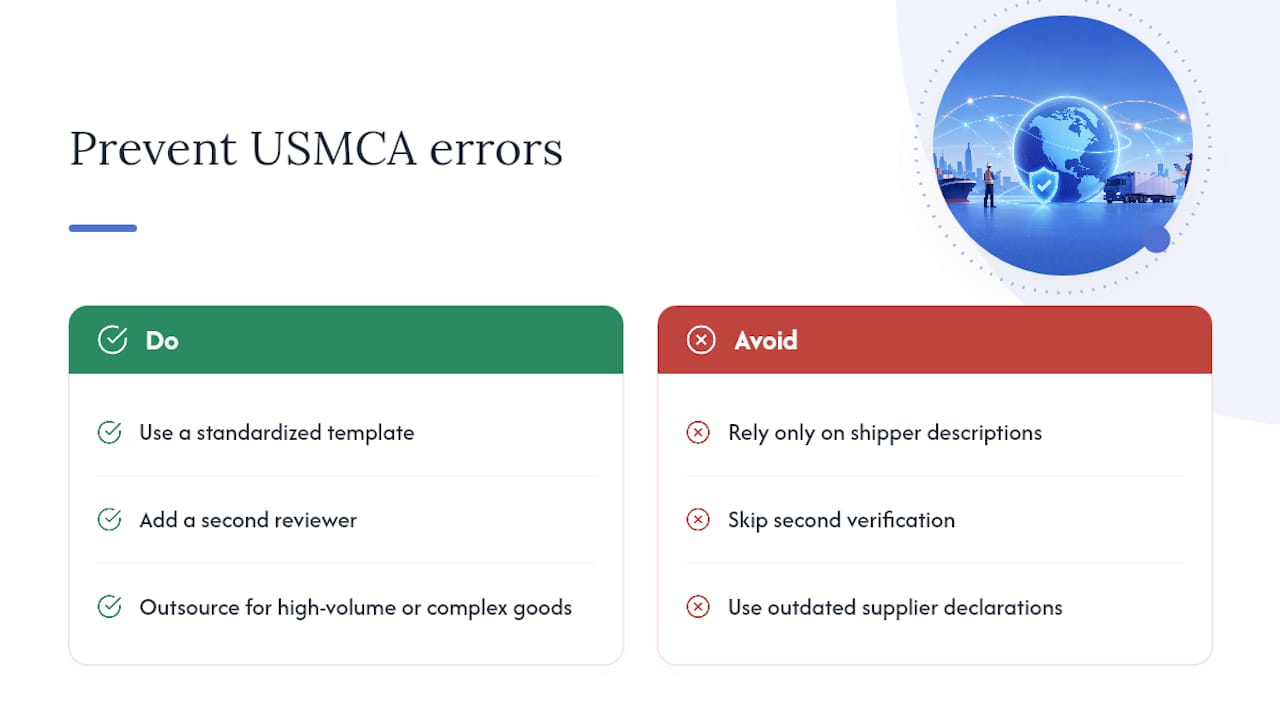
- Standardize one USMCA invoice template across your company so no field gets skipped by habit.
- Centralize supplier declarations in one location instead of scattered across individual purchase files.
- Pre-validate every HTS code against hts.usitc.gov before it goes on a certificate, not after a claim gets flagged.
Pro Tip: Run a quarterly self-audit on five random certifications from the past three months. If you find the same error twice, that’s a template problem, not a one-off mistake, and it’s worth fixing before CBP finds it for you.
If a claim gets denied or you’re dealing with vehicle content rules, complex regional value content math, or high shipment volume, bring in a licensed customs broker or trade attorney rather than guessing.
How Do You Prepare a USMCA Certification Step by Step?
- Confirm the applicable rule of origin for the product’s HTS classification before you do anything else.
- Collect supplier evidence: bills of materials, production records, or a supplier’s written origin declaration.
- Complete all nine Annex 5-A data elements, matching the description exactly to what’s on the invoice.
- Sign and date the certification, including the certifying statement.
- Attach the certification to the invoice or shipping documents, or embed the language directly on the invoice.
- Retain every supporting record for five years, and confirm the importer has the certification in hand before the claim is filed.
For blanket certifications, set the period up front and don’t let it silently expire. When a scenario doesn’t fit cleanly into these steps, CBP’s own guidance is the tiebreaker, not a forum post or a competitor’s blog.
How Universal Shipping Helps With USMCA Documentation
Trade compliance rewards people who’ve seen the paperwork fail before, not just people who’ve read the regulation. Customs clearance and documentation review as part of licensed brokerage services include checking HTS classifications against the actual product, not just the description a shipper wrote down six months ago.
A standardized template catches most errors before they leave the building. What catches the rest is a second set of eyes that has watched a CBP verification request go sideways because a supplier declaration was two years out of date. If your company ships high volume, deals in vehicle or auto parts content, or simply doesn’t have a dedicated compliance person, that’s the point where outsourcing the review stops being optional and starts being cheaper than the alternative.
— Akbar
Get Your USMCA Paperwork Reviewed Before You Ship
A licensed broker can provide North American shippers a faster path to compliant paperwork by checking HTS codes, verifying the nine data elements, and catching gaps before CBP does.
That matters most for companies juggling multiple producers, blanket certifications, or vehicle content rules, where one wrong classification can unwind an entire shipment’s preferential treatment. Usiship’s customs clearance and brokerage services handle certification review alongside entry filing, so your documentation and your shipment move through the same pipeline instead of two disconnected processes. If your supply chain involves multiple vendors, a supplier audit checklist is worth pairing with your internal review before you lock in a template.
Request a document review with Usiship’s customs clearance team before your next shipment goes out, and get your certifications checked against the current Annex 5-A requirements while there’s still time to fix anything.
Sources
FAQ
How do you complete a USMCA certificate?
Include all nine Annex 5-A data elements (certifier, contact details, exporter, producer, importer, good description with six-digit HS classification, origin criterion, blanket period if applicable, and a signed certifying statement) on an invoice or standalone document.
Do you need a USMCA certificate of origin for every shipment?
You need a compliant certification whenever you claim preferential tariff treatment, except for non-commercial importations and shipments valued at $2,500 or less under standard de minimis treatment.
Who fills out the USMCA certificate of origin?
The exporter, producer, or importer can complete it, but whoever certifies must be able to support the origin claim with their own records or a supplier’s written representation.
How do you prove USMCA compliance during a verification?
Keep five years of supporting records, including bills of materials, production data, invoices, and supplier declarations, organized by shipment so you can match them instantly to the certification on file.
Is the old NAFTA certificate still valid under USMCA?
No. CBP’s interim implementation guidance confirms that the legacy NAFTA Form 434 is not accepted for USMCA preferential treatment claims, so certifications need to reflect the current nine-element format.