
Truckload Rates per Mile: What to Expect in 2026
As of the week of October 12, 2026, national spot truckload rates run about $3.09 per mile for dry van and $3.65 for both reefer and flatbed, all-in including fuel, according to the FreightFA rate index. That is a benchmark, not a quote. Your price depends on the lane, the equipment, the fuel terms and the extras written into the agreement. This guide shows the current numbers, how to calculate your own cost per mile, and how to compare quotes that were built differently.
TL;DR
- National spot averages for the week of October 12, 2026: $3.09 per mile for dry van, $3.65 for reefer, $3.65 for flatbed, all-in including fuel.
- The dry van figure splits into roughly $2.26 of linehaul and $0.83 of fuel, so always check whether a rate includes fuel before comparing it.
- Your all-in rate per mile is total freight cost (linehaul, fuel, accessorials) divided by total miles. A $3,200 move over 1,100 miles is $2.91 per mile.
- A national average is not a lane price. Equipment, reload availability, distance, season and appointment rules can move a quote far from it.
Table of Contents
- Current truckload rates per mile by equipment
- Why the headline number is only a starting point
- How to calculate your own cost per mile
- Fuel: the term that changes the quote most
- Spot versus contract rates
- What carriers actually pay to run a mile
- Our perspective
- Get a lane-specific quote
- Quick checklist before you accept a rate
- FAQ
- Sources
Current truckload rates per mile by equipment
The table below uses the latest weekly snapshot we have, which reports national spot rates including fuel. The dry van split between linehaul and fuel comes from the same snapshot, based on DAT’s Trendlines data.
| Equipment | National spot rate, all-in (week of Oct. 12, 2026) |
|---|---|
| Dry van | $3.09 per mile |
| Reefer | $3.65 per mile |
| Flatbed | $3.65 per mile |
For dry van, that $3.09 is about $2.26 of linehaul plus $0.83 of fuel. The same snapshot puts diesel at $6.18 per gallon, which is why the fuel piece is so large this fall.
It helps to see how far rates have moved this year. DAT’s March 17, 2026 release put February national spot rates at $2.41 per mile for van, $2.88 for reefer and $2.72 for flatbed. Contract rates that month were $2.52, $2.89 and $3.13. DAT tied part of that monthly gain to three winter storms that disrupted freight networks in the eastern U.S.
Do not set the February and October figures side by side as if they measure the same thing. DAT’s benchmark covers hauls of 250 miles or more and is built from actual shipment invoices. Weekly all-in snapshots from other trackers include fuel in their own way. The direction is clear, though: rates are well above where they started the year.
Why the headline number is only a starting point
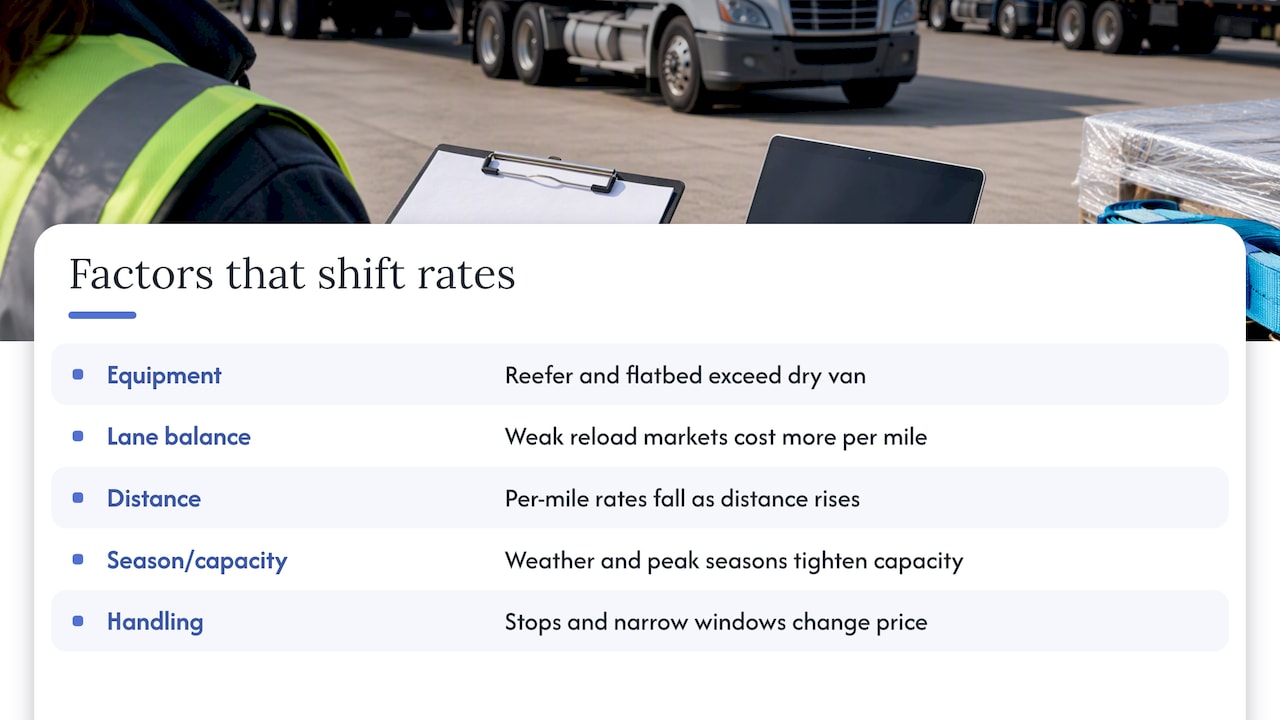
A national average blends thousands of lanes. A Dallas to Chicago run and a Fresno to Reno run do not price alike, and neither prices like the average. Several things pull a real quote away from the benchmark.
Equipment. Reefer and flatbed cost more per mile than dry van, as the table shows. Specialty trailers, hazmat endorsements, team drivers and tarping add to that.
Lane balance and reloads. A truck that delivers into a market with little outbound freight has to deadhead or wait. The carrier prices that risk into the inbound rate. Rural origins and weak reload markets cost more per mile than busy freight corridors.
Distance. Per-mile rates fall as distance rises and climb on short hauls. Benchmarks that focus on 250 miles and up will understate what a 90-mile move costs per mile.
Season and capacity. Produce season, peak retail weeks and weather events tighten capacity. DAT’s analysis of the winter gains showed that disruption, not distance, drove much of the jump. If you know a squeeze is coming, book capacity before it arrives.
Handling and appointments. Narrow delivery windows, live loading, multiple stops and securement needs all change the price.
Spot or contract. Spot pricing follows the market day to day. Contract pricing gives you a planned rate for recurring freight, but it may not track the spot market closely. More on that below.
How to calculate your own cost per mile
The formula is simple: all-in rate per mile equals total freight cost divided by total miles. The CalcBee truckload calculator shows the arithmetic: $3,200 over 1,100 miles comes to $2.91 per mile.
Follow these steps for a clean comparison:
- Add every charge. Linehaul, fuel surcharge, and any accessorials: detention, layover, lumper fees, stop-off charges, tolls.
- Pick one distance basis. Use loaded miles from origin to destination, and use the same routing for every quote you compare.
- Divide. Total cost over total miles gives your all-in rate.
- Test the carrier’s side. If you also want to know whether a rate is workable for the truck, divide by loaded miles plus deadhead and repositioning miles. A high quoted rate can still be a poor deal for the carrier when empty miles, waiting and unpaid handling pile up, as the FreightFA per-mile tool explains.
A worked example. Two quotes for the same 1,100-mile dry van move arrive:
| Quote A | Quote B | |
|---|---|---|
| Linehaul | $2,300 | $2,650 |
| Fuel | $900 (separate line) | Included |
| Accessorials | $0 quoted, detention billed later | $150 quoted |
| Total | $3,200 | $2,800 |
| All-in per mile | $2.91 | $2.55 |
These figures are illustrative, not market data. They show the trap: Quote A’s linehaul alone looks cheaper per mile ($2.09 against $2.41) until fuel is added. Quote B’s “fuel included” line needs the same scrutiny, which brings us to fuel.
Fuel: the term that changes the quote most
With diesel at $6.18 per gallon, fuel is roughly a quarter of a dry van’s all-in rate. “Fuel included” is not a complete commercial term. What matters is the index, the base price, the mileage basis, the adjustment table and the effective dates.
The U.S. Department of Energy’s ATLAS fuel surcharge page shows what a documented method looks like. For its truckload tender schedule, it lists a surcharge of $0.79 per mile for the pricing date of October 12, 2026, based on diesel at $6.179 per gallon, effective October 14 to 20, 2026. That schedule governs DOE tenders, not the commercial market at large. Your own contract formula is the one that applies to you.
What to ask for in every quote:
- Which diesel index the surcharge uses, and how often it resets.
- The base price at which the surcharge starts.
- Whether it is cents per mile or a percentage of linehaul.
- The effective dates.
For a plain-language walk-through of auditable weekly formulas, this guide to delivery fuel surcharge formulas is a useful reference, and our own fuel surcharge index spreadsheet guide shows how to rebuild a carrier’s surcharge yourself.
Spot versus contract rates
Spot rates reflect the capacity available right now. They can be a bargain in a soft week and punishing in a tight one. Contract rates fit planned, recurring freight and give you budget predictability, though they may lag the spot market in either direction.
In February, DAT’s contract rate for van ($2.52) sat above spot ($2.41), while for flatbed contract ($3.13) sat well above spot ($2.72). Contract is not automatically the cheaper option. You are paying for a committed truck and a stable number.
A practical split many shippers use: put predictable, repeating lanes on contract, and keep spot for overflow, one-offs and lanes you are still testing. If you want a deeper comparison of how flexible spot pricing weighs against contract planning, this overview of spot-market freight and contract needs covers the trade-offs from the carrier side.
What carriers actually pay to run a mile
If you wonder what trucking companies are paying per mile, the useful number is cost, not rate. A 2025 update based on ATRI data, summarized by Small Fleet HQ, reports an average 2024 marginal operating cost of $2.260 per mile for Class 8 trucking operations. That includes $0.48 for fuel, $0.39 in truck and trailer payments and $1.779 in non-fuel operating cost. We have not verified it against the original ATRI report, so treat it as a secondary summary.
What it tells a shipper: a rate that looks cheap against the national average may not cover what the carrier needs to run the lane. The result is missed pickups, late deliveries or a truck that disappears when a better load shows up. The lowest rate per mile is not always the lowest cost.
Our perspective
We handle truckload and less-than-truckload moves alongside warehousing and fulfillment, so we see how shippers get hurt by per-mile numbers. It is rarely the rate itself. It is the comparison.
The most common mistake we see is comparing a linehaul-only quote with an all-in one. The second is judging a lane against a national benchmark. Neither tells you whether the price is good for your freight. A quote is good when it matches the shipment’s real facts: equipment, weight, dimensions, pickup and delivery windows, appointment rules and fuel treatment.
Our advice is to ask for every component separately, then do the division yourself. If a provider cannot explain the fuel formula in two sentences, keep asking. And when a number looks far below the market, ask what service it assumes.
Per-mile is also the wrong lens for some freight. Smaller shipments often cost less in LTL, and a pilot of freight consolidation can fill trucks you would otherwise ship half empty. For long lanes, intermodal is worth testing on one lane first.
— Akbar
Get a lane-specific quote
A reliable truckload quote needs: origin and destination ZIP codes, pickup and delivery dates, equipment type, commodity, weight and dimensions, temperature or securement requirements, appointment details and expected accessorials. Send those and you get a price for your freight, not an average.
Universal Shipping covers FTL and LTL moves across all 50 states, with real-time tracking and one team for transportation, warehousing and fulfillment. If your freight needs a stop before the final mile, our warehousing publishes storage rates: $5-6 per month per bin, $17-19 per month per pallet, and $37 per hour for additional services. See our pricing page or talk to our team about freight forwarding and truckload options.
Quick checklist before you accept a rate
- Is fuel in the rate, and if so, under what formula?
- Which accessorials are quoted and which could be billed later?
- Are miles loaded miles only, and by which routing?
- Is the rate spot or contract, and for how long is it valid?
- Does the freight need a different class or handling? Our freight class guide helps avoid reclass fees on LTL shipments.
Refresh the market picture weekly. Fuel and capacity can change a quote quickly, and the sources in this article update on a weekly or monthly rhythm.
FAQ
What is a good truckload rate per mile right now?
Against the national spot snapshot for the week of October 12, 2026, $3.09 per mile all-in is the dry van average, and $3.65 for reefer and flatbed. A good rate for you is one near the benchmark for your lane, equipment and service level, with fuel and accessorials clearly stated. Short hauls and weak reload markets will usually price higher.
Does the per-mile rate include fuel?
It depends on the source. Weekly all-in snapshots include fuel, while linehaul figures leave it out. The dry van linehaul is about $2.26 and fuel adds about $0.83. Ask every provider to show linehaul and fuel separately.
Is 40 cents a mile good?
It depends on what is being measured. As a freight rate, 40 cents per mile is far below any truckload benchmark above. As a component, such as a fuel surcharge, it is a number you would check against the formula in your contract. Carrier operating costs averaged about $2.260 per mile in 2024, per the ATRI-based summary above.
What are trucking companies paying per mile?
Carriers pay roughly $2.260 per mile to operate a Class 8 truck, based on the 2024 ATRI-based figure, including $0.48 for fuel. That is cost, not what shippers pay. Driver pay varies by carrier and is a separate question.
Sources
- DAT Trendlines
- DAT: truckload spot rates post seventh straight monthly gain
- FreightFA Truck Rate Index
- FreightFA trucking rates per mile
- U.S. DOE ATLAS fuel surcharge schedule
- Small Fleet HQ owner-operator statistics
- CalcBee truckload rate per mile calculator