
Cut Turn Time 20% With Transloading for Logistics Managers
Transloading is the process of transferring freight from one transportation mode to another mid-journey, typically moving an ocean container’s contents onto a domestic truck or rail car. The main payoff is mode optimization: shippers typically cut per-unit drayage costs, avoid port congestion fees, and often speed up final delivery. Consider it when your inbound mode and outbound network don’t match, when container free time is running out, or when port yards are backed up.
TL;DR:
- Transloading is most beneficial when inbound ocean freight needs to switch to regional trucking or rail due to mode mismatches or port congestion.
- Facility choice depends on cargo type, dwell time, and whether on-dock or off-dock yards better suit your logistics budget.
- Cycle times often bottleneck at gate documentation, yard congestion, or labor staffing, so specific dwell and damage KPIs are critical for evaluation.
- Effective transload operations require proper equipment, advanced tracking technology, and contingency plans for weather and equipment failures.
- Cost savings and environmental benefits depend heavily on minimizing container dwell time, using virtual gate systems, and optimizing outbound routing.
Table of Contents
- What Is Transloading and Who Handles It?
- How Does the Transloading Process Actually Work?
- When Does Transloading Make Sense?
- Transloading vs Cross-Docking vs Drayage: What’s the Difference?
- What Drives Transload Costs and Delays?
- How Do You Evaluate a Transload Facility’s Capabilities?
- What Should You Ask Before Choosing a Transload Partner?
- What Safety Rules Govern Transloading Operations?
- What Equipment and Technology Run a Transload Yard?
- What Can Go Wrong With Transloading, and How Do You Manage It?
- Is Transloading Better for the Environment Than Direct Trucking?
- Operator Perspective: Implementation Pitfalls and Quick Wins
- How Usiship Handles Transloading and Modal Transfers
- Sources
- FAQ
What Is Transloading and Who Handles It?
Transloading meaning, in practice, comes down to one function: a facility receives freight in one mode, holds it briefly, and dispatches it in another. An international 40-foot ocean container might arrive by ship, get unloaded at a transload facility, and leave as palletized freight inside a 53-foot domestic trailer bound for a distribution center. That single transfer point is where a supply chain either gains efficiency or loses it.
Three facility types handle most of this work in the United States:
- Rail-to-truck yards positioned near intermodal rail ramps, built for high-volume container turnover
- Port transload facilities located on-dock or near-dock at major seaports, moving ocean freight into domestic equipment
- Drop yards (off-dock staging areas) that absorb overflow when port or rail yards hit capacity
On-dock facilities move faster because freight never leaves port property, but they’re expensive and space-constrained. Off-dock yards trade a short shuttle move for lower congestion and more flexible scheduling. Facility choice usually depends on cargo type, whether you’re handling containerized freight, breakbulk, bulk commodities, or temperature-controlled goods, and how much dwell time your budget can absorb.
How Does the Transloading Process Actually Work?
Every transload move follows roughly the same sequence, though delays tend to cluster at the same three points regardless of facility.
- Inbound arrival: the container or trailer checks in at the gate, documentation gets verified, and customs clearance happens here if the freight hasn’t cleared already.
- Unload and inspect: workers open the container, check for damage, and segregate commodities that need different downstream handling.
- Consolidation and palletizing: freight gets sorted, labeled, and built onto pallets or repacked to match outbound equipment and the receiving warehouse’s rules.
- Reload and dispatch: the outbound truck or rail car gets loaded and cleared to leave, with a new bill of lading and tracking handoff.
Cycle time usually breaks down at the gate (documentation delays), in the yard (waiting for equipment or space), or on the labor side (insufficient crew for peak unload volume). A facility that’s fast at unloading but slow at outbound dispatch just moves the bottleneck instead of solving it.
Pro Tip: Ask any prospective transload partner for their average dwell time broken down by stage, not just a single “turn time” number. A facility that hides behind one blended metric is usually masking a slow step.
When Does Transloading Make Sense?
Transloading earns its cost when one of a few specific conditions shows up in your shipment profile.
- Modal mismatch: your inbound mode (ocean) doesn’t match your outbound network (regional truck routes)
- Free time pressure: container free time is expiring and drayage to final destination would run past it
- Consolidation opportunity: two or more 40-foot containers can combine into fewer 53-foot domestic trailers, cutting trip count
- Oversized or odd-dimension freight: project cargo or breakbulk that needs specialized handling equipment unavailable at the final destination
It applies across containerized freight, breakbulk, dry and liquid bulk, refrigerated cargo, and oversized project loads. The outcome you’re chasing is usually one of three things: lower per-unit drayage, faster last-mile delivery because freight rides in equipment already positioned near the destination, or better equipment utilization across your network. Shippers who skip the landed-cost math and only look at the transload handling fee tend to undercount the savings from avoided per diem and detention charges that a well-timed transload prevents.
Transloading vs Cross-Docking vs Drayage: What’s the Difference?
These terms get used interchangeably in casual conversation, and that’s a problem when you’re writing a contract.
- Transloading moves freight between transport modes (ocean to truck, rail to truck) and almost always involves unpacking one piece of equipment and repacking another.
- Cross docking moves freight between vehicles of the same or similar mode, often truck to truck, with minimal or no storage and usually no repacking.
- Drayage is the short-haul truck move of a container between a port or rail ramp and a nearby facility. It’s a transport leg, not a transfer process.
- Transshipment typically refers to ocean-to-ocean transfers at an intermediate port, common in international shipping but distinct from domestic mode-switching.
Cross docking vs transloading matters most when you’re negotiating liability. Cross-docked freight rarely changes custody in a way that requires new documentation, while transloaded freight generates a new bill of lading and often a new insurance touchpoint. If your contract calls a transload a cross-dock, you may find gaps in cargo insurance coverage exactly when you need it.
What Drives Transload Costs and Delays?
Yard congestion and container dwell time are the two variables that quietly inflate transload costs more than the handling fee itself. Every extra day a container sits before transfer adds risk of demurrage, and rail operators have been direct about why: intermodal terminals are built for throughput, not storage, and demurrage exists specifically to keep containers moving rather than parked.
An ITS deployment evaluation found that pairing off-site staging with virtual gate technology cut terminal turn times by about 20 percent, which translates directly into fewer per diem days and faster transload throughput.
Modal shift compounds the effect. A Port of New York/New Jersey simulation found that raising outbound rail share modestly cut local truck congestion and improved container dwell times modestly for refrigerated units. The same modeling showed that adding two hours to gate operating windows dropped median dwell time for dry containers by a few percent.
To calculate landed-cost impact honestly, add per diem, detention, and demurrage exposure to the transload fee, not just the fee alone. Mitigations worth testing:
- Off-site staging yards to absorb overflow before it triggers per diem charges
- Virtual gate systems that let trucks check in remotely
- Extended gate hours during peak volume
- Standardized pallet configuration rules to speed outbound loading
Track terminal turn time, container dwell time, and cargo damage rate as your core KPIs. If any of those three drift upward for more than two consecutive weeks, the facility’s process, not your freight volume, is usually the cause.
How Do You Evaluate a Transload Facility’s Capabilities?
A fused geospatial dataset built from USACE Master Docks, NTAD, and IANA sources documents thousands of U.S. transload-capable facilities, tagging each with transfer-type notation and cargo-code designations. That’s a useful starting point for shortlisting sites before you ever call a sales rep.
When filtering candidates, check for:
- Which modes each site actually supports (rail to truck, ocean to truck, or both)
- Whether the facility handles bi-directional transfers or only one flow direction
- Equipment on hand (reach stackers, side loaders, forklifts rated for your cargo weight)
- Published operating hours versus your shipment’s arrival windows
Dataset fields describe general capability, not guaranteed commodity handling. Always confirm directly with the facility that they’ve handled your specific cargo type, whether that’s hazmat, reefer, or oversized freight, before booking.
What Should You Ask Before Choosing a Transload Partner?
Run through this checklist before signing with any facility:
- Site equipment: does the yard have the cranes, forklifts, or reach stackers your cargo weight and dimensions require?
- Operating hours and gate procedures: do their hours match your inbound arrival windows, and how automated is check-in?
- Insurance and liability: who carries cargo insurance during the transfer window, and where does custody legally change hands?
- Integration: can the facility connect with your transportation management system or warehouse management platform for real-time visibility?
- Contingency plans: what happens if outbound capacity is full when your inbound freight arrives?
Ask for real turn-time examples with commodities similar to yours, not blended facility averages. Require specific KPI targets in the SLA, such as a maximum dwell time in hours and a damage-rate ceiling, rather than vague language like “efficient handling.”
Pro Tip: Request peel-off or speed-stack handling in writing. This lets your dray driver grab the next container without a yard search, which shaves real time off every single pickup.
What Safety Rules Govern Transloading Operations?
Transload yards carry real physical risk: heavy equipment, stacked containers, and constant vehicle movement in a confined space. Facilities operating in the United States fall under Occupational Safety and Health Administration standards covering powered industrial trucks, material handling, and hazard communication, and any site handling hazardous materials must also follow Department of Transportation hazmat regulations for storage, labeling, and transfer.
Practical compliance starts with clear separation of pedestrian and equipment traffic. Reputable yards mark walkways, restrict foot traffic near active load zones, and require high-visibility gear for anyone on the ground. Forklift and crane operators need current certification, and facilities should log inspection records for lifting equipment on a fixed schedule rather than reactively.
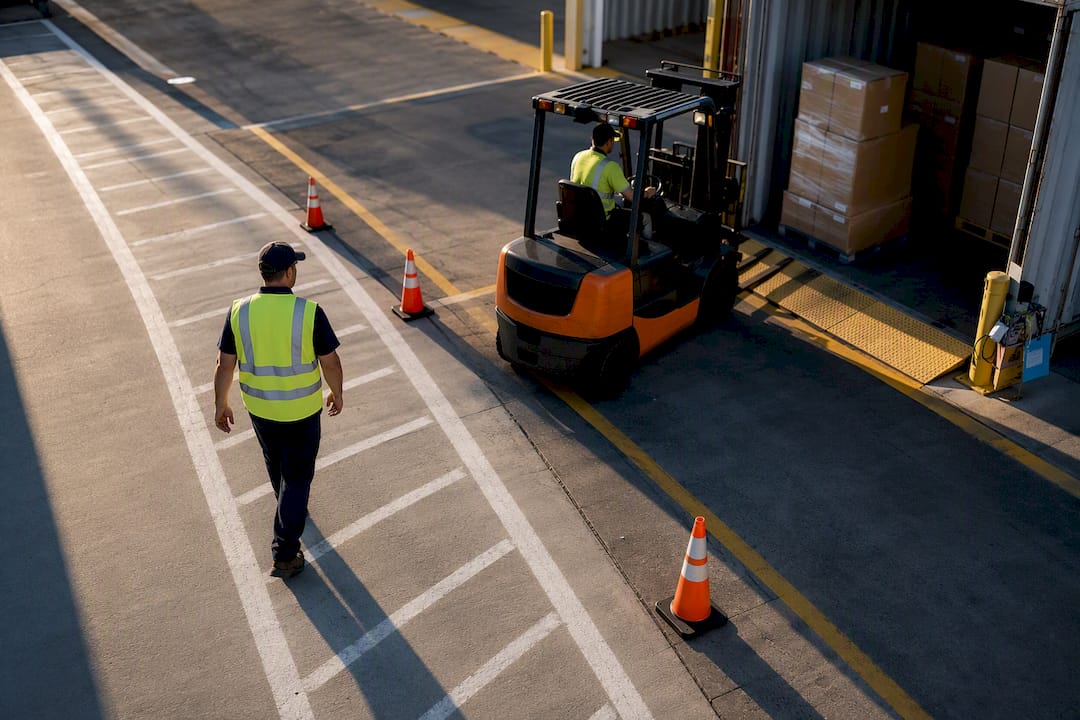
Documentation matters just as much as physical safety. Customs paperwork has to be verified before cargo moves, particularly for imported freight that hasn’t cleared yet. A facility that lets containers into the yard without confirming clearance status is creating downstream liability for everyone in the chain, including the shipper.
Damage inspection at unload is a safety and compliance function, not just a quality check. Photographing cargo condition at intake protects the facility, the carrier, and the shipper if a claim surfaces later. Ask any partner facility how they document damage and how long they retain those records, since claims often surface weeks after the freight has already moved on.
For refrigerated or bulk liquid cargo, temperature logs and containment protocols need to meet the same standard the cargo required in transit. A transload facility that breaks the cold chain during a two-hour transfer window has erased whatever care went into the preceding leg of the journey.
What Equipment and Technology Run a Transload Yard?
Physical equipment and digital tracking work together in a functioning transload operation, and weak performance in either area shows up fast in your KPIs.
On the equipment side, reach stackers and top handlers move containers around the yard, while forklifts rated for palletized freight handle the finer work of loading outbound trailers. Cranes come into play at larger rail-served facilities moving containers directly between rail cars and truck chassis. Dock levelers and specialized ramps matter for breakbulk and oversized project cargo that can’t move through standard container handling.
Tracking technology is where transloading has changed the most in recent years. Virtual gate systems let trucks check in remotely before arrival, cutting the physical queue at the gate itself, a factor directly behind the 20% turn-time improvement documented in federal deployment evaluations. GPS-enabled container tracking gives shippers visibility into exactly when freight arrives, gets unloaded, and dispatches again, which matters enormously when you’re trying to avoid demurrage on a tight free-time window.
Warehouse management and transportation management system integration ties the physical yard to your broader supply chain visibility. A facility that can push status updates directly into your TMS eliminates the manual check-in calls that waste hours during peak season. Barcode and RFID scanning at each handling stage, inbound, sort, outbound, creates the audit trail you need if a claim or dispute comes up later.
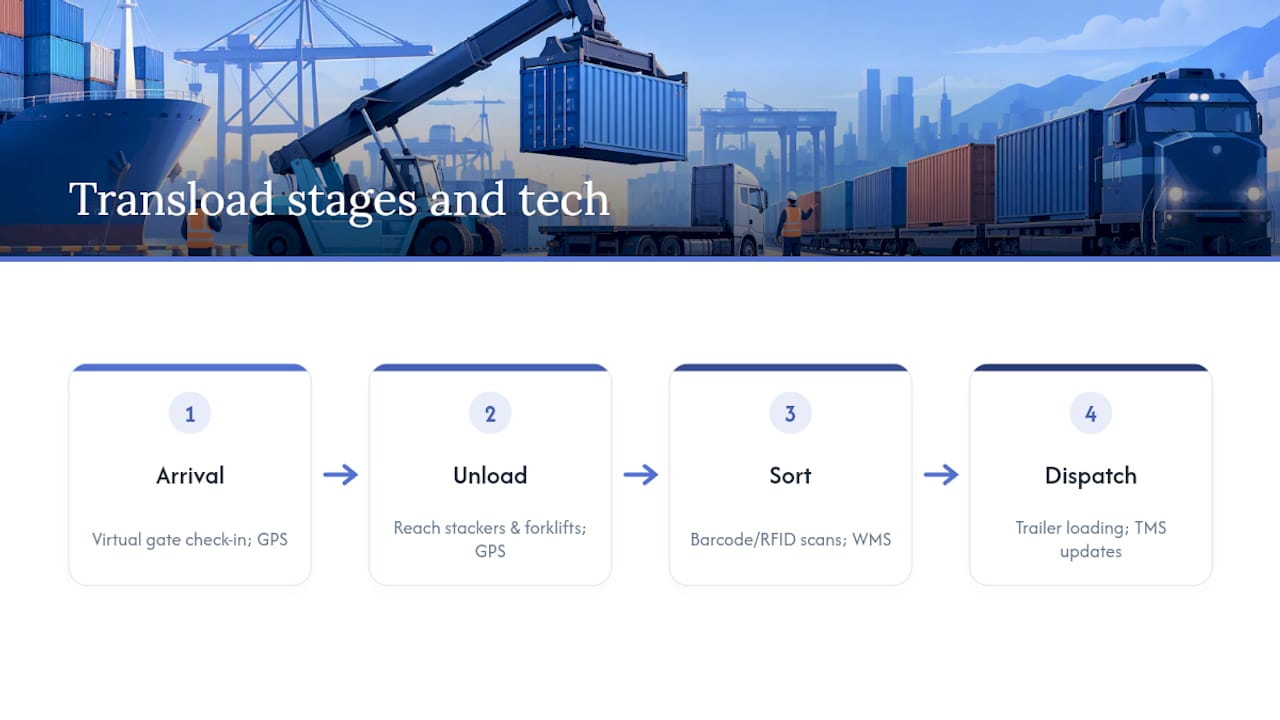
None of this technology replaces trained yard staff. The best-equipped facility still depends on crew who know how to sequence loads, spot damage early, and keep the gate moving during a volume spike.
What Can Go Wrong With Transloading, and How Do You Manage It?
The most common transload failure isn’t equipment breakdown. It’s timing mismatch: inbound freight arrives faster than outbound capacity can absorb it, and the yard starts double-handling containers just to make room.
Double handling is expensive and it compounds. Every extra move increases the odds of cargo damage, and damage claims on transloaded freight are notoriously hard to resolve because custody changed hands mid-journey. Insist on photo documentation at every handling stage so liability is traceable if something goes wrong.
Labor shortages create a second recurring risk. A facility running below staffing targets during peak season will quietly extend dwell time, even if their contracted turn-time metrics look fine on paper. Ask facilities how they handle seasonal volume spikes before you sign, not after your freight is already stuck in their yard.
Communication breakdowns between the transload facility and the outbound carrier cause a third category of trouble. If the dray driver shows up and the facility hasn’t staged the load, that’s a wasted trip and a missed delivery window. Peel-off or speed-stack arrangements, agreed in writing, solve most of this by giving outbound drivers a pre-staged load ready to grab.
Weather and equipment failure round out the list of risks worth planning for. Yards without backup power or covered staging areas can lose an entire shift to a storm. Ask about contingency plans for equipment downtime and severe weather before treating any facility as your primary partner, and always have a secondary facility identified for high-value or time-sensitive freight.
Is Transloading Better for the Environment Than Direct Trucking?
Shifting freight from truck-only movement to a rail and truck combination through transloading generally cuts emissions, since rail moves freight with meaningfully lower fuel consumption per ton-mile over long distances. The MIT simulation of Port of New York/New Jersey found that increasing outbound rail share from 15% to 25% reduced local truck congestion by 11.5%, and fewer truck trips on regional highways means lower localized emissions along those corridors.
Consolidation adds a second sustainability lever. Combining two international containers into fewer domestic trailers means fewer total trips to reach the same destinations, cutting fuel use per unit shipped. This is one of the underappreciated angles of transloading: the cost savings and the environmental benefit come from the exact same operational decision.
Facility design plays a role too. Yards that run efficient, low-dwell operations burn less idle fuel from trucks and equipment waiting in queue. A congested yard with long dwell times doesn’t just cost money in demurrage, it keeps engines running and equipment idling longer than necessary. Facilities investing in virtual gate technology and off-site staging are, indirectly, also cutting idle emissions tied to gate congestion.
None of this makes transloading a guaranteed environmental win. A facility with poor routing that adds unnecessary shuttle legs between yards can offset the modal-shift gains. The net benefit depends on whether the facility and its outbound routing are actually designed for flow, not just added as an extra step in the chain.
Operator Perspective: Implementation Pitfalls and Quick Wins
The biggest mistake operators make is treating a transload yard like storage. It’s a flow system, and every container sitting idle is capacity someone else needs. Unsynchronized inbound arrivals and outbound capacity cause double-handling more than any other single factor. Quick wins: standardized pallet rules, peel-off stacking for outbound drivers, extended gate hours, and a virtual gate pilot. None of these require new construction, just better sequencing.
— Akbar
How Usiship Handles Transloading and Modal Transfers
If reading through the operational checklist above left you wondering how to actually staff and run this, that’s the gap Usiship is built to close. Universal Shipping Inc. combines warehousing, transloading, and freight movement under one operation instead of handing you off between separate vendors for each leg.
The practical value shows up in the handoffs most shippers struggle with: yard coordination between inbound arrival and outbound dispatch, palletization that meets LTL carrier requirements, and demurrage avoidance through timely transload execution. Usiship’s freight forwarding services cover the customs clearance and documentation side, while warehousing and fulfillment solutions handle the physical transfer, staging, and outbound loading. Tracking tools help keep you informed at various stages instead of requiring calls to the yard for status updates.
If your team is weighing a transload pilot for an upcoming shipment, request a feasibility review through Usiship’s pricing page to see which service tier fits your volume and timeline.
Sources
- Virtual Gate Technology Used To Conduct Port Terminal Transactions at Off-Site Truck Staging Areas
- Data fusion for the development of a multimodal freight transload facilities dataset in the U.S.
- CSX response regarding intermodal supply chain issues
FAQ
What Is the Meaning of Transloading?
Transloading means transferring freight from one transportation mode to another during a single shipment’s journey, such as moving cargo from an ocean container onto a domestic truck or rail car. The goal is usually mode optimization: lowering total landed cost or speeding up final delivery by matching the right equipment to each leg of the trip.
What Is the Difference Between Transloading and Drayage?
Drayage is the short-haul truck move of a container between a port or rail ramp and a nearby facility. It’s a single transport leg, while transloading is the broader process of unloading one mode and reloading another, which often includes a drayage move as one step within it.
Can You Give an Example of Transloading?
A common example is an ocean container arriving at a port, being unloaded at a transload facility, and having its contents repacked into a 53-foot domestic trailer for delivery to a distribution center. This lets the shipper consolidate two ocean containers into fewer domestic trailers, cutting the number of outbound trips needed.
What Is the Difference Between Transloading and Cross-Docking?
Transloading moves freight between different transport modes and almost always involves unpacking and repacking. Cross docking vs transloading comes down to mode and handling: cross-docking typically moves freight between vehicles of the same mode with minimal storage and little to no repacking involved.
Does Usiship Offer Transloading Services?
Yes, transloading is part of Universal Shipping Inc.’s broader warehousing and freight forwarding operations, which combine yard coordination, palletization, and outbound dispatch under one service. Current pricing for warehousing and handling services is available on the Usiship pricing page.