
U.S. Shipping Zones Explained: Cut Costs and Deliver Faster
Shipping zones are carrier-defined distance bands that determine domestic U.S. shipping rates and transit windows. Zone 1 is your backyard; Zone 8 is a cross-country haul. The higher the zone, the more you pay and the longer your customer waits. Start right now: look up the zone for your top five routes using the USPS “Get Zone for ZIP Code Pair” tool and note which ones land in Zone 5 or above.
Three quick follow-ups once you have those numbers:
- Check whether USPS flat-rate boxes undercut your current zone-based rate on heavy items shipping to Zones 5–8.
- Flag any SKUs triggering dimensional weight (DIM) charges, since DIM and high zones compound each other fast.
- Identify your two or three highest-cost zone routes and mark them for a fulfillment-location review.
Key Takeaways
Shipping zones are the single biggest structural driver of domestic U.S. shipping cost, and the fastest way to reduce them is to get your inventory physically closer to your customers.
| Point | Details |
|---|---|
| Zones measure distance, not road miles | Carriers use straight-line ZIP-to-ZIP distance; always verify zone per carrier, not by assumption. |
| Zone 1–8 spans local to cross-country | Zone 1 covers roughly up to 50 miles; Zone 8 covers the cross-country distance range for higher zones and carries the highest rates. |
| Flat-rate boxes bypass zone pricing | USPS flat-rate packaging ignores zone and often wins on cost for heavy items shipping to Zones 5–8. |
| Multi-warehouse cuts average zone | Splitting inventory between two well-placed fulfillment centers can cap most orders at Zone 4 or below. |
| Usiship offers zone audits and fulfillment | Usiship models your zone distribution and positions inventory to reduce zone-driven shipping cost. |
Table of Contents
- What are shipping zones and why do carriers use them?
- How do carriers calculate which zone applies?
- Zone 1 through Zone 9: a quick distance reference
- How do zones affect what you pay and when your customer gets the package?
- Where to find the zone for any shipment
- Practical ways to lower your average zone and shipping costs
- The tradeoff most ecommerce owners underestimate
- Usiship helps you act on zone data, not just read it
- Sources
What are shipping zones and why do carriers use them?
A shipping zone is a distance band measured from an origin ZIP code to a destination ZIP code. Carriers use these bands to price shipments and plan their delivery networks. A package moving 40 miles stays in Zone 1 or 2; the same package crossing the country lands in Zone 7 or 8. Zone maps that radiate outward from an origin ZIP are a useful visual shortcut, though they are approximate guides rather than definitive answers.
Carriers rely on zones for three reasons: pricing consistency across millions of daily shipments, network capacity planning at regional hubs, and setting realistic transit-time expectations. Without zones, every shipment would require a custom distance calculation, which is not practical at scale.
USPS, UPS, and FedEx all use the same general zone logic, but they do not always assign the same zone to an identical ZIP pair. A route that USPS calls Zone 4 might be Zone 5 under UPS’s chart. Always confirm per-carrier before committing to a rate estimate.
How do carriers calculate which zone applies?
Zone assignment runs on origin-to-destination ZIP code matrices. Carriers use straight-line (linear) distance rather than road miles, which is why a shipment to a geographically close but road-distant address can still land in a lower zone than expected.
Here is the standard calculation flow:
- The carrier identifies the origin ZIP (typically your warehouse or fulfillment center).
- It maps that origin against the destination ZIP using its internal zone chart.
- The first three digits of the destination ZIP usually determine the zone. USPS calls this the 3-digit prefix method, and you can verify it directly through the USPS Domestic Zone Chart.
- Some destination ZIPs have 5-digit exceptions, meaning the full ZIP overrides the 3-digit default. These are flagged in the official zone chart.
- Special address types get separate treatment: APO/FPO/DPO military addresses and U.S. territorial ZIPs (Puerto Rico, Guam, U.S. Virgin Islands) typically fall into Zone 9. USPS DMM Notice 123 documents these exceptions in full.
UPS and FedEx follow similar prefix logic but publish their own zone charts with different cutoffs. Never assume one carrier’s zone applies to another.
Pro Tip: Before running a batch zone lookup, validate your destination ZIP list using the USPS ZIP Code Lookup tool. A single bad ZIP in a CSV can throw off an entire zone analysis.
Zone 1 through Zone 9: a quick distance reference
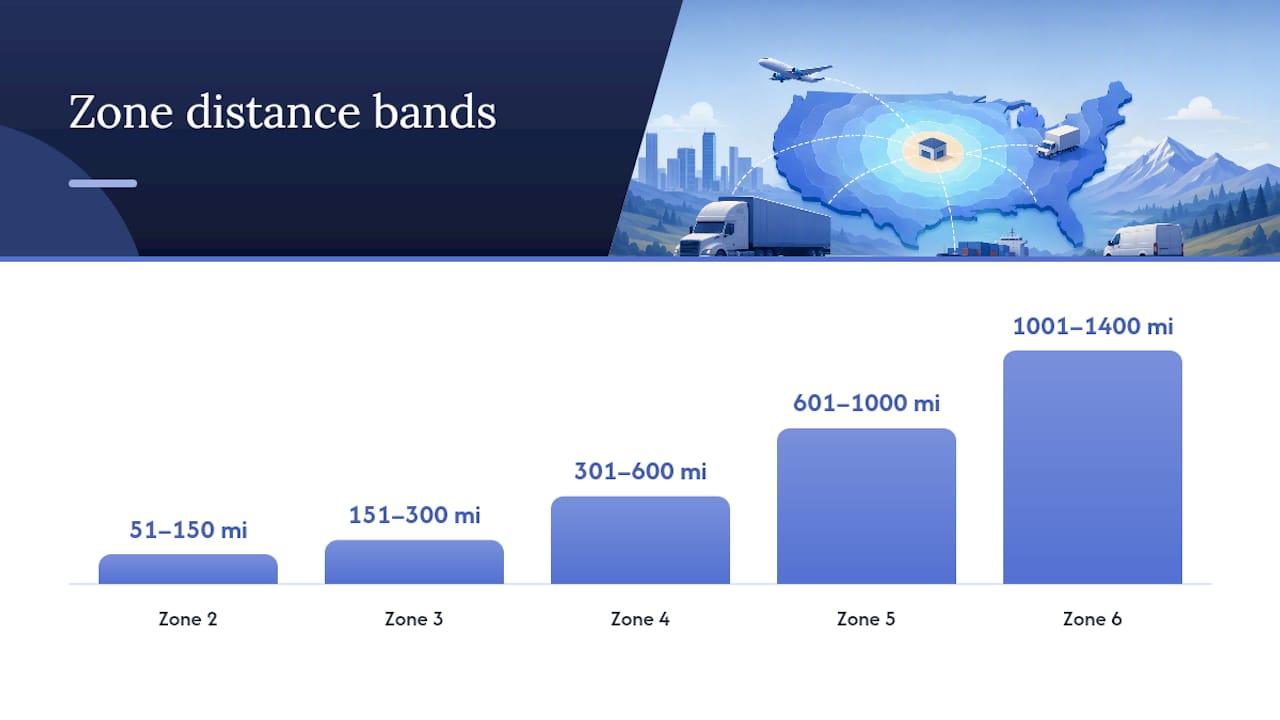
The table below shows the commonly cited straight-line distance bands for U.S. domestic carriers. Treat these as planning guidance; the exact zone for any ZIP pair comes from the carrier’s official chart, not from the distance alone.
| Zone | Approximate Distance | Notes |
|---|---|---|
| Zone 1 | Up to Zone 1 distance | Local delivery; lowest rates |
| Zone 2 | 51–150 miles | Regional, same-day or next-day feasible |
| Zone 3 | 151–300 miles | Regional; 1–2 day transit typical |
| Zone 4 | 301–600 miles | Mid-range; 2–3 day transit |
| Zone 5 | 601–1,000 miles | Cross-regional; costs rise noticeably |
| Zone 6 | 1,001–1,400 miles | Long-haul; 3–5 day transit |
| Zone 7 | 1,401–1,800 miles | Near cross-country |
| Zone 8 | Cross-country distance range for higher zones | Full cross-country; highest rates |
| Zone 9 | Territories | Puerto Rico, Guam, USVI, APO/FPO/DPO |
These distance bands are widely cited as reference guidance, with exact cutoffs determined by each carrier’s official zone chart.
Sample lookup: A shipment from Chicago, IL (ZIP 60601) to Los Angeles, CA (ZIP 90001) spans roughly 1,750 miles. That puts it squarely in Zone 7 under most carrier charts. Run the same pair in the USPS tool and you will see the exact zone confirmed in seconds.
How do zones affect what you pay and when your customer gets the package?
The relationship is direct: move up one zone and your rate goes up, often by a meaningful dollar amount on a standard small package. Move up three zones and you may be looking at a rate that is double what you paid for a local delivery.
Flat-rate boxes are the main exception. USPS Priority Mail flat-rate packaging ignores zone entirely, which is why flat-rate options frequently become cost-competitive starting around Zones 5–7 for heavier items. A 10-pound package shipping cross-country in a flat-rate box often costs less than the same package billed at zone-based rates.
Three factors interact with zone pricing and can change the math significantly:
- Dimensional weight: Carriers calculate DIM weight by dividing package volume by a divisor (typically 139 for UPS and FedEx). If DIM weight exceeds actual weight, you pay on DIM. In high zones, this compounds quickly.
- Carrier surcharges: Residential delivery fees, fuel surcharges, and address-correction charges stack on top of zone-based rates. A Zone 6 residential delivery can carry $5–$7 in surcharges beyond the base rate.
- Negotiated rates: High-volume shippers often negotiate zone-specific discounts that compress the spread between Zone 2 and Zone 7. Published rates are the ceiling, not the floor.
To quantify zone impact in your own data, track average order value by zone, margin per zone, and the percentage of orders missing your transit SLA by zone. Those three metrics will show you exactly where zone costs are eroding profit.
Where to find the zone for any shipment
Official carrier tools:
- USPS: The Domestic Zone Chart lets you enter an origin ZIP and download a full zone chart, or use the “Get Zone for ZIP Code Pair” feature for a single lookup. Best for USPS Priority Mail, First-Class Package, and Parcel Select.
- UPS: The UPS rate-and-service tool on ups.com includes zone lookup by origin/destination ZIP. Use it when comparing UPS Ground versus UPS 2nd Day Air across zones.
- FedEx: FedEx’s zone lookup on fedex.com works similarly. Enter origin and destination ZIPs to get the zone for FedEx Ground or Express services.
Third-party tools:
Tools like Pirate Ship display USPS zone maps visually, radiating zones outward from your origin ZIP. WareSpace and similar fulfillment-focused resources publish zone calculators with worked examples that show cost differences across zones side by side. These are useful for quick comparisons but always verify the result against the official carrier chart before making a pricing or fulfillment decision.
For high-volume sellers:
- Export your order history with origin and destination ZIPs.
- Use a shipping platform’s batch zone-check feature (most major shipping software supports CSV import for zone lookups).
- Segment results by zone and sort by total shipping spend per zone.
- Flag any zone that accounts for more than 20% of total shipping cost as a priority for the tactics in the next section.
Shopify merchants can also manage postcode-based shipping zones directly in their store settings, including CSV import for large zone lists.
Practical ways to lower your average zone and shipping costs
The most effective zone-reduction tactics fall into two categories: operational moves that physically shorten the distance between inventory and customer, and commercial levers that reduce what you pay per zone.
Operational tactics:
- Multi-warehouse placement: Split inventory between two or three fulfillment centers positioned near your highest-order-density regions. A West Coast warehouse and an East Coast warehouse together can cap most domestic shipments at Zone 4 or below.
- Zone-skipping: Ship a consolidated bulk load to a regional hub or 3PL closer to the customer cluster, then inject into local delivery from there. This trades one long-haul freight leg for many short last-mile legs, often at a lower blended cost.
- Flat-rate boxes for heavy cross-country SKUs: Identify products over 5 pounds that regularly ship to Zones 6–8 and test USPS flat-rate packaging. The savings can be immediate.
- Regional carriers: For specific geographic corridors, regional carriers often beat national carrier rates in Zones 2–4. Worth testing on high-volume lanes.
Commercial levers:
Negotiate zone-specific discounts with your primary carrier once your monthly volume justifies it. Carriers typically open rate negotiations at meaningful monthly spend thresholds. Also audit your packaging: right-sizing boxes to reduce DIM weight lowers the effective cost in every zone.

Pro Tip: *Multi-warehouse pays off when your order volume is high enough that the inventory carrying cost of a second location is less than your current zone-driven shipping overspend.
The tradeoff most ecommerce owners underestimate
Zone optimization gets pitched as a straightforward win: add a warehouse, cut zones, save money. The reality is messier. A second fulfillment node means split inventory, doubled replenishment complexity, and the constant risk of stockouts at one location while the other sits overstocked. For businesses with fewer than a few hundred daily orders, that operational overhead often costs more than the shipping savings recover.
The smarter first move is usually not a new warehouse. It is a zone audit on your current SKU mix.
Carrier negotiation is underused at the mid-market level. If you are shipping enough volume to qualify for a carrier account, you are likely leaving zone-based discounts on the table. That conversation costs nothing and can compress your Zone 6–8 rates without touching your warehouse footprint.
Decentralize when the data says to. Centralize when the complexity says stop.
Usiship helps you act on zone data, not just read it
Running a zone audit is one thing. Knowing what to do with the results is another. Usiship’s ecommerce fulfillment network is built around exactly this problem: positioning inventory closer to your customers so that fewer shipments ever reach Zone 5 or above. With warehouse solutions across the U.S. and established carrier relationships that support negotiated zone-based rates, Usiship can model your current zone distribution, identify where a second fulfillment node would cut the most cost, and handle the operational complexity of running it. Whether you need a full zone-cost audit, a regional fulfillment pilot, or logistics transportation services that already account for zone optimization, the starting point is a conversation. Contact Usiship at Usiship to request a zone-cost review for your business.
Sources
Official carrier tools and references used in this article:
- Domestic Zone Chart – Postage Price Calculator – USPS
- Postal Explorer – Notice 123
- Stamps
- Shipping Zones Explained — Zones 1-9 Guide | ShippingLabel