
Amazon Sellers (U.S.): Seller Fulfilled Prime Ops Checklist for 2026
Seller Fulfilled Prime requires a Professional selling account, a U.S. default shipping address, prequalification, and a successful 30-day trial, plus sustained high scores on on-time delivery, valid tracking, late shipments, and cancellations. Amazon reviews performance weekly, and 2026 brought tighter delivery-speed thresholds that push sellers toward multi-node inventory and tighter carrier SLAs.
TL;DR:
- Sellers must prequalify through Amazon by demonstrating a strong shipping history, high on-time delivery rates, and low cancellation and late-shipment rates before enrolling in the 30-day trial.
- Maintaining delivery performance thresholds during the trial is essential, as failure limits reapplication opportunities and risks disenrollment from Seller Fulfilled Prime.
- Running detailed tests of actual transit times to common buyer locations and ensuring weekend delivery options are available significantly improve chances of passing and staying enrolled.
- Accurate inventory labeling, multi-region warehousing, and automated tracking uploads are critical operational factors to meet Amazon’s strict delivery and tracking standards.
- Proper capacity planning ahead of peak periods and proactive carrier performance management help avoid metric dips that jeopardize Prime eligibility.
Table of Contents
- Eligibility and enrollment: how to prequalify and register for the 30-day trial
- Performance metrics and thresholds Amazon measures
- Shipping promise mechanics and carrier requirements
- Passing the trial and staying enrolled: monitoring and remediation
- Operational checklist: warehouse, carriers, tooling, and staffing
- How a U.S. 3PL supports Seller Fulfilled Prime readiness
- Inventory management and labeling requirements specific to Seller Fulfilled Prime
- Packaging standards and best practices to maintain Prime eligibility
- Customer service expectations under Seller Fulfilled Prime
- Technical setup requirements and systems integration
- Tips for scaling and managing peak periods within SFP guidelines
- An operations-first take on surviving the trial
- Get your fulfillment network ready before you opt into the trial
- FAQ
- Sources
Eligibility and enrollment: how to prequalify and register for the 30-day trial
Before Amazon lets you near a 30-day trial, it checks two baseline boxes: a Professional selling account and a U.S. default shipping address on file in Seller Central. You can verify both under Account Info, and neither is negotiable since Seller Fulfilled Prime is built around domestic fulfillment promises that Amazon can stand behind.
Prequalification goes further than account type. Amazon looks at your shipping history, order volume, and existing performance metrics before it opens the trial registration page to you. Sellers with thin order history or recent account health flags typically will not see the option appear yet. If you do not see the trial listed under your Seller Central programs, check your business reports first since inconsistent on-time delivery or a spike in cancellations is often the reason the invitation has not arrived.
Once prequalified, enrollment works like this:
- Opt in through the SFP trial registration page in Seller Central when it appears under your eligible programs.
- Commit to shipping a minimum volume of Prime-eligible orders during the 30-day window so Amazon has enough data to judge you.
- Maintain the same performance thresholds during the trial that you will need to maintain afterward, since Amazon treats the trial as a live audit, not a grace period.
- Understand that failing a trial limits how soon you can reapply, so treat the first attempt as the one that counts.
Amazon does not publish an unlimited retry policy, so building your operational capacity before opting in matters more than opting in early.
Performance metrics and thresholds Amazon measures
Four numbers decide whether you keep the Prime badge. On-time delivery rate (OTDR) measures the share of shipments that arrive by the promised date, counted against the delivery estimate shown to the shopper at checkout, not your internal ship date. Valid-tracking rate checks whether your tracking numbers scan correctly and update through to delivery. Late-shipment rate tracks how often packages leave your dock after the promised ship date, and cancellation rate flags orders you cancel after the customer has already committed to buy.
Amazon reviews these metrics weekly and will send email warnings before pulling the badge, but by the time a warning lands, the damage to that week’s scorecard is already done. Conservative sellers set internal targets meaningfully higher than Amazon’s published pass or fail line so a single bad carrier day or a regional weather delay does not push them under the real threshold.
- Treat OTDR as a floor, not a target: aim higher than Amazon’s minimum so normal volatility never puts you at risk.
- Audit valid-tracking rate weekly since a mis-scanned label can tank this number even when the package actually arrived on time.
- Watch cancellation rate separately from the other three, since it is often a sign of inventory sync problems rather than shipping performance.
Third-party sellers account for a majority of units sold on Amazon, according to Statista’s tracking of third-party seller share, which is part of why the Prime badge carries real conversion weight and why the operational investment to earn it tends to pay back over time.
Shipping promise mechanics and carrier requirements
Amazon calculates the delivery date a shopper sees based on your closest available inventory to that shopper’s zip code, the shipping template you have configured, and your historical carrier performance in that lane. If your inventory sits in one regional warehouse, every promise to a distant zip code inherits a longer transit time, which raises the odds you miss it.
Weekend delivery matters more than most sellers assume. Amazon expects SFP sellers to offer meaningful national coverage, and that includes weekend options in many lanes, so carriers that only run Monday through Friday routes create coverage gaps that show up as failed promises in your dashboard.
- Set shipping templates by region rather than using one blanket cutoff time for the whole country.
- Confirm your primary carrier offers weekend delivery in the zip codes where you promise one-day or two-day service.
- Reconfirm carrier on-time performance quarterly, since a carrier that was reliable last year can slip without warning.
You can connect Amazon Buy Shipping, link your own UPS or FedEx account, or route through Amazon Shipping, and each option changes who absorb the risk when a carrier misses a promise. Buy Shipping and linked carrier accounts both feed tracking data back to Amazon automatically, which protects your valid-tracking rate far better than manual tracking entry.
Pro Tip: Run a one-week test shipping to your five most common buyer zip codes before enrolling, and time actual transit against the promise your template generates.
Passing the trial and staying enrolled: monitoring and remediation
Before you opt into the trial, set Control Prime order volume so you are not promising same-day or one-day delivery to more orders than your warehouse can realistically pick, pack, and hand to a carrier on time. This single setting is the difference between a controlled test and an avoidable failure.
- Cap your daily Prime order volume at a level your current staffing can hit consistently, then raise it in small increments once you confirm you are hitting targets.
- Check the SFP performance dashboard and business reports weekly to spot zip codes or carriers dragging your OTDR down before Amazon’s own review catches it.
- When a specific zip code or carrier lane underperforms, narrow your shipping template to exclude or extend the promise for that lane rather than letting it drag your account-wide average down.
- If a metric slips close to the threshold, add temporary third-party logistics capacity or reroute volume to a backup carrier immediately rather than waiting for the next review cycle.
- If you fail the trial, treat the gap before reapplying as a fix-the-root-cause period, not just a waiting period, since the same operational gaps will fail you again.
Operational checklist: warehouse, carriers, tooling, and staffing
Most SFP failures trace back to three fixable gaps: inventory sitting in too few locations, carrier contracts without real accountability for scan timing, and no early-warning system for metric drift.
- Place inventory in at least two regions if your order volume is spread coast to coast, since a single warehouse cannot promise fast delivery to both coasts honestly.
- Negotiate carrier contract language that specifies first-scan timing and scan accuracy, not just final delivery windows, since a late first scan cascades into a late delivery every time.
- Automate tracking number upload through Buy Shipping, the Shipping API, or a linked carrier account instead of manual entry, which cuts valid-tracking errors significantly.
- Set up automated alerts tied to your performance dashboard so a drifting metric reaches a human before it reaches Amazon’s weekly review.
- Staff pick, pack, and carrier handoff around your actual cutoff times rather than designing cutoffs around existing staff schedules.
Pro Tip: Review your carrier’s contract for scan-accuracy language specifically, since a package that physically ships on time but scans late still counts against your late-shipment rate.
A U.S. logistics resource like Freightsuite’s blog covers carrier management and SLA practices in more depth if you want a wider view before renegotiating existing contracts.
How a U.S. 3PL supports Seller Fulfilled Prime readiness
We built our fulfillment network to close exactly the gaps that trip up SFP trials: warehousing across multiple U.S. states, FBA prep, order processing, and last-mile delivery integrations that connect directly into carrier tracking feeds. When inventory sits closer to more buyers, your delivery promises get shorter and more defensible.
A practical pilot looks like testing a handful of representative zip codes, dense urban and more rural, with SLA monitoring and live tracking before you touch the actual 30-day trial. Running that test through a logistics partner before enrollment turns a high-stakes audit into a known quantity.
Inventory management and labeling requirements specific to Seller Fulfilled Prime
SFP inventory lives entirely in your own warehouse or 3PL facility, which means every labeling and scan-accuracy problem that FBA sellers never see becomes your direct responsibility. Mislabeled units cause pick errors, pick errors cause late shipments, and late shipments cause the exact metric drift that triggers disenrollment warnings.
Keep SKU labels legible and scannable at the point of pick, and confirm barcode placement matches what your warehouse management system expects before a unit ever reaches a shelf. A 300 DPI print standard for labels reduces scan failures at receiving and during outbound picking, which protects both your cancellation rate and your valid-tracking rate.
Multi-SKU inventory accuracy matters more under SFP than under standard FBM, because a stockout discrepancy between your system and Amazon’s listing triggers a cancellation, and cancellations count against the exact metric Amazon reviews weekly. Reconcile inventory counts daily if your catalog has more than a few dozen active SKUs, and reconcile in real time if you run high order velocity. A warehouse management system that syncs directly with Seller Central removes the manual reconciliation step that causes most of these mismatches in the first place.
Packaging standards and best practices to maintain Prime eligibility
Prime shoppers expect packaging that survives transit without damage, and a damaged-in-transit return counts against your account health the same way a late shipment does. Use packaging rated for the actual weight and fragility of your product rather than a one-size box for your whole catalog, since under-protected items generate returns that inflate both your refund volume and your customer complaint rate.
Double-box fragile items and use void-fill that actually prevents shifting in transit, not just material that looks like cushioning. For items shipping through multiple carrier handoffs, assume rougher handling than a single-carrier direct route and package accordingly.

Specialty items such as furniture or oversized goods need freight-specific packing rather than standard parcel materials, since a wrapped-but-not-packed sofa or mattress rarely survives LTL handling. Sellers running SFP for larger items benefit from working through packing standards tailored to that freight class, since a box rated for a 10-pound item will not protect a 60-pound one through a standard carrier network.
Customer service expectations under Seller Fulfilled Prime
Prime customers expect the same return and refund experience whether the seller or Amazon fulfilled the order, and SFP sellers are held to that standard directly rather than through Amazon’s FBA return desk. That means your return policy needs to match Amazon’s Prime-level customer expectations, including prepaid return labels in most cases and fast refund processing once a return is received.
Respond to customer messages within Amazon’s required response window, since slow response times affect your account health separately from your shipping metrics but compound the overall risk of losing SFP status. Process refunds promptly once a returned item is received and scanned back into inventory, since delayed refunds generate complaints that show up in your account health dashboard.
Set a clear internal policy for how your team handles a damaged or missing item claim, because inconsistent handling creates inconsistent customer experiences, and Prime shoppers notice the difference between a fast, clean resolution and a slow one faster than non-Prime shoppers do.
Technical setup requirements and systems integration
SFP leans hard on automated data flow between your systems and Amazon’s. Manual tracking entry, manual order status updates, and manual inventory syncing all introduce delay and error exactly where Amazon’s metrics are least forgiving.
At minimum, connect your shipping process to Amazon through Buy Shipping, a linked UPS or FedEx account, or the Shipping API so tracking numbers populate automatically rather than through manual upload. A warehouse management system or transportation management system that talks directly to Seller Central removes the lag between a physical pick and the digital record Amazon sees.
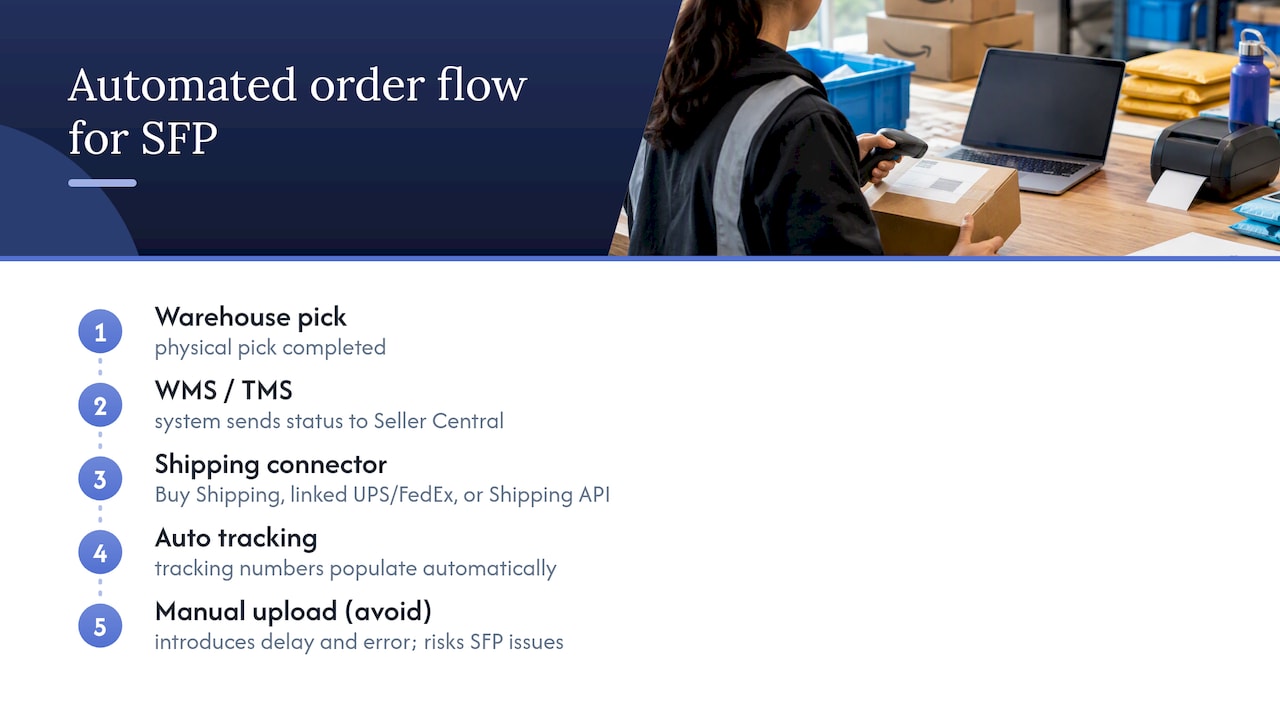
If your order volume is high enough to justify it, custom API integration between your inventory system and Amazon’s order management reduces the chance of overselling, which is one of the more common causes of SFP cancellation spikes. Even sellers without the scale for custom development should prioritize any available plug-in or app that automates tracking upload over manual entry, since that single change often produces the fastest visible improvement in valid-tracking rate.
Tips for scaling and managing peak periods within SFP guidelines
Peak periods like the holiday season push order volume up fast, and that is exactly when Control Prime order volume settings matter most. Raise your daily cap gradually in the weeks leading into peak rather than removing the cap entirely, since an uncapped surge in orders your warehouse cannot handle produces exactly the late-shipment spike that triggers Amazon’s review flags.
Line up temporary staffing or backup 3PL capacity before peak season starts rather than after your metrics start slipping. Carriers also run tighter capacity during peak, so confirm your carrier’s own peak-season performance history in your specific lanes rather than assuming normal-season reliability will hold.
Build in a buffer week before major shopping events to test your current setup against a simulated volume increase, so you find weak points in your pick, pack, and ship process while you still have time to fix them. Sellers who wait until actual peak volume hits to discover a bottleneck are making that discovery in the exact window where a mistake costs the most.
An operations-first take on surviving the trial
Seller Fulfilled Prime is not a learning period. It is an audit from day one, and Amazon measures the delivery promise your shipping template generates on the product page, not your intentions or your average performance in a good week.
The sellers who pass are the ones who tested their actual zip-code coverage and carrier reliability before opting in, not during. If you have not run that test yet, run it before you touch the trial toggle.
— Akbar
Get your fulfillment network ready before you opt into the trial
We help sellers close the warehouse and carrier gaps that cause SFP trial failures through 3PL fulfillment services, multi-state warehousing and fulfillment, and FBA prep. Check current rates on our pricing page and request a readiness assessment before your trial window opens.
FAQ
What are the requirements to qualify for Seller Fulfilled Prime?
You need a Professional selling account, a U.S. default shipping address, and prequalification status before Amazon opens the 30-day SFP trial to you. Passing the trial requires sustained performance on on-time delivery, valid tracking, late shipments, and cancellations.
What are the eligibility criteria for Amazon Prime?
For sellers specifically, Prime eligibility under the Seller Fulfilled Prime program depends on account type, shipping history, and a successful trial period measured against Amazon’s performance thresholds. Shoppers see the Prime badge only on listings that meet these ongoing operational standards.
How can a seller get a Prime tag on Amazon?
A seller earns the Prime badge through Seller Fulfilled Prime by prequalifying, completing the 30-day trial, and maintaining Amazon’s performance requirements afterward, or by using Fulfillment by Amazon, where Amazon handles shipping directly. Both paths require meeting Amazon’s documented program standards rather than a one-time application.
How do I know if an item is prime eligible?
A listing shows the Prime badge on the product page once the seller or fulfillment method behind it meets Amazon’s delivery-speed and performance requirements for that item’s shipping destination. Shoppers see this directly on the listing, and sellers can confirm their own eligible listings through the SFP performance dashboard in Seller Central.