
Routing Guide Compliance: A Vendor’s Guide to Avoiding Fees
Routing guide compliance means shipping every order to a retailer exactly the way that retailer’s written rules say: the approved carrier, the right authorization, a booked appointment, correct labels and paperwork. Vendors who get this right avoid deductions from their invoices. The way to get it right is a repeatable routine that ties the retailer’s rules to your warehouse, your carrier and your shipping paperwork. A freight partner that runs transportation and warehousing together makes that routine far easier to hold.
TL;DR
- A routing guide is a retailer’s rulebook for inbound freight. Practical Law describes it as a uniform set of rules vendors must follow when moving goods to stores, distribution centers or consumers.
- Most violations come from five places: the wrong carrier, a missed routing request, no delivery appointment, bad labels or packing lists, and wrong billing terms.
- Penalties are usually deducted from your invoice. Fees in published guides range from $100 per incident to $500 per piece, plus labor and freight.
- The fix is a per-retailer checklist, a single owner for every guide, and a warehouse that labels, palletizes and books carriers to that checklist.
- Retailer rules sit on top of federal law. Hazardous materials rules apply no matter what a retailer’s guide says.
Table of Contents
- What routing guide compliance actually covers
- What retailers actually require: real examples
- What noncompliance costs
- A routine you can run on every shipment
- Retailer rules and federal law are different things
- Keeping up when a retailer revises its guide
- Where Usiship fits
- FAQ
- Sources
What routing guide compliance actually covers
A routing guide tells you how freight reaches the retailer. Many retailers want to control transportation because they negotiate carrier rates across the whole enterprise. Kroger, for example, says it has negotiated preferred pricing with select parcel and LTL carriers and expects full compliance so it avoids unplanned surcharges and accessorial costs. (An accessorial is an extra charge for a service beyond the basic haul, such as a liftgate or a delivery appointment.)
So compliance is not just a paperwork exercise. When you ship on your own carrier or ignore the billing terms, you break the retailer’s cost model, and the retailer recovers that cost from you.
A complete guide usually touches six areas:
- Carrier selection. Which carriers you may use for truckload, less-than-truckload (LTL, freight that shares a trailer with other shippers) and parcel.
- Routing authorization. The request you submit before the goods are ready, and the approval number you receive back.
- Appointments. The delivery slot booked at the distribution center (DC).
- Labels and documents. Carton labels, bills of lading (BOL, the contract and receipt for the freight), packing lists and advance ship notices.
- Packaging and palletizing. Pallet height, stacking and sorting by purchase order.
- Billing terms. Prepaid, collect or third-party billed.
What retailers actually require: real examples
Guides differ widely, which is why one generic process fails. These examples come from published guides and show the range.
| Retailer guide | Carrier and billing rule | Timing or appointment rule |
|---|---|---|
| Macy’s Backstage | Shipments with an authorization number must ship collect or third-party billed | Routing request 3 to 14 business days before the ready-to-ship date |
| Kohl’s (2019 guide) | Routing monitored through the retailer’s transportation system | Request once per week per DC by Thursday 11:59 PM CST; POs accumulated into full trailers of 3,600 cube |
| Weis Markets | Any carrier for prepaid truckload; approved carriers for ambient LTL (12 non-stackable pallets or less, or 10,000 lbs or less) | Vendor Shipping Form received before pickup |
| RCI | Parcel of 1 to 125 lbs via FedEx Ground Collect; LTL of 126 to 10,000 lbs through its TMS | Non-preferred carriers must secure an appointment or the delivery is not accepted |
| NFM | Appointments required for all shipments | Live-unload appointments at least 48 business hours ahead; drivers need a valid photo ID |
| CVS | Rules for collect and prepaid BOLs | No appointment without a valid purchase order; delivery dates must meet OTIF guidelines |
OTIF means on time, in full: the order arrived by the requested date with the complete quantity.
Three patterns stand out. First, the rules depend on shipment size, so the same vendor may follow three different processes for parcel, LTL and truckload to one retailer. Second, timing windows are narrow. Third, the same detail, such as the BOL, is checked in several places.
Labels and BOL details that trip vendors
CVS asks for one identification label per carton, placed on a side and not the top. It must carry the supplier name, CVS item number, product description, case pack, weight for cartons of 10 lbs and over, and a scannable item or case UPC (the barcode number). Macy’s wants a unique number on every BOL, same-day POs from one location to one destination DC combined on a single BOL, every PO listed with carton counts and weights, and the authorization number in the Special Instructions box.
These are small details, but they are exactly what a receiving dock checks. Our guides on packing list requirements and the advanced shipping notice cover the data behind them.
What noncompliance costs
Penalties are usually taken from what the retailer owes you. They are rarely a surprise invoice, which makes them easy to miss until a payment comes in short.
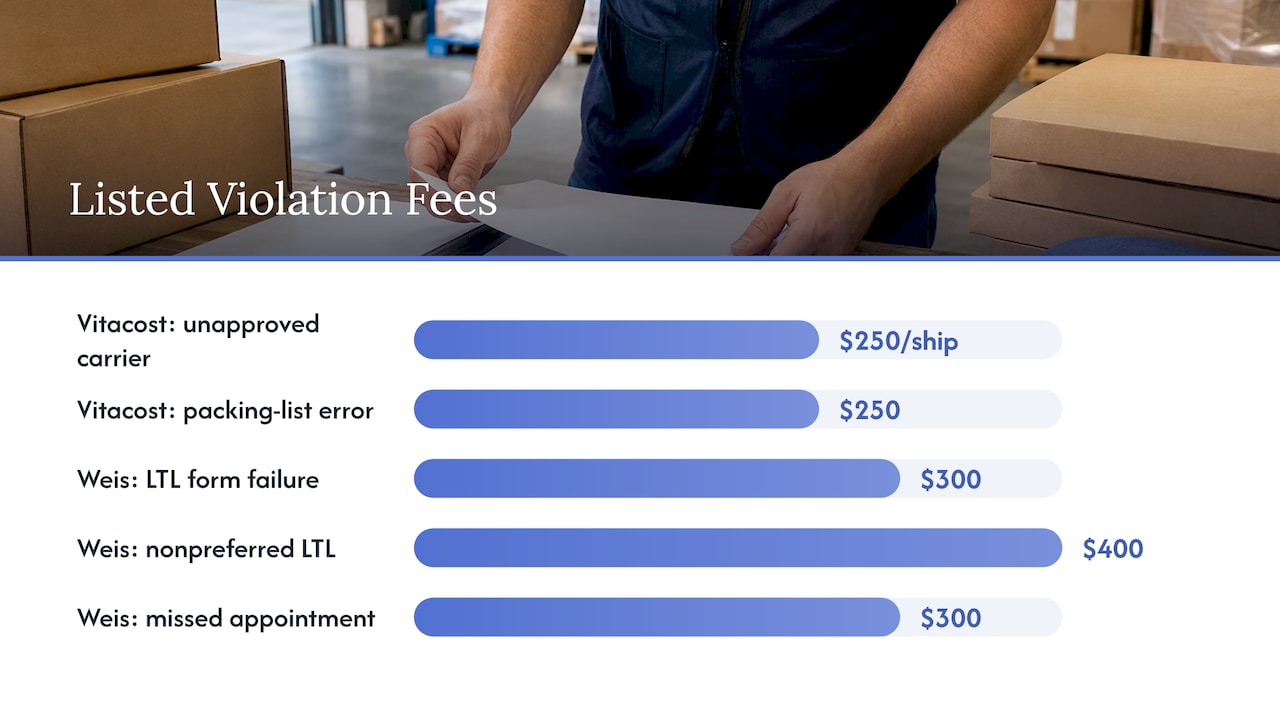
- Vitacost’s schedule sets a $100 base fee per incident plus $50 per labor hour. Flat fees include $250 per shipment for choosing a carrier without approval, $250 for a packing-list error or missing list, and $50 per pallet over 6 feet unless double-stacked at 5 feet.
- Weis Markets charges $300 for failing to submit the LTL routing form, $400 for using a non-preferred LTL carrier, $300 for a missed delivery appointment, $300 per day for late POs and $60 per hour for detention.
- CVS deducts “LOG” charges from the supplier’s invoice, for example $350 for collect-vendor BOL failures or $500 for prepaid-vendor BOL failures, plus $100 administration. Suppliers that stay noncompliant can become responsible for 100% of freight invoices.
- Von Maur charges $200 plus all freight charges for shipping with the wrong carrier and $200 per incident for POs not sorted and loaded by PO number. Disputes must be filed within 4 months of the charge date.
Refusal is the other cost. RCI says using the wrong collect billing option can lead to the shipment being refused. A refused truck means return freight, missed ship windows and a late-delivery penalty on top.
The dispute windows matter. If a deduction is wrong, you need the BOL, the authorization and the proof of delivery at hand within weeks. Our guide on vendor compliance chargebacks walks through that process.
A routine you can run on every shipment
This is the process, step by step, including where it breaks.
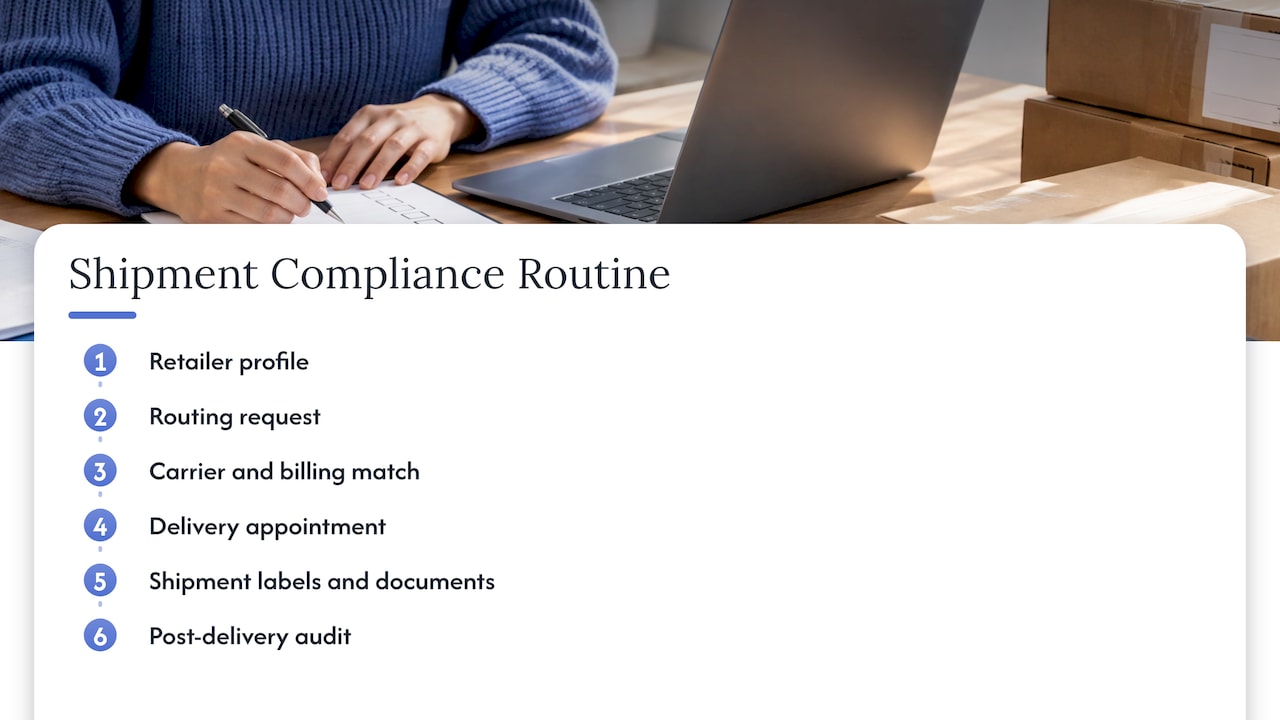
Step 1: Build a one-page profile for each retailer
For every customer, record the current guide version and date, approved carriers by shipment size, routing request deadline, appointment lead time, label format, billing terms and the dispute window. Write down the ship-to DC, because RCI, for instance, consigns everything to a single DC unless told otherwise.
Where it goes wrong: profiles built from memory. Guides are PDFs on retailer portals and they get revised, so the profile must name the version it came from.
Step 2: Submit the routing request on time
Best Buy’s process shows the typical workflow. The vendor submits and monitors routing requests on the retailer’s portal with load-at-origin, UPC, PO, cartons per UPC, trailer feet per PO, a reference number and an available date. Instructions appear once the retailer’s contracted carriers accept the load, and a truckload carrier contacts the vendor at least 24 hours before pickup.
Where it goes wrong: requesting too late, or requesting before the goods are truly ready. Macy’s will cancel the appointment and offset expenses if freight is not ready on the scheduled pickup date. Request against the date your warehouse can actually confirm, not the date sales promised.
Step 3: Match the carrier and billing to the guide
Check shipment weight and pallet count against the guide’s thresholds. Weis, for example, draws the line at 12 non-stackable pallets or 10,000 lbs. Confirm whether the shipment must go prepaid, collect or third-party billed. Kroger notes that parcel shipments cannot be shipped collect to retail store locations.
Where it goes wrong: a rate-shopped carrier chosen for price. In a routed program the cheapest rate to you is irrelevant if the retailer’s carrier is required. Understanding class and weight also helps you avoid reclass fees, which we cover in our freight class guide.
Step 4: Book the delivery appointment
Most guides require an appointment, and some will not issue one without a valid purchase order. NFM wants live-unload appointments at least 48 business hours ahead. Macy’s requires the carrier to obtain the appointment and provide an EDI 214, an electronic status message that confirms pickup and delivery events.
Where it goes wrong: assuming the carrier handled it. Confirm the appointment number appears on the BOL before the truck leaves.
Step 5: Label, pallet and document to the guide
Apply the carton label to the right face, build pallets to the maximum height, sort and load by PO number if the guide asks, and attach a packing list. Send the ASN before the truck arrives, so the receiving dock can scan once and check in.
Where it goes wrong: this is the step with the most fees. A label a scanner cannot read or a missing packing list triggers charges in several guides, including a flat $250 in Vitacost’s schedule.
Step 6: Audit after delivery
Compare each remittance against what you shipped. Look for deduction codes, match them to the shipment and dispute within the window. Track violations by type so the same one does not repeat.
Retailer rules and federal law are different things
A routing guide is a contract condition. It can change when the retailer wants. Federal rules are not optional. Hazardous materials regulations, for instance, apply to any person who offers, causes to be transported, or transports hazardous materials in commerce. That covers classification, packaging, marking, labeling, shipping papers, emergency response information and certification. No one may offer a hazardous material for transport unless it is properly classed, described, packaged, marked and labeled.
Routing for hazmat can also be restricted by state and local rules. New York’s DMV manual explains that some states and counties require permits and may limit routes, and that carriers must give drivers a written route plan for certain explosives. If you ship regulated goods, meet the legal requirement first, then the retailer’s guide. Where the two seem to conflict, ask your carrier’s compliance contact and the retailer’s transportation team before the load moves.
Keeping up when a retailer revises its guide
Guides change, and so do the people at your customers. GS1 US notes that as personnel change and routing guides are revised, standardizing the guide and the change management process becomes more important to avoid misinterpretation.
In practice:
- Name one owner for each retailer guide.
- Re-download the guide on a fixed schedule, for example at the start of each quarter and before peak season, and compare the version date with your profile.
- Push changes to the warehouse floor as a one-page change note, not a forwarded PDF.
- Keep ship-to details and instructions consistent across systems. The same discipline applies to managing delivery addresses, where one stale record causes repeated errors.
Inbound flows matter too. Our inbound freight management guide explains how to set up the process on the receiving side.
Our view: compliance is a warehouse job as much as a transportation job
Most routing violations are not made in an office. They happen on the dock: a label on the wrong side, a pallet built a few inches too tall, a BOL missing the authorization number. That is why we think transportation and warehousing belong on the same platform.
At Universal Shipping, we combine freight forwarding, FTL and LTL shipping, warehousing, fulfillment, cross-docking and last-mile delivery in one integrated setup, with real-time tracking and 24/7 personalized service. Our approach is designed so the team that stores and packs your goods works in step with the team that moves them.
For a vendor shipping to several retailers, one set of hands and one source of shipment data means the profile you build for each guide gets applied the same way every time. We think that is the most dependable path to fewer deductions and cleaner receiving.
Akbar
Where Usiship fits
If you ship to retailers and want the warehouse side of compliance handled consistently, our 3PL fulfillment services and warehousing and fulfillment solutions cover storage, order processing, packaging, returns and freight under one roof. Published storage rates are $5 to $6 per month per bin and $17 to $19 per month per pallet, and additional services are $37 per hour. The full list is on our pricing page.
For freight moves, our freight forwarding services cover air, ocean and land, along with customs brokerage.
FAQ
What is the difference between a routing guide and a compliance guide?
They are often the same document or two sections of one. The routing portion covers carriers, authorization and appointments. The compliance portion covers labels, packaging, documents and the fees for violations. Some retailers, such as Von Maur, publish a single compliance guide with a charge schedule.
Who is responsible when the carrier breaks the guide?
Usually the vendor pays. Macy’s guide says noncompliance can leave the vendor paying freight charges it would otherwise cover, plus administrative fees and expense offsets. That is why you should confirm carrier, appointment number and billing terms before the truck leaves.
How do I find the current routing guide for a retailer?
Start with the retailer’s vendor or supplier portal, where guides are published as PDFs with a version or effective date. Note that date in your retailer profile. If the version is unclear, ask the retailer’s transportation or vendor compliance contact to confirm.
Can I dispute a routing chargeback?
Often yes, but windows are short. Von Maur allows 4 months from the charge date. Keep the BOL, authorization number, appointment confirmation and proof of delivery, then match them to the deduction code.
Sources
- Retailer Routing Guides, Practical Law
- Kroger Vendor Standard Routing Instructions
- Macy’s Backstage Routing Guide
- Kohl’s routing guide 2019
- Weis Markets Inbound Freight Compliance and Routing Guide
- RCI Vendor Routing and Compliance Guide
- NFM Routing Guide
- CVS Routing Guide Instructions
- Vitacost Inbound Routing Guide and fee schedule
- Von Maur Compliance Guide
- Best Buy Inbound Shipping Guide
- 49 CFR Part 171 Subpart A, eCFR
- CDL-11 Hazardous Materials Manual, New York DMV
- GS1 US Voluntary Guidelines for the Routing Guide
- Managing Delivery Addresses