
Residential Freight Delivery: Ship to Any U.S. Home, 5–10 Business Days
Residential freight delivery is available in all 50 states, and every major LTL carrier and freight forwarder offers it. You choose the service level based on how much handling you need: curbside is cheapest, white glove costs the most and covers unpacking and placement. Expect quotes built from weight, dimensions, and accessorial fees, with scheduling handled through appointment windows rather than a set delivery time. Get an itemized quote before you book so you know exactly what you’re paying for.
TL;DR:
- Residential freight delivery costs vary significantly depending on accessorial fees, with liftgate, limited access, and stairs charges adding to the base rate.
- The service level chosen, from curbside to white glove, directly impacts the final cost and determines how far into the house the carrier will deliver.
- Proper shipment preparation, including palletizing, securing, photographing, and verifying details, is crucial to prevent damage claims and disputes.
- Federal rules require a detailed bill of lading for household goods shipments, including pickup and delivery dates, charges, and valuation options for consumer protection.
- Delivery times typically range from five to ten business days, with scheduled appointment windows and potential costs for missed or failed attempts.
Table of Contents
- What Makes Residential Freight Delivery Different From Commercial Freight
- Curbside, Threshold, Room-of-Choice, or White Glove?
- How Much Does Residential Freight Delivery Actually Cost?
- What Federal Rules Protect You During a Residential Move?
- How to Prepare Your Shipment Before Pickup Day
- What’s a Realistic Delivery Timeline for Residential Freight?
- Is Residential Freight Delivery Getting Greener?
- A Field Lesson on Getting Residential Delivery Right
- Book Residential Freight Delivery With Usiship
- Where to Verify the Rules Yourself
- Sources
- FAQ
What Makes Residential Freight Delivery Different From Commercial Freight
Commercial freight delivery drops a pallet at a loading dock with a forklift standing by. Residential delivery has none of that. A driver shows up at a house or apartment building, often without a dock, an elevator, or even a paved driveway wide enough for a full-size truck.
That gap in infrastructure is why residential stops take longer and cost more per shipment. A driver hauling a sofa or a washing machine to a dock can unload in minutes. The same item delivered to a home might require a liftgate to lower the pallet to ground level, a hand truck to move it up a driveway, and furniture pads to protect it from doorframe scrapes.
Access constraints compound the problem. Narrow streets, steep driveways, gated communities, walk-up apartments, and buildings with small elevators all slow the process down and sometimes make certain equipment impossible to use at all. Carriers know this going in, which is exactly why residential stops carry their own line item on almost every freight invoice, separate from the base shipping charge.
Curbside, Threshold, Room-of-Choice, or White Glove?
Every residential freight quote starts with a choice about how far into the house the carrier actually goes. Picking the wrong tier is the single most common reason people get surprised by a bill or a delivery that doesn’t meet their expectations.
- Curbside delivery is the base tier. The truck drops the shipment at the curb or the end of the driveway, and you’re responsible for getting it the rest of the way. It’s the cheapest option and the right call for anyone with help on hand and no stairs to deal with.
- Threshold delivery moves the shipment to the first covered entry point, like a garage or a front porch, out of the weather. It costs a bit more than curbside but saves you from hauling a 200-pound crate across a wet lawn.
- Room-of-choice delivery brings the item inside and into a specific room. This is where flights of stairs, narrow doorways, and tight hallways start generating extra fees, since carriers price stair carries and clearance issues separately.
- White glove delivery covers everything: unpacking, assembly, placement, and debris removal on the way out. It costs the most of the four tiers, but for high-value furniture, fragile installations, or anything that needs professional setup, it removes nearly all the labor and liability from your side.
If you’re shipping something like a dining set or a custom cabinet, furniture shipping services built around white-glove handling are usually worth the premium over standard freight.
How Much Does Residential Freight Delivery Actually Cost?
Base rates start with weight, dimensions, and NMFC class, the same variables that drive any LTL shipment. A denser, more compact pallet almost always ships cheaper than a bulky, low-density one, even at the same weight, because carriers price freight class around how much space it occupies on the trailer relative to its weight.
Accessorial charges are where residential quotes diverge from commercial ones. The common ones include:
- Residential delivery fee — a flat surcharge just for delivering to a home address instead of a business with a dock.
- Liftgate fee — charged when the truck needs hydraulic lowering equipment to get the pallet to ground level.
- Limited access fee — applies to gated communities, rural routes, or any location a standard 53-foot trailer can’t easily reach.
- Stair carry fee — charged per flight when the delivery goes beyond a ground-floor threshold.
- Appointment fee — some carriers charge extra to schedule a specific delivery window rather than an all-day range.
- Redelivery fee — billed when nobody’s available to receive the shipment on the first attempt.
Two carriers quoting the same base rate can land on very different final numbers depending on how liberally they interpret these accessorials, and tariffs aren’t always transparent up front.
Pro Tip: Ask every carrier for a written, itemized quote that lists each accessorial by name and dollar amount, along with the thresholds that trigger it (how many stairs, what counts as limited access). A quote with one lump “delivery fee” is hiding something.
What Federal Rules Protect You During a Residential Move?
Household goods shipments and general freight shipments aren’t regulated the same way, and that distinction changes what protections you get. Under 49 CFR Part 375, carriers moving household goods in interstate commerce have to issue a bill of lading with specific required information and hand you a copy before the shipment ever gets loaded.
That bill of lading isn’t paperwork for paperwork’s sake. Federal rules require it to spell out pickup and delivery dates, all applicable charges, and your valuation options before the truck leaves your driveway. Skipping this step, or accepting a shipment without one, leaves you without a paper trail if something goes wrong.
Liability is the other piece that catches people off guard. Under the same Part 375 framework, carriers must disclose your choice between full value protection and released value, which caps reimbursement at a much lower rate per pound if you don’t pay for the higher coverage. Freight moved under general commercial terms doesn’t always carry these same disclosure requirements, which is one more reason to confirm upfront whether your shipment is classified as household goods or standard freight. Keep every document related to the move; claim timelines are often measured in months, not weeks, and you’ll want the paper trail if a dispute comes up.
How to Prepare Your Shipment Before Pickup Day
Good prep prevents most of the damage claims and reclassification disputes that eat into a delivery budget. Palletizing correctly matters more than people expect: even weight distribution, proper strapping, and stretch wrap around the load all reduce the odds a carrier reclassifies your freight or charges extra handling fees once it hits the dock.
- Confirm your address details. Unit numbers, gate codes, and a direct phone number for someone who’ll be home all need to be on file with the carrier, not just in an email thread.
- Palletize and secure everything. Strap items down, wrap them, and distribute weight evenly across the pallet footprint.
- Photograph the shipment before it ships. Time-stamped photos of packaging and item condition are your best evidence if a claim comes up later.
- Gather your documents. Keep the invoice, any declared valuation paperwork, and a copy of the bill of lading somewhere you can find them fast.
- Reconfirm pickup 48 hours out. A quick call to the carrier catches scheduling errors before they become missed pickups.
If you’ve never palletized freight before, a short step-by-step palletizing guide walks through strapping and wrap technique in more detail than a checklist can.
What’s a Realistic Delivery Timeline for Residential Freight?
Most LTL residential shipments move in a 5 to 10 business day window from pickup to delivery, though cross-country shipments run longer. Carriers typically call to schedule an appointment window, often a four-hour block, once the freight nears its destination terminal; tighter windows usually cost extra.
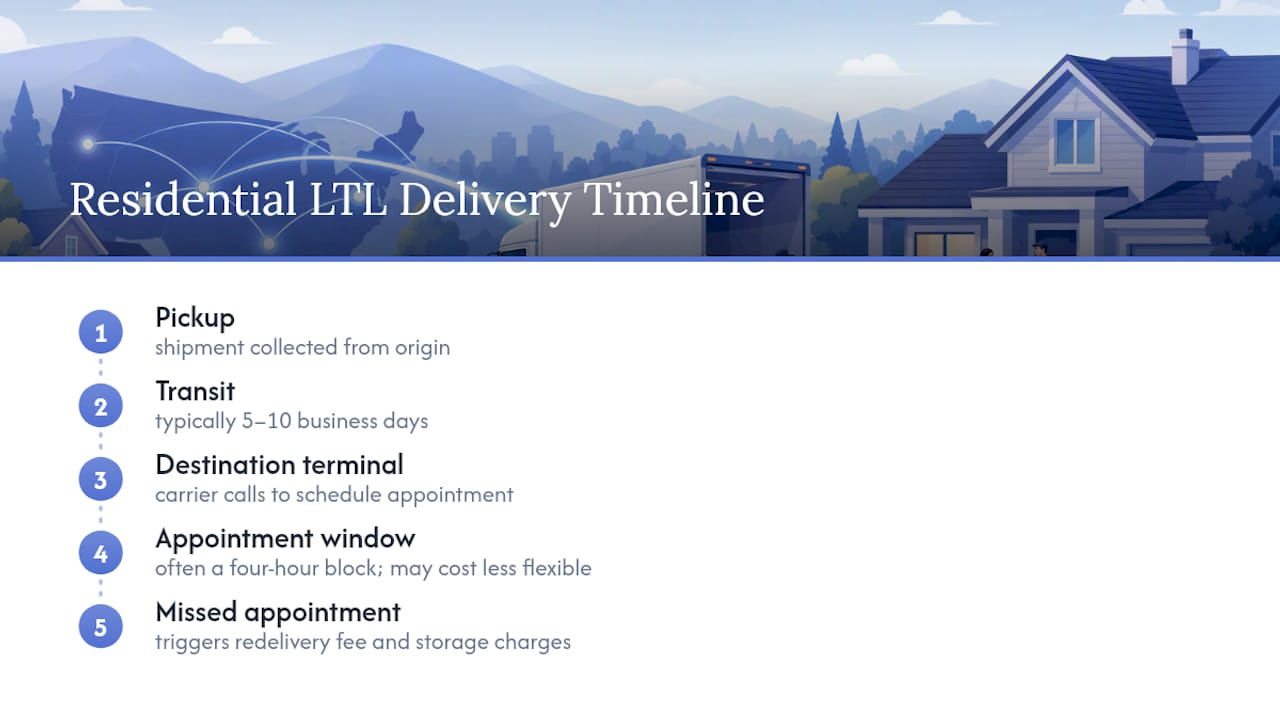
Missed deliveries trigger real costs. A failed first attempt usually means a redelivery fee, and the shipment may sit in a warehouse accruing storage charges while a new appointment gets arranged. The fix is simple: confirm the appointment the day before, keep your phone on, and give a flexible window rather than insisting on an exact hour whenever you can.
Is Residential Freight Delivery Getting Greener?
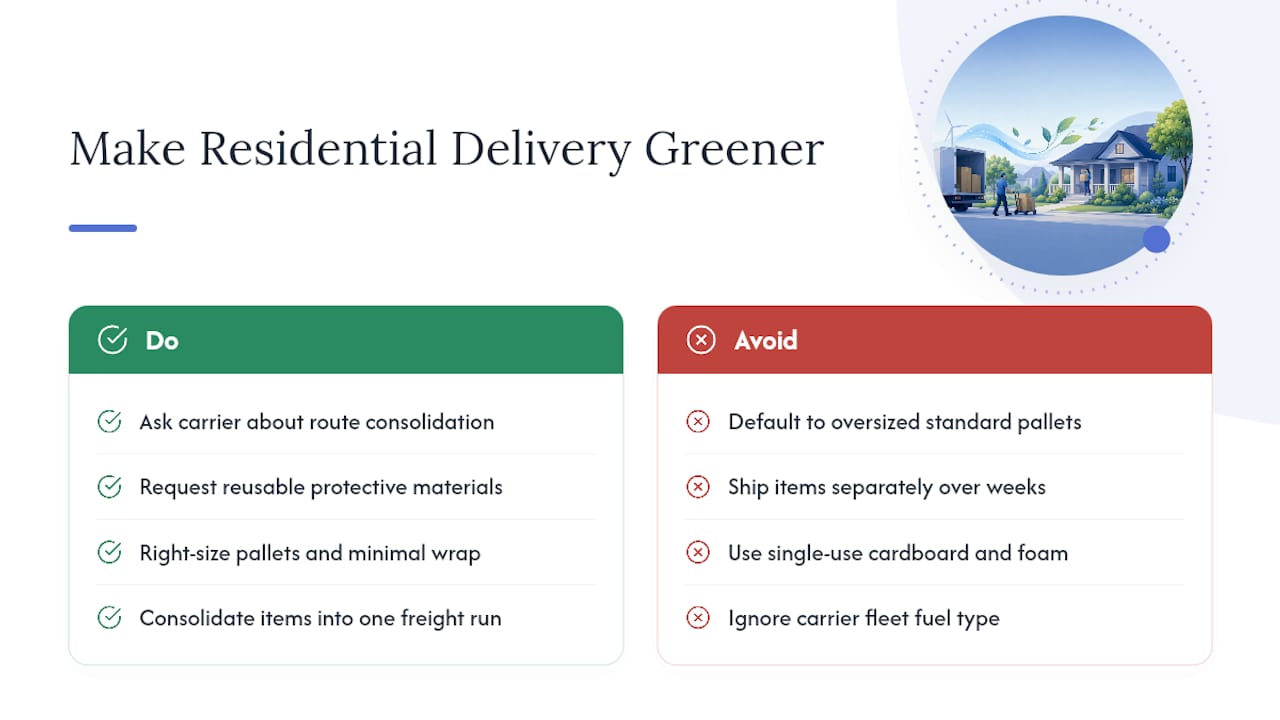
Final-mile delivery to homes is one of the least fuel-efficient legs of the entire freight chain, since a single truck often makes one stop instead of a dock full of pallets, and residential routes tend to involve more idling, more backtracking, and more partial loads than commercial runs. That inefficiency is pushing carriers toward route consolidation, where multiple residential stops in the same neighborhood get grouped onto one truck instead of dispatched separately.
Electric and hybrid last-mile fleets are expanding in dense metro markets, though heavier freight trucks handling large furniture and appliances still lean on diesel for now because of payload and range limits. Some carriers have also shifted toward reusable packaging blankets and pads instead of single-use cardboard and foam, cutting down on landfill waste from every delivery.
For shippers, the practical sustainability lever is packaging choice. Right-sized pallets and minimal excess wrap reduce both material waste and the dead weight that inflates fuel use per shipment. Consolidating multiple items into a single freight run, rather than shipping them separately over several weeks, also cuts total truck miles. None of this requires a green certification or a special program. It just means asking your carrier whether they offer route consolidation or reusable protective materials before you book, and choosing pallet sizes that match your actual freight instead of defaulting to a standard size that leaves extra space and weight.
A Field Lesson on Getting Residential Delivery Right
Damage disputes that drag on for months almost always trace back to two things: no photos before pickup and the wrong service level chosen to save a few dollars.
Pick the service tier based on the item’s fragility and your own physical ability to move it, not just the price difference between tiers. And document everything before the truck ever pulls away. A phone photo takes ten seconds and settles arguments that otherwise take weeks.
— Akbar
Book Residential Freight Delivery With Usiship
Usiship is the practical alternative to piecing together your own freight and final-mile plan carrier by carrier. Instead of juggling separate quotes for LTL transport, liftgate service, and white-glove placement, you get all of it, plus specialty furniture packing, coordinated through one provider with real-time tracking and a person you can actually reach.
Whether you’re shipping a single oversized item to a home or running recurring residential deliveries for a business, Usiship’s freight forwarding services cover the LTL and FTL side, while 3PL fulfillment handles anything that needs warehousing or prep along the way. Pricing for warehousing add-ons like monthly pallet storage is published on the Usiship pricing page, so you can see real numbers before you commit to anything. Request a quote through that page, list your access details and item dimensions, and you’ll get an itemized breakdown back instead of a guess.
Where to Verify the Rules Yourself
Start with the federal source: 49 CFR Part 375 covers bill of lading and consumer protection rules directly, and the FMCSA’s Your Rights and Responsibilities When You Move handbook explains mover obligations in plain language.
Sources
- PART 375—TRANSPORTATION OF HOUSEHOLD GOODS IN INTERSTATE COMMERCE; CONSUMER PROTECTION REGULATIONS
- § 375.6 – Receipt or bill of lading (49 CFR 375.6)
- § 375.201 liability considerations — CFR Title 49 Part 375
- Fleetworks
FAQ
Can You Get Freight Shipments Delivered to a Residential Address?
Yes, residential freight delivery is standard across nearly every LTL carrier and freight forwarder in the U.S. You choose a service tier, from curbside to white glove, and pricing adjusts based on how far into the home the carrier needs to go.
Can LTL Carriers Deliver to Residential Addresses?
Yes, LTL carriers regularly deliver to homes, though most residential stops carry an added accessorial fee compared to a commercial dock delivery. Expect a scheduled appointment window rather than a same-day guaranteed time slot.
How Much Does It Cost to Ship 300 Pounds?
Cost depends on distance, freight class, and which accessorials apply, such as liftgate or limited access fees, so there’s no single flat rate. Request an itemized quote from a carrier or forwarder using your exact weight, dimensions, and delivery address for an accurate figure.
Can FedEx Freight Deliver to a Residential Address?
Yes, major national LTL carriers including FedEx Freight offer residential delivery as a standard accessorial service. The fee and available service tier vary by shipment size and local terminal capabilities, so confirm both when you book.