
Putaway Strategies: 5 Ways to Assign Warehouse Locations
The best putaway strategy is the one that matches how your products move. Fast sellers go close to the pick face. Slow, bulky or restricted items go to dense or segregated storage. Every placement gets confirmed by a scan, so the system always knows where stock is. Most growing ecommerce sellers, retailers and importers end up with a directed, velocity-based approach. It is easy to describe and hard to keep up when stock is arriving every day. If you would rather have a warehouse team run it, our warehousing and fulfillment solutions cover storage and inventory management under one roof.
TL;DR
- Putaway is moving received goods from the dock to a storage location and confirming that location in your system. It is where inventory accuracy is won or lost.
- The main strategies are fixed (dedicated), random, zone-based, class-based (ABC) and directed putaway. Most real warehouses blend two or three.
- Pick the strategy from your order profile, SKU count, product types and software, not from what looks tidy.
- Scan both the item and the location on every put. Track first-time accuracy, putaway cycle time and space utilization.
- Review slotting every few months. A strategy that fit last spring’s catalog rarely fits this holiday season’s.
Table of Contents
- What putaway means in a warehouse
- The five main putaway strategies
- How to choose your strategy
- The putaway process, step by step
- Common putaway mistakes
- What to measure
- Quick wins before big investments
- Doing putaway in-house or with a 3PL
- Our perspective
- FAQ
- Sources
What putaway means in a warehouse
Putaway is the step between receiving and picking. Goods arrive, are checked against the purchase order, and then move to a storage location where they wait for orders. The destination is usually one of two types. A reserve location holds non-pickable stock that buffers inventory for replenishment. A pick location is directly accessible to pickers, as PL Programs’ process guide explains.
Why care about something that looks like simple shelving? Researchers at Georgia Tech estimate that put-away accounts for about 15% of warehouse operating expenses. The same text points out that the location itself should be scanned when product is put away, so the data can later build efficient pick lists. A wrong or unrecorded location turns into a search party at pick time. The product exists in your system but nobody can find it.
If you are earlier in the chain, our guide to the warehouse receiving process covers the steps that feed putaway.
The five main putaway strategies
No strategy is universally best. Each trades travel time, space use and software demands differently.
| Strategy | How it works | Best fit | Watch out for |
|---|---|---|---|
| Fixed (dedicated) | Each SKU has its own permanent location | Small catalogs, low volume swings, manual operations | Empty slots sit idle when stock runs low |
| Random (dynamic) | Stock goes to any open compatible slot | Large catalogs, tight space, rotating clients | Needs scanning and software; without it, stock gets lost |
| Zone-based | Product families or conditions get their own area | Fragile, hazardous, temperature-sensitive or high-value goods | Zones can fill unevenly |
| Class-based (ABC) | Fast movers near the dock or pick face, slow movers far away | Ecommerce with a clear top-seller group | Classes drift; needs regular recalculation |
| Directed | Software tells the operator exactly where to put each item using rules | Any operation with a WMS (warehouse management system) | Rules are only as good as your data |
Fixed or dedicated putaway
Every SKU lives in the same place every time. Workers learn the layout, and little technology is needed. It suits small warehouses with few SKUs and steady demand. The cost is space: a slot reserved for a product you have run out of cannot hold anything else.
Random or dynamic putaway
Stock goes wherever there is room. This maximizes cube utilization, which is how much of your available storage volume is actually in use. It only works when every put is scanned to a location. Georgia Tech’s authors describe putaway as managing a second inventory, one of storage locations: you must know at all times which are free, how large they are and what weight they can hold.
Zone-based putaway
Zones separate goods by their needs: cold, hazardous, high-value, oversized or bonded. Zoning is less about efficiency and more about rules that cannot be broken. Place it first in your logic, before speed rules apply.
Class-based putaway (ABC)
You rank SKUs by how often they ship. A items, the fast movers, go to the most accessible spots. C items go to bulk storage. Our article on ABC inventory analysis explains why each class needs different handling rules, and our guide to warehouse slotting strategies shows how to maintain the classes once set.
Directed putaway
This is the layer on top. A warehouse management system looks at the item, checks which slots are open and applies your rules, then tells the operator where to go. Modern Materials Handling notes that most facilities use directed putaway, with the system sending stock to zones such as aisles next to a pick module, full-pallet areas near the dock, or velocity-based case-pick locations.
How to choose your strategy
Work through these questions in order.
1. What constraints are non-negotiable? Safety, temperature and hazardous segregation outrank speed. Build these as zones first.
2. How many SKUs do you carry, and how fast do they turn? A catalog of a few hundred slow-moving SKUs can live happily with fixed locations. Thousands of SKUs with fast turnover, or a mix of client inventories, push you toward random or directed putaway.
3. What does your order profile look like? If 20% of your items drive most of your picks, class-based slotting pays quickly. If orders are scattered across the catalog, the gain is smaller and space efficiency matters more.
4. What system do you have? Random and dynamic strategies depend on software that records every location. Without it, simple fixed or class-based rules are safer.
5. What is your product shape? Match size, weight and stackability to the location. Heavy items belong low and near the dock. Small items belong in shelving or bins. Full pallets go to bulk, partials to forward pick.
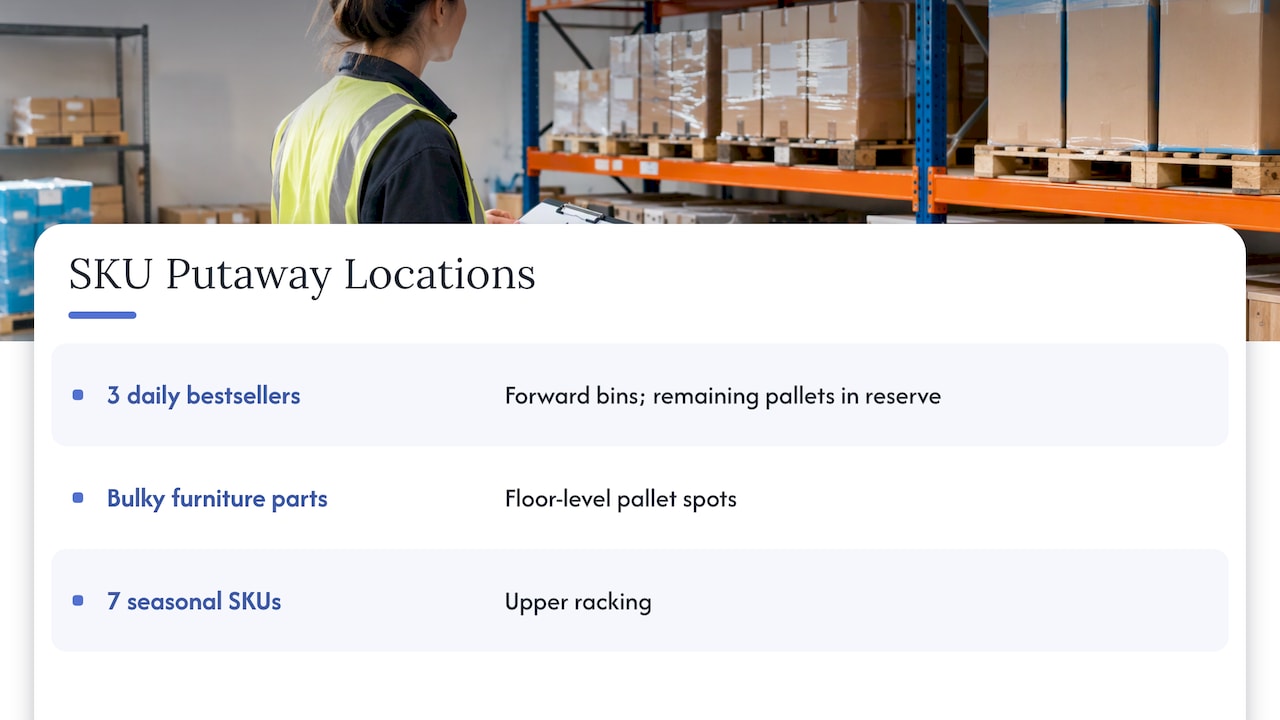
A worked example: an importer receives a 40-foot container holding 12 SKUs. Three of them are ecommerce bestsellers shipping daily. Two are bulky furniture parts. Seven are seasonal. A sensible plan puts the bestsellers in forward pick bins and the furniture parts on floor-level pallet spots. The seasonal items go in upper racking, and the remaining pallets of bestsellers go to reserve, so replenishment is a short move.
Do not forget the rack geometry
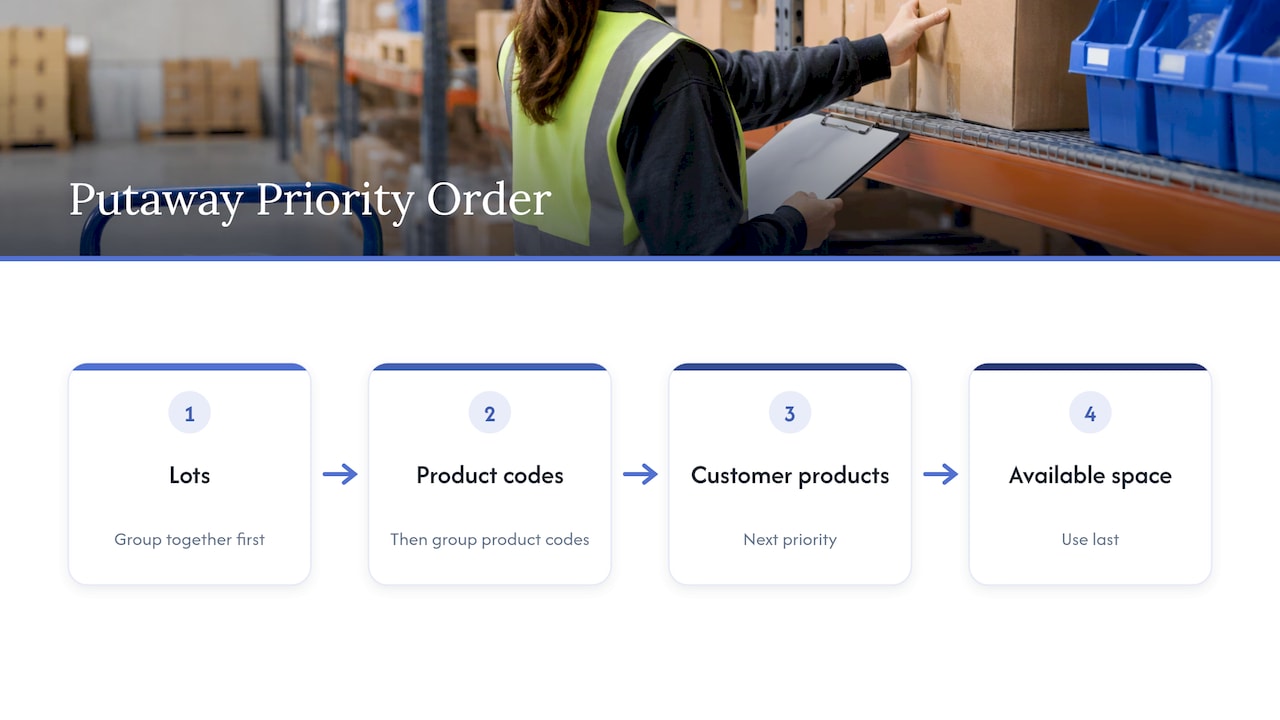
Putaway rules should reflect the storage type. The Global Cold Chain Alliance’s Guide to Effective Warehouse Operations recommends prioritizing putaway by grouping lots together first, then product codes, then customers’ products, and using any available space last. It also warns about honeycombing: placing a 20-pallet lot into a 24-pallet drive-in rack leaves 4 slots unusable. Match lot size to lane depth.
For how the building itself shapes these choices, see our piece on warehouse layout design.
The putaway process, step by step
Whatever the strategy, the transaction itself follows the same path.
- Receive and check. Count and inspect against the purchase order or advance ship notice. Keep received stock separate from available stock until putaway is complete.
- Stage. Move goods to a defined staging area at the dock. Staging should be short and controlled, not a place where pallets sit for days.
- Assign a location. Either the system directs the move or the operator picks a slot using written rules. Rules should cover temperature-sensitive, hazardous and high-value items and say what happens when the primary location is full.
- Move and scan. The operator scans the item and the destination location. A mismatch should stop the transaction before the worker walks away.
- Close the transaction. The final scan updates counts, makes the stock pickable and reconciles the receipt against the order.
Where things go wrong: step 1 skipped details cause errors that flow downstream, step 2 piles turn into informal storage nobody records, and step 4 shortcuts create stock that is physically somewhere but digitally nowhere. Dock congestion also feeds this chain, so dock scheduling deserves a look if trucks arrive in bunches.
Common putaway mistakes
- Skipping the location scan. Scanning only the item proves nothing about where it ended up. Scan both.
- Informal overflow. Aisle ends and floor corners become unrecorded storage. Define overflow locations and record them like any other.
- Never re-slotting. Sales change. A bestseller from spring may be a laggard by Q4. Review classes monthly or quarterly depending on volatility.
- Running too full. When utilization climbs past roughly 85%, congestion grows, pick-face replenishment gets harder and operators start improvising. Leave headroom for peaks.
- Treating putaway and replenishment separately. If forward pick faces empty out because reserve stock was put somewhere awkward, you pay twice in handling.
- Adjusting records without finding the cause. Changing counts to match the floor guarantees the same error returns.
What to measure
You cannot tell whether a strategy works without a few numbers.
| KPI | What it tells you |
|---|---|
| First-time putaway accuracy | Share of items stored in the correct location on the first attempt |
| Putaway cycle time | Time from receipt to a pickable status |
| Average travel distance per put | Whether your slotting logic cuts walking |
| Putaway throughput per labor hour | Productivity of the team or equipment |
| Storage utilization | How full your space is, relative to a healthy buffer |
| Exception rate | Mismatches and overflow events per 1,000 tasks |
Start with accuracy and cycle time. They show problems fastest. Review all of them whenever you change a rule, so you know whether the change helped.
Quick wins before big investments
You do not need automation to improve. In order:
- Scan every location and item at putaway.
- Put your top 20% of SKUs by pick frequency in a hot zone near the dock or pack area.
- Write the rules down: what goes where, what happens on overflow, who approves exceptions.
- Re-run your ABC ranking on a schedule.
- Only then consider dynamic slotting software, mobile robots or dense automated storage for small items.
Automation earns its cost when the basics are already clean. If it is layered over bad location data, it just moves the confusion faster.
Doing putaway in-house or with a 3PL
Running putaway well means a trained crew, scanners, a system, a layout that fits your products and a routine for re-slotting. Many small and mid-sized businesses find that expanding their own space and staff for this is a large step. A third-party logistics provider (3PL) already runs this routine every day across many clients.
Usiship offers warehousing and fulfillment from US facilities, plus inventory management, cross-docking and transloading, with real-time tracking. Our published storage rates are $5–$6 per bin per month and $17–$19 per pallet per month, and additional services are billed at $37 per hour. Receiving, order processing, additional picks, returns and packaging are listed on the pricing page, where you can see the full structure. Our 3PL fulfillment services page explains how inbound freight, storage and outbound shipping connect.
If you want a comparison of the two routes first, read our 3PL vs in-house shipping breakdown. If you sell on Amazon, the putaway question starts even earlier, with prep and labeling; see our FBA labeling checks.
Our perspective
Putaway looks like a small task, but it decides whether the rest of the chain works. When freight, storage and shipping sit in separate hands, a mistake made at the dock appears days later as a missing order. That is why we build around one connected platform: transportation, warehousing and fulfillment in the same view, with real-time tracking so you can see where your goods are.
Our approach is to treat the location as part of the product record. Stock is not really received until you know where it is, and an item you cannot find is an item you cannot sell. For importers and ecommerce sellers, whose inventory arrives in large container-sized batches, getting that first placement right saves handling for every order that follows.
We would rather see a business choose a simple strategy and run it consistently than chase a complex one it cannot maintain. If you want help turning your SKU list into a storage plan, start with the warehousing team and bring your top sellers, your pallet counts and your seasonal peaks.
Akbar
FAQ
What is the difference between putaway and picking?
Putaway moves inventory in from receiving to storage. Picking pulls inventory out to fill orders. They share the same aisles and locations, so a good putaway plan directly reduces picking time. Putaway also typically moves larger units per trip, such as pallets or cases, which is why its labor content is generally lower than picking’s.
Is it “putaway” or “put away”?
As a noun or adjective in warehousing, “putaway” is one word: the putaway process, a putaway task. As a verb, it is two words: the team will put away the pallets. Warehouse software and documents commonly use the one-word form for the process itself.
Which putaway strategy is best for ecommerce?
Most ecommerce operations do best with a directed approach built on ABC velocity classes. Bestsellers go to forward pick locations, slower items to bulk storage, and special-handling goods to their own zones. Software confirms each put by scan. Revisit the classes regularly as your catalog changes.
How often should I change my putaway locations?
Review classes and slotting on a regular schedule, monthly or quarterly for fast-changing catalogs. Re-slot also after major events such as a new product line, a peak season or a layout change. Our slotting guide walks through how to maintain a plan.
What accuracy should I aim for?
Track first-time putaway accuracy: correctly stored items divided by total items put away. Use it as a trend line against your own baseline. Improve it by scanning both item and location on every put and by closing out exceptions with a root-cause check.
Sources
- Warehouse & Distribution Science, Georgia Tech
- Guide to Effective Warehouse Operations, GCCA
- Putaway 101: Everything in its Place, Modern Materials Handling
- Warehouse Process Basics: Putaway, PL Programs