
Project Cargo Logistics: How Oversized Moves Get Planned
Project cargo is freight that is too large, too heavy, too valuable or too critical to ship as ordinary freight. Moving it is a project-control job, not a truck booking. It takes engineering, route surveys, permits, specialized equipment and one schedule that every party works from. This guide covers what counts as project cargo, how a U.S. move runs from first drawing to proof of delivery, what drives the price, and what to have ready before you ask for a quote.
TL;DR
- Project cargo is oversized, heavy, high-value or schedule-critical equipment tied to a larger project, such as turbines, transformers, refinery modules or factory machinery.
- A move is engineered in stages: cargo data, surveys, lifting and lashing design, equipment choice, permits, customs, insurance, execution, and supervised delivery.
- There is no standard rate. The quote depends on weight, dimensions, center of gravity, route, states crossed, port capability, cranes, permits, escorts and more.
- Permit rules are set state by state and route by route, so never apply one state’s thresholds to the whole country.
- The most common failure is bad cargo information. Exact packed dimensions, gross weight and lifting points decide whether the plan holds.
Table of Contents
- What counts as project cargo
- Why project cargo is a different kind of shipment
- The workflow of a U.S. project cargo move
- What drives the price of a project cargo move
- What to send before you ask for a quote
- The risks nobody sees on the quote
- Where transloading, cross-docking and storage fit
- Our perspective
- How Usiship supports project shipments
- Questions readers ask
- Sources
What counts as project cargo
The term has no single legal definition. Skuld, a marine insurer, notes that the CSS Code defines many common cargoes but gives no clear definition of project and equipment cargo. Most industry sources agree on the idea. Project cargo is the national or international transportation of large, heavy, high-value or project-critical equipment, and it is often called heavy lift.
UK P&I Club’s guidance lists typical examples:
- Wind-turbine blades, towers and generators
- Oil, gas and petrochemical equipment, including refinery modules
- Transformers and power-generation equipment
- Cranes, port equipment and rolling stock
- Mining and factory machinery
- Boilers, tanks, towers and heavy pipes
- Pre-assembled construction modules
The same guidance separates project cargo from breakbulk. Breakbulk is cargo loaded individually rather than in containers or on pallets. Some project cargo is breakbulk, while other pieces travel on flat racks, Ro-Ro, heavy-lift, multipurpose or semi-submersible vessels.
Critical does not always mean heavy
A small item can need project-level controls. Allianz’s project cargo guide and the UK P&I material both point out that an item can be critical because it is slow or hard to replace, unusually valuable, or needs unusual loading, stowage, lashing or discharge. A custom control cabinet with a 20-week lead time can hold up a plant start-up as surely as a 90-ton vessel.
Why project cargo is a different kind of shipment
The academic literature frames it well. A 2022 overview in the Journal of Shipping and Trade ties the growth of the field to renewable energy build-outs and modular construction. It treats total delivery cost, end-to-end visibility, routing, variability, the link between international and domestic legs, and technical safety as interdependent planning variables. Change one and the others move.
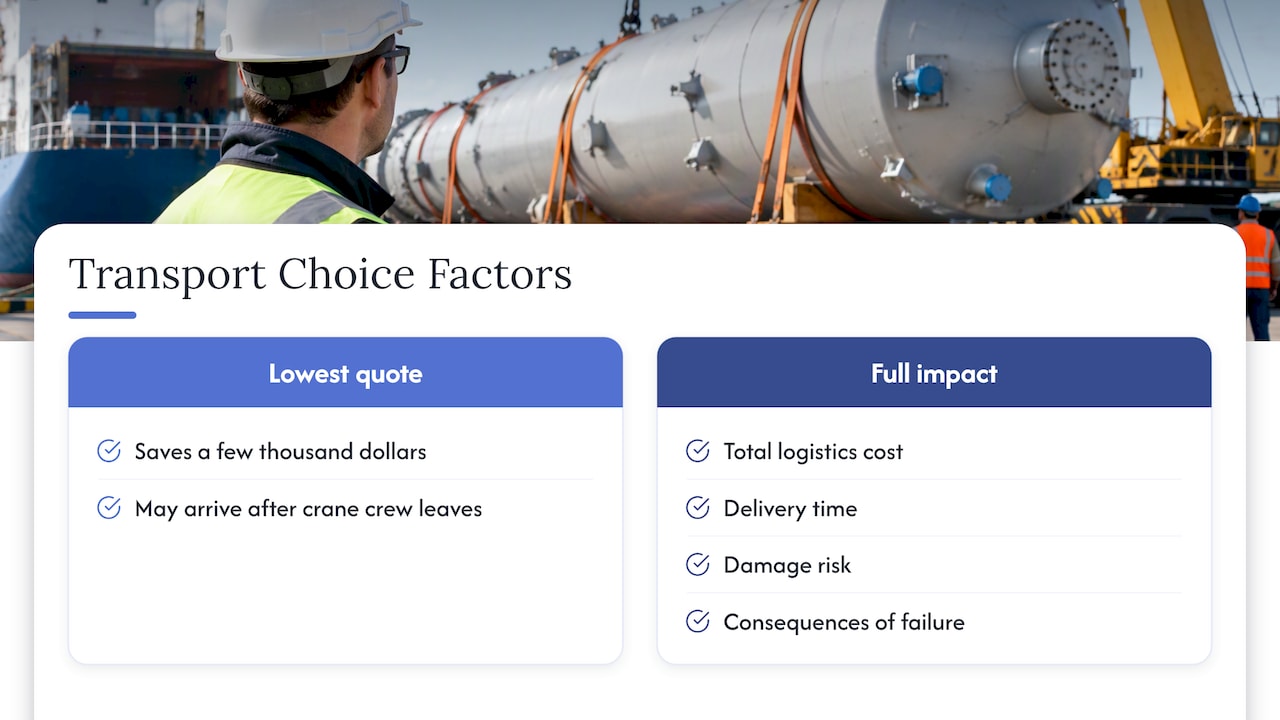
That has a practical consequence: the cheapest apparent transport option is often the wrong one. The same review explains that equipment selection should weigh total logistics cost together with delivery time, damage risk and the consequences of failure, because the cargo is part of a larger infrastructure schedule. A trailer that saves a few thousand dollars but arrives a week after the crane crew has left costs far more than it saved.
The exposure can be large. Allianz notes that damage or delay to project cargo can create multimillion-dollar losses and, for critical equipment, delay the wider project.
The workflow of a U.S. project cargo move
Every job differs, but a sound U.S. move follows the same backbone.
- Collect cargo data. Drawings, specifications, photos, packed dimensions, gross weight, center of gravity and lifting points.
- Survey the route. Origin site, port or rail ramp, road route and destination site, including access, turning radius and ground conditions.
- Engineer the handling. Lifting plan, packing, sea-fastening and lashing design.
- Choose the equipment. Road, rail, ocean, air, Ro-Ro, breakbulk or a multimodal combination, with the trailer type or vessel that fits the cargo.
- Secure permits and escorts. State and local oversize and overweight permits, and pilot cars where required.
- Coordinate customs and insurance. Import entry, bond and cargo cover, reviewed before loading.
- Execute with tracking. One master schedule, milestone control and contingency routes.
- Supervise delivery. Unloading, positioning, inspection and proof of delivery.
The order matters. Permits, for example, depend on the engineered load configuration, so a late change in packaging can send you back to step 3.
Permits are state by state
There is no national oversize permit. Each state issues its own, and the rules differ. A few examples show the spread:
- Texas describes loads over 80,000 pounds, 8.5 feet wide or 14 feet tall as oversize or overweight, requiring permits and routing through its TxPROS system. That routing system accounts for bridges, overhead structures, construction zones and obstructions.
- Nebraska’s administrative code says a vehicle or combination exceeding legal weight or size limits is subject to permit from the Department.
- Illinois requires a permit when a load exceeds legal sizes and weights on a highway under state jurisdiction.
- North Carolina’s single-trip publication states a permit is valid for 10 calendar days.pdf). It also sets its own commodity, dimension, weight and movement restrictions, including a $12 charge per dimension over the legal limit and a 132,000-pound maximum for that permit category. Movement is limited to sunrise to sunset unless stated otherwise.
Those figures belong to those states. A load that moves freely on one permit in Texas may need a different permit, a different route and an escort one state over. A multi-state move means a permit per state, each with its own validity window, so the schedule has to line up all of them.
What drives the price of a project cargo move
Anyone quoting you a flat per-ton or per-mile rate before seeing the cargo is guessing. The price is built from the specifics of the job. The research we draw on lists the inputs:
| Cost driver | Why it moves the price |
|---|---|
| Weight, dimensions, center of gravity | Decide trailer type, axle configuration and lifting gear |
| Origin, destination, route length | Mileage, transit time and the number of states crossed |
| Number of states | One permit, route survey and escort plan per state |
| Port capability | Berth depth, crane capacity and available heavy-lift equipment |
| Lifting and rigging, cranes | Equipment hire and crew at origin, transfer points and site |
| Permits and escorts | Fees, pilot cars and travel-time restrictions |
| Packaging, storage, transloading | Protection, staging and moving between modes |
| Customs and insurance | Duties, brokerage, and cover matched to value and criticality |
| Site constraints | Access, ground bearing, working windows at delivery |
A serious quote separates base transport from accessorial charges and states its contingency assumptions. If a quote is one line with no assumptions, ask what happens when a permit is delayed, a bridge is closed or a crane waits a day.
What to send before you ask for a quote
A less obvious failure point is information quality. Allianz’s guidance stresses that small errors in cargo data can invalidate a lifting, lashing, permit or insurance plan, and that poor securing can damage both cargo and vessel. Send:
- Exact packed dimensions (not the bare machine, the crated or skidded unit)
- Gross weight
- Center of gravity and marked lifting points
- Drawings and photos
- Packaging details
- Whether the item can be divided into smaller pieces
- Required delivery date and the site’s receiving window
- Origin and destination addresses, including whether the site has a dock, a crane or neither
Divisibility deserves a decision early. Several smaller pieces may ride legal-size equipment and avoid permits, while one monolithic piece needs the full engineered treatment. Often the answer is a mix, and only the full data shows which.
The risks nobody sees on the quote
The least visible schedule risks sit at the interfaces between parties: port cranes and berth depth, highway clearances and bridge limits, permits, transloading, customs and site readiness. Three habits reduce them.
- One master schedule. Every party, from the shipper to the crane crew, works from the same dated plan, with contingency routes already surveyed.
- Confirm the receiving site. Make sure it can accept the lift, with the right ground, crane and crew on the day.
- Review insurance before loading. Insurers may attach warranties to critical items based on replacement lead time, value, footprint, weight, center of gravity and the lifting or securing needed. Learn the terms before the cargo moves, not after an incident.
Customs is a frequent hidden delay on import legs. Mismatched documents are a common cause of holds, so our packing list checklist is worth reviewing before the cargo leaves origin, and a customs power of attorney set up in advance keeps entry from stalling at the port. Heavy imports also usually need the right bond, which our guide to customs bond types explains.
Where transloading, cross-docking and storage fit
Project cargo rarely goes door to door on one vehicle. A component may land at a port, move to a transload facility for restacking onto different equipment, wait in a warehouse until the site is ready, and then travel the last leg. Transloading is how cargo changes equipment without being handled more than necessary, and cross-docking keeps smaller associated parts moving instead of sitting. Staging also cushions the common mismatch between a vessel arrival and a site that is not ready. If you expect storage, compare current rates using our warehouse storage fee benchmarks.
When only part of the shipment is truly oversized, the rest can move as standard freight. Our guide to oversized freight shipping for project teams covers that split, and expedited freight options help when one missing part holds up the whole project.
Our perspective
Most project cargo trouble we see for shippers starts well before a truck is booked. It starts when the documents, the packing, the customs entry and the delivery site are treated as separate problems owned by different people. We built Usiship around the opposite idea: transportation, warehousing and customs handled on one platform, with real-time tracking so you see where a shipment is without chasing anyone.
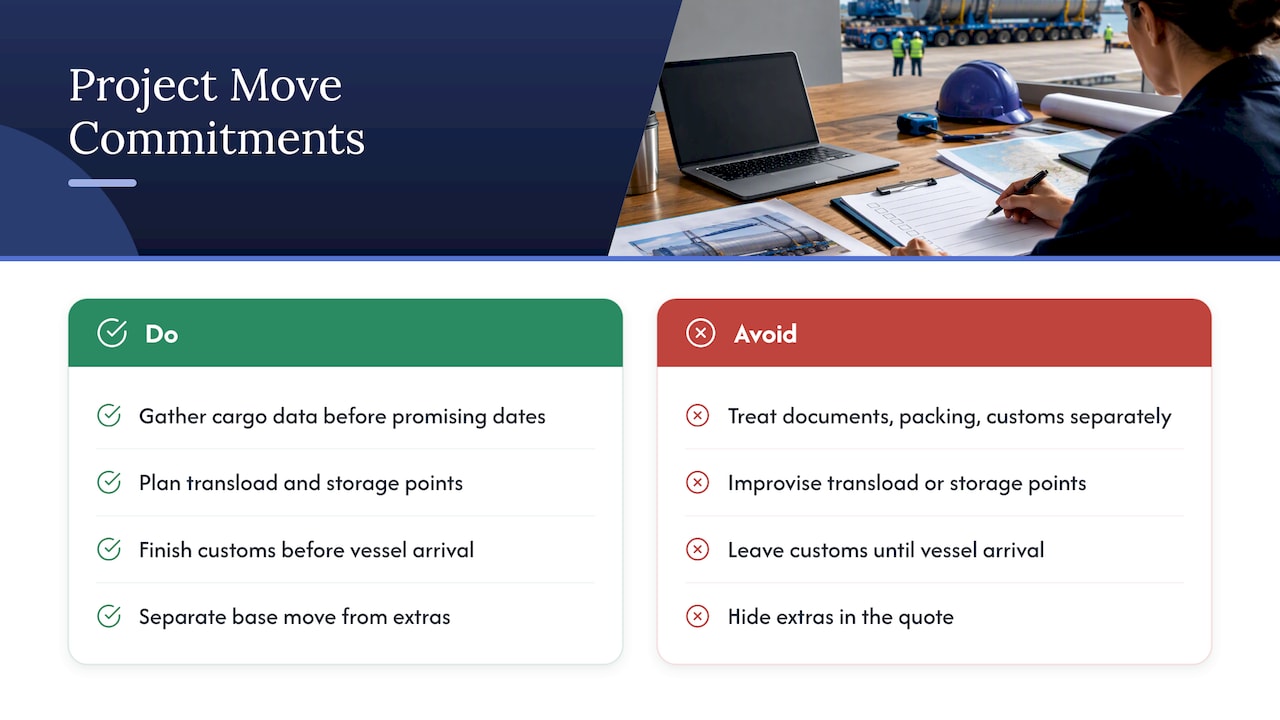
For project work, that means a few commitments. We want the cargo data in hand before we promise a date. We want transload and storage points planned rather than improvised. We want customs paperwork finished before the vessel arrives. And we want you to see a quote that separates the base move from the extras, so a surprise at the site does not turn into a surprise on the invoice.
We will also tell you when a move is better handled in pieces, or when a part you consider critical needs more lead time than the schedule allows. Honest early answers cost less than rescue moves late.
— Akbar
How Usiship supports project shipments
We coordinate the parts of a project move that sit around the heavy haul itself: freight forwarding by air, ocean and land, with customs brokerage, warehousing and fulfillment for staging, and specialty freight packing for protection. Our customs clearance team handles import entry for U.S. importers. Project cargo has no published price at Usiship because each move is scoped from its own data. Contact us through our site with your drawings and dates, and we will tell you what the move needs.
Questions readers ask
What is project cargo in logistics?
It is oversized, heavy, high-value or project-critical equipment that needs specialized planning, handling and equipment. It usually belongs to a larger project such as a power plant, wind farm, refinery or factory build. Standard freight rates and processes do not fit it.
What is an example of project cargo?
Wind-turbine blades and towers, transformers, refinery modules, cranes, boilers, large tanks and pre-assembled construction modules are typical. A smaller item can qualify too if it is hard to replace or needs unusual lifting and securing.
Is project cargo the same as breakbulk?
No. Breakbulk is cargo loaded individually rather than in containers or on pallets. Some project cargo is breakbulk, but other project pieces move on flat racks, Ro-Ro or heavy-lift vessels, and some breakbulk is not project cargo at all.
How much does project cargo shipping cost?
There is no reliable universal price. The quote is built from weight, dimensions, route, states crossed, port capability, lifting, permits, escorts, packaging, customs, insurance and site constraints. Ask for base transport and accessorial charges to be listed separately.
Do I need a permit to move oversized cargo in the U.S.?
If the load exceeds legal size or weight limits, yes, and each state issues its own permit with its own limits, routes and validity. For example, North Carolina’s single-trip permit is valid for 10 calendar days, a figure that does not apply elsewhere. Your forwarder or carrier should confirm the rules for every state on the route.
Sources
- The study of project cargo logistics operation: a general overview, Journal of Shipping and Trade
- How to safely load, stow, secure and discharge heavy lifts and project cargo, Allianz
- Heavy-lift and Project, UK P&I Club
- Routing Optimization System, Texas DMV
- Shipment of project and equipment cargoes, Skuld
- Title 415, Nebraska Administrative Code, Chapter 3
- Single Trip Publication ST-1, NCDOT.pdf)
- Illinois Administrative Code, Title 92, Part 554
- Project cargo, Wikipedia