
Pro Number Meaning: What Shippers Need to Know
A PRO number is the identifier a carrier assigns to a freight shipment so it can be tracked, billed, and handled inside that carrier’s operational systems. It is not something you create; it is something the carrier issues, usually a 7 to 10 digit code that shows up on your bill of lading and freight bill.
You need this number for three things:
- Live tracking: checking a carrier portal or TMS for scan history and delivery status.
- Billing reconciliation: matching freight invoices to the actual shipment that moved.
- Escalations and claims: giving carrier support a fast way to pull up your load.
Merriam-Webster’s own entry describes a PRO number as part of a single continuous series a motor carrier assigns to shipments in order, regardless of freight class. That serialized, carrier-owned nature is exactly why it works so well for tracking. It belongs to the carrier’s system, not yours.
Key Takeaways
The PRO number is the carrier’s own tracking key, and pairing it with the SCAC code is what makes freight visibility and billing reconciliation actually work.
| Point | Details |
|---|---|
| PRO is carrier-issued | Carriers assign the PRO number at pickup, distinct from the shipper’s BOL number. |
| Formats vary by carrier | Expect 7 to 10 digit codes, sometimes alphanumeric, with no universal prefix standard. |
| Use PRO for live status | Quote the PRO for tracking and claims; save the BOL for contract and manifest questions. |
| Pair PRO with SCAC | Storing both together speeds up escalations and carrier lookups. |
| Watch for interlining | Handoffs between carriers can generate a second PRO for the same load. |
Table of Contents
- What Is a PRO Number and Who Assigns It?
- What Do Pro Number Formats Look Like?
- Pro Number vs. Bill of Lading vs. Tracking Number
- Where Can You Find Your Pro Number Right Now?
- How Do You Track a Shipment Using a Pro Number?
- Common Mistakes and Best Practices With Pro Numbers
- How Usiship Uses Pro Numbers for Visibility and Billing
- Frequently Asked Questions
- Sources
What Is a PRO Number and Who Assigns It?
The name traces back to “progressive number,” a reference to the sequential, rotating order carriers use to log shipments as they enter their network. It is fundamentally different from a Bill of Lading number, which the shipper or a 3PL typically generates as part of the shipping contract.
In most cases, the carrier assigns the PRO number the moment freight is entered into their dispatch or pickup system, often right when the driver arrives for pickup. That’s the standard flow for less-than-truckload and truckload freight moving through a traditional carrier network.
There is a variation worth knowing. Some carriers allow high-volume shippers or their 3PL partners to preallocate blocks of authorized PRO numbers ahead of time, which lets those numbers get printed directly on the BOL before the truck even shows up.
You’ll typically find the PRO number in these places:
- Printed on the Bill of Lading, usually near the top or in a dedicated tracking field.
- On the freight bill your accounting team receives for payment.
- Encoded in the barcode label affixed to pallets or cartons.
- Inside carrier portals, tracking pages, and EDI/ASN messages tied to that shipment.
What Do Pro Number Formats Look Like?
There’s no single national standard for how a PRO number is built, and that trips up a lot of shippers who assume formats work like a parcel tracking number. Most carriers use somewhere between 7 and 10 digits, though some run as long as 11, and a handful of carriers use alphanumeric strings instead of pure numerics.
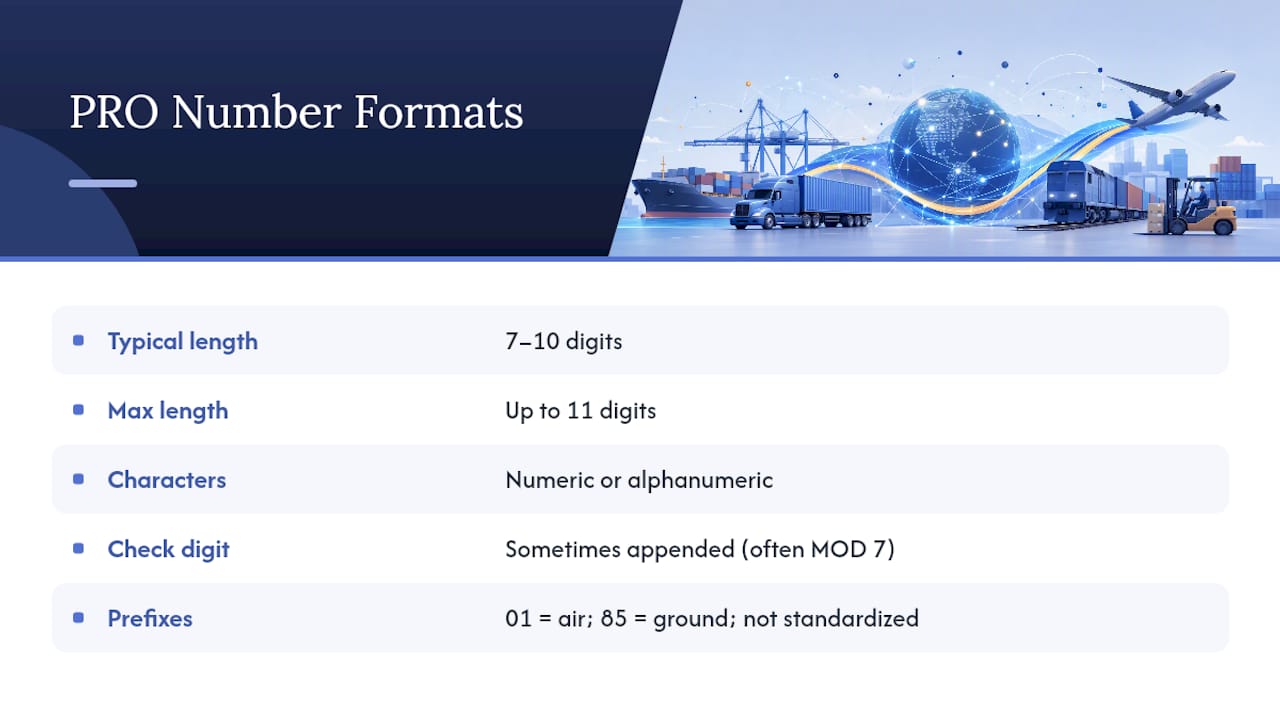
Some carriers append a check digit, often calculated with a MOD 7 algorithm, as the final character in the sequence, which helps their own systems catch data entry errors during scanning. A few glossaries also note that certain two-digit prefixes have historically hinted at mode, with 01 sometimes flagging air freight and 85 flagging ground. Treat that as a loose pattern, not a rule. Prefix meaning isn’t standardized across the industry, so don’t build automated logic in your TMS that assumes one carrier’s prefix convention applies to another’s.
Pro Tip: If you’re building validation rules for a warehouse management system or a multi-carrier TMS, don’t hardcode a fixed digit length. Pull actual sample PROs from each carrier you work with first, because a rule built around one carrier’s 10-digit format will silently reject a legitimate 9-digit PRO from another.
Pro Number vs. Bill of Lading vs. Tracking Number
These three identifiers get confused constantly, and using the wrong one with the wrong party wastes time on both ends.
The PRO number is carrier-issued and lives inside the carrier’s own tracking and billing system. It’s the number that unlocks live scan data, delivery status, and exception details when you call carrier support or log into their portal.
The Bill of Lading number, by contrast, is generated by the shipper or 3PL as the legal contract of carriage. It matters enormously for claims disputes, cargo insurance, and manifest-level questions, but it usually won’t pull up live tracking status on its own because carrier tracking systems are typically indexed by PRO, not BOL.
Parcel tracking numbers are a different animal entirely, assigned by small-package carriers and tied to a single box rather than a full freight shipment. If you’re moving LTL or truckload freight, you’re dealing with PRO numbers, not parcel-style tracking codes.
Here’s the practical rule: give the carrier your PRO number when you want live status or you’re escalating a delay. Reach for the BOL when the conversation is about contract terms, cargo value, or a claim that needs supporting documentation.
Where Can You Find Your Pro Number Right Now?
Start with the documents you already have on hand, then work outward:
- Check the Bill of Lading first. The PRO is usually printed near the top in a dedicated field.
- Pull up the freight bill or invoice from the carrier, which almost always lists the PRO for billing reference.
- Look at the shipping label or barcode sticker physically attached to the freight.
- Log into the carrier’s online portal or tracking page and search by shipment date, PO number, or reference number if you don’t have the PRO handy.
- Search your email inbox for the pickup or booking confirmation, which typically includes the PRO once it’s assigned.
- Check your EDI, ASN, or manifest files if your systems are integrated with the carrier electronically.
If a carrier’s terminal can’t locate a shipment by PRO, don’t assume the number is wrong. Cross-reference it with the carrier’s SCAC code, the exact pickup date and time, and the origin terminal, since interline handoffs sometimes generate a second, carrier-specific PRO that hasn’t synced to the terminal you’re calling yet.
How Do You Track a Shipment Using a Pro Number?
Once you have the number, tracking follows a predictable sequence:
- Locate the PRO on your BOL, freight bill, or confirmation email.
- Enter it into the carrier’s tracking portal, or pull it through your TMS if it’s integrated with that carrier’s system.
- Review the scan history and status events, which show pickup, transit checkpoints, and delivery attempts.
- Escalate with both the PRO and the carrier’s SCAC code if the portal shows no activity or the shipment appears stuck, since support teams need both pieces to pull accurate records.
Beyond the carrier’s own portal, you have a few other paths. Third-party freight tracking tools can aggregate multiple carriers into one dashboard if you manage volume across several providers. EDI and API pulls let larger shippers automate status checks directly into their own systems instead of manually checking portals. Mobile terminal scans, visible on some carrier tracking pages, show the exact dock or facility where the freight last moved.
Pro Tip: Watch for interlining. When a shipment moves from one carrier’s network to a partner carrier for part of the route, it can pick up a second PRO number specific to that partner’s system. If your tracking suddenly goes cold, ask the original carrier whether the load interlined and request the secondary PRO before assuming the shipment is lost.
Common Mistakes and Best Practices With Pro Numbers
The most frequent error is quoting a BOL number when a carrier representative asks for a PRO. It slows down every call, because their system is built around PRO lookups, not BOL lookups. A close second is assuming freight tracking behaves like parcel tracking, where a single number follows the shipment start to finish. It often doesn’t, especially across interline handoffs. Teams also lose time by failing to record the SCAC code alongside the PRO, and by not updating their system of record when an interline move generates a second identifier.
A few habits fix most of this:
- Standardize PRO capture as a required field in your TMS or shipping checklist, not an optional note.
- Always store the SCAC code paired with the PRO, since that pairing functions as the complete tracing mechanism carriers use internally.
- Preallocate carrier-authorized PRO ranges where your carrier relationship allows it, especially for high shipment volumes.
- Use the PRO number, not the BOL, as your primary reference when filing a claim.
Pro Tip: When escalating a claim, hand the carrier four things up front: the PRO number, the SCAC code, the exact pickup date and time, and a photo or scan copy if you have one. Claims teams move faster when they don’t have to chase down basic identifiers first.
How Usiship Uses Pro Numbers for Visibility and Billing
Inside a working freight operation, the PRO number is the thread that connects pickup to invoice. At Usiship, that means capturing the PRO and SCAC together the moment a load is tendered to a carrier, then printing both on the BOL and shipping label before the truck leaves the dock.
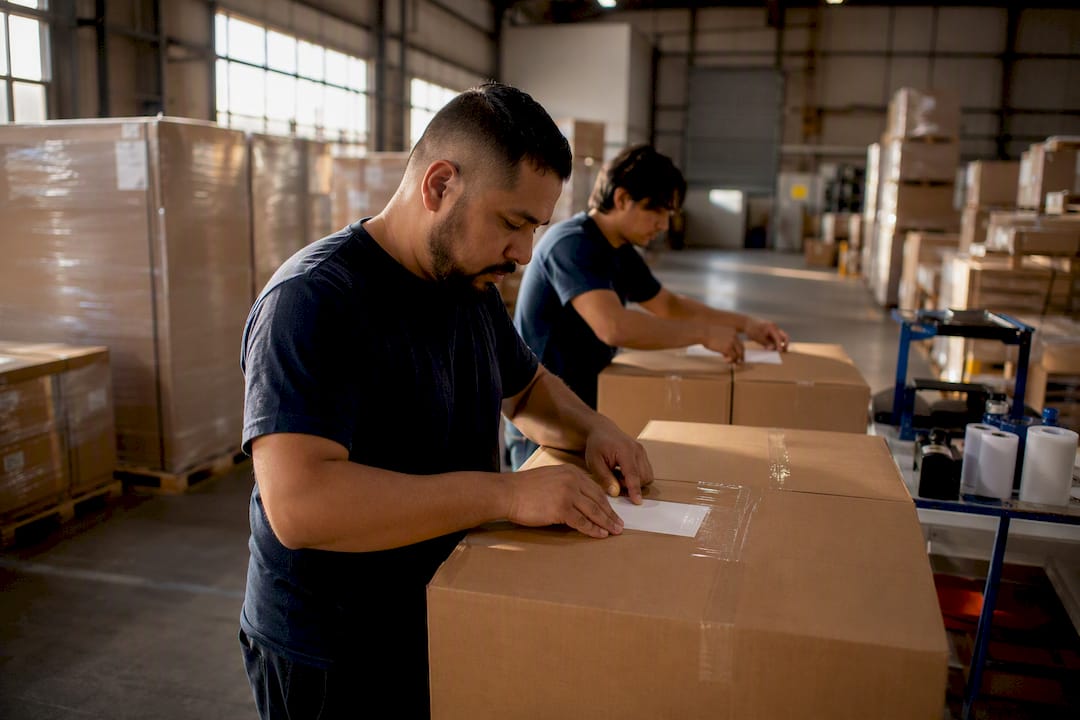
From there, the numbers get ingested into the TMS and EDI feeds so scan activity can be monitored in near real time instead of chased down manually. When a shipment throws an exception, whether it’s a delay, a damage report, or a missed delivery window, that PRO is what routes the issue to the right team quickly. On the billing side, freight bills get tied back to the PRO for accounts payable reconciliation, which keeps invoice disputes rare and fast to resolve when they do happen.
A logistics team’s take on getting this right
Recording the PRO and SCAC pair at the moment of tender, not after the fact, is the single habit that prevents more shipment headaches than any other process change we’ve seen. Add a required PRO and SCAC field to your shipping checklist or TMS validation rules this week. It costs nothing and it saves hours the first time a shipment goes sideways.
Frequently Asked Questions
What is a PRO number in simple terms?
A PRO number is the tracking identifier a freight carrier assigns to your shipment, used for live status checks, billing, and claims inside that carrier’s system.
What is the difference between a PRO number and a tracking number?
A PRO number applies to LTL and truckload freight and is tied to the carrier’s operational system, while a parcel tracking number usually applies to small-package shipments through services built around single-box tracking.
How do I find my PRO number if I only have a purchase order?
Check your pickup confirmation email or ask your carrier or 3PL to look up the shipment by PO number, pickup date, and origin, since they can usually match it to the assigned PRO.
Can a shipment have more than one PRO number?
Yes. When freight interlines between carriers, the partner carrier often assigns its own PRO for its leg of the move, so a single shipment can carry two identifiers.
Do I need the PRO number to file a freight claim?
You generally need both the PRO number and the SCAC code, along with pickup details, to file and track a freight claim efficiently.