
Per Diem Charges: Use the FMC 30 Day Rule to Fight $173–$197 Per Day
Per diem charges are daily fees that carriers, terminals, or equipment owners bill when a shipper keeps a container or chassis past the agreed free time. The single most important action you can take right now is to check your free-time clock against your gate and appointment timestamps, then confirm the invoice arrived within the window the Federal Maritime Commission requires. Invoice timing is now a legal defense, not just an administrative detail.
TL;DR:
- Matching gate timestamps and appointment records is critical because timely invoices must include specific details to be enforceable under FMC rules.
- Most detention or demurrage costs stem from operational delays, so contracts should explicitly define free-time, rates, and responsible parties to avoid disputes.
- FMC’s 2024 regulation mandates invoices within 30 days, and this deadline remains enforceable following the 2025 court ruling; late or incomplete invoices can be contested.
- Documenting container movements with receipts and logs strengthens your position in disputes, reducing the likelihood of unnecessary charges.
- Implementing operational controls and coordinating freight processes can significantly lower per diem exposure and avoid costly delays.
Table of Contents
- Quick glossary: per diem vs detention vs demurrage vs free time
- How per diem charges arise and who bills them
- U.S. regulatory rules that matter: the FMC rule and the court decision
- How to prevent or reduce per diem exposure
- Step-by-step dispute and mitigation playbook
- Forecasting and internal controls for per diem costs
- What shippers consistently get wrong about per diem
- How Universal Shipping helps you manage per diem risk
- Sources
- FAQ
Quick glossary: per diem vs detention vs demurrage vs free time
In U.S. container shipping, these terms get used loosely, but they mean different things.
- Per diem often refers to detention, the daily fee for keeping carrier equipment such as a container or chassis outside the terminal beyond free time.
- Detention applies specifically to equipment use once it leaves the terminal gate, and the DCSA shipping glossary draws this line clearly against demurrage.
- Demurrage applies to a container still sitting inside the terminal after free time expires, regardless of whether it ever left the yard.
- Free time is the number of days allowed before charges start, and the clock typically begins at vessel discharge, cargo release, or an agreed appointment, depending on the contract.
- Storage or yard fees are a separate terminal charge that can stack on top of demurrage when a container occupies space longer than the terminal’s own allowance.
Because these charges can overlap on a single invoice, matching each line item to its triggering event is the first step in any review.
How per diem charges arise and who bills them
Per diem charges start with an operational miss: a missed pickup appointment, a late equipment return, a container that gates out but never comes back on schedule, or a missed vessel cutoff that delays the whole cycle. Each of these resets or extends the clock differently depending on the contract and the port.
Three types of parties typically issue the bill:
- Vessel-operating common carriers (VOCCs) bill detention for equipment used beyond free time once it has left the terminal.
- Marine terminal operators (MTOs) bill demurrage for containers that overstay inside the facility.
- Equipment lessors bill per diem directly when a shipper or trucker holds leased chassis or containers longer than agreed, and these costs often pass through contracts to the shipper of record.
Combined detention and demurrage at major U.S. ports like Los Angeles and Long Beach can reach $173 to $197 per container per day, a range that makes clear why even a few days of delay on a single container can turn into a meaningful line item across a shipment program.
U.S. regulatory rules that matter: the FMC rule and the court decision
The FMC’s final rule on detention and demurrage billing practices took full effect on May 28, 2024, and it changed the leverage shippers have over disputed invoices. Carriers and terminal operators must issue invoices within 30 calendar days of the date the charges were last incurred, and the invoice has to include specific content such as the dates charges applied, the container number, and the applicable rate.
- Invoices missing required content, or sent to the wrong party, can be unenforceable under the rule.
- Billed parties get at least 30 calendar days from invoice receipt to request mitigation, a refund, or a waiver.
- A U.S. Court of Appeals decision issued in late 2025 set aside only the rule’s section on who may be invoiced, leaving the 30-day deadline and invoice content requirements intact.
For a shipper, the practical takeaway is that most of the compliance leverage from the 2024 rule still stands: a late or incomplete invoice remains a legitimate basis to contest a charge, even after the court narrowed one provision.
How to prevent or reduce per diem exposure
Most per diem exposure gets built into a contract long before a container ever reaches port, so the fix starts with understanding shipping options and cost considerations.
- Negotiate explicit free-time terms that state the exact number of days and the event that starts the clock.
- Lock in agreed per diem and detention rates in writing so a dispute never hinges on a verbal understanding.
- Define appointment and cutoff obligations clearly, including who is responsible for missed slots caused by terminal congestion versus shipper delay.
- Require the contract to name the billing party and specify invoice timing consistent with FMC rules.
On the operational side, require gate timestamp capture at every handoff, confirm appointments through a standing workflow rather than one-off calls, and set up dedicated staging or drop zones so equipment does not sit idle waiting for a dock door. Clear driver and carrier communication protocols close most of the remaining gap.
Pro Tip: Paying a reasonable, pre-agreed detention rate on time often costs less than the operational disruption of fighting every invoice, so reserve disputes for charges that are miscalculated, misdirected, or simply late.
Step-by-step dispute and mitigation playbook
When a per diem invoice lands, work through it in order rather than reacting to the total at the bottom.
- Check the invoice against the required content: dates, container or chassis number, applicable rate, and the billing party’s identity.
- Pull your own gate receipts and timestamps and compare them against the carrier’s claimed dates to confirm free time was actually exceeded.
- If the invoice is late, incomplete, or sent to the wrong party, file a mitigation or refund request within the 30-day window described in the Final Rule on Detention and Demurrage Billing Practices.
- Document every communication with dates and names attached, since this record becomes your evidence if the dispute escalates.
- If the carrier or terminal does not resolve the issue, escalate to FMC informal assistance, then a formal Charge Complaint if needed. An FMC initial decision shows how these administrative cases can involve demurrage, detention, and per diem charges stacked across many shipments, underscoring why early documentation matters.
Shippers with a strong freight-claims habit tend to move faster here; our freight claims playbook covers the same nine-month filing discipline that applies to per diem disputes.
Forecasting and internal controls for per diem costs
Treating per diem as an unpredictable cost is the most common budgeting mistake. Build a model using historical port-level per-day ranges, your actual carrier terms, and your own appointment compliance rate, then track a small set of operational numbers monthly.
- Arrival-on-time percentage tells you how much of your exposure is self-inflicted versus carrier- or terminal-driven.
- Free-time utilization flags containers that are consistently running close to the deadline before a fee ever appears on an invoice.
- Average per diem days per container gives you a single number to trend quarter over quarter.
Rising warehouse storage fees are a related planning factor, with U.S. benchmarks pointing to 40 to 80% higher fees by 2026, which makes it worth modeling storage and per diem exposure together rather than as separate line items. Recovery levers include contractual pass-throughs to the customer causing the delay, negotiated carrier terms, and chargebacks built into your own client contracts. A fuel surcharge index helps separate fuel-driven rate swings from the detention and demurrage costs you’re actually trying to control.
What shippers consistently get wrong about per diem
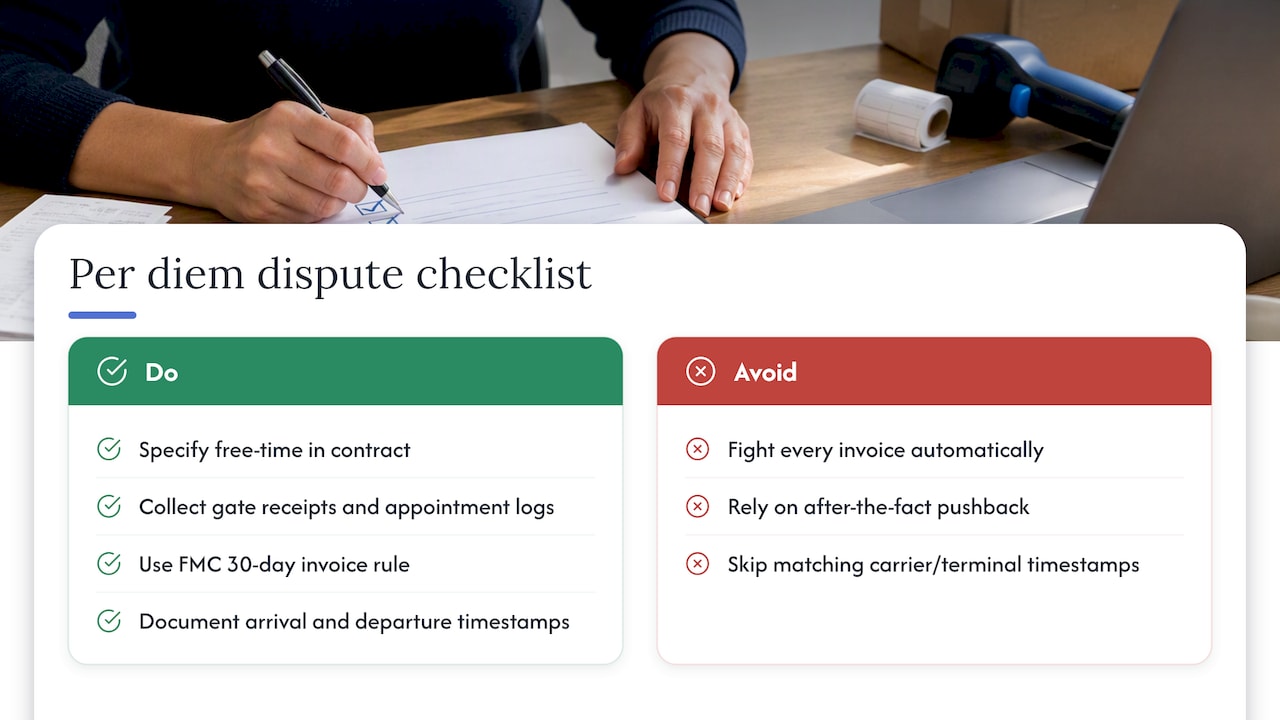
Most shippers treat every per diem invoice as a fight worth having, and that instinct costs more than it saves. Detention is compensation for the real use of equipment and driver time, not an automatic penalty to be contested on principle, and a contract with clear free-time language resolves more disputes before they start than any amount of after-the-fact pushback.
The bigger blind spot is documentation discipline. Carriers and terminals keep timestamp records as a matter of course, so a shipper without matching gate receipts and appointment logs starts every dispute from a weaker position, regardless of how legitimate the underlying complaint is. The FMC’s 30-day invoice rule gave shippers real leverage, but leverage only works when you can show, in writing, exactly when your container arrived and when it left.
— Akbar
How Universal Shipping helps you manage per diem risk
Fighting per diem charges one invoice at a time is expensive. The integration of freight forwarding, customs brokerage, and warehousing can reduce handoffs, leading to fewer chances for missed appointments or late returns that result in charges.

- Freight forwarding and customs brokerage keep cutoff and release timing coordinated instead of split across vendors.
- Warehousing and fulfillment give you a controlled drop point so containers move off port equipment faster.
- Contract audits and detention mitigation reviews check your existing carrier terms against FMC invoice requirements before a dispute ever happens.
A per-diem risk audit can include reviewing current contracts, estimating historical exposure, and developing a practical action plan to share with carriers. Visit our pricing and service plans to request a quote and see which tier fits your shipment volume.
Sources
FAQ
What is the difference between per diem and detention charges?
In U.S. shipping, per diem is usually another name for detention: a daily fee for keeping carrier equipment like a container or chassis beyond free time. Demurrage is a separate charge for a container that overstays inside the terminal itself, as the FMC explains.
How long do carriers have to send a per diem invoice?
Carriers and terminal operators must issue detention and demurrage invoices within 30 calendar days of the last day the charge applied, under the FMC’s final rule. An invoice that misses this window or lacks required content can be challenged.
Can I dispute a per diem charge after the 2025 court decision?
Yes. The D.C. Circuit only set aside the rule’s provision on who may be invoiced, so the 30-day deadline and invoice content requirements still apply and remain valid grounds for a dispute.
How much can per diem charges cost at major U.S. ports?
Combined detention and demurrage at ports like Los Angeles and Long Beach can run $173 to $197 per container per day, so a short delay on multiple containers can add up quickly. Rates vary by carrier contract and terminal.
What documentation do I need to dispute a per diem charge?
You need gate receipts and timestamps showing arrival, release, and return dates, compared against the invoice’s claimed dates and your contract’s free-time terms. Our freight claims guidance outlines the documentation habits that make a dispute easier to win.