
Peak Season Surcharge for Shippers: 2026 Guide
A peak season surcharge (PSS) is a temporary, demand-driven fee that carriers add on top of base rates when freight volumes spike beyond normal capacity. FedEx, UPS, USPS, and ocean carriers like Hapag-Lloyd all publish PSS schedules, and in 2026, carriers are levying new surcharges across multiple trades with fees higher than prior years. Three things every logistics team should know right now:
- Timing: Parcel surcharges typically run October through January; ocean PSS windows often span June through October, varying by lane.
- Billing basis: Parcel carriers charge per package; ocean carriers charge per container (TEU or FEU); air freight charges per kilogram.
- Immediate action: Pull your carrier contracts today, confirm your baseline volume definitions, and flag finance to budget for incremental surcharge costs this quarter.
Key Takeaways
Peak season surcharges are predictable, recurring costs that compound fast at volume. Shippers who model them in Q3 and negotiate contract terms before peak windows open consistently pay less than those who absorb published tariff rates without question.
| Point | Details |
|---|---|
| PSS is temporary but predictable | Parcel windows run roughly October–January; ocean windows typically June–October, varying by lane. |
| Billing basis varies by mode | Ocean charges per container, parcel per package, air per kilogram. All modes can hit the same shipper simultaneously. |
| Baseline rules drive parcel costs | UPS and FedEx use June volume baselines; growing shippers automatically fall into higher tiers without renegotiation. |
| USPS filings are public | PRC-filed holiday price changes show exact zone/weight increments you can model before the window opens. |
| Usiship reduces peak exposure | Distributed fulfillment, multi-modal routing, and licensed customs brokerage through Usiship give shippers concrete tools to shift volume and timing away from peak surcharge windows. |
Table of Contents
- What is a peak season surcharge, and how does it differ from other fees?
- Why do carriers apply a PSS?
- When and where does PSS apply?
- Which modes and shipment types does PSS cover?
- How is PSS calculated? Recent carrier examples
- How PSS hits your budget and operations
- Practical tactics to reduce your PSS exposure
- Regulatory and filing considerations in the United States
- A practitioner’s perspective on managing PSS
- How Usiship helps you control peak-season freight costs
- Sources
What is a peak season surcharge, and how does it differ from other fees?
A PSS is a temporary surcharge applied during predictable high-demand windows, distinct from other accessorial fees in both trigger and duration. A fuel surcharge fluctuates weekly with diesel or bunker fuel indices and never fully disappears. Demurrage charges punish a shipper for holding a container too long at a port. A holiday surcharge is narrowly scoped to a specific date range, often just a few days around a major holiday.
PSS is broader. It covers an entire season, sometimes two or three months, and reflects a carrier’s need to recover costs from capacity constraints, not just a single operational event. That distinction matters when you’re negotiating contracts: a fuel surcharge clause and a PSS clause need separate language, separate caps, and separate notice-period requirements. Conflating them in a master service agreement leaves you exposed to charges you thought were covered.
Why do carriers apply a PSS?
The economics are straightforward: when demand exceeds available capacity, the marginal cost of moving one more unit rises sharply. The U.S. Energy Information Administration describes the same dynamic in electricity markets, where peak demand raises wholesale prices and providers pass those costs through. Carriers do the same thing with freight.
Specific operational triggers include:
- Capacity shortages: Vessel space, aircraft belly capacity, and truck availability all tighten simultaneously as retail and e-commerce volumes surge.
- Equipment repositioning: Containers pile up in destination markets (U.S. West Coast, European ports) and must be repositioned empty to origin markets, at the carrier’s cost.
- Seasonal labor costs: Carriers hire temporary dock workers, drivers, and sortation staff at premium wages during peak windows.
- Hub congestion: Port and airport dwell times increase, reducing effective capacity and raising per-unit handling costs.
- Fuel and handling spikes: Fuel costs tend to rise with economic activity, and peak-season handling volumes push overtime and equipment wear costs higher.
A concrete example: when a Far East to U.S. West Coast trade lane experiences a surge in pre-holiday imports, carriers face a container imbalance. Empty boxes pile up in Los Angeles while origin ports in Shanghai and Ningbo run short. Repositioning those empties costs real money, and carriers recover it through a route-level PSS announced weeks before the peak window opens.
When and where does PSS apply?
The calendar varies by mode and trade lane, and conflating them is a common planning mistake.
Parcel (domestic U.S.): The holiday window is the dominant driver. FedEx and UPS typically activate surcharges in late September or October, with peak pricing concentrated in the weeks surrounding Thanksgiving and Christmas. FedEx’s 2026 schedule shows all surcharges active by October 26, with the highest tier running November 23 through December 27. UPS’s 2025 structure ran from late September into mid-January, with peak pricing around late November through late December.
Ocean (transpacific and transatlantic): The window typically opens earlier, often June 1, to capture pre-holiday inventory builds by U.S. importers. Hapag-Lloyd and other major carriers publish PSS notices for specific trade lanes, and the June–October window is common, though some carriers extend into November on high-demand routes.
Air freight: Peaks align with both the pre-holiday parcel surge (October–December) and, on certain lanes, Chinese New Year (January–February), when factory shutdowns create a rush to ship before the holiday and a backlog immediately after.
Rail and road: Harvest-season grain movements in the Midwest and Northern Plains can trigger seasonal rate increases on rail, with some carriers raising rates in fall windows for agricultural commodity lanes. Trucking rates follow a similar pattern, tightening in Q4 as retail replenishment competes with e-commerce fulfillment for available capacity.
Start/end dates are typically announced four to eight weeks in advance via carrier tariff bulletins and press releases. Hapag-Lloyd, for instance, publishes PSS notices on its website with explicit effective dates and per-container amounts by trade lane. Missing those announcements means you’re budgeting on stale rates.
Which modes and shipment types does PSS cover?
PSS applies across every major freight mode, but the billing basis differs, and so does who typically absorbs the cost.
| Mode | Billing basis | Typical fee structure | Who usually pays |
|---|---|---|---|
| Ocean (FCL) | Per container (TEU/FEU) | Fixed dollar amount per box | Importer (buyer) |
| Parcel | Per package | Tiered by service level and volume | Shipper/merchant |
| Air freight | Per kilogram | Rate per kg above base | Shipper/consignee |
| Rail | Per ton or per car | Seasonal rate premium | Shipper (commodity owner) |
| Truckload/LTL | Per shipment or per mile | Fuel + demand surcharge blend | Shipper |
A mid-size e-commerce importer can get hit in two places at once: a per-container PSS on the ocean leg bringing goods from Asia, then a per-package demand surcharge on the last-mile parcel delivery to the end customer. Contract pass-through language determines whether your 3PL or carrier absorbs any portion, but in most standard agreements, the shipper bears the full fee. Review your tariff incorporation clauses carefully, because carriers often update surcharge schedules by reference to their published tariffs, meaning a new PSS can become contractually binding without a contract amendment.
How is PSS calculated? Recent carrier examples
The math is not complicated, but the compounding is.
| Carrier | Mode | Fee range / example | Effective window | Notes |
|---|---|---|---|---|
| FedEx | Parcel (domestic) | Higher than 2025; peaks late Nov–Dec | Active by Oct. 26, 2026; peak Nov. 23–Dec. 27 | Includes residential and demand tiers |
| UPS | Parcel (domestic) | Per-package tiers by service type | Late Sept. 2025–mid-Jan. 2026 | Baseline set from June volume |
| USPS | Parcel (domestic) | Per-zone/weight increments | Oct. 5, 2025–Jan. 18, 2026 | Subject to PRC review |
| Hapag-Lloyd | Ocean (transpacific) | Per-container, varies by trade lane | Typically June–October | Published via PSS notices |
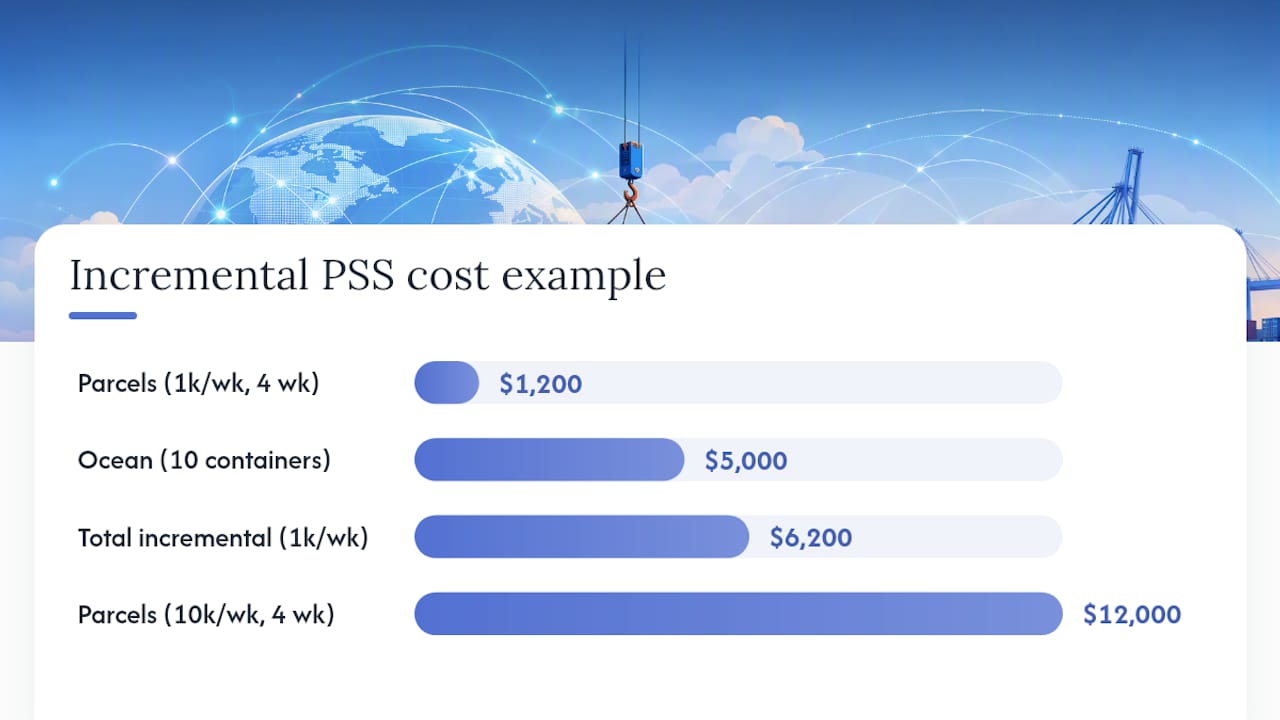
Worked example: Suppose you ship 1,000 e-commerce parcels per week through UPS and 10 ocean containers per month via Hapag-Lloyd. If UPS applies a per-package demand surcharge of $0.30 during peak weeks, that’s $300 per week, or roughly $1,200 across a four-week peak window. Add a $500 per-container PSS on 10 ocean boxes and you’re looking at $5,000 in incremental ocean costs for that month alone. Total incremental PSS exposure: approximately $6,200 for one month of normal operations. Scale that to 10,000 parcels per week and the parcel line alone becomes $12,000 for the same four-week window.
The baseline-volume mechanic makes this worse for growing shippers. UPS measures a customer’s baseline from June weekly volumes, then applies tiered surcharges when weekly shipments during peak exceed that baseline.
USPS’s 2025 filing with the Postal Regulatory Commission shows per-zone and per-weight increments for Priority Mail, USPS Ground Advantage, and Parcel Select, with an effective window of October 5, 2025 through January 18, 2026. That filing is public, zone-specific, and weight-specific, which means you can model the exact incremental cost for your shipment mix before the window opens.
How PSS hits your budget and operations
The per-package number looks small. The aggregate does not.
For an e-commerce merchant shipping 50,000 parcels in November, a $0.30 per-package surcharge adds $15,000 to that month’s shipping bill. If residential delivery carries an additional surcharge tier, as FedEx’s 2026 announcement shows with higher home delivery fees, the per-package cost compounds further. Residential surcharges stack on top of demand surcharges, not instead of them.

Beyond the direct cost, PSS creates operational pressure in three areas. First, packaging decisions: some shippers shift to lighter or smaller packaging to reduce dimensional weight charges that interact with surcharge tiers. Second, returns: peak-season return volumes arrive in January, often after the surcharge window closes, but the cost of processing those returns still reflects peak-season handling rates. Third, inventory timing: shippers who wait too long to build inventory end up shipping more units during the highest-surcharge weeks, paying premium rates on goods they could have moved in September.
Cash flow is the less-discussed impact. A $50,000–$100,000 incremental surcharge bill landing in December or January, on top of normal freight costs, can strain working capital for smaller importers and e-commerce businesses.
Pro Tip: Track your week-over-week shipment volume starting in July. If your weekly volume is drifting upward relative to your June baseline, you’re heading toward a higher surcharge tier. Catching that drift in August gives you time to negotiate a revised baseline or shift volume to an alternative carrier before the surcharge window opens.
Practical tactics to reduce your PSS exposure
Negotiation and operational planning both matter here. Neither alone is enough.
Contract negotiation checklist:
- Request an explicit PSS cap or ceiling in your master service agreement, expressed as a maximum dollar amount per package or per container.
- Negotiate the baseline definition. Ask for a rolling 13-week average instead of a single June month, which better reflects your actual shipping pattern.
- Require a minimum notice period (30 days is standard; push for 45) before any new surcharge takes effect.
- Ask for enterprise carve-outs: high-volume shippers often qualify for modified surcharge schedules that are not published in the standard tariff.
- Confirm whether your contract incorporates the carrier’s tariff by reference. If it does, every tariff update is automatically binding. Negotiate a change-of-terms clause instead.
Operational tactics:
- Shift fulfillment windows: move as much volume as possible into September and early October, before peak surcharge tiers activate.
- Pre-build inventory: bring ocean shipments in earlier in the year to avoid June–October PSS windows on transpacific lanes.
- Use distributed fulfillment: placing inventory closer to end customers through ecommerce fulfillment centers reduces last-mile distance and can shift some volume to lower-surcharge zones.
- Explore intermodal options: rail-to-truck combinations can sometimes avoid the highest-demand parcel surcharge tiers on certain domestic lanes.
- Incentivize early purchases: promotional pricing in September and early October pulls demand forward, reducing the volume concentration in the highest-surcharge weeks.
Shippers who combine volume forecasting with a multi-carrier strategy consistently outperform those who rely on a single carrier relationship. Running a volume-sensitivity model in Q3, before peak windows open, gives procurement teams the data they need to make credible counter-proposals to carriers.
Regulatory and filing considerations in the United States
USPS operates differently from private carriers because it must file temporary price changes with the Postal Regulatory Commission. That filing process is public and transparent. The 2025 holiday filing showed explicit per-zone and per-weight increases for Priority Mail, USPS Ground Advantage, and Parcel Select, with the effective window running October 5, 2025 through January 18, 2026. The PRC reviews these filings, and the approved schedule is published on the USPS newsroom and the PRC’s own docket system.
For private carriers like FedEx and UPS, there is no equivalent regulatory filing requirement. Surcharge schedules are published as tariff updates on carrier websites and announced via press releases. The legal mechanism is tariff incorporation: your shipping agreement references the carrier’s published tariff, and the carrier updates that tariff with new surcharge schedules. This is why monitoring carrier tariff pages directly, not just waiting for account manager notifications, is a compliance necessity.
When reviewing a carrier notice or tariff update, check four things: the effective date, the scope (which services and lanes are covered), the baseline or threshold that triggers the surcharge, and whether enterprise or contract accounts are carved out. A notice that says “applies to all accounts” may still have a separate rate schedule for high-volume contract customers. Ask your carrier rep directly, in writing, whether your account falls under the standard tariff or a negotiated schedule.
For customs clearance timing, importers can sometimes reduce ocean PSS exposure by clearing goods in-bond and holding them in a bonded warehouse, delaying formal entry until after the peak window closes. This requires coordination between your customs broker and your warehouse provider, but it’s a legitimate and underused tactic.
A practitioner’s perspective on managing PSS
The shippers who get hurt most by peak season surcharges are not the ones who fail to read the announcements. They’re the ones who read them and assume the published rate is the rate they’ll pay. Carriers negotiate. The published tariff is a ceiling, not a floor, and most enterprise shippers have more leverage than they use.
What actually changes outcomes is the combination of early forecasting and contract specificity. When a shipper comes to a carrier negotiation in August with a volume-sensitivity model showing projected weekly shipments through January, and a specific ask around baseline definitions and surcharge caps, the conversation is different. Carriers want to retain volume. A shipper who demonstrates they understand the math and have alternatives is in a fundamentally stronger position than one who waits for the invoice.
The multi-modal piece matters too. Shippers who treat ocean, parcel, and air as separate cost centers managed by separate teams miss the compounding effect. A coordinated strategy that pulls ocean inventory forward, uses distributed fulfillment to reduce last-mile parcel volume in peak weeks, and pre-clears goods through customs before congestion peaks can cut total PSS exposure materially. That kind of coordination is exactly what integrated logistics transportation services are built to provide.
How Usiship helps you control peak-season freight costs
Peak season surcharges hit hardest when your supply chain is rigid: one carrier, one fulfillment point, one clearance timeline. Usiship gives importers and e-commerce shippers the flexibility to shift volume, timing, and routing before surcharge windows open.
Usiship’s integrated platform covers ecommerce fulfillment with distributed U.S. inventory positioning, licensed customs brokerage for in-bond timing strategies, and multi-modal freight forwarding across air, ocean, and domestic ground. Instead of absorbing published tariff rates across all modes simultaneously, Usiship clients can pre-position inventory earlier in the year, route around congested lanes, and clear goods before peak windows drive up port dwell times and carrier fees. If you’re heading into Q4 with a single-carrier parcel contract and no baseline renegotiation on the table, the surcharge bill in January will be larger than it needs to be. Get a quote from Usiship and build a peak-season plan before October.
This article provides general logistics and freight information. Surcharge schedules, regulatory filings, and carrier tariffs change frequently. Confirm current rates and filing status directly with your carrier or a qualified logistics professional before making contracting or budgeting decisions.
Sources
Check these sources regularly starting in July, and increase your monitoring frequency to weekly once August arrives.