
8–18 Pallets: Partial Truckload Rules for U.S. Logistics Managers
Partial truckload (PTL) shipping moves freight too big for standard LTL but not large enough to fill a trailer, typically 8 to 18 pallets or 8,000 to 30,000 pounds. Once your shipment clears roughly six pallets, PTL usually beats standard LTL on speed and damage risk, though you’ll pay a premium versus space-based pricing. Below that threshold, stick with LTL. Above 18 to 20 pallets, get an FTL quote too.
TL;DR:
- PTL typically moves 8 to 18 pallets or 8,000 to 30,000 pounds, with direct routing and fewer touches, making it faster and less damaging than volume LTL.
- Carriers often provide flat per-load rates after capacity checks, and rates fluctuate daily based on lane demand, freight density, and accessorial needs.
- Proper packaging, labeling, and accurate documentation are crucial for preventing damage claims and unexpected accessorial charges in PTL shipments.
- Booking PTL is usually a manual process involving negotiations and capacity checks, with rates often comparable to FTL once shipments exceed 10 pallets.
- Optimal for shipments with fragility, tight delivery windows, or high damage risk, PTL minimizes handling and transit time but requires upfront planning to avoid cost volatility.
Table of Contents
- What Is Partial Truckload Shipping, and How Does It Differ From LTL and FTL?
- PTL vs Volume LTL vs FTL: Which Wins for Your Shipment?
- What Are the Business Benefits of Partial Truckload Shipping?
- How Does Partial Truckload Shipping Actually Work?
- What Drives the Cost of Partial Truckload Shipping?
- How Do You Prepare a Partial Truckload Shipment?
- What Should You Ask a PTL Carrier or Broker Before Booking?
- Who Handles PTL Logistics for U.S. Shippers?
- What Environmental Factors Matter in Partial Truckload Shipping?
- What Are the Biggest Risks in Partial Truckload Shipping, and How Do You Avoid Them?
- An Operational Take on When PTL Actually Pays Off
- Get a Partial Truckload Quote Built for Your Lane
- Sources
What Is Partial Truckload Shipping, and How Does It Differ From LTL and FTL?
Four freight modes cover almost every shipment size a mid-sized shipper deals with, and picking the wrong one either wastes money or slows delivery. Standard LTL handles small shipments, usually 1 to 5 pallets under about 5,000 pounds, priced by freight class and the density of your goods. Volume LTL covers a step up, roughly 6 to 12 pallets, where the shipment starts eating an entire truck’s worth of floor space even though it’s still billed through LTL-style logic.
Partial truckload sits above that. It behaves more like a small full truckload than a big LTL shipment, moving with direct routing and a flat negotiated rate instead of class-based pricing. Full truckload, obviously, means you’re paying for the whole trailer regardless of how much of it you actually fill.
The mode boundaries aren’t rigid. Carriers set their own cutoffs, and freight density matters as much as pallet count.
- Standard LTL: 1 to 5 pallets, under 5,000 lbs, class-and-space pricing
- Volume LTL: 6 to 12 pallets, terminal-network handling, space-based discount pricing
- PTL: 8 to 18 pallets or 8,000 to 30,000 lbs, flat per-load rate, direct routing
- FTL: dedicated trailer, flat rate regardless of fill percentage
Notice the overlap between volume LTL and PTL in the 8 to 12 pallet range. That’s not a mistake in the numbers. It’s the zone where you should be quoting both.
PTL vs Volume LTL vs FTL: Which Wins for Your Shipment?
The three modes trade off against each other on exactly three variables: how many times your freight gets touched, how fast it arrives, and what it costs. Get familiar with the tradeoffs and you can make the call in minutes instead of waiting on three separate quotes every time.
- Handling touches. Volume LTL usually moves through a terminal network with four to six touch points (pickup, origin dock, linehaul, destination dock, delivery, sometimes a transfer in between). PTL moves with one or two touches, often loading direct from your dock to the destination with no terminal stop.
- Damage exposure. Fewer touches means fewer forklift moves, fewer chances for a pallet to get crushed or mishandled at a cross-dock. If you ship anything fragile, glass, electronics, upholstered furniture, that handling difference is the whole reason to pay more for PTL.
- Cost crossover. FTL rates don’t scale down linearly with shipment size, so once you’re north of 10 pallets, a full truckload quote can land surprisingly close to a PTL rate. Always request an FTL quote alongside PTL and volume LTL once you cross that line, because the rate difference is often smaller than shippers expect.
- The gray zone rule. Between 6 and 12 pallets, quote all three modes every time. Lane, freight class, and current carrier capacity swing the winner more than shipment size alone.
Transit time follows the same logic as touches: fewer stops means faster delivery, and PTL transit is often comparable to FTL on the same lane, typically a day or two faster than standard LTL on longer corridors.
What Are the Business Benefits of Partial Truckload Shipping?
Speed and reduced handling are the two headline benefits, but they translate into real operational wins depending on what you’re shipping. A retailer replenishing stores on a tight planogram calendar cares about schedule reliability. A furniture importer cares about arriving without a cracked leg or a torn cushion. PTL serves both because it minimizes the variables that cause delays and damage in the first place.
- Faster transit: direct or near-direct routing cuts days off multi-terminal LTL transit
- Lower damage claims: one or two handling touches versus four to six in a terminal network
- Better schedule predictability: fewer connection points means fewer chances for a missed linehaul
- Right-sized cost: cheaper than booking a full trailer you can’t fill
The freight profiles that benefit most share a pattern: moderate density, some fragility, and a delivery window that actually matters. Retail replenishment orders, furniture and case goods, and industrial components headed to a production line all fit that description. If a stockout or a late delivery costs you more than the PTL rate premium, the math favors PTL almost automatically.
Pro Tip: If you ship the same lane regularly at 8 to 15 pallets, ask about a short-term recurring PTL commitment. Carriers often price contracted mini-dedicated capacity lower than one-off spot quotes, and your service consistency improves because the carrier already knows the lane.
How Does Partial Truckload Shipping Actually Work?
Booking PTL looks less like clicking an instant LTL rate and more like negotiating a small charter. Most partial and volume freight over roughly 6 pallets or 5,000 pounds gets flagged for a human-reviewed, flat-fee quote rather than an automated class-rate calculation, because the carrier needs to check lane capacity and current trailer availability before committing to a price.
Here’s the typical flow once you submit shipment details:
- A broker or carrier checks lane-specific capacity and quotes a flat per-load rate, not a class rate
- Your freight may be co-loaded with one or two other shippers’ pallets headed the same direction, or it may move alone if volume justifies it
- The trailer routes directly to the destination area with minimal terminal handling, unlike the multi-stop LTL network
- Tracking is typically load-level rather than pallet-scanned at every terminal, since there are fewer handoffs to log
Rates fluctuate daily based on available capacity, which is why partnering with a broker or TMS with rate-retrieval tools speeds up procurement instead of forcing you to call around every time you need a number. A road freight TMS platform that pulls live lane rates saves real time if you’re booking PTL more than occasionally.
What Drives the Cost of Partial Truckload Shipping?
PTL pricing works nothing like standard LTL. Instead of a rate built from freight class, NMFC code, and cubic space, you’re negotiating a flat per-load number that reflects the specific lane and truck availability that week.
Five variables move that number the most: the lane itself (rural destinations cost more than major corridors), freight density and dimensions (heavy, dense freight is cheaper per pound than bulky, light freight, a distinction that matters even more for dimensionally complex items like custom metal parts), total pallet count or linear feet used, accessorial charges (liftgate, inside delivery, limited-access sites), and fuel surcharges tied to seasonal demand.
- Compare the base rate, not just the total, across at least two carriers
- Add accessorials and fuel surcharge into your total landed cost before comparing quotes side by side
- Ask about re-weigh and reclassification policies before you book, not after a dispute
- Factor in expected damage and delay risk, not just dollars per mile
Volume and partial rates change daily depending on carrier capacity, which is exactly why a quote you got last Tuesday may not hold this Thursday. Itemized quotes protect you here: demand a breakdown of accessorials and minimums up front, because unclear reclass policies are the single most common source of surprise charges on partial freight invoices.
How Do You Prepare a Partial Truckload Shipment?
Good prep prevents the two things that ruin a PTL shipment: damage claims and surprise accessorial fees. Since your freight is co-loaded or handled with less padding than a dedicated FTL trailer, packaging quality matters more here than on a full truckload.
- Palletize and secure properly. Use a pallet rated for your freight weight, shrink-wrap tightly, and strap anything top-heavy so it survives a shared trailer with other shipments shifting around it.
- Label every unit clearly. Include your PO number, destination address, and pallet count on each pallet, not just the master bill of lading.
- Complete the bill of lading accurately. List correct weight, NMFC class if applicable, and accessorial needs (liftgate, appointment delivery) before pickup, not at delivery.
- Declare accurate freight value. Underdeclaring value to save a few dollars on cargo insurance backfires badly if a claim ever needs filing.
- Flag hazardous or limited-quantity items. Regulated goods need proper documentation under DOT limited-quantity compliance rules before they ever reach the dock.
Skipping any of these steps is exactly how a clean PTL rate turns into an invoice full of reclass and inspection fees.
What Should You Ask a PTL Carrier or Broker Before Booking?
Not every carrier handling PTL freight operates the same way, and the differences show up as late deliveries or unexpected charges if you don’t screen for them up front. Treat this like a short RFQ checklist rather than a gut-feel decision.
- Ask about lane capacity and how often they run your specific route
- Request their claims history and average resolution time for damaged freight
- Confirm tracking capability, load-level GPS at minimum, ideally with TMS integration
- Verify cargo insurance limits and whether declared value coverage is automatic or add-on
- Get accessorial charges itemized in writing, not verbally quoted
- Ask directly whether they co-load with other shippers or guarantee a dedicated trailer
A carrier who dodges the claims-history question or gives vague answers on accessorials is a red flag worth walking away from, regardless of how competitive their base rate looks.
Who Handles PTL Logistics for U.S. Shippers?
Universal Shipping Inc. runs domestic freight transportation across all 50 states, including PTL, LTL, and FTL, with lane-specific quoting instead of generic rate calculators. That matters for PTL specifically, since accurate quotes depend on real-time capacity checks, not static rate tables.
Cross-docking, warehousing, and real-time tracking run on the same platform, which cuts the coordination gap between booking a PTL load and knowing where it actually is. For shippers moving bulky, fragile freight like furniture, that integrated visibility reduces the handoff errors that cause most PTL claims.
What Environmental Factors Matter in Partial Truckload Shipping?
Fewer handling touches don’t just cut damage risk, they cut fuel burn too. A shipment that moves direct from origin to destination in one PTL load skips the multiple linehaul legs and terminal transfers that a volume LTL shipment typically runs through, and each of those legs burns diesel independently.
Co-loading is where PTL earns its sustainability case most clearly. Sharing trailer space with another shipper’s freight headed the same direction means one truck moves two shipments instead of two half-empty trucks moving separately. That’s a meaningful efficiency gain over booking a full truckload you can only fill halfway, since an underfilled FTL trailer burns roughly the same fuel as a full one while moving less freight per gallon.

Route consolidation plays a role too. Carriers running PTL lanes tend to batch shipments along established corridors rather than routing through a sprawling terminal network, which shortens total miles driven per pound of freight delivered. If your company tracks Scope 3 emissions from freight transport, mode choice is one of the more controllable levers you have, and shifting appropriate shipments from FTL to PTL or from multi-touch volume LTL to direct PTL routing is a practical way to trim miles without changing what you ship or how often. It won’t replace a broader sustainability program, but it’s a lever that costs nothing extra to pull once you know the thresholds.
What Are the Biggest Risks in Partial Truckload Shipping, and How Do You Avoid Them?
Three problems account for most PTL headaches, and all three are preventable with the right upfront questions.
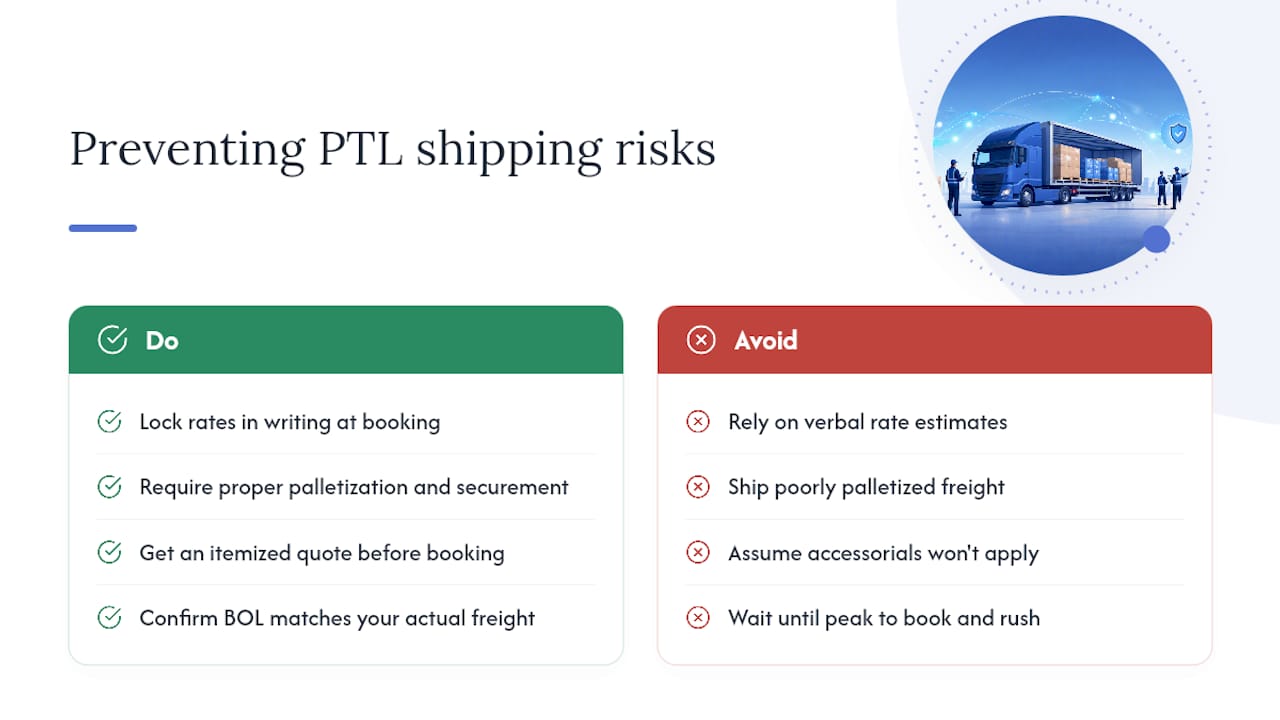
Rate volatility tops the list. Because partial and volume rates change daily based on carrier capacity, a quote from last week may not hold today. Lock in rates in writing at booking, and don’t assume a verbal estimate from a broker call will match the final invoice.
Co-load damage risk comes second. Sharing trailer space means your freight sits next to someone else’s pallets, and poor securement on either side can cause shifting damage in transit. This is exactly why palletization quality matters more for PTL than for a dedicated FTL trailer where your freight rides alone.
Accessorial surprises round out the top three. Liftgate fees, limited-access delivery charges, and reclassification after a carrier reweighs your freight are the most common sources of invoice disputes. The fix is procedural: get an itemized quote before booking, confirm your BOL details match your actual freight exactly, and ask about the carrier’s reweigh policy before you have a dispute, not during one.
Capacity crunches during peak shipping seasons (typically Q4 retail season) can also push PTL rates up sharply on popular lanes. Booking a few days earlier than you think you need to during those windows avoids getting stuck paying an expedited premium.
An Operational Take on When PTL Actually Pays Off
Default to PTL once fragility, lead time, or claims history outweigh the rate premium. Below that threshold, keep quoting LTL and FTL alongside it. Cost, speed, and damage risk rarely all favor the same mode, so the discipline of comparing them is what actually saves money.
— Akbar
Get a Partial Truckload Quote Built for Your Lane
Universal Shipping Inc. quotes PTL, volume LTL, and FTL side by side on the same request, so you’re not chasing three separate carriers to find out which mode actually wins on your lane this week. Nationwide coverage across all 50 states means the lane-capacity checks that make PTL pricing accurate happen in-house rather than through a patchwork of regional brokers.
Warehousing, cross-docking, and real-time tracking run on the same platform as the freight booking itself, which is exactly the kind of integration that cuts handling errors on co-loaded PTL shipments. Whether you’re moving retail replenishment pallets, bulky furniture, or industrial components, request a freight quote and get a lane-specific rate comparison across PTL, LTL, and FTL before you book your next shipment.