
Pass OSHA Audits: 4 Pallet Stacking Checks for U.S. Warehouses
OSHA doesn’t give you a magic number for stacking pallets. It requires that stacked materials be stable and secure against sliding or collapse, full stop. That means the real work falls on you: set written height and weight limits for your facility, inspect pallets before they go up, wrap or band every load, and keep sprinkler heads and aisles clear. Get those four things right and you’ve covered the core of pallet stacking rules that actually hold up in an audit or an incident review.
TL;DR:
- Most warehouses set their own stacking height limits around 4 to 6 pallets high, typically between 48 and 75 inches, with 60 inches being a common baseline.
- Maintaining at least 18 inches clearance between the top of a stack and sprinkler deflectors is essential to avoid fire code violations and ensure sprinkler effectiveness.
- Proper unitization through wrapping, banding, or corner boards is critical to prevent shifting and must be verified during daily inspections.
- Stacks should not lean, overhang pallets, or block aisles, and damaged pallets or irregular loads should be segregated to reduce collapse risk.
- Regular staff training, documented policies, and inspections are essential to ensure safe stacking practices and prevent incidents.
Table of Contents
- What OSHA Actually Requires for Pallet Stacking Rules
- How High Can You Stack Pallets? Setting Height and Clearance Limits
- Choosing the Right Pallet Stacking Pattern
- Checking Weight Distribution Against Pallet and Rack Capacity
- Hazards That Cause Pallet Stacks to Fail
- Inspection Checklist and Forklift Rules for Safe Stacking
- Adapting SOPs From Universal Shipping’s Palletizing Guides
- Stacking Rules for Fragile, Hazardous, and Perishable Goods
- How Humidity, Temperature, and Vibration Affect Stack Stability
- Emergency Response When a Pallet Stack Fails
- Training and Competency Standards for Pallet Handling Staff
- The Real Trade-Off Between Storage Density and Safety
- Get Help Implementing Safer Pallet Stacking SOPs
- Sources
- FAQ
What OSHA Actually Requires for Pallet Stacking Rules
OSHA’s general industry standard, 29 CFR 1910.176(b), states that materials stored in tiers must be “stacked, blocked, interlocked, and limited in height so that they are stable and secure against sliding or collapse.” Notice what’s missing: a number. There’s no federal ceiling that says pallets can go 5 feet high and no higher. Instead, OSHA writes a performance standard, and inspectors judge your facility by outcomes, not by a checklist of inches.
In cargo and maritime settings, 1917.14 governs stacking of cargo and pallets, reiterating that stacked loads must resist sliding and collapse in those specific work environments. Inspectors reviewing a general warehouse look for foreseeable hazards, not a tape measure violation.
- Stacks leaning visibly or showing signs of shifting under load
- Aisles narrowed or blocked by overflow pallets
- Loads placed without any wrap, banding, or interlocking
- No documented facility policy on maximum stack height
If you can’t show a written policy and evidence you enforce it, you’re exposed even if nothing has fallen yet. OSHA’s enforcement logic rewards documentation as much as physical stability.
How High Can You Stack Pallets? Setting Height and Clearance Limits
Because federal rule leaves height open, most warehouses build their own operational benchmarks. A common default among facilities storing boxed goods is 4 to 6 pallets high, roughly 48 to 75 inches, with many operations landing on 60 inches, or 5 feet, as a conservative baseline for general merchandise.
Sprinkler clearance is the number that gets overlooked most. Facilities commonly keep at least 18 inches between the top of a stack and the sprinkler deflector. Stack past that line and you’re not just risking a fall. You’re compromising fire suppression coverage for the whole zone, which is the kind of violation that turns a minor citation into a serious one.
Lower your limits below the standard benchmark when:
- Pallets are damaged, mismatched, or of uncertain load rating
- Product is irregular, top-heavy, or poorly unitized
- The storage zone sits near heavy forklift traffic or vibration sources
- Ceiling height, rack beams, or seismic bracing constrain vertical space
Treat these benchmarks as a starting point, not a ceiling you default to everywhere in the building.
Choosing the Right Pallet Stacking Pattern
The pattern you choose determines how forgiving your stack is when something isn’t perfectly uniform. Four patterns cover almost every scenario a warehouse floor sees.
- Column stacking. Boxes stack directly on top of each other, corner over corner. Fast to build, but weak against side pressure. Best for uniform cartons that are already strong and won’t shift.
- Interlock, or brick, stacking. Each layer rotates so seams don’t line up vertically. This distributes weight sideways and resists toppling far better than column stacking, which makes it the right call for mixed-size cartons or anything shipped rough.
- Block stacking. Pallets sit directly against each other in tight rows with no rack structure. It maximizes floor density but sacrifices selectivity and airflow, so it works best for high-volume, low-SKU-count storage.
- Split-block stacking. A hybrid that leaves narrow gaps between block groups for inspection access and airflow, useful when block stacking perishable or moisture-sensitive goods.
Whatever pattern you choose, unitize before you stack. Stretch wrap, strapping, and corner boards turn a loose pile of boxes into a single rigid unit, and slip sheets between layers stop shifting when a forklift jostles the base pallet during transit.
Checking Weight Distribution Against Pallet and Rack Capacity
Every rack beam carries a placard listing its rated capacity, usually broken into per-level and per-bay figures. Ignore that placard and you’re stacking blind. The math itself is simple: add the pallet’s tare weight to the product weight, multiply by the number of pallets in the stack, and compare the total against both the pallet’s stated load rating and the rack’s per-level limit, whichever is lower.
A few things trip up otherwise careful operations:
- Static rating (weight while stationary) and dynamic rating (weight while being moved or vibrated) are different numbers. Use the dynamic figure when forklifts are actively working the stack.
- Pallet tare weight varies by material. A standard wood pallet weighs far less than a heavy-duty plastic or metal one, and skipping that figure in your math understates the real load.
- Uneven weight across a single pallet, not just total weight, causes lean and collapse even when the total stays under the rated limit.
When a load approaches the rated capacity of your racking, or you’re storing something outside typical parameters, loop in the rack manufacturer or a structural engineer before you commit product to the shelf. That call costs you a day. A rack failure costs you the aisle, the inventory, and possibly a worker.
Hazards That Cause Pallet Stacks to Fail
Most stack failures trace back to a handful of repeat offenders, and none of them require exotic conditions to show up.
- Leaning stacks that started slightly off-plumb and got worse with each added layer
- Damaged or mismatched pallets mixed into a single stack
- Product overhang past the pallet’s edge, which concentrates stress on the deck boards
- Stacks built taller than the facility’s own posted limit because “it fit”
- Aisles narrowed by overflow, cutting off forklift maneuvering room and emergency egress
The fix isn’t complicated, but it does require consistency. Segregate damaged pallets into a clearly marked repair or scrap zone instead of letting them re-enter rotation. Designate storage zones by product type and stack height so operators aren’t making judgment calls on the fly. Repair uneven floor sections promptly, since a half-inch dip under one corner of a pallet is enough to start a lean that compounds four layers up.
For taller or higher-risk stacks, physical restraints earn their cost: guard rails at aisle intersections, pallet clips that lock adjoining units together, or netting over block-stacked zones prone to shifting.
Pro Tip: Walk your highest-risk stacking zone at the end of a shift, not the start. Product has settled, forklifts have bumped things all day, and lean shows up far more obviously after eight hours of activity than it does on a fresh morning stack.
Inspection Checklist and Forklift Rules for Safe Stacking
A short daily inspection prevents more incidents than any engineering control you can bolt on afterward. Build these into a pre-shift routine and don’t treat them as optional.
- Check pallet condition first. Cracked deck boards, missing blocks, or protruding nails disqualify a pallet from stacking, no exceptions.
- Confirm unitization. Every stacked load should be wrapped, banded, or otherwise secured before it goes vertical, not after.
- Eyeball stack plumbness. A stack that’s visibly off-vertical gets corrected or broken down immediately, not monitored “for now.”
- Inspect the floor surface. Cracks, debris, or standing liquid under a stacking zone get flagged and cleared before product goes down.
- Verify forklift technique. Forks should engage at least three-quarters of the pallet’s depth, loads should travel low, and operators moving stacked pallets should be certified, not just experienced.
Put your facility’s stacking limits in writing, post them at the storage zone, and define an escalation path for what happens when someone spots a stack that violates policy. A verbal rule that lives in a supervisor’s head isn’t a policy. It’s a liability waiting for a shift change.
Adapting SOPs From Universal Shipping’s Palletizing Guides
Universal Shipping’s own operational guide, 5 Steps to Palletize Freight That Passes LTL, walks through the same checkpoints freight carriers inspect before accepting a shipment: pallet condition, load unitization, weight distribution, and labeling. It’s a practical starting point for building an internal SOP rather than writing one from scratch.
Density-versus-cost trade-offs show up constantly in warehouse operations, and the numbers can swing hard depending on region and facility type. Universal Shipping’s benchmark data on warehouse storage fees gives a sense of how much stacking discipline and space efficiency actually affect the bottom line, not just the safety column. Facilities running tighter, better-documented SOPs tend to see fewer damaged-goods write-offs and fewer wasted labor hours reworking unstable stacks.
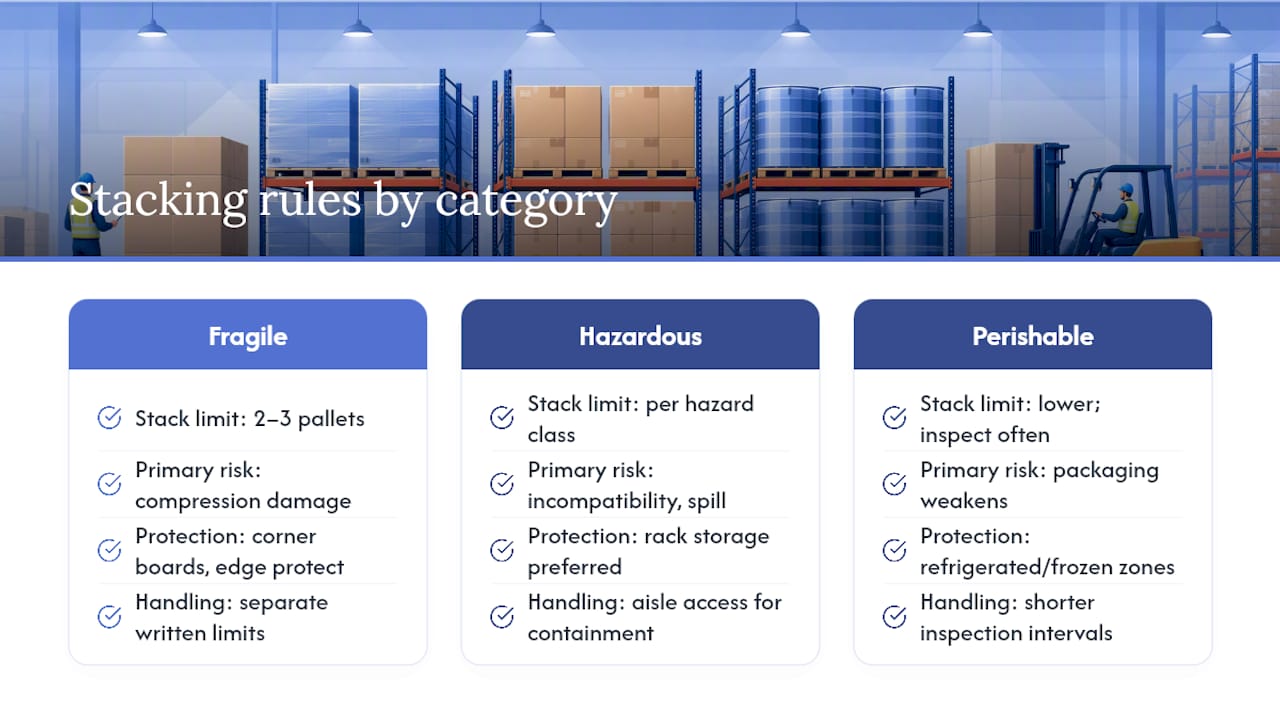
Stacking Rules for Fragile, Hazardous, and Perishable Goods
General stacking benchmarks assume uniform, sturdy cartons. Fragile, hazardous, and perishable freight all break that assumption in different ways, and treating them identically is where a lot of preventable damage and injury comes from.
Fragile goods need lower stack limits than your standard benchmark, often capped at two or three pallets high regardless of what your general policy allows. Compression from layers above crushes packaging long before a visible collapse happens, so damage often shows up only when the customer opens the box. Corner boards and edge protection matter more here than raw wrap quantity, since point pressure at the corners is usually what fails first.
Hazardous materials carry their own regulatory layer on top of general stacking rules, including segregation requirements that keep incompatible chemical classes from being stored or stacked together. Stack height limits for hazardous freight should account for spill containment access and the ability to reach any single pallet without disturbing others, which usually rules out tight block stacking in favor of rack storage with clear aisle access on all sides.
Perishable goods introduce a stability variable that has nothing to do with weight: temperature and humidity cycling weakens corrugated packaging over time, so a stack that was stable on day one can loosen by day five. Refrigerated and frozen storage zones need shorter inspection intervals than dry storage, precisely because the packaging itself is degrading while it sits.
The common thread across all three: your facility’s default height and weight limits are a baseline for standard freight, not a rule that applies uniformly to everything crossing the dock. Build separate, written limits for each product category you regularly handle, and train staff to recognize which category a given pallet falls into before it gets stacked, not after.
How Humidity, Temperature, and Vibration Affect Stack Stability
Environmental conditions change how a stack behaves even when nothing about the load itself has changed. Warehouse managers who only think about stacking rules in terms of height and weight are missing half the picture.
Humidity softens corrugated cardboard over time, and a pallet load that was rock solid when it arrived can sag and shift weeks later in a humid storage environment. This is a bigger problem in non-climate-controlled facilities near coastal regions or during summer months, where ambient moisture creeps into packaging gradually. Check stacks in humid zones more frequently than your standard inspection interval, and consider shrink wrap rated for moisture resistance rather than standard stretch film.
Temperature swings cause a related but distinct issue: packaging materials expand and contract, and repeated cycling loosens banding and wrap tension over time. A stack banded tightly in a 70 degree loading dock can arrive at a 40 degree cold-storage zone with noticeably looser tension within days.
Vibration is the most underestimated factor of the three. Facilities with heavy forklift traffic, nearby conveyor systems, or uneven concrete floors should lower their stack-height limits and inspect more often, because constant low-level vibration gradually walks a stack out of plumb even without any single dramatic event causing it. This is why a stack near a busy cross-aisle needs a different height policy than the same product stored in a quiet corner of the same building.
None of these factors show up on a static load rating chart. They show up in daily observation, which is exactly why a five-minute walk-through beats a one-time engineering calculation every time.
Emergency Response When a Pallet Stack Fails
A collapsed stack is a different situation than the near-misses your inspection checklist is designed to catch, and your team needs a clear, rehearsed response rather than an improvised one.
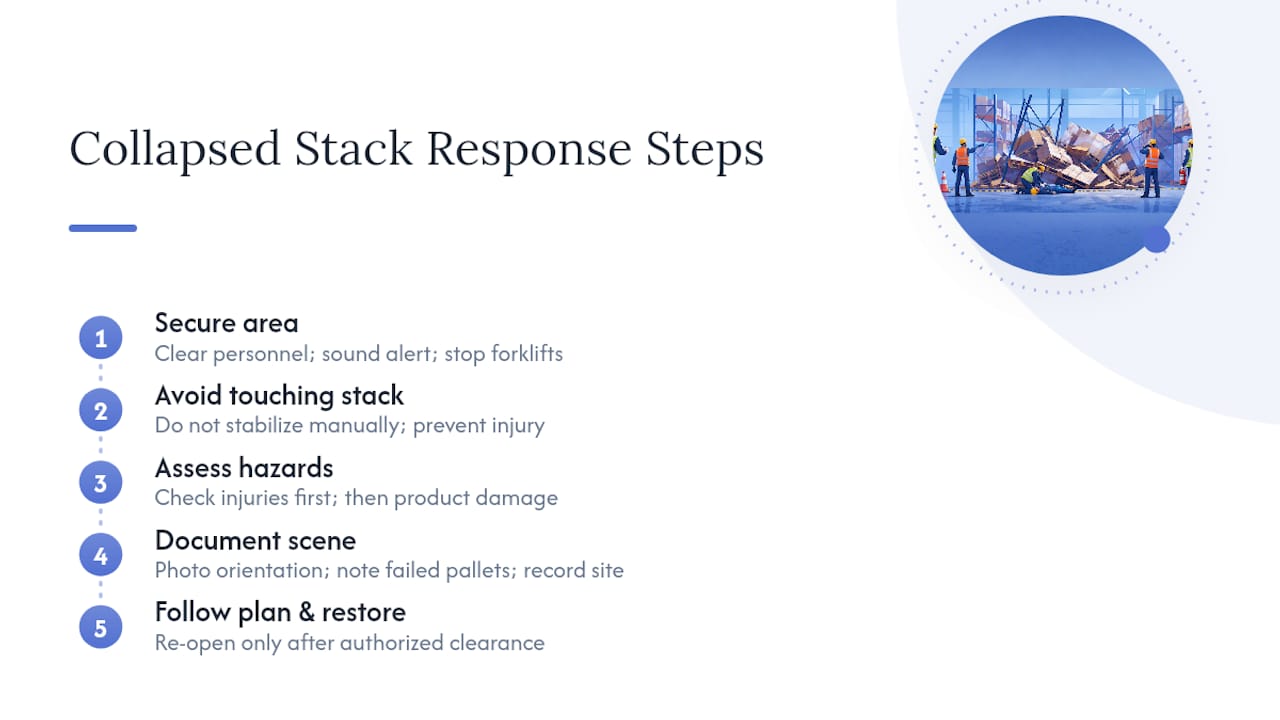
The immediate priority is clearing personnel from the fall zone and any adjacent aisles, since a partial collapse often precedes a full one by seconds, not minutes. Sound an alert, stop forklift traffic in the affected zone, and do not attempt to stabilize or right a leaning stack manually. Pushing against a compromised stack, even with good intentions, is one of the more common ways a bystander gets injured during what would otherwise have been a contained equipment-only incident.
Once the area is clear, assess for injuries first and product damage second. If hazardous materials were part of the collapsed load, treat the area as a containment zone until you’ve confirmed nothing has spilled or ruptured, and follow your facility’s hazmat response protocol rather than general cleanup procedures.
Document the collapse before cleanup begins wherever it’s safe to do so: photograph the stack orientation, note which pallets failed, and record the storage zone’s conditions at the time. This record matters for OSHA reporting obligations and for identifying whether the root cause was pallet condition, stacking pattern, floor unevenness, or a policy violation. Skipping this step to speed up cleanup is a common mistake that costs you the ability to prevent a repeat.
Every facility running stacked storage should have a written collapse response plan posted alongside its general emergency procedures, not buried in a training manual nobody has reopened since orientation. The plan should name who has authority to shut down a zone, who documents the incident, and how the area gets cleared for return to service.
Training and Competency Standards for Pallet Handling Staff
Stacking rules only work if the people building the stacks actually understand them, and that requires more than a one-time orientation video.
Forklift operators handling stacked pallets need current certification under OSHA’s powered industrial truck standard, which includes both classroom instruction and a practical evaluation of actual load-handling skill, not just a written test. Recertification should happen on a set schedule and immediately after any incident involving that operator, regardless of fault.
Beyond forklift certification, staff building or inspecting stacks by hand need facility-specific training on your written height and weight limits, your pallet condition standards, and your escalation process for flagging an unsafe stack. This training should be role-specific: a receiving dock worker building initial stacks needs different depth of knowledge than a picker who simply retrieves from an existing stack.
Competency isn’t a one-time credential. Build in periodic spot checks where a supervisor observes actual stacking behavior against the written SOP, not just a signature on a training completion form. Facilities that treat training as ongoing observation rather than a checkbox tend to catch bad habits, like consistently under-engaging forks or skipping the wrap step under deadline pressure, before those habits cause an incident.
The Real Trade-Off Between Storage Density and Safety
Every warehouse manager feels pressure to stack higher and pack tighter. The right call is almost always to protect your safety threshold first and treat density as the variable you adjust around it, not the other way around. Track inspection pass rates, pallet failure incidents, and stack-related near-misses monthly. Those three numbers tell you faster than any audit whether your pallet stacking rules are working.
— Akbar
Get Help Implementing Safer Pallet Stacking SOPs
Building a written stacking policy is one thing. Running it consistently across a busy dock, shift after shift, is where most facilities lose the thread. Usiship’s 3PL fulfillment services apply the same OSHA-anchored inspection and unitization standards covered in this guide to every pallet that moves through Usiship-managed storage, so your goods are handled under a documented SOP instead of whatever habit a given shift falls into.
If you’re building freight for LTL carriers, Usiship’s palletizing guide walks through the exact checkpoints carriers inspect before acceptance, and the warehousing and fulfillment page covers how monthly pallet storage is priced and managed under Usiship’s own facility standards. Pallet storage runs $17 to $19 per pallet per month, with bin storage priced separately for smaller units. Reach out through the pricing page to request a facility audit or get a quote on outsourced palletizing and warehousing for your next shipment.
Sources
- Occupational Safety and Health Administration (OSHA)
- Pallet Stacking: Best Practices for Safe and Efficient Storage – The Pallet Squad
- How To Stack Pallets: Safety Tips and Patterns | BigRentz
FAQ
What are the OSHA rules for pallet stacking?
OSHA’s 29 CFR 1910.176(b) requires stacked materials to be blocked, interlocked, and limited in height so they stay stable and secure against sliding or collapse. It does not set one universal maximum height, so facilities must translate that performance standard into their own written limits.
How many pallets are you allowed to stack?
There’s no federal number, but most facilities storing boxed goods use 4 to 6 pallets high, roughly 48 to 75 inches, as an operational benchmark. Damaged pallets, irregular loads, or high vibration zones call for lower limits than that default.
What is the proper procedure for stacking pallets?
Inspect each pallet for damage, confirm the load is unitized with wrap or banding, choose a pattern (interlock for mixed sizes, column for uniform cartons), and verify the stack stays within your facility’s height and weight limits. Forklift operators should engage forks to at least three-quarters of the pallet depth when placing each layer.
Can you stack two pallets on top of each other?
Yes, stacking two pallets directly is common and generally safe as long as both pallets are in good condition, the load is unitized, and the combined height stays within your facility’s written limit and clear of sprinkler deflectors. Damaged or mismatched pallets should never be stacked together regardless of height.
Does Usiship handle pallet stacking and warehousing for other businesses?
Yes, Usiship’s 3PL fulfillment services include palletizing, inspection, and monthly pallet storage handled under documented SOPs. Pallet storage pricing runs $17 to $19 per pallet per month, with current rates listed on the pricing page.