
Pallet Size USA: What Shippers and Warehouses Need to Know
The standard pallet size in the USA is the GMA pallet at 48" × 40" (1,219 × 1,016 mm), with seven top deckboards, five bottom deckboards, and notched stringers for four-way entry. This full structural specification dominates U.S. grocery, retail, and general distribution. Most major retailers and automated DCs expect inbound pallets matching this footprint and board layout; confirm all pallet details (dimensions and board count) before shipping.
- Standard U.S. pallet: 48" × 40" (1,219 × 1,016 mm), approximately the footprint of a standard pallet size
- Metric quick-read: 1,219 mm long × 1,016 mm wide
- Immediate action: Check your receiving facility’s pallet requirements and switch to GMA-compatible pallets before shipping to any major retailer or automated DC
Key Takeaways
The GMA 48"×40" pallet is the U.S. standard, and using any other footprint without prior DC approval creates measurable cost and operational risk across trailer loading, racking, and automated handling.
| Point | Details |
|---|---|
| U.S. standard footprint | The GMA pallet at 48" × 40" (1,219 × 1,016 mm) is the dominant spec for U.S. retail, grocery, and automated DCs. |
| Chargeback risk is real | Non-conforming pallets can trigger chargebacks; always confirm receiving specs before booking freight. |
| Automation requires GMA spec | Seven top boards, five bottom boards, and notched stringers are required for conveyor and palletizer compatibility. |
| Export pallets need ISPM 15 | Wooden pallets crossing international borders must carry an HT stamp; plastic or corrugated avoids this requirement entirely. |
| Usiship for palletized freight | Usiship handles LTL/FTL booking, warehouse optimization, and customs clearance for shippers navigating pallet compliance across U.S. lanes. |
Table of Contents
- Common U.S. pallet sizes at a glance
- Why the 48"×40" GMA pallet became the U.S. standard
- Other pallet sizes used in U.S. operations and when you’ll encounter them
- Pallet construction and materials: what actually matters for your operation
- How pallet size and construction affect shipping, racking, and automation
- How to choose the right pallet for your operation
- Conversions and measurement tips
- Why automated DCs reject non-standard pallets
- The pallet spec conversation nobody has until it’s too late
- Usiship handles the freight so you can focus on the pallet spec
- Sources
Common U.S. pallet sizes at a glance
The table below covers the footprints you will actually encounter in U.S. operations, from the dominant GMA spec to the ISO and Euro sizes that arrive on import shipments. Sizes outside the GMA 48×40 can cause inbound rejections and chargebacks at retail DCs, so note the compatibility column before committing to a non-standard footprint.
When to pick each size: Use 48×40 for anything going to a U.S. retailer or automated DC. Use 48×48 or 42×42 only when product geometry demands it and you have DC pre-approval. Euro and ISO pallets are fine for internal use or import staging, but repalletize to GMA before sending to domestic retail.
Why the 48"×40" GMA pallet became the U.S. standard
The Grocery Manufacturers Association (GMA), now represented by the Consumer Brands Association, pushed for pallet uniformity across grocery and CPG supply chains decades ago. The goal was simple: one footprint that worked across every supplier, carrier, and retailer in the network. The 48×40 won because it fits the physics of U.S. logistics almost perfectly.
A standard 53-foot dry van trailer is 98–102 inches wide inside. Two 48×40 pallets placed side by side (40" + 40" = 80") leave enough clearance for loading without wasted space. Standard warehouse rack beams are designed around the same footprint. Equipment vendors, conveyor manufacturers, and palletizer builders all calibrate to 48×40 as the default. Deviating from it means either custom equipment or operational workarounds.
According to Olympic Forest Products, the GMA pallet is the most widely used pallet standard in the United States, optimized for trailers, racking, and automated handling across grocery and CPG distribution. PalletOne notes that the 48×40 footprint aligns with standard door widths and truck sizes, making it the cornerstone of food and beverage logistics.
Key structural details that matter operationally:
- Seven top deckboards, five bottom deckboards per Atlas Pallets, with wider lead boards on top for load stability
- Notched stringers that provide four-way forklift entry, required by most automated palletizers and conveyor systems
- Dynamic load capacity of roughly 2,300–2,800 lbs per Toronto Pallet Solutions, depending on grade
- Empty weight typically in the 35–50 lb range for standard wood GMA pallets
That board layout is not arbitrary. High-speed automated equipment reads the pallet’s geometry to position forks and conveyor guides. A board in the wrong place or a missing notch can stop a palletizer line cold.
Other pallet sizes used in U.S. operations and when you’ll encounter them
The GMA 48×40 is dominant, but it is not the only size moving through U.S. warehouses. Here is where the alternatives actually show up, according to Kamps Pallets and Florida Pallet Supply:
- 48×48 (square): Common for drums, paint cans, and chemical containers where a square base is more stable. Wider than standard rack beams at many DCs, so always verify before shipping.
- 42×42: The telecom and paint industry standard. If you receive pallets from a telecom supplier, expect this size. It will not slot into GMA-spec racking without adjustment.
- 40×40: Dairy, beverage, and produce operations use this footprint. Shorter in both dimensions, which changes trailer loading patterns and can reduce cube efficiency.
- 48×45: Automotive and military supply chains favor this size for specific component loads. It is oversized for most standard racks and requires DC pre-approval.
- Half pallets (24×40): Retail display programs and specialty shipments. Not designed for standard racking or automated handling.
- Euro pallets (1,200×800 mm / 47.2"×31.5"): The dominant European standard, narrower than GMA. Mecalux explains that Euro pallets use metric sizing and are incompatible with U.S. standard rack beams and most domestic conveyor systems. They arrive regularly on import containers and need to be identified at receiving.
- ISO pallets (1,200×1,000 mm): Close to GMA in width but not identical. The ISO 6780 standard covers several footprints used in international trade; the 1,200×1,000 mm size is the closest to GMA but still requires a compatibility check before racking.
Mixed-pallet fleets are a real problem. Import containers frequently arrive with a mix of Euro, ISO, and GMA pallets. Build an inbound inspection step into your receiving process to catch non-standard sizes before they reach automated intake. Non-conforming pallets at major retail DCs can trigger chargebacks that may occur per pallet; verify specific amounts with your receiving facility (https://floridapalletsupply.com/pages/articles/pallet-sizes-dimensions-chart). That adds up fast on a full truckload.
Accept a non-standard pallet only when product geometry genuinely requires it (oversized machinery, irregular shapes) and you have written DC approval. For furniture shipping and other large-format loads, a non-standard footprint is sometimes unavoidable, but confirm the receiving facility’s requirements in writing first.
Pallet construction and materials: what actually matters for your operation
Stringer vs. block pallets
A stringer pallet uses three parallel boards (stringers) running the length of the pallet to support the deck. Standard stringers allow only two-way forklift entry (from the ends). Notched stringers cut openings into the side of each stringer, enabling four-way entry. Block pallets use nine wooden blocks at the corners, center edges, and middle, and they support four-way entry natively. Most GMA pallets are stringer-style with notched stringers.
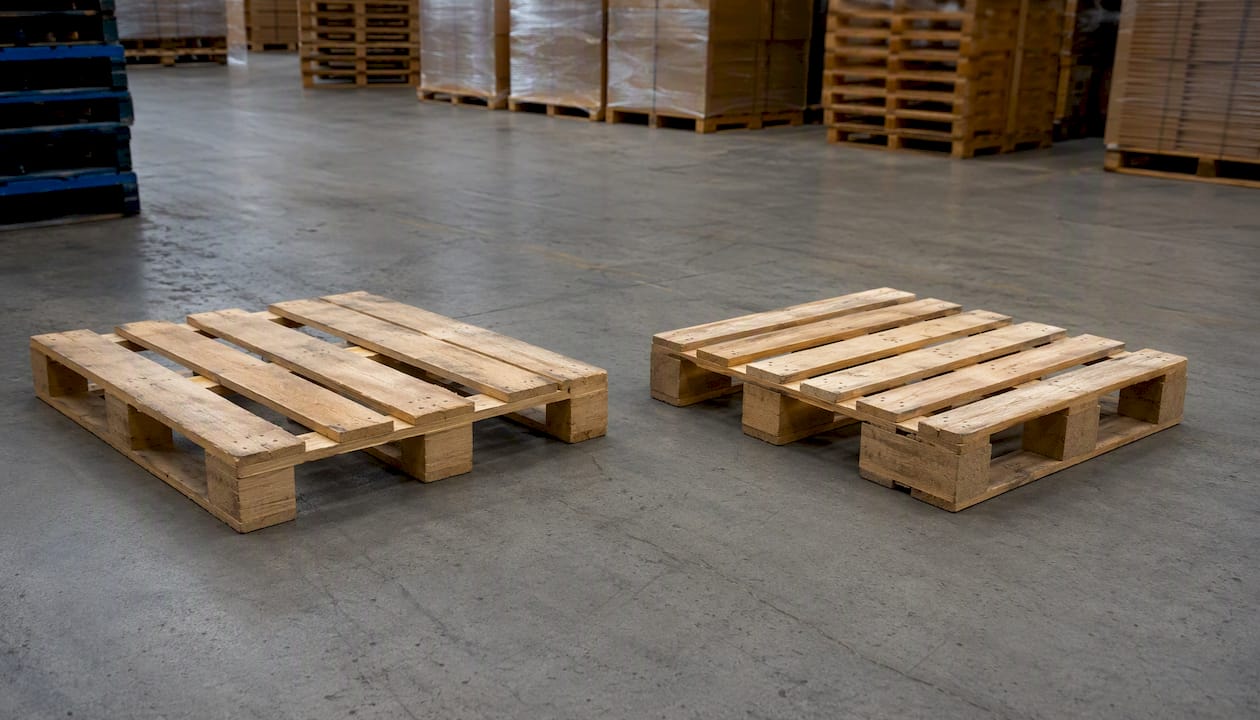
Four-way entry is not a convenience feature. Automated palletizers, conveyor systems, and robotic pick modules require it. A two-way-only pallet in an automated DC is a jam waiting to happen.
Material options
- Wood: The most common and least expensive. Repairable, widely available, and the default for GMA pallets. The main drawback is moisture absorption and variability in used/recycled stock.
- Plastic: More expensive upfront but longer-lasting, washable, and consistent in dimension. Good for food-grade, pharmaceutical, and cleanroom environments.
- Metal: Used for very heavy loads or high-temperature environments. Rare in general distribution.
- Corrugated: Lightweight, single-use, and export-friendly. No heat-treatment required, which matters for international shipments.
ISPM 15 and export pallets
Any wooden pallet crossing an international border must comply with ISPM 15, the international phytosanitary standard requiring heat treatment (HT) or methyl bromide fumigation, plus an official stamp. Pallets without the HT stamp can be seized and destroyed at the border. For export lanes, plastic or corrugated pallets sidestep this requirement entirely and are worth the cost premium on high-value shipments. Usiship’s customs clearance services can help you navigate export pallet documentation alongside your freight.
How pallet size and construction affect shipping, racking, and automation
Trailer and container loading
A standard 53-foot dry van holds 26 GMA 48×40 pallets in a straight two-row configuration. Switching to a 48×48 footprint drops that count because the extra width reduces how many pallets fit side by side. Pinwheel loading (alternating pallet orientation 90°) can recover some of that lost space on certain footprints, but it requires careful weight distribution and carrier approval.
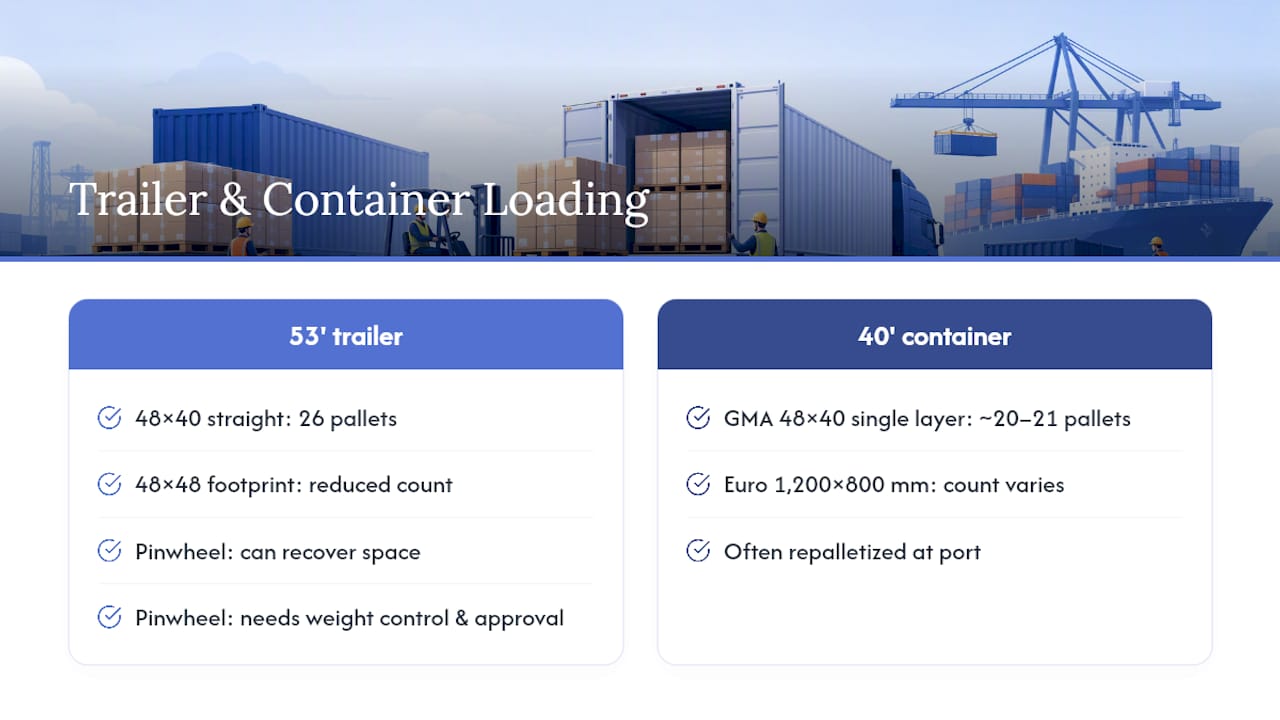
Container loading follows the same math. A standard 40-foot ocean container fits roughly 20–21 GMA pallets in a single layer. Euro pallets (1,200×800 mm) fit differently, and the count changes depending on orientation, which is one reason importers often repalletize at the port before domestic distribution.
Racking compatibility
Standard selective racking is designed around the 48×40 footprint. Beam length, upright spacing, and load ratings are all calculated for that size. A 48×48 pallet overhangs standard beams; a 42×42 pallet may not engage the beam fully, creating a tip hazard. Before you rack a non-standard pallet, get a load calculation from your rack supplier. Usiship’s warehouse optimization services include racking compatibility reviews for exactly this scenario.
Automation compatibility
Automated palletizers, stretch wrappers, and conveyor systems are calibrated to the GMA 48×40 footprint and its seven-top/five-bottom board layout. A pallet that is even an inch off in either dimension can cause misalignment at intake sensors, conveyor guide rails, or robotic pick heads. Notched stringers are not optional in these environments; they are a hard requirement.
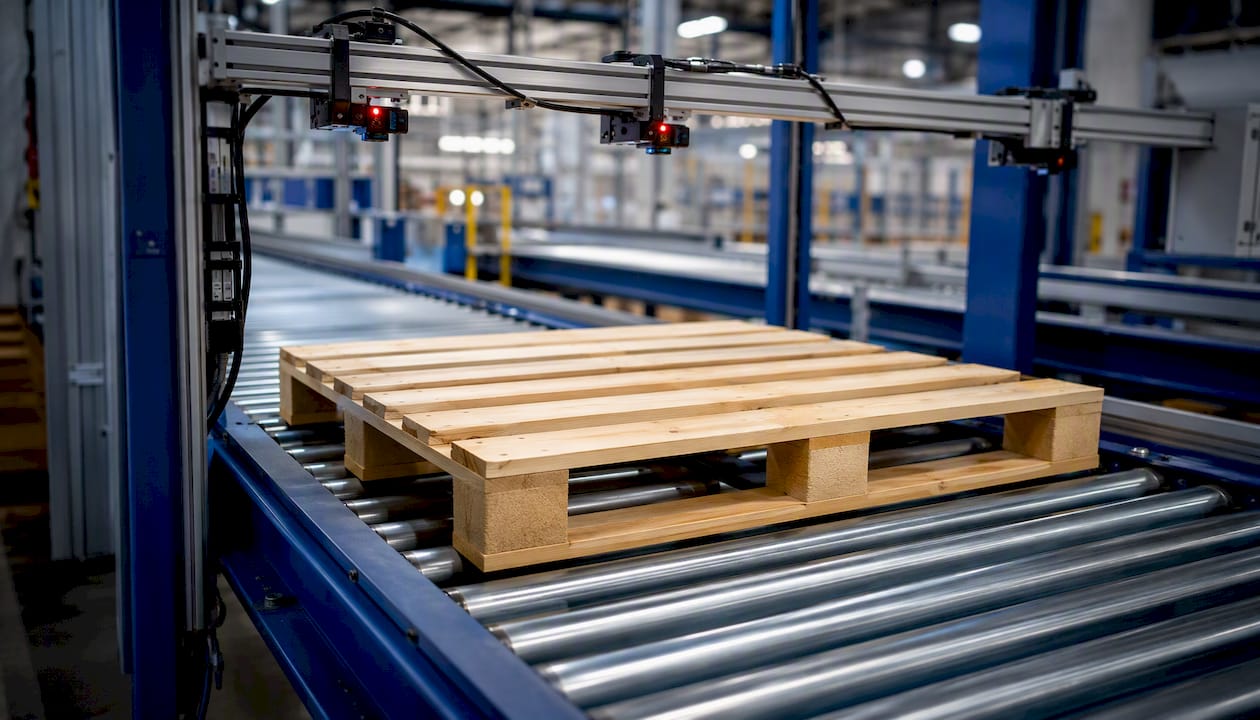
Pro Tip: Before shipping a new pallet type to an automated DC, run a single sample pallet through the intake conveyor during a low-volume period. One test pallet is far cheaper than a line stoppage during peak hours.
How to choose the right pallet for your operation
Follow this sequence before committing to a pallet spec:
- Define your unit load. Measure your product stack (L × W × H) and calculate the total weight per pallet. This sets your minimum load capacity requirement.
- Pull the receiving DC’s pallet spec. Most major retailers and 3PLs publish inbound routing guides that specify pallet size, grade, and entry type. Get this document before you order pallets.
- Check trailer and container fit. Confirm how many pallets of your chosen size fit in your carrier’s equipment. A size that reduces pallet count per trailer raises your per-unit freight cost.
- Verify racking compatibility. Confirm beam length and load ratings with your warehouse. If you use a 3PL, ask for their standard rack spec.
- Confirm automation compatibility. Ask whether the DC uses automated intake, conveyor systems, or robotic picking. If yes, GMA 48×40 with notched stringers is almost always required.
- Run a trial load. Ship one test pallet before committing to a full run. Check for damage, chargeback notices, or rejection at intake.
Supplier questions worth asking: board layout (7 top / 5 bottom?), stringer or block construction, HT/ISPM 15 stamp availability, average empty weight, and dynamic/static/rackable load ratings by grade.
Red flags to watch for: repeated chargebacks on inbound shipments, conveyor jams at the DC, product damage on the bottom layer, or inbound rejection notices citing pallet non-compliance. Any of these signals a pallet spec problem, not a carrier problem.
Conversions and measurement tips
Getting the dimensions right before you book freight prevents a lot of downstream pain. The correct measurement sequence is Length × Width × Height, where length is always the longest horizontal side.
Common conversions:
- 48" = 1,219 mm; 40" = 1,016 mm
- 1 inch = 25.4 mm; 1 mm = 0.03937 inches
- Square feet = (length in inches × width in inches) ÷ 144
- GMA 48×40: (48 × 40) ÷ 144 = 13.3 sq ft
- Height: always measure from the floor to the top of the top deckboards, not just the stringer height
Common measurement mistakes:
- Swapping length and width (always put the longer dimension first)
- Forgetting to include deck board thickness in the height measurement
- Measuring the load height without the pallet height, then getting rejected for exceeding LTL height limits
Pro Tip: Measure pallet orientation before loading the trailer. Confirm with the receiving facility whether they expect the 48" side or the 40" side facing the dock door. A reversed orientation can block dock plate engagement and delay unloading.
LTL carriers typically enforce a maximum loaded pallet height of 84 inches (7 feet) for standard freight, though some carriers allow up to 96 inches with prior approval. Always confirm the LTL pallet height limit with your carrier before booking, since exceeding it can result in re-rating or refusal.
Why automated DCs reject non-standard pallets
Automated distribution centers are built around predictable pallet geometry. The GMA 48×40 spec, with its seven top deckboards, five bottom deckboards, and notched stringers, is what conveyor guides, intake sensors, and palletizer heads are calibrated to, per Atlas Pallets. A pallet that deviates from this layout, even slightly, can misalign at the first conveyor transfer point and stop the line.
Industry observation: Automated DCs that run GMA-spec pallets report significantly fewer intake jams and conveyor stoppages than facilities that accept mixed pallet types. The cost of a single line stoppage during peak season typically exceeds the cost of repalletizing an entire inbound shipment to GMA spec. Consistent board layout and notched stringers are not quality preferences; they are operational requirements for high-throughput automation.
Before onboarding a new pallet supplier or accepting a new pallet type from a vendor, run a sample pallet through your intake conveyor during a low-volume window. Ask your supplier for a compliance certificate confirming board layout, stringer type, and dimensional tolerances. This single step prevents the most common and most expensive pallet-related disruption in automated operations.
The pallet spec conversation nobody has until it’s too late
Most shippers discover their pallet is wrong the hard way: a chargeback notice, a line stoppage at a DC, or a container held at customs because the wooden pallet lacks an HT stamp. The GMA 48×40 standard exists precisely to prevent these surprises, yet a surprising number of operations still treat pallet choice as an afterthought.
The detail that gets overlooked most often is board layout. Two pallets can share the same 48×40 footprint and still behave completely differently on an automated conveyor. A pallet with the wrong number of deckboards or a missing notch will fail at intake just as reliably as one with the wrong dimensions. The spec is the whole spec, not just the footprint.
For importers, the Euro and ISO pallet problem is worth addressing at the port, not at the DC. Repalletizing a container at a transload facility costs a fraction of what a retail chargeback or line stoppage costs downstream. Build that step into your inbound process and treat it as a fixed cost of importing, not an optional upgrade.
The right pallet is the one your entire supply chain, from supplier to carrier to DC, is built around. For most U.S. operations, that is the GMA 48×40. Confirm it, document it, and test it before you scale.
Usiship handles the freight so you can focus on the pallet spec
Choosing the right pallet is half the equation. Getting it to the right place, on time, and without a chargeback is the other half. Usiship gives shippers a single point of contact for LTL and FTL freight booking, warehouse slotting and racking review, customs clearance for export pallets, and ecommerce fulfillment, all coordinated across all 50 U.S. states.
If you are shipping palletized freight and need to confirm pallet compatibility with a specific DC, carrier, or racking system, Usiship’s logistics team can walk through your routing and warehouse requirements before you book. For export shipments requiring ISPM 15 compliance, Usiship’s customs clearance services cover the documentation alongside your freight. Get a quote at Usiship and have your pallet spec confirmed before your next shipment moves.
Sources
- What Is a GMA Pallet? | The Standard Pallet for U.S. Supply Chains — Olympic Forest Products
- GMA Pallets Explained — Atlas Pallets, LLC
- What Is the Standard Pallet Size? 48"x40" — PalletOne
- How to Measure a Pallet the Right Way — Olympic Forest Products
- Pallet Sizes & Dimensions Chart 2026: All Standard Sizes Explained — Florida Pallet Supply
- Euro pallet vs. US pallet: What’s the difference? — Mecalux
- What are GMA pallets? — Toronto Pallet Solutions
- Standard Pallet Sizes | With Chart — Kamps Pallets
- Iso