
Save Thousands on Oversized Freight Shipping for Project Teams
A load counts as oversized freight shipping once it exceeds typical legal limits for width, height, or length, or when its gross weight passes the federal baseline weight limit. The moment any of those numbers gets crossed, your next move is simple: measure the load precisely, log axle spacing, and start permit conversations with every state on the route before you book a truck.
TL;DR:
- Most oversize loads are identified by exceeding 8.5 feet in width, 13.5 feet in height, or the federal gross weight limit of 80,000 pounds, requiring precise measurement and permit planning.
- Permits are issued by each state, with timelines ranging from days to weeks, especially for multi-state or complex routes involving bridge surveys and utility checks.
- Route surveys must include clearance verification, escort requirements, utility coordination, and contingency planning to prevent delays or road closures from disrupting the move.
- Costs depend heavily on load dimensions, weight, number of states crossed, permit fees, escort services, and specialized equipment rental, often totaling several thousand dollars or more for complex moves.
- Proper pre-move documentation, securement, and coordination with local authorities reduce risks, while a single point of contact like Usiship streamlines multi-state permits and trailer sourcing.
Table of Contents
- What Qualifies as Oversized and How to Measure and Classify Your Load
- Permits and Regulatory Checklist: Who Issues Them and How Long They Take
- Equipment and Trailer Choices: Matching Gear to the Load
- Route Planning: Escorts, Bridges, and Utility Checks
- Cost Drivers and Ballpark Pricing for Oversized Freight
- Operational Checklist: Pre-Move, Securement, and Day-of Tasks
- How Usiship Handles Oversized Freight: Proof Points
- Compliance Rules Change by Cargo Type
- Weather, Closures, and Other Moves That Go Sideways
- Working With Local Authorities and Law Enforcement
- Crossing State Lines: Why the Rules Never Match
- Contingency Planning for Delays and Incidents
- The Lesson Most Project Teams Learn the Hard Way
- Get an Oversized Freight Quote or Route Survey
- Sources
- FAQ
What Qualifies as Oversized and How to Measure and Classify Your Load
Classification decides everything downstream, from which trailer you rent to how many states sign off before you move. The federal government sets the ceiling: 80,000 pounds gross vehicle weight, with axle loads governed by the bridge formula that FHWA publishes for permit offices. States layer their own triggers on top, and while the numbers shift slightly by jurisdiction, most set the over-width line near 8.5 feet, over-height near 13.5 feet, and overlength varies depending on trailer configuration.
Measuring a load correctly means going beyond the tape measure on the crate. Field teams need:
- Overall length, width, and height including any rigging, chains, or mounted equipment that extends the profile
- Overhang front and rear, measured from the trailer bed, not the tractor
- Declared gross weight and axle-by-axle weight distribution
- Axle spacing, documented in feet and inches for bridge formula calculations
A load is “nondivisible” when breaking it into smaller pieces would destroy its value or require a significant amount of labor that justifies a permit exception. That distinction matters because permit offices treat nondivisible loads differently, often granting exceptions that wouldn’t apply to freight you could legally split up.
Permits and Regulatory Checklist: Who Issues Them and How Long They Take
States issue the actual travel permits. The federal government’s role is setting the weight baseline and publishing state permit contacts and guidance through FHWA, but the paperwork itself flows through each state’s DOT permit office.
A clean permit application usually needs:
- Exact dimensions and weight, including axle spacing diagrams that match the bridge formula
- Proof of insurance meeting the state’s minimum cargo and liability thresholds
- A proposed route with mileage, entry and exit points, and any known structures along the way
- Nondivisible load justification, if you’re claiming an exception to standard weight limits
Pro Tip: File a short affidavit or engineer’s estimate up front showing the load can’t be dismantled without destroying its value or costing more than eight hours of labor. Many state offices move faster once that proof is on file.
Timelines vary by complexity. A single-state, single-trip permit can process in a day or two. Multi-state moves stretch that out because every jurisdiction runs its own review, and superloads often need a full route survey with bridge and clearance analysis, which can add weeks rather than days to your lead time. Start permit coordination as soon as dimensions are locked, not after equipment is booked.
Equipment and Trailer Choices: Matching Gear to the Load
Trailer selection follows the load’s weight distribution and axle spacing, not just its size on paper.
- Step deck: works for tall cargo that needs extra vertical clearance without going full lowboy
- Lowboy or double-drop: the default for tall, heavy equipment since the low deck height buys more overhead room
- RGN (removable gooseneck): lets you drive equipment on and off instead of craning it, useful for tracked machinery
- Extendable flatbed: handles long, narrow freight like beams or pipe sections
- Modular multi-axle trailers and SPMTs: reserved for the heaviest, most awkward loads, where spreading weight across many axles is the only way to stay within bridge formula limits
Axle spacing isn’t just a permit detail. It directly determines which trailer configuration is even legal for a given weight, since the bridge formula punishes tightly spaced axles carrying heavy loads.
Pro Tip: Before you commit to a trailer, confirm lifting and rigging capacity for load and unload, not just road transport. A trailer rated for the haul doesn’t always match the crane capacity waiting at the destination.
Route Planning: Escorts, Bridges, and Utility Checks
A route survey is where oversized freight shipping either stays on schedule or falls apart. Skip it and you find out about a weight-restricted bridge the hard way, usually at 2 a.m. with a state trooper waiting.
- Map every bridge, overpass, and tunnel on the route and confirm posted clearance and weight limits against your load’s actual dimensions.
- Flag steep grades, sharp curves, and known bottlenecks where a wide or long load can’t track through a lane.
- Determine escort requirements. Pilot car and police escort rules are set state by state and tied to width, height, and length thresholds, so what triggers an escort in one state might not in the next.
- Contact utilities early if overhead lines cross the route. Getting a line temporarily raised or de-energized takes advance scheduling, not a same-day phone call.
- Build at least one contingency route before departure day, especially for multi-state moves where a single closure can strand a load for hours.
Permit offices will often specify escort requirements as part of the approval, so build that into your timeline rather than treating it as a separate booking step. A load moving through five states needs five sets of escort rules cross-checked, not one.
Cost Drivers and Ballpark Pricing for Oversized Freight
Distance is only one input. Dimensions, weight, number of states crossed, permit fees, escort costs, specialized equipment rental, and any required utility work all stack on top of base mileage rates.
- Permit fees vary significantly by state and load characteristics.
- Escort vehicles typically bill hourly, and a route requiring both front and rear pilot cars doubles that line item
- Specialized trailer rental (RGN, modular, SPMT) costs more than standard flatbed and often requires booking weeks ahead
As a rough industry guide, a short regional heavy-haul move can cost several thousand dollars, while a complex multi-state superload involving engineering surveys, multiple escorts, and utility coordination can cost significantly more. These are trade-informed ranges, not fixed quotes, since every lane prices differently.
If a quote looks too clean, ask for it broken out. A legitimate bid separates permit costs, escort fees, equipment rental, and any bridge or engineering charges instead of folding everything into one flat number. Low-ball quotes that skip that breakdown tend to surface the missing costs mid-route, when you have the least leverage to negotiate.
Operational Checklist: Pre-Move, Securement, and Day-of Tasks
Getting the paperwork right doesn’t help if the load shifts on the highway. Securement and documentation both need sign-off before wheels turn.
- Confirm permits, insurance certificates, and route approvals are all in hand, not just applied for
- Verify crane bookings and staging site confirmations at both origin and destination
- Check load securement: blocking, chain rating, torque specs, and edge protection against FMCSA cargo securement standards
- Brief escort drivers on communication signals and contingency routes before departure
- Complete a post-move inspection and collect proof of delivery documentation
Pro Tip: Photograph securement points before departure and again at every fuel or rest stop. That record protects you if a claim comes up later, and it takes thirty seconds per stop.
How Usiship Handles Oversized Freight: Proof Points
Coordinating a multi-state oversized move usually means juggling permit offices, trailer sourcing, and insurance verification at the same time, often against a tight installation deadline. Usiship’s logistics and transportation services fold that coordination into one point of contact instead of leaving a shipper to chase five separate vendors.
That integration shows up in a few concrete ways:
- FTL and LTL capacity paired with specialized equipment sourcing for step deck, lowboy, and RGN moves
- Licensed customs clearance for oversized freight that crosses international borders as part of a multimodal move
- Warehousing and staging support so equipment isn’t sitting exposed while permits clear
- Real-time tracking that gives project teams visibility into where a load sits relative to permit windows and escort schedules
A single coordinator managing permit requests across jurisdictions cuts down on the rework that happens when axle diagrams or dimension sets don’t match from one state application to the next.
Compliance Rules Change by Cargo Type
Oversized dimensions are only half the compliance picture. What the load actually is changes which rules apply on top of the standard permit process.
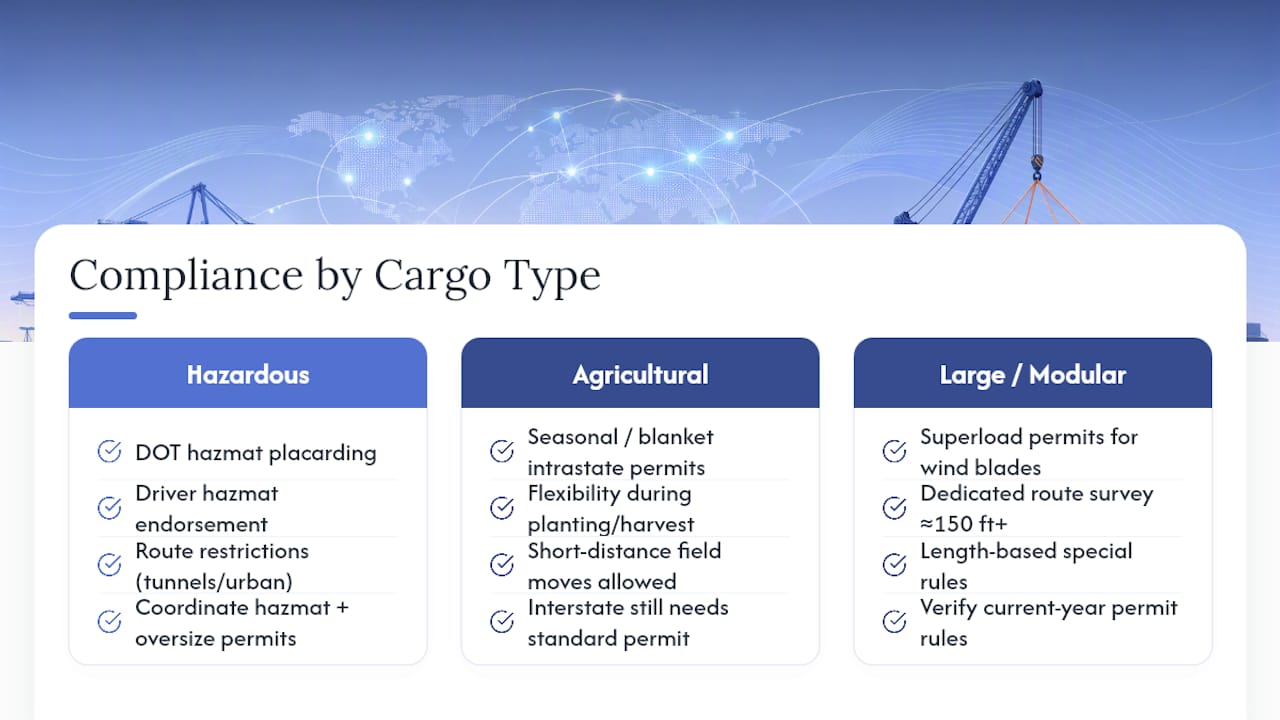
Hazardous materials moving on an oversized trailer trigger DOT hazmat placarding and driver endorsement requirements in addition to the oversize permit. That means the driver needs a hazmat endorsement on their commercial license, the load needs correct placarding for the specific hazard class, and some states restrict hazmat routing through tunnels or dense urban corridors regardless of the oversize permit’s approved path. Coordinate both permit types together, since a route approved for size might still be closed to hazmat traffic.
Agricultural equipment gets more flexibility in some states, particularly during planting and harvest seasons, when certain states issue seasonal or blanket permits for farm equipment moving short distances between fields. That flexibility doesn’t extend to interstate moves, though. Crossing state lines with a combine or grain cart still needs a standard oversize permit in most cases, even if intrastate rules are looser.
Modular buildings, wind turbine components, and construction equipment each carry their own quirks too. Wind blades, for instance, routinely need superload permits given their length, and many states require a dedicated route survey for anything over roughly 150 feet. The rule of thumb: never assume last year’s permit rules apply to this year’s cargo type, even on a route you’ve run before.
Weather, Closures, and Other Moves That Go Sideways
The biggest threat to an oversized move usually isn’t the permit process. It’s what happens on the day of transport.
Weather is the most common disruptor. High wind is particularly dangerous for tall or wide loads, since a load with a large sail area can become genuinely unstable in gusts that wouldn’t bother a standard trailer. Most states allow permit holders to voluntarily delay travel during high-wind advisories without penalty, but you have to communicate that delay to the permit office and any scheduled escorts rather than just sitting still.
Unplanned road closures, whether from construction, an accident, or an emergency detour, are the second major disruptor. This is exactly why a contingency route matters more for oversized freight than for standard truckload moves. A standard truck can often reroute around a closure with minimal fuss. An oversized load can’t, because the alternate route needs its own clearance and weight verification before the driver can legally use it.
Night moves come with their own set of problems, since permits sometimes restrict oversize travel to daylight hours on certain routes, and reduced visibility compounds the risk of underestimating clearance on an unfamiliar detour. Build slack into the schedule rather than assuming a single clean run from origin to destination. Complex multi-state moves that build in a buffer day tend to absorb disruptions far better than ones planned to the hour.
Working With Local Authorities and Law Enforcement
Getting the permit approved is the paperwork step. Coordinating with the people who’ll actually be on the road with you is the operational step, and it’s easy to skip.
Local police departments along the route often need advance notice even when the state permit already specifies escort requirements, particularly for loads moving through downtown corridors or past schools during pickup and drop-off hours. A courtesy call to the local department a day or two ahead, confirming the approved route and timing, avoids the awkward situation of an officer stopping a legally permitted load because nobody at the local level knew it was coming.
Some municipalities also require separate local permits layered on top of the state permit, especially for moves through city centers or over locally maintained bridges that aren’t part of the state highway system. Check with the city or county public works department directly rather than assuming state approval covers every mile.
For superloads, some states require a pre-move meeting between the shipper, the state permit office, and law enforcement to walk through the route together. That meeting isn’t a formality. It’s where an officer might flag a construction zone that went up after the permit was issued, or a school event that will put extra foot traffic near the route on move day. Treat it as free intelligence, not a bureaucratic hurdle.
Crossing State Lines: Why the Rules Never Match
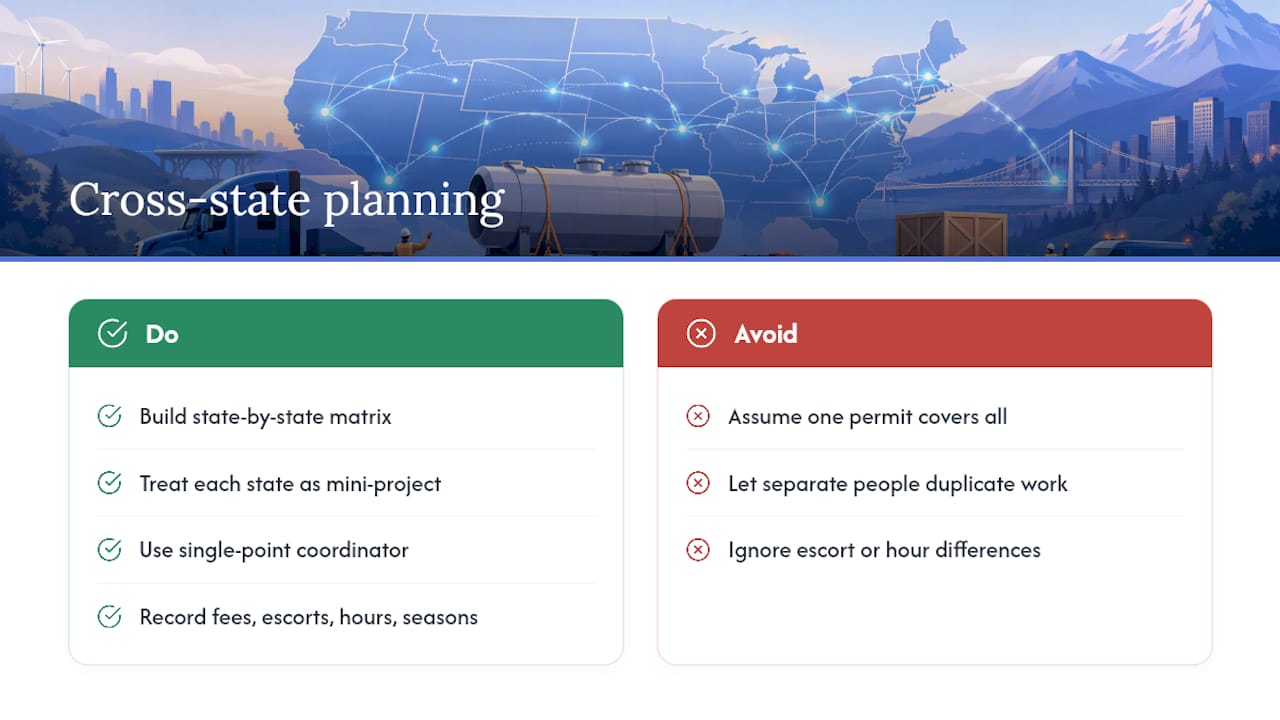
Every state runs its own permit office, its own fee schedule, and its own thresholds for what counts as oversize. A load fully compliant in one state can need an entirely different escort configuration, permit fee, or travel-hour restriction the moment it crosses a border.
This is where multi-state moves get expensive in ways shippers don’t anticipate. One state might allow night travel for a given width; the next might restrict that same load to daylight hours only. One state might require a single rear escort; the next might mandate both front and rear pilot cars plus a police escort through metro areas. None of this is standardized nationally because oversize permitting sits with each state DOT, not with a single federal authority.
The practical fix is treating each state as its own mini-project rather than assuming a permit approved in Texas tells you anything about what Oklahoma will require. Build a state-by-state matrix before the move: permit fees, escort rules, travel-hour windows, and any seasonal restrictions. A single-point coordinator managing that matrix, rather than five separate people each handling one state, cuts down dramatically on the version-control problems that come from slightly different axle diagrams or dimension sets landing on different desks.
Contingency Planning for Delays and Incidents
Even a well-planned oversized move needs a fallback plan, because permits expire, weather shifts, and mechanical failures happen regardless of how much prep went into the route survey.
Permit windows are usually tight, often valid for a specific date range rather than an open-ended period. Build a process for requesting an extension before the current permit lapses, not after, since a lapsed permit means the load can’t legally move until a new one clears. Keep the permit office’s direct contact on hand, not just a general inquiry line.
If a mechanical failure or accident happens en route, the priority is getting the load safely off the traveled way and notifying both the escort team and local law enforcement immediately, since a stalled oversized load on a highway shoulder is its own hazard. Have a pre-identified list of heavy-duty recovery services along major legs of the route, since standard towing companies typically can’t handle superload recovery.
Insurance documentation matters most in exactly this moment. Confirm cargo and liability limits before departure, not after an incident, since inadequate coverage can expose shippers to losses well into six figures on high-value oversized freight. A supplemental policy for a single superload move often costs far less than the gap between a standard limit and the load’s actual value.
The Lesson Most Project Teams Learn the Hard Way
Most oversized freight delays don’t come from a bad trailer or a missed permit fee. They come from teams treating axle spacing and route surveys as paperwork to finish after the truck is booked, instead of the first thing to lock down.
The fix is boring but reliable: measure and document axle spacing before you talk to a single permit office, and always carry a contingency route in your back pocket, even on a lane you’ve run a dozen times. States change permit rules, bridges close for repair, and weather doesn’t check your schedule.
— Akbar
Get an Oversized Freight Quote or Route Survey
Handling an oversized move without a single point of coordination means chasing permit offices, trailer availability, and insurance verification separately, often against a deadline that doesn’t bend. Usiship brings permit handling, trailer sourcing, and route engineering under one roof, backed by licensed customs brokerage for moves that cross international borders and real-time tracking so your team always knows where the load sits relative to its permit window.
That national execution matters most on multi-state lanes, where a single coordinator managing every state’s permit matrix can be more efficient than multiple vendors handling separate applications. If you’re planning a heavy-haul move, request a quote through Usiship’s logistics and transportation services and get a route survey started before dimensions lock in equipment costs you can’t renegotiate later.
Sources
- Oversize/Overweight Load Permits | FHWA Freight Management and Operations
- Oversized Cargo Transportation: How Oversized Freight Is Shipped Internationally
- Avoid Six-Figure Exposure: Cargo Insurance Limits for U.S. Truckers
FAQ
What Is the Cheapest Way to Ship an Oversized Load?
Regional moves with minimal escort requirements and a single-state permit are the cheapest option, since costs climb fast once you add multi-state permits, escort vehicles, and specialized trailer rental.
What Is Considered Oversized for Shipping?
A load is generally oversized once it exceeds 8.5 feet in width, 13.5 feet in height, or typical length limits depending on trailer configuration, or when gross weight passes the federal 80,000-pound baseline.
How Much Does UPS Charge for Oversize Packages?
UPS applies additional handling and large package surcharges based on package dimensions and weight rather than a single flat oversize fee, and those surcharges are separate from the heavy-haul freight permitting this article covers.
How Much Does It Cost to Ship a 300-Pound Item?
A small-weight item typically ships as standard freight rather than oversized freight, with cost driven mainly by distance, freight class, and carrier rather than oversize permits or escorts.
Does Usiship Handle Permit Coordination for Multi-State Moves?
Yes. Usiship coordinates permit applications, trailer sourcing, and route planning across multiple states through its logistics and transportation services, which reduces the rework that comes from managing each state separately.