
OTIF Compliance: What It Means and How to Hit It
OTIF compliance means your orders reach a retailer or customer on the agreed date and with every ordered item in the right quantity, often enough to meet that customer’s target. Miss the target and the customer can charge you. You hit it by treating OTIF as a warehouse, carrier and appointment problem, not only a shipping problem: accurate picking, correct labels and notices, a booked dock slot and a carrier you can track. We built Usiship around keeping transportation, warehousing and fulfillment on one platform, which is exactly where OTIF is won or lost.
TL;DR
- OTIF stands for on-time, in-full. An order counts only if it arrives within the agreed window and contains exactly what was ordered.
- There is no single universal definition. Your customer’s routing guide or vendor manual decides the date, the window and the unit of measure.
- US retailers attach money to it. Walmart’s published goals include 95% in-full, with a 3% cost-of-goods fine on non-compliant cases, and Kroger charges 3% of the invoiced amount per late PO.
- Most misses come from a handful of causes: short picks, wrong labels or notices, missed dock appointments and late carriers.
- Fix them in this order: measure, pick accuracy, appointments, carrier visibility, then buffer stock.
Table of Contents
- What OTIF compliance means
- How the OTIF formula works
- What US retailers require and charge
- What a good OTIF benchmark looks like
- Where OTIF failures actually come from
- How to improve OTIF performance, step by step
- OTIF for importers and ecommerce sellers
- Where Usiship fits
- Our view on OTIF
- FAQ
- Sources
What OTIF compliance means
OTIF stands for On-Time In-Full. Celonis describes it as the percentage of orders delivered on the agreed date or time at the expected volumes. An order qualifies only if the customer gets exactly what was ordered, in the requested amount, at the right location, within the agreed timeframe.
“Compliance” is the step that turns a KPI into an obligation. Your buyer, usually a big-box retailer or a distributor, writes OTIF targets into a vendor manual or routing guide. Hit the target and nothing happens. Miss it and you receive a chargeback, which is a fee deducted from what the retailer pays you.
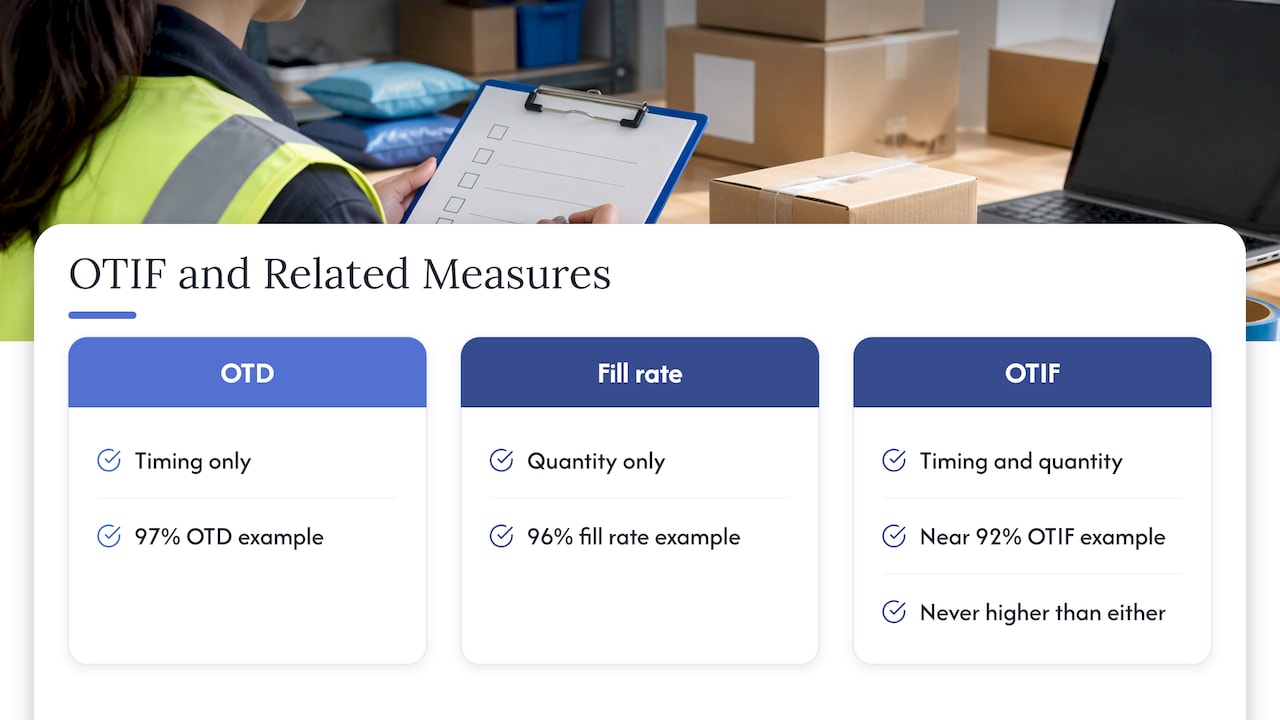
A good way to see it: on-time delivery (OTD) looks at timing only. Fill rate looks at quantity only. Summit Analytics explains that OTIF tests both together, so under matching definitions it can never be higher than either one. A supplier with 97% OTD and 96% fill rate can easily sit near 92% OTIF, because the late orders and the short orders are often different orders.
How the OTIF formula works
The basic order-level formula is simple. Shopify’s guide gives it as orders delivered both on time and in full, divided by total orders, times 100.
Worked example: you ship 400 purchase orders in a month. 372 arrive inside the window. Of those, 352 are complete. Your OTIF is 352 ÷ 400 × 100 = 88%. Your on-time rate is 93%, but the 20 on-time orders that were short still count against you.
Some customers measure by cases rather than orders. SPS Commerce states the case-based version as cases delivered on time and in full, divided by total cases ordered, times 100. The two methods give different numbers from the same shipments, so you need to know which one your buyer uses.
Why your number may differ from your customer’s
McKinsey’s 2019 analysis of the consumer sector found no universally standard OTIF definition. Companies disagree on:
- Requested date or promised date. Which one is “on time”?
- Window boundaries. Is a delivery slot a single day, a few hours, or several days?
- Measurement level. Order, line or case.
- Over-delivery and wrong product. McKinsey’s proposed working definition disregards over-delivery and inaccurate product, but many retailers do not.
This is the most common source of arguments. If your internal dashboard says 96% and the retailer’s scorecard says 89%, the gap is almost always a definition, not a data error. Get the retailer’s definition in writing and measure by it.
Split shipments are a related trap. SPS Commerce notes that split orders may comply when each delivery is assessed separately, but you should confirm with the purchaser before splitting an order.
What US retailers require and charge
Requirements vary by retailer, and they change. Treat the figures below as published examples, then read your own current manual.
| Retailer | Published rule | Penalty |
|---|---|---|
| Walmart | Goals as of March 2024: 90% on-time for prepaid suppliers, 98% for collect suppliers, 95% in-full for all | 3% of cost of goods on non-compliant cases; monthly penalties under $1,000 waived; billed quarterly |
| Kroger | On-time is measured against ORAD, the Original Requested Day of Arrival; the PO must gate in at the DC that day | 3% of the invoiced amount per PO for a vendor-caused miss; can be overturned by a buyer exception email or a 93%+ on-time rate over the current 4-week period |
| Sally Beauty | Vendor manual (September 2025): arrive in the PO window at the scheduled appointment, complete, no substitutions or overages | See the manual; arrivals more than 60 minutes late may be rescheduled |
A few details worth knowing about Walmart. SPS Commerce’s 2024 explainer says Walmart tracks OTIF but no longer grades suppliers on one combined score, so vendors must meet the individual OTIF-related metrics to avoid fines. It also says Walmart generally compares cases received within the delivery window to cases ordered, does not count overages in that calculation, and excludes import, Sam’s Club, e-commerce and direct-to-store purchase orders from the metrics it describes.
If you do get a charge you believe is wrong, dispute it quickly. Inymbus reports that Walmart’s Accounts Payable Dispute Portal in Retail Link accepts disputes, typically within 30 days, backed by proof of delivery, signed bills of lading and carrier appointment confirmations. Those documents only exist if your carrier and warehouse kept clean records, which is one more reason to keep the whole chain visible.
What a good OTIF benchmark looks like
There is no single good number. Your benchmark is the threshold in your customer’s manual: for the Walmart example above, 95% in-full, and 90% or 98% on-time depending on who arranges freight. For context on the whole industry, McKinsey reported consumer-sector OTIF misses in the range of 20% to 30%, and stressed that measurement must be aligned across the supply chain. That is why a supplier at 94% is often ahead of the market and still pays fines if its target is 95%.
Small misses cost real money. On $250,000 of monthly shipments to a retailer with a 3% cost-of-goods fine, if 8% of cases are non-compliant, the exposure is roughly 3% × 8% × $250,000 = $600 for the month. That is under Walmart’s $1,000 monthly waiver, but it is the same exposure that gets large the moment volume doubles or a bad week hits one big PO. The exact calculation depends on your retailer’s rules; use this only as a way to size your own risk.
Where OTIF failures actually come from
OTIF is often treated as a shipping metric, but the cause of a miss usually sits upstream. Sort every miss into one of these buckets before you fix anything:
- Short or wrong picks. The order left the warehouse incomplete or with a substitution.
- Label and notice mismatches. The advance ship notice (ASN, the electronic message telling the buyer what is on the truck) does not match the pallet and carton labels, so receiving flags an exception.
- Appointment problems. The truck arrives without a booked slot, or outside it.
- Carrier delays. A late pickup, a missed transit time or a rolled shipment.
- Supply and production delays. The goods were not ready when the order was due.
Tag each late or short order with one cause for 60 to 90 days. Usually two buckets account for most of the problem, and that tells you where to spend effort.
How to improve OTIF performance, step by step
1. Measure it the way the customer does
Build a report that mirrors the retailer’s definition: the same date (requested or promised), the same window, the same unit (order, line or case). Track OTIF, OTD and fill rate separately so you can see which half is failing. Our guide to improving an on-time delivery KPI in 30 to 90 days covers the timing half in detail.
2. Work backward from the must-arrive-by date
Most retailer programs reduce to a date. Subtract transit time, the dock appointment lead time, the carrier pickup buffer and your own pick-and-pack time, and you have the date the order must be released from the warehouse. If a buyer sets short lead times, the rest of the chain has to move faster; shortening lead times is a problem every supplier faces, whatever the product. Our page on MABD compliance walks through the date math.
3. Make pick accuracy a warehouse standard
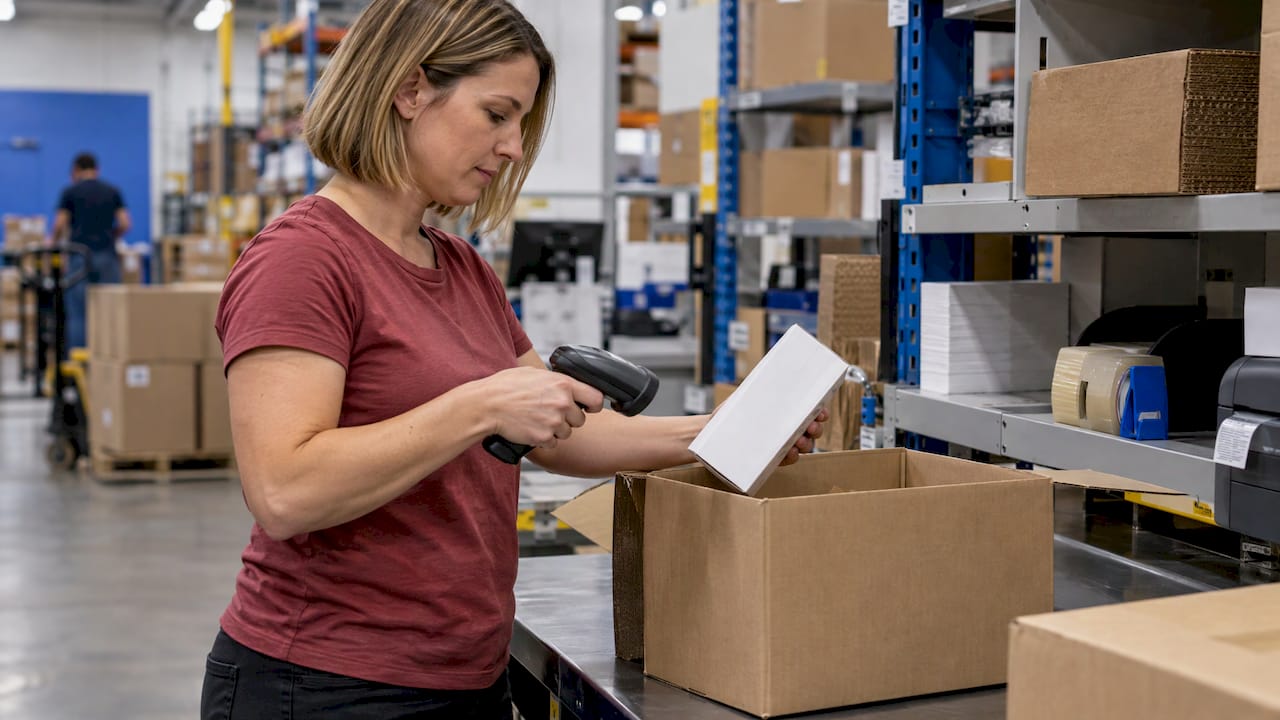
In-full failures mostly start at the pick. The common fixes are scan verification at pick and pack, a second-count rule for high-value or high-volume lines, and a clear policy on substitutions (the answer for OTIF is usually none). Keep your slow and fast sellers organized differently; ABC inventory analysis explains why A, B and C items need different rules, and why safety stock belongs on the A items that retailers re-order constantly.
4. Match labels, ASNs and what is physically on the pallet
A perfectly complete shipment can still be refused or flagged if the labels do not match the notice. Build a pre-ship check: pallet label format per the retailer’s guide, carton counts equal to the ASN, PO numbers on every document. This is a five-minute check at the dock door that prevents the most annoying kind of fine.
5. Book the appointment and protect it
Many retailers measure on-time against the scheduled appointment, not just the date. Sally Beauty’s manual, for example, says arrivals more than 60 minutes late may be rescheduled. A late truck can turn an on-time shipment into a miss. Our guide to booking delivery appointment freight explains how to book and how to avoid fees when slots move.
6. Track the shipment, not just the invoice
You cannot fix a late truck you only learn about when the retailer does. Live location lets you rebook a slot or warn the buyer before the window closes. See why location goes missing in real-time shipment tracking and what to ask of your carrier. For full pallet loads moving to a distribution center, full truckload shipping gives you a dedicated truck and fewer handoffs.
7. Hold buffer stock on the lines that count
If your top SKUs are the ones buyers reorder on short notice, a modest buffer near the customer protects the in-full half. Distributed warehousing can shorten transit and widen your margin for a late truck.
OTIF for importers and ecommerce sellers
If you import, your OTIF can be lost before the goods reach a US warehouse: a customs hold or a missing document moves a container past the date the retailer expects. Clear customs paperwork early, and see how customs power of attorney compliance helps avoid port holds. Note that retailer programs often treat import orders separately; Walmart’s described metrics exclude them, so check which rules apply to your PO type.
If you sell direct on a marketplace, the equivalent pressures are different (delivery promises and receiving rules), but the same logic holds: accurate picks, correct labels, and a predictable carrier.
Where Usiship fits
OTIF problems cross four hand-offs: the warehouse that picks, the carrier that moves, the dock that receives and the customs desk that clears. When each is run by a different company, nobody owns the number. We handle freight forwarding, 3PL fulfillment, warehousing, customs brokerage and last-mile delivery across all 50 states, with real-time tracking and 24/7 support. That integrated setup is designed to give you one place to see where an order is and to act before a window closes.
Published warehouse rates on our pricing page include bin storage at 5-6 USD per month per bin, pallet storage at 17-19 USD per month per pallet, and additional services at 37 USD per hour. Receiving, order processing, additional picks, returns and packaging are quoted on request. To see how the pieces fit, start with our 3PL fulfillment services or warehousing and fulfillment solutions.
Our view on OTIF
Most suppliers we talk to think of OTIF as a carrier problem. It is a handoff problem. The order is picked in one system, labeled in another, booked in a third and tracked in a fourth, and the fine lands on whoever sits at the end.
Our approach is to put transportation, warehousing and fulfillment on one platform, with real-time tracking and personalized 24/7 service, so one team sees an order from receiving to the dock door. We think that is the realistic way for small and mid-sized suppliers to hit retailer targets without hiring a compliance department.
If you are staring at a scorecard you cannot explain, start by finding which of the five failure buckets above is yours. Then fix the handoff that creates it.
Akbar
FAQ
What does OTIF stand for in logistics?
OTIF stands for On-Time In-Full. It measures the share of orders that arrive within the agreed delivery window and contain the full ordered quantity, with no substitutions. Customers use it to score suppliers, and many attach fines to targets.
What is the difference between OTIF and OTD?
On-time delivery (OTD) measures arrival timing only. OTIF also requires the right items in the right quantity. Because it tests both at once, OTIF is never higher than OTD or fill rate when both use the same definition.
What is a good OTIF percentage?
It is whatever your customer’s manual requires. Walmart’s published goals as of March 2024 were 90% or 98% on-time depending on who arranges freight, and 95% in-full. Kroger waives a late fee for vendors at 93% or better on-time over the current four-week period. Read your own vendor manual for the current numbers.
How do I improve OTIF performance quickly?
Start by measuring it the way your customer does, then tag each miss by cause. Most suppliers find the biggest gains in pick accuracy, label and ASN matching, and booked dock appointments, followed by carrier tracking.
Sources
- Celonis: What Is OTIF?
- Shopify: OTIF Shipping
- Summit Analytics: OTIF definition
- SPS Commerce Help Center: What is OTIF?
- McKinsey: Defining on-time, in-full in the consumer sector
- 8th & Walton: Walmart OTIF supplier guide
- ROIAI One: OTIF fines by retailer
- Sally Beauty Vendor Performance Requirements Manual
- SPS Commerce: Walmart OTIF Fundamentals
- Inymbus: What Is OTIF?
- Additive Lead Times: What to Expect and How to Shorten Them