
Order Fulfillment Outsourcing for Ecommerce Brands
For most growing ecommerce brands, outsourcing order fulfillment to a third-party logistics provider (3PL) is the fastest way to scale shipping capacity, convert fixed warehouse costs into variable ones, and reach customers faster without building your own infrastructure. The case is strongest when your shipping volume is substantial enough to justify outsourcing, managing seasonal demand spikes, or running out of space and labor bandwidth. If you’re at 30 orders a month with a single SKU and a tight brand-experience requirement, keep it in-house a little longer. For U.S.-focused ecommerce brands that need omnichannel reach, Usiship (Universal Shipping Inc.) handles the full fulfillment stack—from receiving and warehousing through last-mile delivery and customs clearance.
Industry studies cited by logistics consultants suggest that logistics outsourcing can deliver average cost savings in the range of roughly 15–20% in classic transport and warehousing processes, largely due to the shift from fixed overhead to pay-per-use pricing and access to pre-negotiated carrier rates that most brands can’t match on their own. That number isn’t guaranteed, but it reflects what happens when you stop paying for warehouse square footage you don’t always fill and start paying only for what you actually ship.
Table of Contents
- What does order fulfillment outsourcing actually cover?
- How each core 3PL service actually works
- What are the real benefits of outsourcing, and what are the risks?
- When should you keep fulfillment in-house?
- How do you evaluate and select a 3PL?
- What does fulfillment outsourcing actually cost?
- What technology integrations should you require from a 3PL?
- What does the onboarding process look like, and how long does it take?
- Which KPIs and reports should you track with a 3PL?
- How should returns and reverse logistics be handled?
- What compliance and insurance obligations apply in the U.S.?
- How Usiship runs outsourced fulfillment for ecommerce brands
- Key Takeaways
- What most brands get wrong about outsourcing fulfillment
- Usiship handles the logistics so you can focus on growth
- Authoritative sources and further reading
What does order fulfillment outsourcing actually cover?
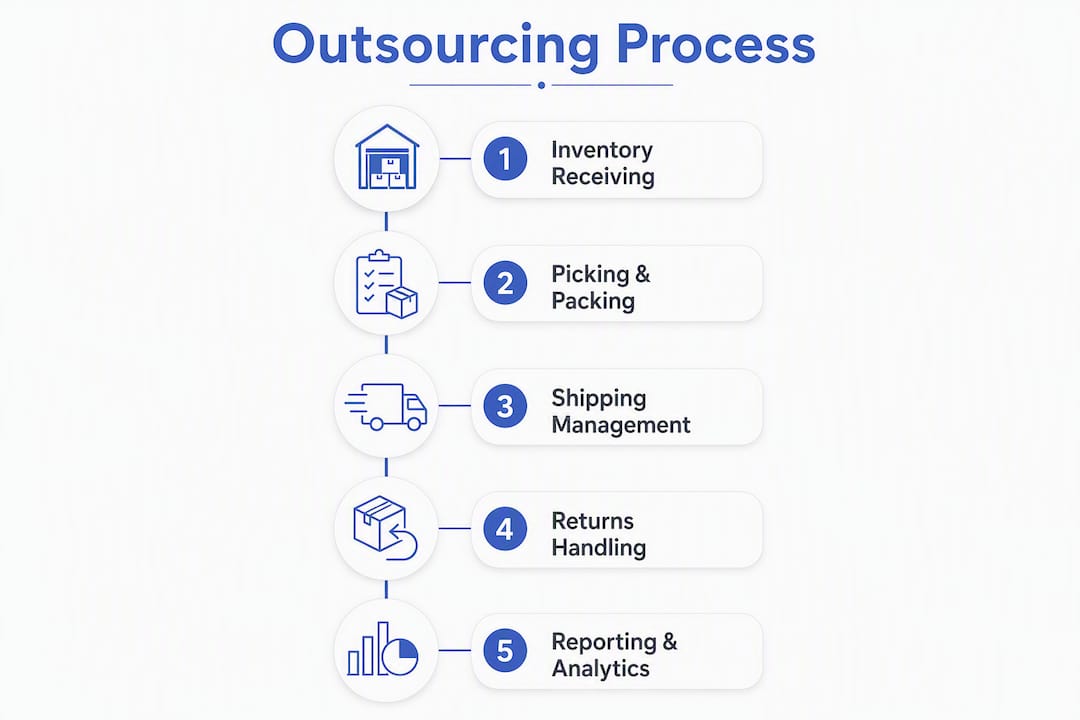
Order fulfillment outsourcing means contracting a third-party logistics provider to handle some or all of the physical steps between a customer placing an order and receiving it. The industry term is “3PL” (third-party logistics), and the scope can range from storage-only to full-service end-to-end fulfillment.
Partial outsourcing typically covers one or two functions, such as warehousing and shipping, while your team still manages inventory planning and returns. Full outsourcing hands the entire post-purchase operation to the 3PL, including receiving inbound freight, storing inventory, picking and packing individual orders, generating carrier labels, shipping, and processing returns.
The discrete services a 3PL typically handles include:
- Receiving: Accepting inbound shipments from your manufacturer or supplier, counting units, and logging them into the warehouse management system (WMS).
- Storage: Holding inventory in bins, shelves, or pallet racking, organized by SKU.
- Inventory management: Tracking stock levels in real time, flagging low-stock alerts, and running cycle counts.
- Pick and pack: Pulling specific items from storage for each order and packing them into appropriate cartons.
- Kitting and assembly: Bundling multiple SKUs into a single sellable unit, building subscription boxes, or assembling promotional sets.
- Carrier selection and shipping: Routing each shipment through the best-priced carrier based on weight, dimensions, destination, and service level.
- Customs support: Managing documentation and brokerage for cross-border shipments, both inbound and outbound.
- Returns and RMA processing: Receiving returned items, inspecting them, and restocking or disposing of them per your policy.
- Value-added services: Amazon FBA prep (labeling, poly-bagging, bundling to Amazon’s specs), gift-wrapping, branded inserts, and custom labeling.
The channel mix matters when you’re scoping a 3PL relationship. DTC brands need fast, consumer-grade packing and carrier options. Marketplace sellers (Amazon, Walmart) need FBA prep compliance and EDI capability. B2B wholesale accounts require pallet-level shipping and retailer-specific compliance labels. Subscription box brands need kitting capacity and a predictable monthly fulfillment cycle. Not every 3PL handles all four equally well, so matching the provider to your channel mix is one of the first filters to apply.
How each core 3PL service actually works
Understanding the operational mechanics at each stage helps you ask sharper questions during vendor evaluation and catch gaps before they become service failures.
Warehouse operations
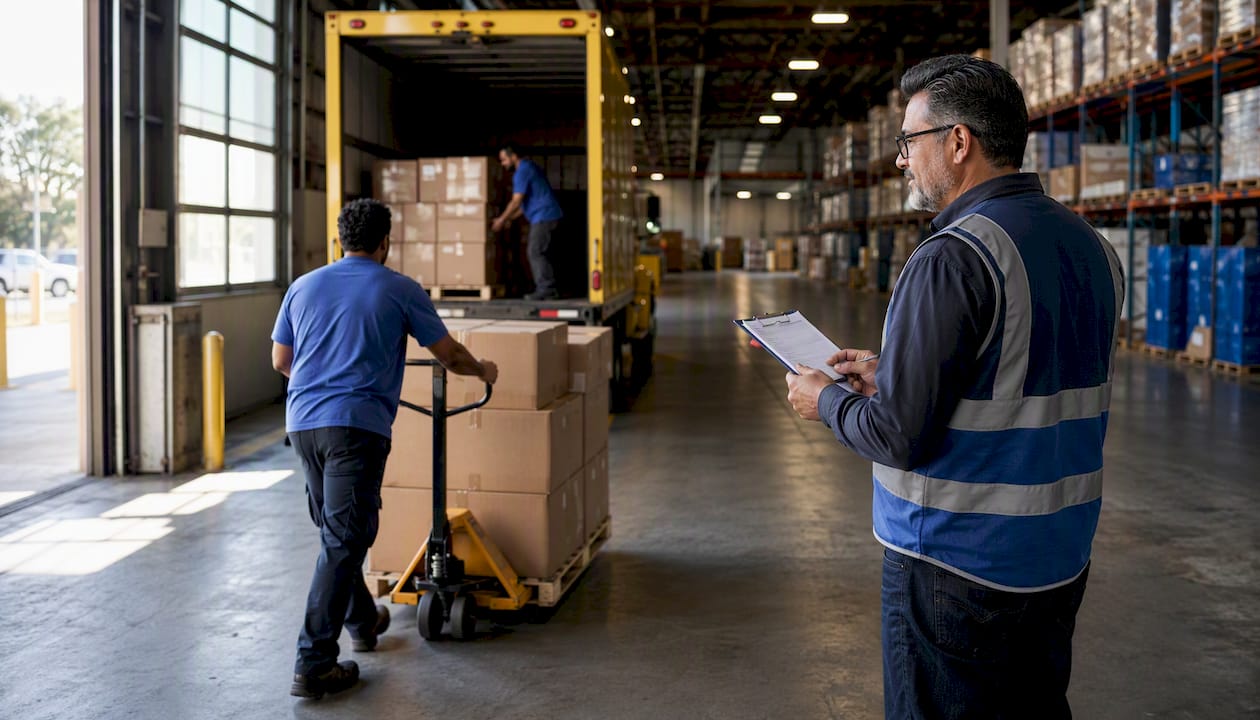
When your inventory arrives at a 3PL facility, the receiving team counts units against your purchase order, scans barcodes, and enters everything into the WMS. Discrepancies get flagged immediately. From there, product goes to putaway, where it’s assigned a bin location (for small, fast-moving items) or a pallet slot (for bulk or slow-moving SKUs). Inventory accuracy at a well-run facility typically runs at 99% or higher, maintained through regular cycle counts rather than a single annual physical inventory.
Picking and packing
Pick methods vary by volume and SKU count. Batch picking sends one picker to collect items for multiple orders in a single warehouse pass, reducing travel time. Zone picking assigns pickers to specific areas of the warehouse, which works well in large facilities with hundreds of SKUs. Wave picking combines both, releasing orders in coordinated waves timed to carrier pickups.
Packing standards matter more than most brands realize. A 3PL that defaults to oversized cartons will inflate your dimensional weight charges on every shipment. Ask specifically about their carton selection logic and whether they use void fill, paper, or air pillows, since packing material affects both cost and the customer’s unboxing experience.
Shipping and carrier management
A 3PL’s volume across all its clients gives it negotiating leverage with UPS, FedEx, USPS, and regional carriers that most individual brands can’t replicate. They route each shipment through a multi-carrier engine that selects the lowest-cost option meeting your service-level requirement. Dimensional weight (DIM weight) is calculated by dividing the package’s cubic inches by a carrier-specific divisor, and it often exceeds actual weight for lightweight, bulky products. A good 3PL flags this during onboarding and recommends packaging adjustments.

Returns and value-added services
Reverse logistics is one of the primary reasons ecommerce brands turn to outsourced fulfillment, because managing returns in-house consumes disproportionate labor relative to the volume. A 3PL handles inbound returns, inspects each item against your disposition rules (restock, refurbish, liquidate, or discard), and updates inventory accordingly.
Value-added services like FBA prep are operationally specific. Amazon requires exact label placement, poly-bag suffocation warnings on items over a certain size, and bundling rules that vary by category. A 3PL with a dedicated FBA prep team knows these specs and updates their procedures when Amazon changes requirements.
Pro Tip: Ask any 3PL candidate to walk you through a returns exception scenario, specifically what happens when a returned item arrives damaged and the customer already received a refund. Their answer reveals how mature their disposition and reconciliation process actually is.
What are the real benefits of outsourcing, and what are the risks?
Benefits worth taking seriously
- Variable cost model: You pay for storage, picks, and shipments you actually generate. Fixed warehouse leases, equipment, and full-time labor disappear from your balance sheet.
- Carrier rate access: 3PLs aggregate volume across dozens of clients to negotiate rates that individual brands rarely qualify for, particularly on express and regional services.
- Faster geographic reach: A 3PL with multiple U.S. distribution centers can position your inventory closer to your customers, cutting transit times and reducing shipping costs simultaneously.
- Expertise on demand: Experienced 3PL staff handle compliance labels, hazmat documentation, and FBA prep without you building that knowledge internally.
- Flexibility during disruption: Supply chain shocks and demand volatility have made operational flexibility a strategic priority, and a 3PL absorbs volume swings that would require you to hire and fire warehouse staff.
- International reach: Providers with customs clearance capability handle cross-border documentation, duties, and brokerage so you can sell globally without building a compliance team.
Risks and how to counter them
- SLA failures: A 3PL that misses ship-by windows or ships wrong items damages your customer relationships, not theirs. Counter this with contractual SLAs that carry financial remedies, not just promises.
- Hidden fees: Setup fees, account minimums, special-project charges, and peak-season surcharges can erode projected savings. Require a fully itemized fee schedule before signing.
- Data exposure: Sharing order data, customer addresses, and SKU-level sales data with a third party creates privacy and competitive risk. Require data access controls, defined retention limits, and ideally SOC 2 certification.
- Single-provider dependency: Concentrating all fulfillment with one 3PL creates a single point of failure. A phased pilot, a hybrid model, or a documented exit plan mitigates this.
The mitigation playbook is straightforward: negotiate SLAs with teeth, run a 30–60 day pilot before full cutover, and retain audit rights over inventory records and billing.
When should you keep fulfillment in-house?
Not every ecommerce business is ready to outsource, and moving too early creates more friction than it solves.
Keep fulfillment in-house if your shipping volume is relatively low. At low volumes, the per-order cost at most 3PLs, including pick fees, packing materials, and account minimums, often exceeds what you’d spend doing it yourself. The math shifts as volume grows, but below that threshold the economics rarely favor outsourcing.
Stay in-house if your product requires proprietary handling that a 3PL can’t replicate without significant custom programming. High-end jewelry brands that hand-wrap every order, or food brands with strict temperature and expiration-date protocols, often find that the brand experience they’ve built is inseparable from the physical fulfillment process.
Hybrid models make sense in several situations. Brands with strong seasonal peaks, say a gift company that ships 70% of its annual volume in Q4, can keep a small in-house operation for the off-season and overflow to a 3PL during peak. Regional brands with a loyal local customer base sometimes retain a small warehouse for same-day or next-day local delivery while routing national orders through a 3PL. FBA-only outsourcing, where you send inventory directly to Amazon’s fulfillment network for marketplace orders while handling DTC in-house, is another common middle ground.
The practical break-even test: calculate your fully loaded per-order cost in-house (rent, labor, packing materials, carrier rates, software) and compare it to a 3PL quote for the same order profile. When the 3PL’s all-in cost per order is lower, or within 10–15% while offering faster transit times, the case for outsourcing is strong. You can read more about 3PL services vs. in-house shipping to run that comparison in detail.
How do you evaluate and select a 3PL?
Vendor evaluation checklist
Start with capability fit before anything else. A 3PL that excels at B2B pallet shipping may be poorly equipped for DTC parcel fulfillment. Confirm the following before requesting a quote:
- Channel compatibility: Does the provider handle your specific channels (DTC, Amazon FBA/FBM, Walmart, B2B wholesale)?
- Network footprint: Where are their facilities? Do they have locations that reduce transit time to your primary customer zip codes?
- Technology stack: Do they offer a real-time WMS portal, API connectivity, and integrations with your ecommerce platform (Shopify, BigCommerce, WooCommerce)?
- Certifications and insurance: Do they carry cargo insurance and warehouse legal liability coverage? Is SOC 2 certification available for data security?
- Financial stability: How long have they been operating? Can they provide references from clients with similar order profiles?
- Peak capacity: What is their maximum throughput during Q4 or other peak periods, and how do they staff for it?
Questions to ask in vendor interviews
- What is your order accuracy rate, and how is it measured?
- What happens when you miss an SLA, and what remedies are available to us?
- How do you handle billing disputes and chargeback claims?
- What is your onboarding timeline for a client of our size and SKU count?
- Can we see your API documentation and a sample integration spec?
- Who is our dedicated account contact, and what is their response-time commitment?
Red flags
Watch for providers who can’t produce a fully itemized fee schedule, refuse to share client references, lack API documentation, or offer only weekly or monthly reporting with no real-time inventory visibility. A 3PL that can’t tell you your current inventory count on demand is not operationally ready for a modern ecommerce brand.
SLA items to require
| SLA Metric | Minimum Threshold to Require |
|---|---|
| Order accuracy rate | ≥ 99.5% |
| Same-day order processing (for orders before cut-off) | ≥ 98% |
| On-time ship rate | ≥ 98% |
| Inventory accuracy | ≥ 99% |
| Return processing time (receipt to disposition) | ≤ 3 business days |
| Inbound receiving time (receipt to available inventory) | ≤ 2 business days |
Pilot plan template
Run a 30–60 day pilot before full cutover. Define the scope (a single SKU or product line, a capped order volume), set success criteria against the SLA table above, and establish rollback triggers, specifically the conditions under which you would pause the pilot and revert to your current process. A pilot that fails fast is far cheaper than a full migration that fails at peak season.
What does fulfillment outsourcing actually cost?
Fee types explained
3PL pricing is modular, and every line item compounds. The main fee categories:
| Fee Type | Typical Basis | Notes |
|---|---|---|
| Receiving | Per pallet, per carton, or per hour | Varies widely; ask for a flat per-pallet rate |
| Storage | Per pallet/month or per cubic foot/month | Billed monthly; long-term storage surcharges apply |
| Pick and pack | Per order + per item picked | Base pick fee plus a per-unit fee for each additional item |
| Packing materials | Per carton, per void fill unit | Some 3PLs include basic materials; branded packaging is extra |
| Kitting/assembly | Per unit or per hour | Quoted separately; complexity drives cost |
| Shipping | Carrier rate + handling markup | Compare against your current carrier rates |
| Returns processing | Per return received + disposition fee | Restocking fees may apply |
| Account/platform fee | Monthly flat fee | Covers WMS access, reporting, and account management |
| Fulfillment minimum | Monthly minimum spend | Common for smaller accounts; confirm before signing |
Main cost drivers
SKU dimensions and weight are the biggest levers. A lightweight, bulky product (think throw pillows or foam packaging) will generate high DIM weight charges on every shipment. Average picks per order matters too: a brand that ships single-item orders has a very different cost profile than one shipping 4–6 items per order. Seasonality affects storage costs directly, since inventory sitting in a warehouse during slow months still accrues storage fees. Higher return rates add meaningful reverse-logistics cost that most brands underestimate in their initial 3PL budget.
Converting fixed logistics costs to variable, pay-for-service models is the core financial argument for outsourcing, and it holds most strongly for brands with uneven demand curves.
How to build a simple per-order cost estimate
Gather these inputs: average order weight, average carton dimensions, average items per order, monthly order volume, SKU count, and current return rate. Request a line-item quote from at least three providers using those inputs. Build a simple spreadsheet with columns for each fee type and sum to a total monthly cost, then divide by order volume to get your all-in cost per order. Compare that to your current fully loaded in-house cost per order.
Pro Tip: Ask each 3PL to quote your top three order profiles by volume, not just an average. A brand with a wide range of order sizes will see very different cost profiles across providers depending on how each one structures its pick fees and carton selection logic.
What technology integrations should you require from a 3PL?
Successful outsourcing depends on technology integration and real-time communication, not just handing off boxes to a warehouse. A 3PL that can’t connect to your systems in real time creates manual reconciliation work that quickly negates the operational savings.
Essential integrations
- Real-time inventory sync: Your WMS and your ecommerce store must share inventory counts continuously. Overselling because of a sync lag is a customer experience failure that falls on you, not the 3PL.
- Order routing: Orders placed on your storefront should flow automatically to the 3PL’s WMS without manual export/import steps.
- Carrier label generation: The 3PL’s system generates and prints carrier labels at pack time, pulling tracking numbers back into your OMS and triggering customer shipping notifications.
- Returns portal: A branded or white-label returns portal that connects to the 3PL’s receiving system so customers can initiate returns and you can track disposition in real time.
- Marketplace connectors: Native integrations with Shopify, Amazon Seller Central, BigCommerce, WooCommerce, and Walmart Marketplace. Confirm which are native and which require a middleware tool like Pipe17 or Extensiv.
API vs. EDI
API connections are the standard for DTC and marketplace ecommerce. They’re faster to implement (typically 2–4 weeks for a standard Shopify or BigCommerce integration), support real-time data exchange, and are easier to troubleshoot. EDI (Electronic Data Interchange) is the standard for B2B wholesale and large retail partners like Target or Walmart, which require specific transaction sets (850 for purchase orders, 856 for advance ship notices, 810 for invoices). If you sell through both channels, confirm the 3PL supports both protocols.
Integration checklist and realistic timeline
| Phase | Activity | Typical Duration |
|---|---|---|
| Discovery | Map data flows, confirm integration method (API/EDI), review API docs | 1–2 weeks |
| Development | Build or configure connectors, set up WMS credentials | 2–4 weeks |
| Sandbox testing | Run test orders, verify inventory sync, confirm label generation | 1–2 weeks |
| Reconciliation check | Compare WMS inventory to store inventory; resolve discrepancies | 3–5 days |
| Peak-load test | Simulate high-volume order batches to confirm throughput | 1–3 days |
| Go-live | Soft launch with limited SKUs or order volume | 1–2 weeks |
Pro Tip: Request the 3PL’s API documentation before you sign a contract. A provider that can’t share docs until after signing is signaling that their integration process is manual, slow, or underdeveloped. That’s a meaningful operational risk.
What does the onboarding process look like, and how long does it take?
A realistic onboarding timeline for a mid-size ecommerce brand runs 6–10 weeks from contract signing to live fulfillment. Rushing it is the most common cause of early service failures.
Onboarding checklist
- Contract and legal: Sign the master services agreement, confirm insurance certificates, and establish data processing terms.
- SKU mapping: Provide a complete SKU list with dimensions, weights, barcode formats (UPC, FNSKU, ASIN), and any special-handling notes.
- Packaging and label specs: Define carton marking requirements, carrier label placement, and branded insert or packing slip instructions. Barcodes should be GS1-compliant; label placement follows carrier specs (typically top or side of carton, unobstructed).
- Data transfer: Export historical order data, customer records, and inventory counts; confirm data format compatibility with the 3PL’s WMS.
- Integration setup: Complete the API or EDI connection, run sandbox tests, and confirm inventory sync accuracy.
- Test orders: Ship 10–20 real test orders across your top SKUs and order profiles. Inspect packing quality, label accuracy, and tracking notification timing.
- Training: Brief your customer service team on the 3PL’s tracking portal, return initiation process, and escalation contacts.
- Go/no-go criteria: Define the minimum accuracy and processing rates required before full cutover. If test orders reveal issues, resolve them before scaling.
Sample phased timeline
| Milestone | Target Week |
|---|---|
| Contract signed, kickoff call | Week 1 |
| SKU data and packaging specs submitted | Week 2 |
| Integration development begins | Week 2–3 |
| Inbound inventory shipped to 3PL | Week 3–4 |
| Sandbox testing complete | Week 4–5 |
| Test orders shipped and reviewed | Week 5–6 |
| Soft launch (limited SKUs/volume) | Week 7–8 |
| Full cutover | Week 9 |
Common pitfalls
Barcode issues are the most frequent onboarding delay. Products with missing, damaged, or non-compliant barcodes require relabeling at the 3PL, which adds cost and time. Packaging mismatches, where your product dimensions don’t match what you submitted in the SKU data, cause carton selection errors and DIM weight surprises. Inventory discrepancies between your records and the physical count at receiving are normal at 1–2%, but anything above that signals a data problem worth resolving before go-live.
Pro Tip: Send a small inbound shipment (one or two SKUs, a few dozen units) before your main inventory transfer. It lets you verify the receiving process, confirm barcode scanning, and catch label spec issues without risking your full stock.
Which KPIs and reports should you track with a 3PL?
Outsourcing fulfillment doesn’t mean outsourcing accountability. The metrics below are the minimum operating dashboard you should require from any 3PL, with reporting delivered weekly for operational metrics and monthly for financial and trend data.
- Order accuracy rate: Percentage of orders shipped with the correct items, quantities, and packaging. Target ≥ 99.5%.
- On-time ship rate: Percentage of orders shipped by the carrier cut-off on the promised ship date. Target ≥ 98%.
- On-time delivery rate: Percentage of shipments delivered within the promised transit window. Tracked by carrier but reported by the 3PL.
- Inventory accuracy: Physical count vs. WMS count, expressed as a percentage. Target ≥ 99%.
- Days of inventory on hand (DOH): Average days of stock remaining at current sales velocity. Flag when DOH drops below your reorder lead time.
- Returns rate: Percentage of shipped orders returned. Track by SKU to identify product quality or description issues.
- Cost per order: Total monthly fulfillment spend divided by orders shipped. Track month-over-month to catch billing anomalies.
- Return-to-shelf time: Days from return receipt to item available for resale. Target ≤ 3 business days.
Weekly scorecards should cover order accuracy, on-time ship, and any SLA exceptions with root-cause notes. Monthly reviews should include cost per order trends, inventory accuracy, DOH by SKU, and a forward-looking capacity plan for the next 60–90 days.
How should returns and reverse logistics be handled?
Returns are where fulfillment costs hide. A 3PL that handles returns well can turn a cost center into a partial recovery; one that handles them poorly creates customer service fires and inventory write-offs.
Typical returns workflow
A customer initiates a return through your returns portal or customer service team. A return merchandise authorization (RMA) number is generated and a prepaid label is issued. The item ships back to the 3PL’s returns processing area, where it’s received, scanned, and inspected against your disposition rules:
- Restock: Item is in sellable condition, returned to inventory.
- Refurbish: Item needs minor cleaning or repackaging before it can be resold.
- Liquidate: Item is damaged or unsellable at full price; routed to a liquidation channel.
- Discard: Item is unsalvageable.
The customer refund or exchange is triggered based on your policy, ideally at the point of inspection completion rather than at receipt, to give you visibility into what’s actually coming back.
Policies that reduce returns costs
Pre-return authorization (requiring customers to request a return before shipping) reduces “surprise” returns and gives you data to identify high-return SKUs early. Clear return labels with the correct 3PL address (not your office) prevent misdirected returns. Graded dispositions, where you define exactly what “sellable” means for each product category, prevent the 3PL from restocking items that will generate a second return. Restocking fees for opened or non-defective returns are legally permissible in the U.S. and reduce frivolous return rates when disclosed clearly at purchase.
Pro Tip: Build a returns dashboard that shows return rate by SKU, disposition breakdown, and return-to-shelf time. That data is more useful for product decisions than it is for operations management, and most brands never look at it that way.
What compliance and insurance obligations apply in the U.S.?
Outsourcing is legal in the United States, but the legal and compliance obligations don’t transfer to the 3PL just because you’ve handed them your inventory. You remain responsible for product compliance, customer data privacy, and import/export regulations.
Insurance to confirm
- Cargo insurance: Covers loss or damage to your inventory in transit. Confirm the coverage limit and whether it’s per-shipment or per-occurrence.
- Warehouse legal liability (WLL): Covers damage to your inventory while stored at the 3PL’s facility. Standard WLL policies cover fire, theft, and certain weather events; confirm exclusions.
- Your own inventory insurance: WLL covers the 3PL’s legal liability, not the full replacement value of your goods. Carry your own inland marine or stock throughput policy for full coverage.
Data security and privacy
When you share customer order data (names, addresses, purchase history) with a 3PL, you’re extending your data supply chain. Require a data processing agreement (DPA) that defines what data the 3PL can access, how long they retain it, and who is responsible for a breach. SOC 2 Type II certification is the clearest signal that a 3PL has audited controls over data security, availability, and confidentiality. For brands selling to California residents, CCPA compliance obligations extend to your service providers, including your 3PL.
- Access controls: Limit 3PL staff access to only the data required for fulfillment operations.
- Retention limits: Define how long the 3PL retains order and customer data after the relationship ends.
- Audit rights: Include a contractual right to audit the 3PL’s data handling practices annually.
Special handling and cross-border compliance
Hazardous materials (lithium batteries, aerosols, flammable liquids) require DOT-compliant packaging, labeling, and carrier declarations. Confirm the 3PL is certified to handle your specific hazmat categories before shipping inventory. For brands importing inventory, Usiship’s customs clearance services cover brokerage and documentation for both inbound and outbound cross-border shipments, reducing the compliance burden on your team.
Contractual protections to include in every 3PL agreement: indemnification clauses covering 3PL errors, data breach notification requirements with defined timelines, audit rights for both billing and data, and a defined exit process including inventory return timelines and data deletion.
This article provides general information about U.S. fulfillment compliance and is not legal advice. Confirm current regulatory requirements with a licensed customs broker, data privacy attorney, or qualified compliance professional for your specific situation.
How Usiship runs outsourced fulfillment for ecommerce brands
Usiship (Universal Shipping Inc.) operates as an integrated logistics provider across all 50 U.S. states, combining warehousing, omnichannel and ecommerce fulfillment; FTL/LTL transportation; customs clearance; Amazon FBA prep; and last-mile delivery under one platform. For ecommerce brands, that integration matters because it eliminates the coordination gap between your 3PL and your freight forwarder, a gap where shipments get delayed, costs get duplicated, and accountability gets diffused.
What Usiship’s onboarding looks like in practice
Usiship’s onboarding process follows the phased structure described earlier in this guide: contract and data setup in the first two weeks, integration development and inbound inventory in weeks two through four, test orders and reconciliation in weeks five and six, and soft launch through full cutover by weeks eight through ten. Their technology-driven platform supports real-time inventory tracking and order status visibility, so your team and your customer service staff can see what’s happening without calling an account rep.
During the first 90 days, the KPIs Usiship focuses on align with the operating dashboard outlined above: order accuracy, on-time ship rate, inventory accuracy, and cost per order. Those metrics establish the baseline and surface any process adjustments needed before volume scales.
Usiship’s optimized warehouse solutions are designed for businesses that need both storage efficiency and fulfillment throughput, not just one or the other. For brands with cross-border inventory flows, the in-house customs clearance capability means inbound shipments from overseas suppliers clear faster and land in the fulfillment center without the handoff delays that come from using a separate broker.
Key Takeaways
Order fulfillment outsourcing delivers the strongest results when you combine a clear SLA framework, real-time technology integration, and a phased pilot before full cutover, not when you treat it as a simple task handover.
| Point | Details |
|---|---|
| Outsource when volume justifies it | Brands shipping 100+ orders per month typically see better economics with a 3PL than in-house. |
| Require SLAs with teeth | Demand order accuracy ≥ 99.5%, on-time ship ≥ 98%, and financial remedies for misses. |
| Technology integration is non-negotiable | Real-time WMS-to-store inventory sync and API connectivity must be confirmed before signing. |
| Run a pilot before full cutover | A 30–60 day pilot with defined success criteria and rollback triggers prevents costly migration failures. |
| Usiship covers the full stack | Usiship provides omnichannel fulfillment, warehousing, FBA prep, customs clearance, and last-mile delivery across all 50 U.S. states. |
What most brands get wrong about outsourcing fulfillment
The conventional wisdom says outsourcing fulfillment is primarily a cost decision. Pick the cheapest 3PL that meets your volume requirements, hand over the inventory, and watch the savings materialize. That framing is wrong in a way that costs brands real money.
The brands that struggle most after outsourcing are the ones that treated it as a vendor transaction rather than an operational integration. They signed a contract, shipped their inventory, and assumed the 3PL would “just handle it.” What they discovered instead: their Shopify store was overselling because inventory sync had a 15-minute lag. Their customer service team didn’t know how to look up order status in the 3PL’s portal. Their return rate spiked because the 3PL was restocking items that didn’t meet their quality threshold, and nobody had defined what that threshold was.
The brands that get it right do three things differently. First, they treat the integration setup as a product launch, not an IT task. They test it thoroughly, with real orders across their full SKU range, before cutting over. Second, they brief their customer service team on the new fulfillment workflow before go-live, not after the first complaint. Third, they review the weekly scorecard every week for the first 90 days, not just when something goes wrong.
There’s also a counterintuitive point about scale: outsourcing doesn’t automatically get cheaper as you grow. Some 3PL pricing structures actually penalize high-volume clients with storage minimums, peak surcharges, and account fees that don’t scale linearly. The brands that manage this best renegotiate their rate card at 6 and 12 months, using their own volume data as leverage. If your 3PL won’t open the rate card for discussion after you’ve proven your volume, that’s a signal worth taking seriously.
Usiship handles the logistics so you can focus on growth
The gap between a brand that scales its fulfillment well and one that doesn’t usually comes down to one thing: whether they found a provider that could handle the full operation, not just the warehouse piece.
Usiship gives U.S. ecommerce brands a single point of contact for warehousing, order fulfillment, FTL and LTL transportation, Amazon FBA prep, customs clearance, and last-mile delivery across all 50 states. That means no separate freight forwarder, no separate customs broker, and no coordination gap between the people holding your inventory and the people moving it. When you contact Usiship for a discovery call, you’ll walk away with a cost estimate based on your actual order profile, a sample SLA framework, and a realistic onboarding timeline. Visit usiship.com to start that conversation, or go directly to the ecommerce fulfillment services page to see the full scope of what’s available for your brand.
Authoritative sources and further reading
- Logistics Management: Outsourcing vs. In-House — Forbes Business Development Council analysis of when outsourcing creates strategic value vs. when in-house control is worth the cost.
- Outsourced Fulfillment: Definition, Advantages, and Disadvantages — Inbound Logistics’ definition and scope of outsourced fulfillment, covering inventory management, shipping, and returns.
- Is Outsourcing Illegal in the U.S.? — ZipRecruiter’s overview of the legal status of outsourcing in the United States and the obligations that remain with the contracting business.
- Omnichannel and Ecommerce Fulfillment Services — Usiship’s dedicated ecommerce fulfillment service page, covering omnichannel capabilities and U.S. coverage.
- Optimized Warehouse Solutions — Usiship’s warehouse operations page, detailing storage, fulfillment throughput, and inventory management capabilities.
- Customs Clearance Services — Usiship’s licensed customs brokerage page, relevant for brands importing inventory or managing cross-border fulfillment.