
Office Furniture Shipping: Modes, Costs and Quote Prep
Office furniture ships best when one party plans the whole route: the freight mode, the staging warehouse, the delivery appointment and the customs paperwork for imports. Chairs and flat-packed desks can go by parcel, but most commercial orders move as palletized LTL or full truckload, and the damage and delay come from the handoffs between steps. Usiship, Universal Shipping Inc., runs freight forwarding, FTL and LTL, warehousing, customs clearance, last-mile delivery and specialized furniture shipping across all 50 states, so those handoffs sit under one roof.
TL;DR
- Pick the mode by volume: parcel for a few small items, LTL for partial loads, FTL for large single-destination orders, ocean containers for factory-direct imports.
- Budget from realistic ranges: one large piece across the US averages roughly $350 to $825, and white-glove service pushes it past $1,000.
- Palletize, brace and label everything. Disassembly and good packaging do more to prevent damage than any insurance policy.
- A complete quote request (items, ZIP, dock, liftgate, elevator) prevents re-quotes and surprise fees.
- Staging freight in a warehouse until the floor is ready removes the biggest scheduling risk on a furniture project.
Table of Contents
- Which shipping method fits your order
- What office furniture shipping costs
- Importing office furniture from overseas
- Packing office furniture for freight
- What a freight quote needs from you
- Coordinating warehouse, delivery and the install date
- Our perspective
- Ship your furniture with Usiship
- FAQ
- Sources
Which shipping method fits your order
There is no single best way to ship office furniture. The right mode depends on how many pieces you move, how far, and how fast the site needs them. A commercial furniture logistics guide lays out the trade-offs this way:
| Mode | Best for | Trade-off |
|---|---|---|
| Parcel | A few small items, accessories, single chairs | Fast, but expensive per piece at scale |
| LTL (less-than-truckload) | Partial or smaller orders that share a trailer | Lower cost, more handling |
| FTL (full truckload) | Large orders to one destination | Most efficient per unit, needs volume to fill a trailer |
| Ocean container | Factory-direct imports | Lowest unit cost at volume, longest transit and port handling |
LTL means your pallets share a truck with other shippers’ freight. That is why it costs less than a dedicated truck, and also why pallets are touched at terminals along the way. FTL means the trailer is yours alone, which suits a full office fit-out going to one building.
A rule of thumb for choosing
If the order fits in a handful of cartons and each is manageable by one person, parcel is usually simplest. Once you have pallets, think freight. Once you have enough pallets that a trailer would be mostly full, price FTL against LTL, because the per-unit math flips. If the furniture is coming from overseas, the question becomes container size, covered below.
We handle domestic FTL and LTL as well as air, ocean and land forwarding, so a mixed project can be planned across modes rather than forcing every item into one.
What office furniture shipping costs
Cost depends on weight, dimensions, distance, service level and how many pieces ride together. National averages give you a starting range, not a quote.
- One large piece of furniture shipped across the US averages roughly $350 to $825, and exceeds $1,000 with white-glove service, higher insurance or expedited shipping.
- Shipping a full houseful across the country averages about $3,000 to $12,000, with a lower per-item cost because of economies of scale. The same logic applies to an office: the more pieces share a shipment, the less each one costs.
Why a single chair can cost more than a hundred
Parcel carriers bill by the larger of actual weight or dimensional weight. A bulky chair carton takes up far more space than its weight suggests. One manufacturer’s guidance on imports from Asia works through the example: a chair carton of roughly 0.19 to 0.21 cbm and 18 to 22 kg becomes about 38 kg of chargeable weight under an express formula of length times width times height divided by 5000. That is why a single sample chair can cost $250 to $400 by express, while the same chair in a full container carries roughly $10 to $25 in freight. Never budget a container order from sample rates.
Cost factors you control
- Palletizing. Freight priced on correct weight and dimensions avoids reclassification charges later.
- Delivery location. A commercial dock is cheaper to serve than a site with no dock, which needs a liftgate.
- Timing. Expedited service costs more. Planning mode and lead time together saves money.
- Consolidation. Combining orders into one shipment spreads cost across more pieces.
- Storage time. Holding goods at a warehouse costs money, but so does a delivery that arrives before the space is ready.
Importing office furniture from overseas
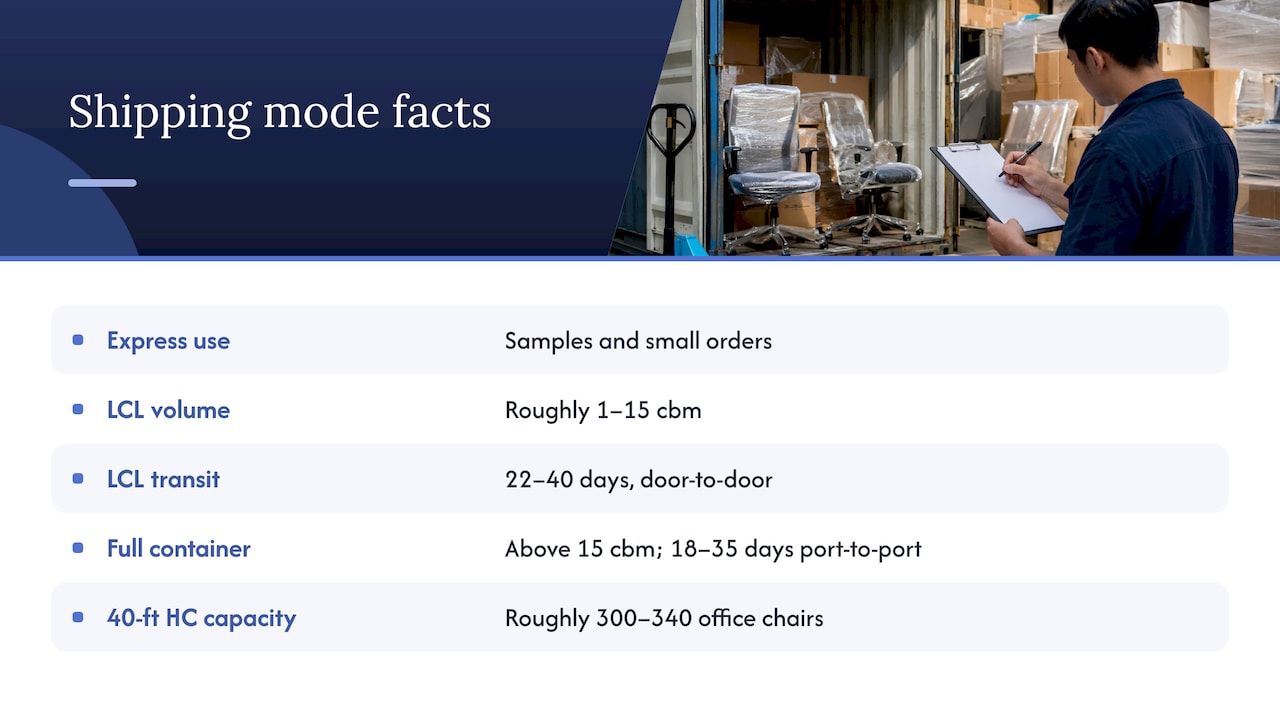
For factory-direct orders, volume sets the method. The same manufacturer guidance suggests express for samples and small orders, LCL sea freight for roughly 1 to 15 cbm, and a full container above 15 cbm. LCL (less-than-container load) means your cartons share a container. It quotes door-to-door transit of 22 to 40 days, while full containers run 18 to 35 days port to port. A 40-foot high-cube container holds roughly 300 to 340 office chairs, which gives you a way to sanity-check any per-unit quote.
Wood packaging and customs
Furniture often arrives on wooden pallets or in crates, and wood packaging has its own rule. Under ISPM 15, an international standard for wood packaging, pallets must be treated and stamped, and unmarked wood can be held or sent back. Our guide to ISPM 15 wood packaging rules, stamps and treatments explains what to check before a container leaves the factory. Wood furniture itself can also carry plant-import paperwork, so confirm the documentation with your broker before booking.
Customs clearance is part of what we do, alongside ocean and air forwarding. Having the broker and the forwarder in one place means the commercial invoice, the packing list and the carrier booking are built from the same data. If urgency justifies air, our guide to avoiding customs holds on air freight covers the preparation.
Packing office furniture for freight
Most furniture damage happens in handling, not in transit. Packing is where you win or lose.
Disassemble what you can
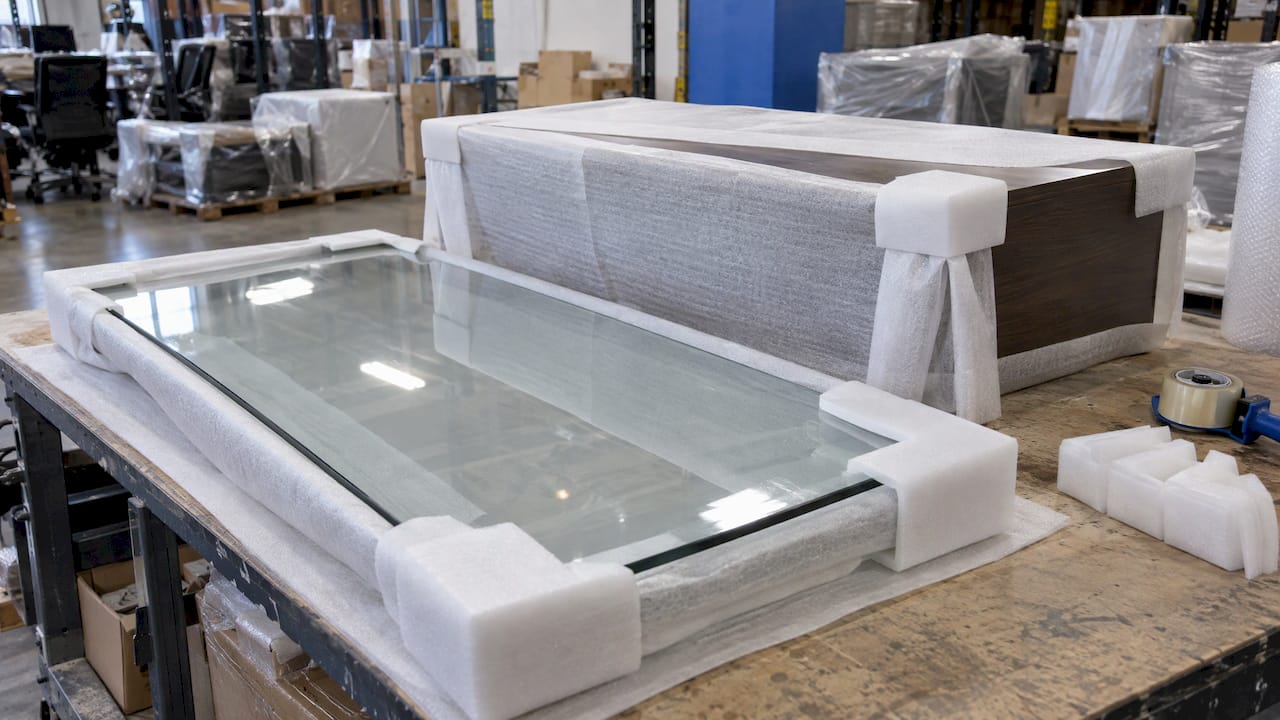
Remove legs, casters, bases and drawers where the design allows. Bag the hardware, label the bag and tape it to the matching piece. Removing parts shrinks the carton, which lowers dimensional weight and protects fragile edges. One national retailer’s vendor packaging guidelines are a good model for commercial standards. They call for desiccant packets in every package, braced drawers and removable parts, surfaces wrapped in non-abrasive material with no tape stuck to the product, and disassembled legs protected with foam in a separate labeled carton, with a red ribbon marking loose components.
Protect surfaces and glass
Wrap finished surfaces in soft, non-abrasive material before adding outer layers. Corners take the most hits, so reinforce them. For glass tops or panels, use thick padding and mark the carton fragile on every side. For more on packing fragile items with care, the same principles apply to desk panels and monitor stands: cushion every side, fill voids and label clearly.
Palletize properly
Freight carriers expect pallets that survive forklifts and stacking. Keep cartons inside the pallet footprint, strap them down, wrap the load and record the final dimensions and weight. Our walkthrough on palletizing freight so it passes LTL shows the five steps. Good palletizing also supports a damage claim if something goes wrong, which our cargo damage prevention guide covers in more detail.
If you would rather not do this in-house, our specialty freight packing service is built for items that do not fit standard boxes.
What a freight quote needs from you
A vague request gets a padded quote or a corrected one later. A commercial furniture quote checklist recommends listing every item with quantity and destination room or floor, and giving the delivery ZIP, dock and liftgate status, elevator and door sizes, and whether a receiving warehouse will hold the delivery until the site is ready. Those are the same details a freight desk needs.
Bring this list to any quote:
- Item list with quantities and carton or pallet counts
- Weight and dimensions per pallet (measured, not estimated)
- Origin and destination addresses, flagged commercial or residential
- Dock or no dock, liftgate needed, appointment required
- Elevator size and door widths for inside delivery
- Required delivery window and whether storage is needed first
- For imports, the commercial invoice, the packing list and the origin port
Our 12-step freight forwarding process shows where each of these details is used from quote to delivery.
Coordinating warehouse, delivery and the install date
The most common furniture project failure is timing, not damage. Freight arrives before the floor is finished, or the install crew is ready and the pallets are still in transit. A warehouse between the factory and the site solves both.
Stage, inspect, then deliver
When pallets land at a warehouse, you can count them against the packing list, record any damage while the carrier is still present, and hold goods until the site is ready. Then a single scheduled delivery goes out. Warehousing, cross-docking and transloading are part of what we offer, so freight can move from a container or trailer to the next leg without sitting idle. Storage is priced on our pricing page: $5 to $6 per bin per month, $17 to $19 per pallet per month, and $37 per hour for additional services. Other handling lines, such as receiving, are listed there without a published price.
Book the delivery appointment
Many commercial buildings and warehouses require appointments, and missing one can mean fees or a rescheduled truck. Read our guide on booking delivery appointment freight and avoiding fees before you confirm a date. For the final leg to an office or storefront, our B2B last-mile delivery guide explains how it works and what it costs. If the destination is a home office, see residential freight delivery.
Plan oversized pieces early
Conference tables, large reception desks and modular workstations may exceed standard freight dimensions. Our piece on project cargo logistics shows how oversized moves are planned, which is the same discipline you want for a big furniture order: measure the path, the doors and the truck access before booking.
Our perspective
Furniture is a awkward product for logistics: bulky, finish-sensitive and often tied to a hard move-in date. Most of the trouble we see described in this category comes from splitting the job among separate parties, one for the truck, one for storage, one for the last mile, and none of them owning the whole timeline.
That is why we built our approach around integration. Transportation, warehousing and delivery sit on one platform, with real-time tracking and 24/7 service, so a pallet that clears customs, rests in a warehouse and goes out on an appointment is one managed shipment, not three.
Our advice to any business buying furniture in volume: decide the mode by pallet count, measure before you quote, and stage freight until the site is ready. Then keep the whole path with one logistics partner, so there is a single place to ask where your order is.
Akbar
Ship your furniture with Usiship
If you are moving an office fit-out, a retail display order or a container of imported chairs, we can handle the freight, the warehouse stage and the delivery together. Our freight forwarding services cover FTL, LTL, air, ocean and customs brokerage, and our warehousing and fulfillment solutions hold goods until your site is ready.
Send us your item list, pallet dimensions and delivery ZIP through usiship.com and we will plan the route from there.
FAQ
What is the cheapest way to ship office furniture?
The cheapest method depends on volume. A few small items usually go cheapest by parcel, while larger orders cost less per piece when consolidated on pallets by LTL or a full truckload. Disassembling pieces and measuring accurately keeps freight charges from being adjusted later.
How much does it cost to ship an office chair?
It varies widely with the mode. A single chair by express parcel can cost far more than the same chair in bulk freight because of dimensional weight. One manufacturer cites $250 to $400 for a sample chair by express versus $10 to $25 per chair in a full container. For a domestic order, get a quote based on measured pallets.
Do I need white-glove delivery for office furniture?
It depends on the destination. If furniture must be placed in a room, unpacked or moved through an elevator, an inside delivery service matters. It also adds cost, and white-glove service can push a large piece past $1,000. Tell your logistics provider the delivery conditions up front.
Can warehouses hold office furniture until my site is ready?
Yes. Staging freight in a warehouse lets you inspect it, count it and schedule one delivery when the space is finished. We offer warehousing with bin and pallet storage, listed on our pricing page.
What do I need to import office furniture?
You need a commercial invoice, a packing list, a customs broker and compliant packaging. Wood pallets and crates must meet ISPM 15 treatment and marking rules. Share these documents with your forwarder before the goods leave the origin.
Sources
- Shipping Furniture Across The Country: A How-To Guide, Forbes
- Shipping Office Furniture from China: FCL, LCL & DDP
- FF&E Logistics & Installation Guide
- US Furniture Packaging Guidelines, URBN
- What to include in a furniture quote request
- Packing breakables with care