
Multi-Node Fulfillment: What It Is and When It Pays Off
Multi-node fulfillment means fulfilling orders from more than one location, such as several warehouses, stores, 3PL sites or dark stores, and routing each order to the node that serves it best. It pays off when your orders ship to customers spread across the country and the savings in transit time and shipping zones outweigh the extra inventory and software you need to run it. It does not pay off automatically, and most small brands should prove the case with data before opening a second node.
This guide explains how the model works, what a node is, what it costs to run, and how to decide whether your order profile supports it.
TL;DR
- A node is any location that holds inventory and can ship an order: a warehouse, a store, a dark store or a 3PL site.
- Orders are routed by rules or software that weigh delivery speed, cost and the number of packages per order.
- The gains come from shorter distances and fewer long shipping zones. The costs are more safety stock, split shipments and tighter systems.
- It fits brands with national demand, fast-delivery promises and enough volume per region. It rarely fits low-volume or very bulky catalogs.
- Start with a pilot of one extra node, backed by accurate inventory data, before you commit to a full network.
Table of Contents
- What counts as a fulfillment node
- How orders get routed across nodes
- What multi-node can do for speed, cost and service
- When multi-node fulfillment makes sense
- The costs and tradeoffs to plan for
- Planning inventory placement and measuring results
- How to start without overcommitting
- Our perspective
- Run your multi-node pilot with Usiship
- FAQ
- Sources
What counts as a fulfillment node
A fulfillment node is any place your inventory can be picked, packed and shipped from. The classic node is a distribution center or 3PL warehouse. Retail stores count too: GS1 US describes micro-fulfillment centers in the back of stores and dark stores that fulfill online orders only as fulfillment sites alongside conventional warehouses.
So a multi-node network is simply a setup where inventory is spread across several of these sites and the order can come from any of them. Common examples:
- Two or three 3PL warehouses, for example one on each coast and one central.
- A main warehouse plus a handful of retail stores that ship online orders.
- A mix of your own site, a 3PL and drop-ship vendors who hold their own stock.
The opposite is a single-node model, where every order leaves one building no matter where the buyer lives. That is simple and efficient at small scale. It gets expensive when half your customers are two or three shipping zones away.
How it differs from omnichannel fulfillment
Omnichannel fulfillment is about the customer experience across channels: web, marketplaces, stores and wholesale served from shared inventory. GS1 US defines fulfillment as completing the distribution and shipping process for consumers’ online orders, and treats that as distinct from traditional store replenishment. Multi-node is the physical network that often makes omnichannel promises possible. You can run multi-node without selling in stores, and you can sell omnichannel from a single warehouse, but the two usually arrive together as a brand grows. Our omnichannel and ecommerce fulfillment services are built around that overlap.
How orders get routed across nodes
Having stock in several places is only half the model. The other half is deciding, order by order, where each one ships from. This is usually called distributed order management, or order orchestration.
Salesforce describes the logic plainly: automated flows identify the locations best able to fulfill an order, often prioritizing the smallest set of locations so that fewer shipments go out, and weighing delivery speed and cost. Proximity to the recipient is one input, not the only one.
A typical orchestration flow, as laid out by Virto Commerce, runs through these steps:
- Ingest the order from the cart, marketplace or EDI feed.
- Validate constraints such as address, shipping method, hazmat limits or carrier cutoffs.
- Select the node or nodes that will fulfill it.
- Reserve stock at those nodes.
- Monitor for exceptions such as stockouts, delays or carrier failures, and reroute if needed.
If you want to see how this looks as a controlled test, we wrote up a 90 day pilot for distributed order management that starts with a few rules rather than a full rebuild.
Rules that work in practice
Most brands begin with a short priority list and add rules only when the data shows a need:
- Ship from the nearest node that has every item. This keeps the order to one box and one label.
- Avoid splitting orders. If no single node has everything, ship from the node with the most lines, or hold briefly for a transfer.
- Protect service levels. Reserve certain stock for expedited orders or marketplace programs with strict delivery requirements.
- Respect node capacity. Cap daily orders per node so a promotion does not bury one building while another sits idle.
One research note is worth knowing if you are tempted to build a complicated optimizer. In numerical tests, simple threshold-style heuristics for consolidating shipments across two warehouses landed within 1 to 2 percent of the optimal solution. Simple rules, applied consistently, get you most of the benefit.
What multi-node can do for speed, cost and service
The core logic is geographic. Parcel rates rise with zone distance, and transit time rises with it. If a node sits closer to your buyers, more orders ship in short zones and arrive sooner. That is why same-day and next-day promises are hard to keep from one central building without paying for premium service.
The largest public example is Amazon. Research on its U.S. regionalization, fully deployed by March 2023, found it reduced the distance between sites and customers by 15 percent and cut middle-mile touchpoints by 12 percent. The same study reports savings of more than $0.45 per unit while delivery speeds improved. Amazon operates at a scale few brands approach, so treat the numbers as proof the mechanism works, not as a forecast for your business.
Shared networks can add to the effect. McKinsey’s analysis of multi-client fulfillment found cost savings of 7 to 9 percent compared with dedicated fulfillment for 3PLs, and that combined with demand smoothing, site scaling and automation, it can raise e-commerce profitability by two to three times. For a growing brand, this is the practical argument for using a 3PL with several sites instead of leasing your own: you borrow a network that already has the volume.
Beyond cost, customers notice the results:
- Delivery windows shrink from five or six days to two or three in many regions.
- Fewer packages cross the country, which also cuts damage exposure and carrier surcharges tied to long hauls.
- Regional stock gives you a buffer when one building has a disruption, a weather event or a labor shortage.
When multi-node fulfillment makes sense
This is the question the top-ranking pages argue about, and the honest answer is that multi-node is not automatically cheaper or better. It depends on your order profile. Use these checks.
1. Your orders are geographically spread
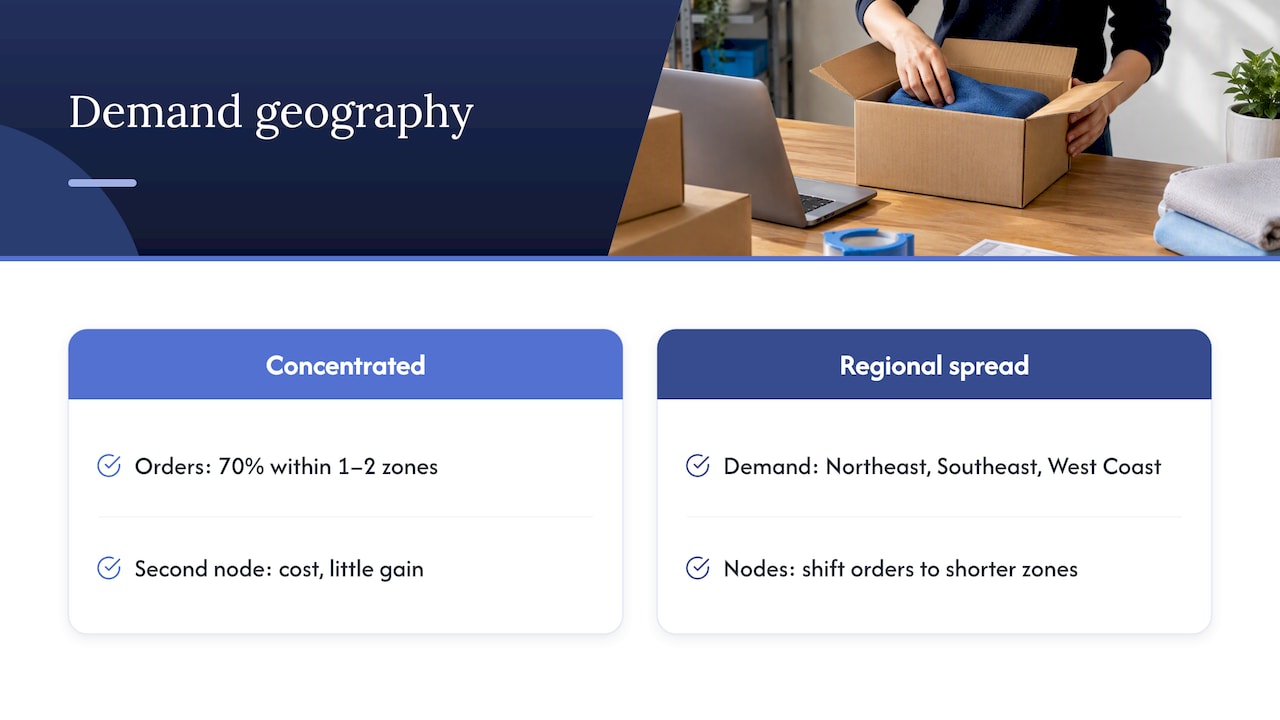
Pull twelve months of orders and map them by destination ZIP. If 70 percent of orders sit within a one- or two-zone radius of your current warehouse, a second node adds cost for little gain. If demand splits between, say, the Northeast, the Southeast and the West Coast, a second or third node can move a large share of orders into shorter zones.
2. You make a delivery promise that one node cannot keep
Two-day shipping, marketplace delivery badges and same-day local delivery all depend on proximity. Programs such as Seller Fulfilled Prime have strict handling and transit requirements, and our Seller Fulfilled Prime ops checklist shows what they demand from your operation. If your current location cannot meet those, a node closer to demand is often the cleanest fix.
3. Shipping cost is a large share of order value
If freight and parcel charges eat a big part of the margin, shorter zones matter more. If you ship high-value items where a few dollars of postage disappears into the margin, the network savings are harder to see.
4. Volume per region is enough to justify stock
Every node needs its own inventory. If a region only sells two units of an item per month, stocking it there ties up cash for little benefit. This is where product segmentation helps. Fast movers go to regional nodes, while slow movers stay in one central location. Our guide to ABC inventory analysis explains how to split your catalog so each class gets different stocking rules.
5. Your catalog is compact and your demand is fairly predictable
Small, light, dense products are the easiest to replicate across nodes. Bulky furniture, seasonal items with sharp spikes and products with very long lead times make forecasting by region harder, and a wrong forecast leaves stock in the wrong place.
A quick decision table
| Your situation | Likely best fit |
|---|---|
| Most orders ship within one or two zones of your warehouse | Single node, optimize carriers and packaging |
| Orders spread across three or more regions, with steady volume | Two or three nodes, fast movers only |
| Marketplace or retail programs with strict delivery dates | Multi-node near the densest demand |
| Low volume, wide SKU count, many slow movers | Single node plus distributed warehousing for top SKUs only |
| Large seasonal swings | Central node plus temporary regional capacity |
For a deeper look at the second and fourth rows, read our explainer on distributed warehousing and when it pays off.
The costs and tradeoffs to plan for
The benefits are real, and so is the added complexity. Plan for these items before you open a node.
More inventory. Splitting stock across nodes means each one needs its own safety stock. Total inventory usually rises, and so does carrying cost, even when each node holds less than a central warehouse would.
Split shipments. MMH’s white paper on single versus multi-DC networks warns of possible extra transportation costs when orders are split, and customer friction from multiple shipments and receipt reconciliation. A customer who gets two boxes on different days is less happy than one who gets a single slower box.
Systems and management. The same paper notes that a multi-DC network needs IT able to reassign customers and partially processed orders to operational DCs, plus spare capacity to absorb demand when one site is down. McKinsey makes a related point for multi-client models: success may require changes to service offerings, commercial structure, warehouse operations and technology.
Inbound freight. You now replenish several nodes instead of one. Smaller, more frequent replenishment shipments cost more per unit unless you consolidate them. Container and LTL planning matter here, and our freight consolidation pilot checklist shows how smaller shippers test consolidation before committing.
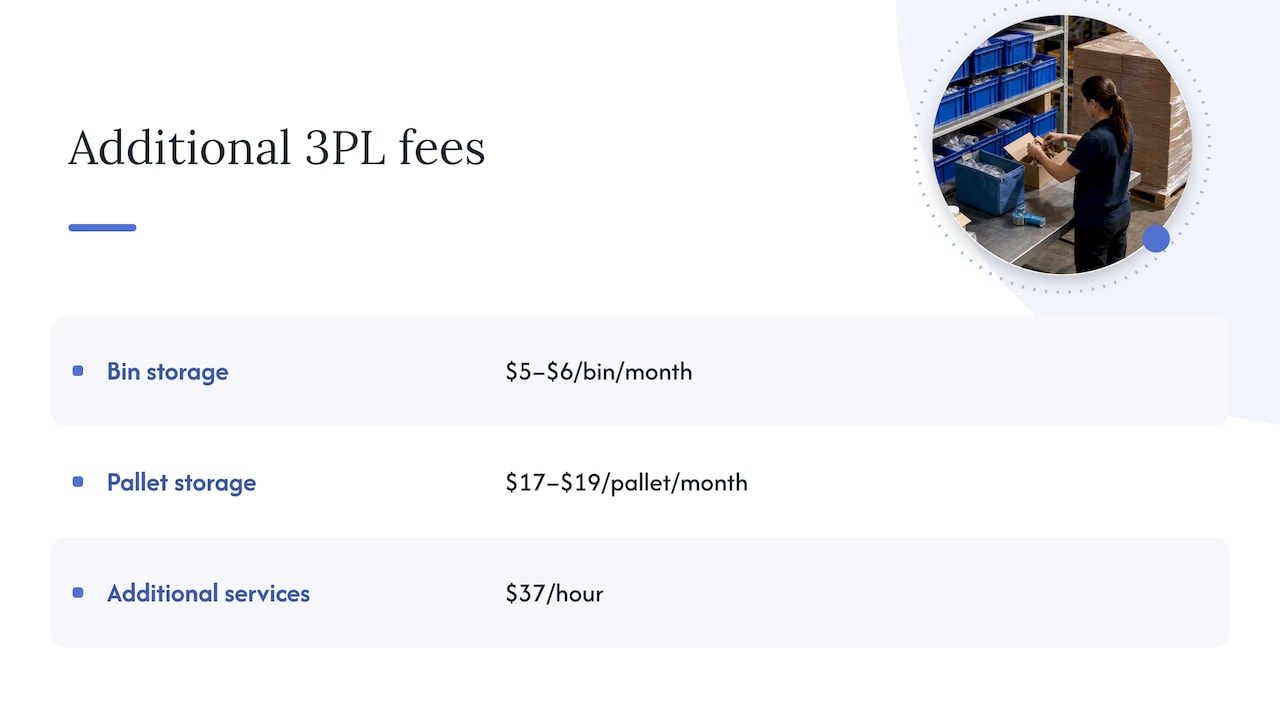
Fixed and variable fulfillment fees. With a 3PL, each additional node typically brings its own storage, receiving and handling charges. As a reference point, our published storage rates are $5 to $6 per bin per month and $17 to $19 per pallet per month, and additional services are billed at $37 per hour. See the full structure on our pricing page. Multiply storage by the number of nodes and by the share of your catalog you replicate to see the true cost.
Planning inventory placement and measuring results
MMH recommends planning around customer service needs, product characteristics, inventory and transportation costs, and management and IT capabilities, and using network analysis to assess node locations and sizes, inventory carrying cost, service levels and inbound and outbound freight. You do not need a consulting engagement to start. A spreadsheet with your order history, current parcel rates by zone and a few location scenarios will answer the first question: how many orders would move into shorter zones?
Get inventory accuracy right first
Routing only works if the system knows what each node holds. GS1 US’s view is that reliable inventory visibility and accurate available-to-promise data are foundational to allocating orders across locations, and that inaccurate records create misplaced or phantom inventory and poor customer outcomes. Cycle counts, scan-at-receiving and clean location data come before any routing engine. Our real-time inventory visibility playbook walks through the capture steps, and these inventory management tips for operations teams cover the day-to-day habits that keep counts honest.
If some of your nodes are stores or small sites run by frontline staff, a clear process for counts and transfers matters as much as software. This five-step multi-location inventory rollout is a practical outline for getting teams at several sites onto the same routine.
Metrics to track
Track a short list monthly, by node and in total:
- Average shipping zone and cost per order, before and after the new node.
- Delivery time from order to doorstep, by region.
- Split-order rate, the share of orders shipping in more than one package.
- Inventory turns and days on hand per node.
- Stockout and reroute rate, which shows whether the stocking rules are right.
- Order accuracy and on-time ship rate at each site.
If split-order rate climbs, your stocking rules are spreading related items across nodes. Keep common bundles together at the same site.
How to start without overcommitting
The lowest-risk path is a staged one.
- Analyze twelve months of orders by destination, SKU and shipping cost.
- Segment the catalog. Pick the top 20 to 30 percent of SKUs that drive most of the volume.
- Choose one additional node in the region where it moves the most orders into shorter zones.
- Set simple routing rules, starting with nearest node with full stock.
- Run a pilot of 60 to 90 days and compare zone mix, delivery time, cost per order and split rate against your single-node baseline.
- Expand or stop based on the numbers. Add a third node only when the second has proven its value.
Using a 3PL for the new node avoids a long lease and lets you scale up or down. Order intake can arrive by email and PDF from wholesale customers as well as from carts, and it helps to keep that flow tidy. This guide on reducing order backlog before it reaches your ERP is useful when manual orders slow routing decisions.
Our perspective
We see the same pattern with growing ecommerce brands. They start with one warehouse, and it works well until a competitor offers two-day delivery or freight costs start to eat the margin. Then the instinct is to open several locations at once. We think that is the wrong order of operations.
Our approach is to treat the second node as an experiment. Prove the case with order data, put the fast-moving SKUs there first and keep the rules simple. The real work is not the building. It is inventory accuracy, clean receiving and a single view of stock across sites. That is why we run warehousing, fulfillment, freight and tracking on one platform, so the inventory you see is the inventory you can promise.
We also believe flexibility beats size. A brand should be able to add a node when demand justifies it, and not be locked into a network built for a customer ten times its size. That is what we aim to give our clients: national reach, real-time visibility and a team that picks up the phone, any hour.
Akbar
Run your multi-node pilot with Usiship
Universal Shipping Inc. brings transportation, warehousing and fulfillment together under one platform, with real-time tracking and support for businesses shipping across all 50 states. We handle receiving, storage, pick and pack, returns, packaging, freight forwarding and last-mile delivery, so a second node does not mean a second set of vendors to manage.
If you are testing whether a regional node pays off, start with our 3PL fulfillment services or look at our warehousing and fulfillment solutions. If you would rather compare a 3PL with running things yourself first, read our piece on 3PL services versus in-house shipping. For rate details, our pricing page lists storage and service fees, and you can contact us through our site for a quote shaped to your order profile.
FAQ
What is multi-node fulfillment?
It is a fulfillment model in which inventory is spread across several warehouses, stores, 3PL sites or other nodes, and each order is routed to the best location to fill it. The goal is to ship from closer to the customer, with fewer packages per order.
What are logistics nodes?
A logistics node is a physical point in your supply chain where goods are received, stored, handled or shipped. In fulfillment, that usually means a warehouse, a distribution center, a store or a micro-fulfillment site that can pick and ship orders.
Is multi-node fulfillment always cheaper?
No. Shorter shipping zones can reduce parcel costs, but you also carry more inventory, pay for extra storage and may see more split shipments. It tends to pay off when your customers are spread across regions and your volume per region is steady. A pilot with real order data is the safest way to check.
How many nodes does a small ecommerce brand need?
Most start with one and add a second only when order data shows a large share of shipments traveling long zones. A common step is two nodes, placed so that together they cover most of your demand in shorter zones. Add a third only after the second has proven its return.
How does multi-node fulfillment relate to omnichannel fulfillment?
Omnichannel fulfillment serves web, marketplace, store and wholesale demand from shared inventory. Multi-node fulfillment is the network that often supports it, by placing that inventory in several locations. You can have one without the other, but they commonly grow together.
Sources
- GS1 US Autonomous Retail Whitepaper
- GS1 US E-Commerce Fulfillment Guideline
- Salesforce Trailhead: distributed order management
- Virto Commerce: order orchestration explained
- Shipping consolidation across two warehouses
- Regionalize and Scale: Amazon’s fulfillment network design
- McKinsey: multi-client fulfillment for e-commerce
- MMH: single or multi-DC network
- Inventory management tips for operations teams
- Five-step rollout for multi-location inventory
- Order backlog reduction before ERP entry