
MABD Compliance: How to Hit Must-Arrive-By Dates
MABD compliance means your shipment reaches the retailer’s distribution center inside the delivery date or window printed on the purchase order. You get there by working backward from the MABD, using the assigned carrier, booking the dock appointment on time and shipping with correct documents. Miss it, and the retailer can fine you, refuse the load or count the miss against your scorecard.
This guide covers what the date really is, how Walmart-style windows work, what a miss costs, how to plan a ship-on date and how to dispute a deduction.
TL;DR
- MABD (Must Arrive By Date) is the date, or window of days, by which a purchase order’s merchandise has to arrive at the retailer’s facility. It is a commitment, not a target.
- OTIF (On Time In Full) is the broader score. MABD covers the “on time” half; completeness covers the “in full” half.
- Work backward: MABD minus transit time minus a buffer gives your ship-on date. Pad LTL lanes, since transit is an estimate.
- Most misses trace to routing guide violations, such as the wrong carrier or a badly booked appointment, not to the road itself.
- Keep evidence for every load. Disputes are won with time-stamped records, and the clock for filing is short.
Table of Contents
- What MABD means and how it differs from OTIF
- How the MABD window works
- What a missed MABD costs
- Why shipments miss the MABD
- Build a ship-on date that holds
- Where a warehouse partner helps
- Our perspective
- Disputing a MABD deduction
- Work with us on MABD-sensitive freight
- FAQ
- Sources
What MABD means and how it differs from OTIF
MABD stands for “Must Arrive By Date.” It is the expected arrival date for a supplier’s merchandise at a retailer’s store, warehouse or other facility, and it can be a single date or a window of days. Walmart, for one, puts a MABD on each purchase order to show when the product must be delivered to meet its on-time requirements.
OTIF adds a second test. It looks at timing and at completeness: did the right quantity show up, on the right day? A load can arrive on time and still fail “in full.” It can also arrive complete but a day late. MABD is the date half of that equation, which is why suppliers tend to say it drives most of their fines.
Two practical points follow:
- The date on the PO is the date that counts. Walmart assigns an Original MABD when the PO is created and an Adjusted MABD when the PO is updated before it reaches the distribution center. Check which one you are measured against.
- Other retailers use the same idea under different names and with different penalties. Read each retailer’s own routing guide rather than assuming Walmart’s rules carry over.
How the MABD window works
A MABD is not always one exact day. Retailers define a window, and a shipment that arrives too early can be as non-compliant as one that arrives late.
Walmart’s windows depend on product category. Typical options are the exact MABD date, or arrival up to one, two or three days before it. Two reported examples show how the window has been described over time:
| Source and period | What it reported |
|---|---|
| Supply Chain Dive, 2017 policy | One-day window for food and consumables, two-day period for general merchandise and soft lines |
| Walmart supplier notice, 2009 to 2010 | For most categories, a four-day window: the MABD date plus the three days before it, with some segments held to tighter windows |
The lesson is not to memorize those numbers. Windows change, and they differ by category and program. Read the window on your own PO and in the current routing guide for your account, then build your plan around the narrowest version that applies to you.
What a missed MABD costs
The consequence depends on the retailer. A miss may lead to an OTIF failure, a separate late fee, or load refusal, and the MABD on the PO is treated as a commitment.
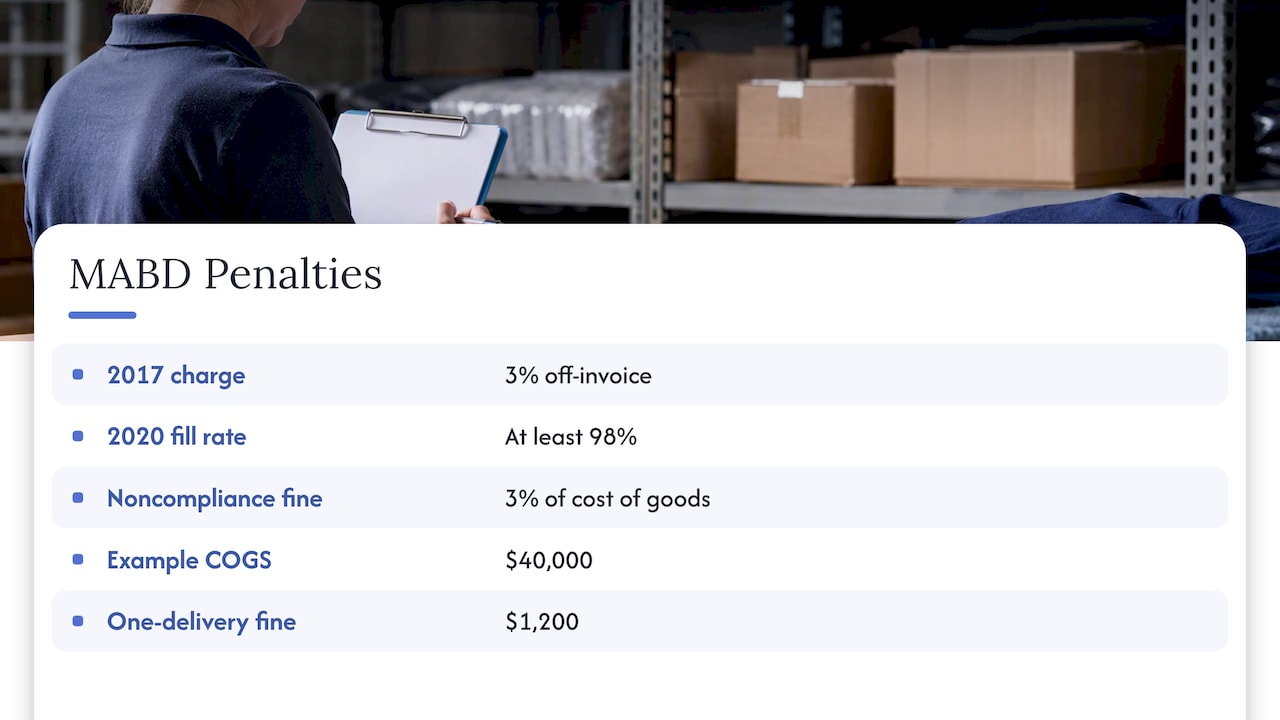
For Walmart, the published figures have been steep. In 2017, the retailer tied delivery timing and completeness to a 3% off-invoice charge for early, late or improperly packaged deliveries. In 2020, FreightWaves reported that certain prepaid suppliers had to meet the MABD or specified delivery days and fill orders at least 98% of the time, with a fine equal to 3% of cost of goods sold for noncompliance. Confirm the current percentage and thresholds for your account in the retailer’s supplier portal before you build a budget.
A quick worked example shows why this matters. Say a truckload of goods has a cost of goods sold of $40,000. At 3%, one non-compliant delivery would cost $1,200 before you count freight, rework or damage to the relationship. Spread that across a month of late loads and the fines can exceed the margin on the whole program.
Why shipments miss the MABD
The usual suspects are less dramatic than weather or breakdowns. Walmart’s routing guide points to routing violations, such as using the wrong carrier or scheduling delivery appointments improperly, along with failing to account for transit time or calculating the ship-on date incorrectly. One compliance vendor notes that routing violations are especially costly because they often compound with other compliance failures.
In practice, misses cluster around five causes:
- Ship date set from the PO date, not the MABD. The calendar starts at the destination and runs backward.
- No buffer on LTL. Transit quotes are estimates, and a terminal delay or a re-weigh can cost a day.
- Wrong or unapproved carrier. Retailers assign carriers or routes on many programs, and using another one is its own violation.
- Appointment problems. Late booking, a missed slot or a rebooking can push a load past the window.
- Bad data. Wrong weight or cube, a mismatched ASN or a faulty label can hold a load at the dock.
A delivery coordination checklist from another industry shows the same pattern: unauthorized carriers and missed delivery appointments are what turn a good plan into a late arrival.
Build a ship-on date that holds
The routing guide’s advice is straightforward: enter accurate weight and cube information, work backward from the MABD to calculate a ShipOn date, ship as requested, arrange pickup with the assigned carrier and prepare documents correctly. Here is a workable routine.

Step 1: Anchor on the earliest acceptable arrival
If your window allows arrival up to three days early, the target is not the MABD itself. Aim for the middle of the window, so a one-day slip in either direction still lands inside it.
Step 2: Subtract real transit time
Use door-to-door transit for the actual lane, not the best case. For LTL, our guide to ZIP to ZIP LTL transit times explains when to pad one to two days. Add time for pickup scheduling, consolidation at the origin and the retailer’s appointment lead time.
Step 3: Book the appointment early
Many retailers require a delivery appointment at the distribution center, and the slot you can get decides the real arrival day. See how to book delivery appointment freight and avoid the fees that come with missed or rescheduled slots.
Step 4: Lock in the carrier and the paperwork
Confirm the carrier the routing guide requires, verify freight class and weights so the bill does not change in transit (the freight class guide covers the reclass traps), and make sure labels and the ASN match the PO. Our piece on fixing ASN errors first walks through the data problems that trigger chargebacks.
Step 5: Recheck lead times
The routing guide also recommends periodically reviewing system lead times with your Replenishment Manager. If your lead time in the retailer’s system is shorter than what your supply chain really needs, every PO starts with a handicap. Also keep in mind that Walmart traffic does not accept POs entered past their assigned MABD, and extensions require intervention from a replenishment contact. Raise a problem early, not after the date.
Where a warehouse partner helps
Late arrivals often start before the truck leaves. Goods that are not received, labeled or palletized in time cannot ship in time. Holding stock near the retailer’s network, cross-docking inbound containers or transloading them into domestic trailers shortens the stretch where a delay can hide. If container handoffs are your bottleneck, see how transloading cuts turn time, and track your results against an on-time delivery KPI so you see slippage before the retailer does.
Our perspective
Suppliers tend to treat MABD as a trucking problem. In our experience it is a coordination problem across four hand-offs: the purchase order, the warehouse, the carrier and the dock appointment. Any of the four can slip, and the retailer only sees the last one.
That is why we run transportation, warehousing and freight on one platform. When the team that picks and palletizes your order can see the same tracking and appointment data as the team that books the truck, the ship-on date stops being a guess. Our approach is built around real-time tracking, predictive routing and 24/7 support so that a slipping load is flagged while there is still time to fix it.
Our advice: build the buffer into the plan, not into the excuse. Pad the transit estimate, book the appointment first, keep every timestamp, and treat every miss as a data point for the next PO.
Akbar
Disputing a MABD deduction
Not every fine is valid. One compliance vendor reports that a meaningful share of disputable chargebacks stem from carrier exceptions and receiving errors at the distribution center. Deadlines reported by blogs differ: one source says OTIF fines can be disputed within 30 days in the OTIF portal, another says Walmart disputes are filed within 60 days of the deduction through Retail Link. Treat the shorter window as your working limit and confirm the current rule in your supplier portal.
Gather this evidence for each load:
- Time-stamped EDI logs and PO acknowledgments
- Signed bills of lading
- Carrier tracking and proof of delivery
- Carrier exception reports and dock appointment confirmations
- GPS or ELD records and the distribution center’s receiving timestamps
If the load was damaged or short, a separate process applies; our freight claims playbook explains the nine-month filing window.
Work with us on MABD-sensitive freight
If you ship to big-box retailers and your late-arrival rate is costing you, we can help you plan the lane, hold the inventory and move the freight. Usiship combines freight forwarding, LTL and FTL transportation, and warehousing and fulfillment under one team across all 50 states.

Storage is published at 5 to 6 USD per month per bin and 17 to 19 USD per month per pallet, with additional services at 37 USD per hour. See the full pricing page or ask us to review your current lanes.
FAQ
Is MABD the same as OTIF?
No. MABD is the date or window on the purchase order. OTIF is the score that measures whether you delivered on time and in full. Missing the MABD is one way to fail OTIF, and delivering the wrong quantity is another.
Can a shipment be too early for the MABD?
Yes. Retailers define a window, and arriving before it opens can be non-compliant. Walmart’s windows vary by category, with options from the exact date to up to three days before it, so check the window on your PO.
What happens if I miss the MABD?
Depending on the retailer, you may face an OTIF failure, a separate late fee or a refused load. For Walmart, published reports have described a fine of 3% of cost of goods sold on non-compliant deliveries. Confirm current terms in your supplier agreement.
How far back should I schedule the ship-on date?
Start at the MABD and subtract transit time, pickup lead time and an appointment buffer. On LTL lanes, add one to two extra days because transit estimates are not guarantees.
How long do I have to dispute a chargeback?
Published figures vary, with 30 days cited for OTIF fines and 60 days for Walmart deductions in general. Use the shorter window as your working deadline and check the retailer’s portal for the current rule.
Sources
- What Is Must Arrive By Date (MABD)?
- OTIF: How To Meet Delivery Appointments
- Walmart OTIF Fundamentals
- Behind the scenes of Walmart’s new on-time, in-full policy
- Dear Valued Walmart Supplier: The Walmart Supply Chain Reliability Program
- MABD Deductions: How to Validate and Dispute Them
- Walmart: Inbound deliveries must be on time, in full
- Walmart routing guide
- How to Avoid EDI Chargebacks
- Walmart deduction codes
- Window and Door Delivery Coordination Checklist