
LTL Shipping for Businesses: Cut Costs and Move Smarter
LTL shipping, or less-than-truckload freight, lets you share trailer space with other shippers rather than paying for an entire truck your cargo doesn’t fill. Pricing is governed by the NMFC classification system maintained by the National Motor Freight Traffic Association (NMFTA), and tools like ClassIT+ make it possible to verify your freight class before a carrier does it for you. If your shipment runs between 150 and 15,000 pounds and you’re not filling a trailer, LTL is almost certainly cheaper than full truckload. Usiship handles LTL freight across all 50 states and can run a shipping audit to find where you’re overpaying.
Table of Contents
- What is LTL shipping, and when should you use it?
- How LTL pricing works: freight class, density, and the rate formula
- How carrier networks and terminals affect your transit times
- How to prepare freight and the documentation you need
- Common accessorial charges and how to avoid or dispute them
- How to get accurate LTL rates and what a complete quote should include
- How to evaluate and choose the right LTL partner or 3PL
- Practical strategies to reduce your LTL spend
- Your next three steps to act on this guide
- Key Takeaways
- The part most shippers get wrong about freight class
- Usiship handles LTL so you can focus on the business
- Useful sources and tools
What is LTL shipping, and when should you use it?
Less-than-truckload shipping works on a hub-and-spoke model: your freight gets picked up, sorted at a regional terminal, moved via linehaul to a destination terminal, and delivered from there. That multi-touch process is why LTL transit times are longer than FTL and may take multiple business days depending on the distance and routing. Each additional terminal stop adds handling, which is why packaging matters more in LTL than in any other mode.
LTL makes sense when:
- Your shipment weighs in a range suitable for LTL freight and occupies a few pallets
- You ship frequently but not enough volume to justify a dedicated trailer
- Your freight is non-urgent and can absorb a 2–5 day transit window
- You want to avoid the minimum charges that parcel carriers apply to heavy, dense items
- You’re consolidating multiple SKUs or orders into a single pallet to reduce per-unit freight cost
Parcel carriers like UPS and FedEx Ground are cheaper for packages under 150 pounds. Full truckload (FTL) wins when you have 10 or more pallets, time-sensitive freight, or cargo that can’t tolerate multiple handling touches. The decision between FTL vs LTL usually comes down to weight, urgency, and how fragile the product is.
How LTL pricing works: freight class, density, and the rate formula
Every LTL shipment gets assigned a freight class, a number between 50 and 500 set by the NMFC (National Motor Freight Classification). Lower class numbers mean denser, easier-to-handle freight and lower rates. Higher class numbers mean the opposite.
The four classification characteristics
The NMFC assigns class based on four factors:
- Stowability — how easily the freight fits with other cargo in a trailer
FreightFigures explains that density drives the outcome for the majority of general commodities, which is why measuring accurately before you ship is the highest-leverage thing you can do.
Density calculation, step by step
Density = weight (lbs) ÷ cubic feet. Cubic feet = (length × width × height in inches) ÷ 1,728.
Example: A pallet measuring 48" × 40" × 48" and weighing 500 lbs.
- Cubic feet: (48 × 40 × 48) ÷ 1,728 = 92,160 ÷ 1,728 = 53.33 cu ft
- Density: 500 ÷ 53.33 = 9.37 lbs/cu ft
- At roughly 9–10 lbs/cu ft, most NMFC tables land this shipment at Class 100
Shave 8 inches off the height by repacking, and density jumps to 11.25 lbs/cu ft, which can push the class down to 92.5 or even 85, saving real money on every shipment.
How carriers quote LTL rates
| Rate Component | What It Is | Typical Behavior |
|---|---|---|
| Base rate (per cwt) | Dollars per 100 lbs, by class | Higher class = higher rate |
| Minimum charge | Floor charge regardless of weight | Often equivalent to ~500 lbs |
| Fuel surcharge | Percentage added to base rate | Fluctuates weekly with diesel index |
| Accessorial fees | Charges for non-standard services | Liftgate, residential, appointment, etc. |
Carriers multiply the base rate by the applicable class multiplier, then add fuel and any accessorials. Minimum charges apply ensuring a floor billing weight, so consolidating small shipments generally saves money.
Pro Tip: Use NMFTA’s ClassIT+ tool to look up the correct NMFC item number and density-based class before you build a quote. A mismatch between your declared class and what a carrier’s inspector finds triggers reclassification fees on top of the corrected rate.
How carrier networks and terminals affect your transit times
Same-terminal shipments, where pickup and delivery both fall within one carrier’s terminal zone, move fastest, sometimes overnight for short regional lanes. The moment a shipment crosses into multi-linehaul territory, each additional sort and transfer can add to transit time. A Chicago-to-Los Angeles lane might touch three terminals: origin, a mid-country hub, and the destination terminal.

Hub-and-spoke networks also create timing patterns worth knowing. Most carriers run morning deliveries and afternoon pickups. If your freight misses the afternoon pickup cutoff at a terminal, it sits until the next linehaul departure, which can add a full day to the quoted transit time. Scheduling pickups early in the day, especially on Mondays and Tuesdays, keeps freight moving through the network without sitting over a weekend.
Transit-time calculators and coverage maps, available through most national carriers and 3PLs, let you verify expected delivery windows before committing to a lane. Always check them against your customer’s delivery requirements, not just the carrier’s published average.
How to prepare freight and the documentation you need
Good preparation prevents two expensive problems: damage claims and reclassification fees. Both are far more common than they need to be.
Packaging and palletizing best practices
- Use one handling unit per pallet whenever possible; multiple loose boxes on a pallet multiply the number of touches and damage opportunities
- Stretch-wrap pallets tightly, covering the base of the pallet itself, not just the cargo
- Add edge protectors on corners for boxed goods; cardboard corners are cheap insurance against forklift contact
- Keep freight within the pallet footprint (48" × 40" standard); overhang invites damage and can trigger a reclass
- Photograph every pallet before tender, with dimensions and weight visible on a scale or tape measure in the frame
Pro Tip: Stack boxes in a column or brick pattern rather than pyramid-stacking. Column stacking distributes weight evenly and reduces the chance a carrier inspector reclassifies your freight as “improperly packaged,” which is a legitimate trigger for a higher class and an inspection fee.
Bill of Lading checklist
The NMFC glossary defines the standard terms that belong on every BOL. At minimum, your Bill of Lading must include:
- Shipper and consignee name, address, and contact
- NMFC item number and declared freight class
- Accurate weight (include pallet weight) and dimensions
- Number of handling units and piece count
- Commodity description (specific enough to match the NMFC item)
- PO number, reference numbers, or invoice references
- Prepaid or collect designation for charges
- Special instructions (liftgate required, appointment needed, etc.)
Missing or vague commodity descriptions are the single most common reason carriers flag a shipment for inspection. “General merchandise” on a BOL is an invitation for a reclassification.
Common accessorial charges and how to avoid or dispute them
Accessorials are the line items that turn a clean quote into a surprise invoice. Most are avoidable with upfront planning.
| Accessorial | What Triggers It | How to Avoid It |
|---|---|---|
| Liftgate delivery | No dock at destination | Declare it upfront; never assume a dock exists |
| Residential delivery | Delivery to a home address | Always flag residential; carriers check ZIP codes |
| Appointment delivery | Consignee requires a scheduled window | Confirm with consignee before tendering |
| Detention | Driver waits beyond free time (usually 30 min) | Stage freight before the truck arrives |
| Storage | Freight held at terminal after failed delivery | Confirm consignee availability before ship date |
| Reweigh/reclass fee | Carrier finds weight or class discrepancy | Measure and weigh accurately; use ClassIT+ |
| Inside delivery | Freight must be moved beyond the threshold | Declare if the consignee has no dock or forklift |
Carriers have the right to inspect and reclassify any shipment. When they do, you pay the corrected class rate plus an inspection and reclassification fee. FreightFigures documents this process clearly: the burden of proof falls on the shipper, not the carrier.
If you receive a reclassification charge you believe is wrong:
- Pull your original BOL, photos, and weight ticket immediately
- Request the carrier’s inspection report and inspector’s measurements
- File a written dispute within 30 days of the invoice date (most carriers have a formal claims portal)
- Reference the NMFC item number and density calculation in your dispute letter
- Escalate to your 3PL or broker if the carrier does not respond within 15 business days
How to get accurate LTL rates and what a complete quote should include
A quote missing one line item is not a quote; it’s a starting point for a larger invoice. Before you accept any rate, confirm the following are included:
- Declared freight class and NMFC item number
- Shipment dimensions (length × width × height per handling unit) and total weight including pallets
- Number of handling units and piece count
- Origin and destination ZIP codes, with residential or limited-access flags if applicable
- All required accessorials (liftgate, appointment, inside delivery)
- Fuel surcharge percentage and whether it’s locked or floating
- Minimum charge threshold and whether your shipment triggers it
- Transit time estimate for the specific lane
The math behind a quote looks like this: (base rate per cwt × weight in cwt × class multiplier) + fuel surcharge + accessorials. If the carrier’s minimum charge exceeds that total, the minimum applies. Always ask whether the quoted fuel surcharge is the current week’s rate or an estimate, since it can shift between quote and pickup.
Measure every dimension yourself. Carrier dock scales and dimensioners are calibrated; your estimate is not. A pallet that measures 52" tall instead of the 48" you quoted can change the density, the class, and the rate.
How to evaluate and choose the right LTL partner or 3PL
Not every carrier or broker is built for every lane or freight type. The right partner for a manufacturer shipping Class 70 steel components out of Ohio is different from the right partner for an e-commerce brand shipping Class 150 apparel from California.
When evaluating an LTL partner, ask:
- Do they publish transit times and coverage maps for your specific lanes?
- What is their claims ratio, and what is the average resolution time?
- Do they offer freight insurance beyond carrier liability limits?
- Can they provide real-time tracking at the shipment level, not just milestone updates?
- Are their accessorial policies published and itemized, or buried in a tariff?
- Do they have experience with your commodity and freight class?
Red flags to watch for: no published transit times, accessorial fees disclosed only after delivery, slow or unresponsive claims handling, and quotes that omit fuel surcharges. A carrier or broker that can’t answer the transit-time question for your lane in under 24 hours is telling you something about how they’ll handle problems.
Usiship’s logistics and transportation services cover domestic LTL and FTL across all 50 states, with real-time tracking, warehousing, and customs clearance for cross-border lanes. For businesses weighing whether to manage freight in-house or through a 3PL, Usiship’s 3PL vs. in-house comparison lays out the tradeoffs clearly.
Practical strategies to reduce your LTL spend
Freight class optimization is one of the highest-impact levers for annual freight savings. A one-class improvement on regular pallet volumes can save thousands of dollars annually, according to FreightFigures’ NMFC analysis. Here’s where to start:
- Audit your current freight classes — Pull the last 90 days of invoices and check whether declared classes match actual density calculations. Misclassification in either direction costs money.
Worked example: A shipper moves 50 pallets per month at Class 100, paying a base rate of $22 per cwt. Each pallet averages 500 lbs. By repacking to reduce height and pushing density above the Class 92.5 threshold, the base rate drops to $19 per cwt. On 50 pallets × 5 cwt each, that’s $750 saved per month, or $9,000 annually, before fuel surcharge savings.
Usiship’s warehouse and staging solutions support consolidation programs for businesses that need a staging point before tendering freight to LTL carriers.
Your next three steps to act on this guide
The gap between knowing LTL mechanics and actually saving money on freight is usually just three actions:
- Verify your NMFC code using ClassIT+. The NMFTA’s ClassIT+ tool is the authoritative source for NMFC item numbers. If your declared class doesn’t match the density-based class in ClassIT+, you’re either overpaying or one inspection away from a reclassification fee.
- Request a shipping audit or LTL quote from Usiship. Bring your last 90 days of freight invoices. Usiship can identify misclassifications, consolidation opportunities, and accessorial patterns that are costing you money. Contact Usiship to get started.
Key Takeaways
LTL freight pricing is driven by freight class (NMFC), and density is the single most controllable variable in that equation.
| Point | Details |
|---|---|
| Freight class drives price | NMFC classes range from 50 to 500; lower class means lower rates, and density is the primary determinant for most commodities. |
| Measure before you quote | Accurate dimensions and weight prevent reclassification fees; always include pallet weight in your declared total. |
| Palletize and consolidate | Fewer handling units reduce damage risk and eliminate duplicate minimum charges on small shipments. |
| Audit accessorials regularly | Liftgate, residential, and appointment charges are often avoidable with upfront planning and consignee confirmation. |
| Usiship for LTL audits | Usiship covers LTL across all 50 states and offers shipping audits to identify class mismatches and cost-reduction opportunities. |
The part most shippers get wrong about freight class
Most supply chain managers treat freight class as a fixed fact, something stamped on a commodity and never revisited. That’s the wrong frame. Freight class is a function of how you pack and present your freight, not just what’s inside the box.
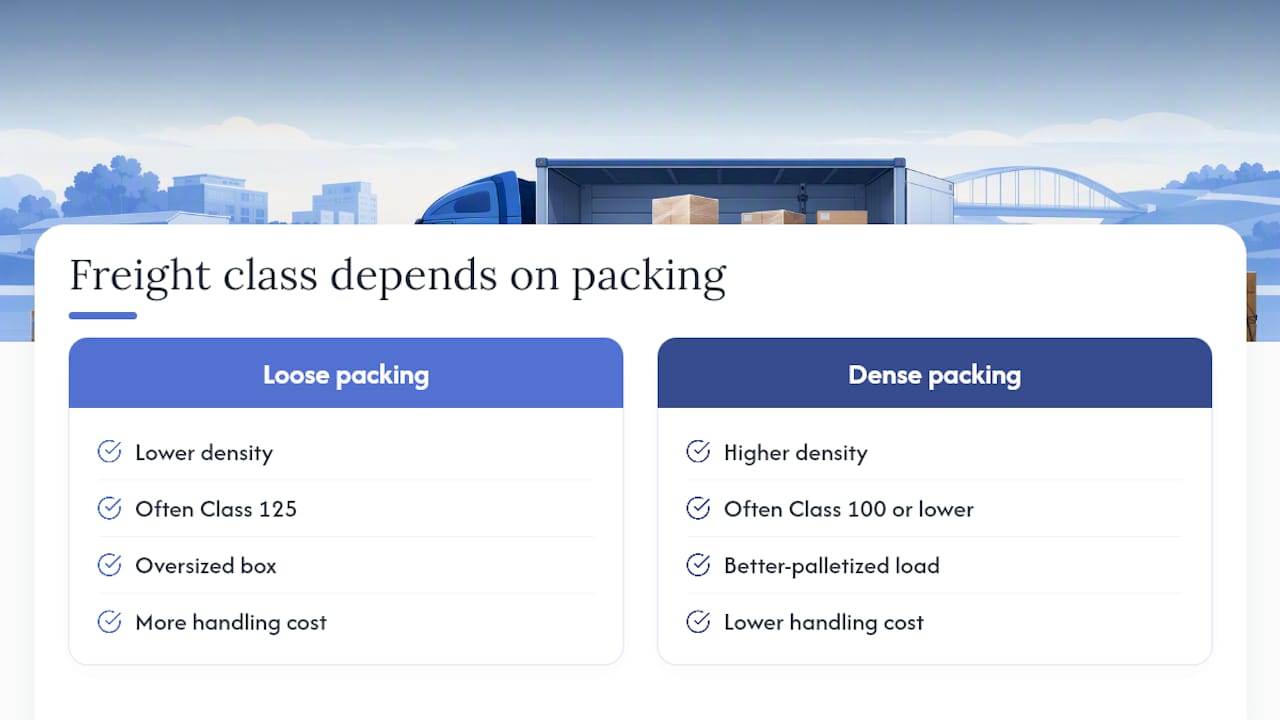
The density calculation is entirely within your control. A product that ships at Class 125 because it’s loosely packed in an oversized box can often ship at Class 100 or lower with better packaging. That’s not gaming the system; that’s accurate classification. The NMFC was designed to reflect the actual cost a carrier incurs to move a shipment, and a denser, better-palletized load genuinely costs less to handle.
The other thing shippers underestimate is how much reclassification fees compound over time. One reclassification on a single shipment feels minor. Fifty reclassifications across a year, each carrying an inspection fee plus a corrected rate, adds up to a meaningful freight budget problem. The fix is almost always the same: measure accurately, use ClassIT+ to verify the NMFC item number, and put the right information on the BOL the first time.
Usiship handles LTL so you can focus on the business
Managing LTL freight well requires getting the class right, the documentation clean, and the accessorials declared upfront. Usiship’s logistics and transportation services cover all of it: LTL and FTL quotes, freight-class verification, palletization guidance, claims handling, and warehousing for consolidation before tender. For businesses with cross-border freight, Usiship also provides customs clearance for shipments moving between the U.S., Canada, and Mexico. Real-time tracking comes standard, and the team handles the carrier relationship so you’re not chasing down inspection reports or dispute timelines on your own. See what Usiship’s transport clients say about working with the team, then request a quote or shipping audit at usiship.com.