
LTL Minimum Charge: What It Is and How to Avoid Overpaying
An LTL minimum charge is the lowest amount a carrier will bill for a shipment, no matter how little the freight weighs. If the rate math on your pallet comes out below that floor, you pay the floor. It is the reason a 90-pound box can cost nearly as much as a 300-pound one, and it is the first line to check on any small LTL quote.
This guide explains where the charge comes from, what the numbers look like, how it differs from minimum weight, and the practical steps shippers use to stop paying for freight they did not ship.
TL;DR
- An LTL minimum charge is a floor price: if weight times rate comes out lower, the carrier bills the minimum instead.
- Published figures vary widely by carrier, lane, tariff and date, so read the rules tariff and your contract rather than trusting a generic number.
- Watch for two variants: the Absolute Minimum Charge (AMC), which discounts cannot go below, and the Single Shipment Minimum Charge (SSMC), which can apply to lone pickups.
- Minimum charge is a dollar amount. Minimum weight is a size threshold. They are different things.
- Fix it by consolidating freight, rating by actual weight and class, and testing quotes with extra weight to see where the floor sits.
Table of Contents
- What an LTL minimum charge is
- How much a minimum charge can be
- AMC, SSMC and other minimum variants
- Minimum charge versus minimum weight
- How to spot a minimum charge on your quote
- Other charges that sit on top of the minimum
- Seven ways to reduce minimum-charge costs
- Our perspective
- Getting rates with the floor visible
- Frequently asked questions
- Sources
What an LTL minimum charge is
LTL carriers price by weight, freight class and lane, then add accessorials and fuel. The minimum charge sits underneath all of that as a floor. It is the lowest amount a carrier will charge for a shipment regardless of size, and carriers apply it because small shipments still carry fixed handling costs: a pickup stop, dock handling at two terminals, a line-haul slot and a delivery stop.
There is also a pricing-power side to it. Industry reporting notes that minimum charges typically supersede contractually negotiated discounts, so a 70% discount on a small shipment may do nothing if the discounted rate lands below the floor.
In practice, the logic is simple:
- The carrier calculates the charge: weight in hundredweight (cwt) times the discounted rate for your class and lane.
- It compares the result with the minimum charge.
- It bills whichever is higher, then adds fuel surcharge and accessorials.
The floor applies before fuel and accessorials in most tariffs, which means your final invoice will sit above the minimum once those are added. Confirm the exact order in the carrier’s rules tariff.
How much a minimum charge can be
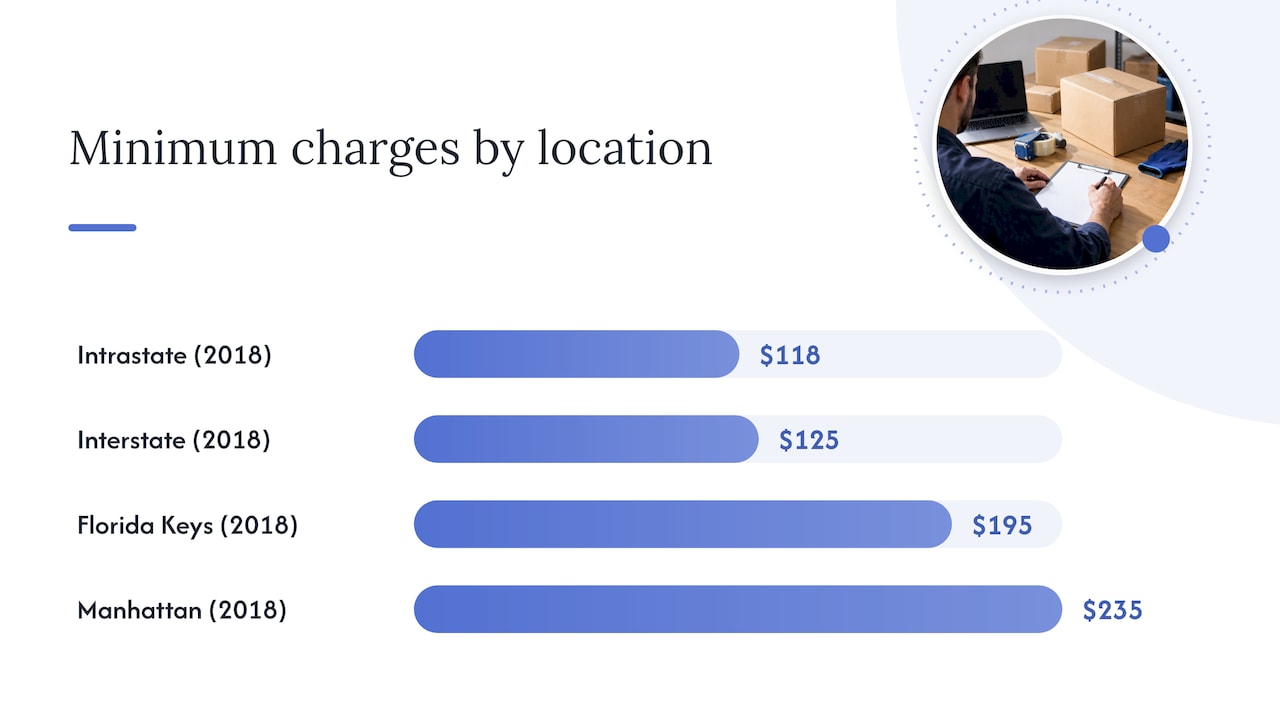
There is no single national figure. Carriers publish their own, and amounts differ by origin, destination, service and tariff date. One carrier example documented by a software provider listed $125 for interstate traffic, $118 for intrastate, $195 for the Florida Keys and $235 for Manhattan. That list dates from 2018, so treat it as an illustration of how much amounts spread by location, not as a current price.
Why do amounts differ so much?
- Lane and geography. Dense urban delivery and remote areas cost more to serve. A carrier’s AMC may vary by origin or destination and is documented in its rules tariff.
- Carrier cost structure. Terminal networks, labor and equipment differ.
- General rate increases. LTL carriers apply GRIs to base rates to cover cost inflation and invest in real estate, equipment and technology. Minimums tend to move with them, so a number from two years ago is likely stale.
- Contract versus tariff. Your negotiated agreement may set its own minimum, higher or lower than the carrier’s public one.
The honest takeaway: ask for the current minimum on your actual lanes, in writing, and find where it lives in the tariff or agreement.
AMC, SSMC and other minimum variants
Carriers do not use one kind of floor. Pricing analysts point to a few, and the names matter when you read a tariff.
| Term | What it means | Where to look |
|---|---|---|
| Minimum charge (MC) | The standard lowest bill for a shipment | Rate quote, contract |
| Absolute Minimum Charge (AMC) | An unbreakable price floor that discounts do not reduce | Carrier rules tariff |
| Single Shipment Minimum Charge (SSMC) | Applies when a shipment is picked up without other freight, often higher than the standard minimum | Rules tariff, pickup terms |
The SSMC is the one that surprises shippers. If you ship a single pallet from a location where the driver picks up nothing else, the carrier may treat it as an isolated stop and bill the higher floor. Shippers who add a second shipment to the same pickup, or who tender several pallets together, can avoid it.
Minimum charge versus minimum weight
These two get confused constantly, and the confusion costs money.
Minimum charge is a dollar floor on the bill. It says: whatever the math gives, you pay at least this.
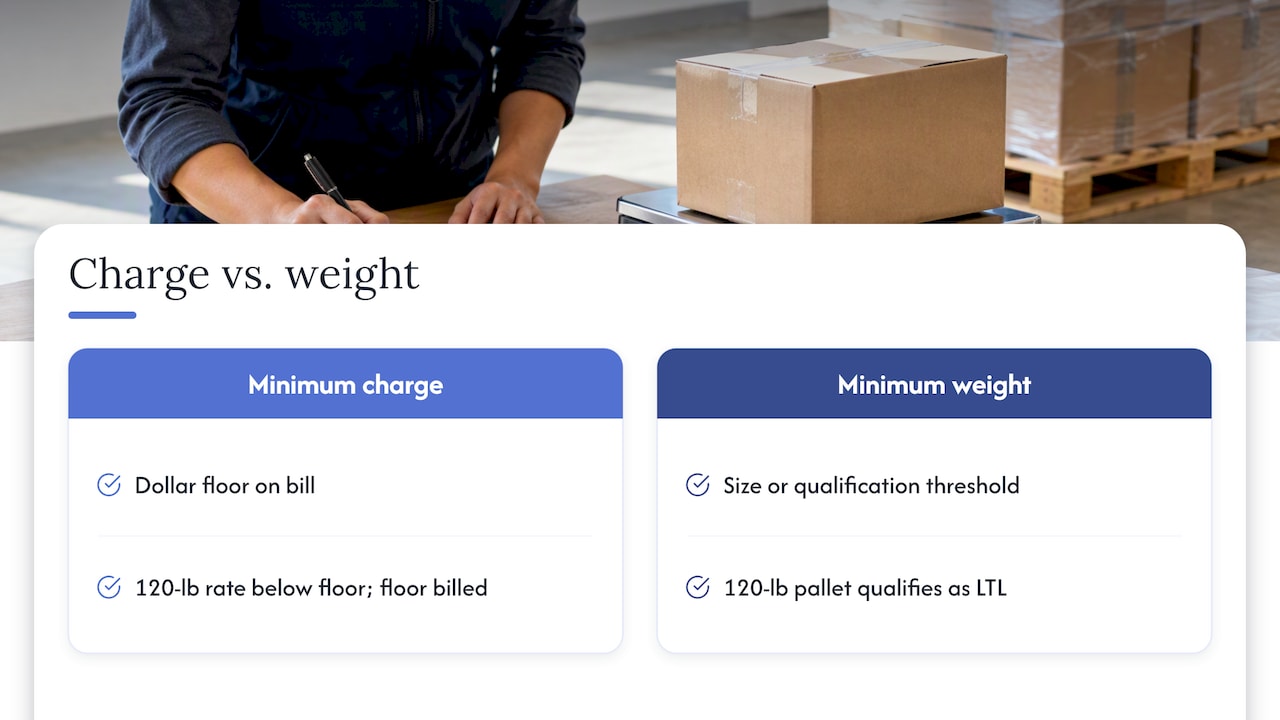
Minimum weight is a size or qualification threshold. LTL is generally understood as freight too big for parcel networks and too small to justify a full truck, so there is a rough lower end where a parcel carrier or a small-package option may be cheaper and an upper end where truckload makes more sense. Some carriers and rate tables also use minimum weights per class or per pricing break, and some tariffs bill a shipment at a deemed weight when density rules apply.
How they interact: a lightweight shipment can satisfy every weight requirement and still land under the minimum charge. A 120-pound pallet of fixed-size goods is a good example. It is a legitimate LTL shipment, yet the rate math produces a figure below the floor, so you pay the floor.
The practical question is never “how light can I go?” It is “at what weight does the rated charge overtake the minimum?” Below that break-even point, extra pounds are close to free.
A worked example
Say a carrier’s minimum charge on your lane is $150, and your discounted rate for your freight class is $40 per cwt. These are made-up figures to show the mechanics, not a quote.
| Shipment weight | Rated charge (weight x $40/cwt) | Billed (before fuel and accessorials) |
|---|---|---|
| 100 lb | $40 | $150 (minimum) |
| 250 lb | $100 | $150 (minimum) |
| 375 lb | $150 | $150 (break-even) |
| 500 lb | $200 | $200 (rated) |
The break-even here is 375 pounds. Anything below it costs the same. Two 150-pound shipments tendered separately cost $300; combined into one 300-pound shipment, they cost $150. That is the whole consolidation argument in one table.
How to spot a minimum charge on your quote
You do not need a tariff PDF to detect a floor. One test from LTL pricing analysis: add incremental weight to the order and watch the price. If the price stays flat while weight rises, the shipment is hitting the absolute minimum rather than being rated by weight.
A short routine:
- Request quotes at your real weight, then at +50, +100 and +200 pounds on the same lane and class.
- Note where the price first moves. That is your break-even.
- Ask the carrier or your forwarder which tariff item governs the minimum, and whether your agreement overrides it.
- Check whether a different pickup arrangement changes the floor (the SSMC question).
- Repeat after any carrier GRI announcement.
Other charges that sit on top of the minimum
The minimum is rarely the whole bill. Small shipments are especially exposed to add-ons, because a $20 accessorial on a $150 floor charge is a 13% jump.
The usual suspects:
- Fuel surcharge, usually a percentage of the base charge. If you want to check yours, our guide to verifying a fuel surcharge index with spreadsheet formulas shows how.
- Residential, liftgate and limited-access fees. Delivery to homes, job sites or docks without a forklift adds fixed charges.
- Reweigh and reclassification fees. Carriers verify weight, dimensions and class at the terminal. Accurate dimensions, weight and commodity details help avoid reweigh or reclassification fees. Our walkthrough of freight class and how to avoid reclass fees covers the steps, and the NMFC class overview helps you match your product to the right code.
- Extreme length and oversize charges. Carriers have been raising these; a trade-press report on 2025 pricing described length surcharges running from hundreds to over a thousand dollars per shipment as becoming standard. Because we could not confirm that page’s wording, plan on checking each carrier’s current length rules directly.
The final price of a small shipment can vary with geography, lane, product classification, weight, dimensions and accessorials, so a quote that ignores any of those is incomplete.
Seven ways to reduce minimum-charge costs
Consolidate shipments
Hold orders for a day or two and ship them as one multi-piece shipment. The worked example above shows why: the floor is paid once instead of twice. Weigh this against customer delivery promises, but for B2B replenishment it is often an easy win.
Palletize properly
Loose cartons invite damage claims, handling fees and reclassification. Tight, stable pallets also give you accurate dimensions for quoting. See our steps to palletize freight so it passes LTL inspection.
Rate by the right class and density
An incorrect class pushes the rated charge up or down, and it can trigger a correction after the fact. Measure and weigh before you quote, not after the carrier does.
Compare parcel against LTL near the break-even
For a few boxes, parcel networks may beat an LTL floor, but dimensional weight rules can erase the advantage. Our piece on dimensional weight changes for small shippers helps you run that comparison fairly.
Negotiate the floor itself
Discounts on base rates are the headline, but the minimum is negotiable too, particularly for shippers with steady volume on a few lanes. Ask what the minimum is in your agreement and whether it can be set per lane or per weight band.
Use a pooled or multi-carrier rate set
Different carriers have different floors on the same lane. A forwarder or 3PL that aggregates volume can often present a lower floor than a small shipper gets directly, and can choose the carrier by lane.
Know when truckload wins
When shipments reach multiple pallets on a regular basis, a dedicated truck may price better. Read what FTL is and when it makes sense and the expected truckload rates per mile to find your own crossover.
Our perspective
We see the minimum charge catch the same type of shipper again and again: a growing ecommerce brand or small manufacturer sending a single pallet to a retailer’s DC, a warehouse, or a customer. The quote looked cheap per hundredweight, the invoice did not, and nobody had looked at the floor.
Our view is that the minimum charge should be treated as a design variable, not a fact of life. Where a shipment sits relative to the break-even is something you control through order batching, pickup timing, packaging and carrier choice. We also think that a quote without the minimum, fuel and likely accessorials spelled out is not a quote yet.
Because we combine freight forwarding, warehousing and fulfillment, we can often solve the problem upstream: hold inventory closer to customers, consolidate outbound orders, and move small replenishments in fewer, fuller shipments, so the floor is paid less often. If your small shipments keep landing on the minimum, bring us a few recent invoices and we will show where the money is going.
— Akbar
Getting rates with the floor visible
If you want a quote that shows the minimum, break-even weight and expected accessorials before you book, our freight forwarding team can price your lanes across modes. If the real problem is that small shipments are leaving too often, our warehousing and fulfillment solutions let you consolidate inbound and outbound freight in one place. Storage and handling fees are listed on our pricing page.
For inbound containers that need to be broken down and re-palletized into LTL-ready loads, see also our guide to the 2026 warehouse storage fee picture.
Frequently asked questions
Is the LTL minimum charge the same as the minimum weight?
No. The minimum charge is a dollar floor on the bill, while minimum weight is a size threshold that decides whether freight suits LTL at all. A light shipment can meet the weight requirements and still be billed the minimum charge because its rated cost falls below the floor.
How much is a typical LTL minimum charge?
It depends on the carrier, lane and tariff date. One documented carrier example showed $125 interstate and $235 for Manhattan, though from 2018. Ask for the current figure on your lanes in writing.
Can I negotiate the minimum charge?
Often yes, especially with steady volume on repeat lanes. Discounts on the rate usually do not lower the floor, so raise the minimum as its own item. Note that the AMC is meant to be an unbreakable floor under standard tariff terms, so any change has to come through your agreement.
How do I know if my shipment is hitting the minimum?
Request quotes at slightly higher weights on the same lane and class. If the price does not change as weight rises, you are on the floor. The price where it first moves is your break-even weight.
Does the minimum charge include fuel and accessorials?
Usually it does not. Fuel surcharges and accessorials are typically added after the minimum is applied, though tariff wording varies, so check the carrier’s rules tariff or your contract.
Sources
- Minimum charge (glossary)
- FedEx’s LTL unit imposes California compliance surcharge, FreightWaves
- Know the absolute minimum charge, Eniture
- LTL industry taking rate increases as volumes drop, FreightWaves
- Moore on Pricing: LTL Pricing, the devil is in the detail, Logistics Management
- Minimum Charge Calculator, FreightMaths