
Limited Access Delivery Costs and How Shippers Avoid Them
Limited access delivery is an LTL accessorial charge applied when freight moves to or from a location without a standard loading dock, business hours, or open commercial access. Expect to pay roughly $75 to $250 per shipment, often stacked with liftgate or inside-delivery fees on the same invoice.
Do this before you tender the shipment:
- Verify the delivery address type in your TMS or with the consignee before booking.
- Tell the carrier upfront about gate codes, security clearance, or appointment windows.
- Budget the fee into your freight cost, or ask about alternate accessible drop points.
Quick math: A limited access fee can significantly increase the freight cost on an LTL shipment. On a lane you run weekly, that’s real money leaking out of your margin.
Key Takeaways
Limited access delivery fees run $75 to $250 per shipment and are largely preventable with address screening and upfront carrier communication.
| Point | Details |
|---|---|
| Know the fee range | Budget $75 to $250 per limited-access occurrence, higher with security clearance or long wait times. |
| Check tariff codes | Look for LTDO or LTDD line items on invoices to confirm the accessorial is correctly applied. |
| Flag sites early | Tag known limited-access addresses like schools, bases, and job sites directly in your TMS. |
| Prebook appointments | Confirm gate passes, TWIC requirements, and appointment windows before the truck is dispatched. |
| Use an integrated provider | Universal Shipping screens addresses, schedules appointments, and reviews charges before billing. |
Table of Contents
- What Qualifies as Limited Access Delivery in LTL Freight
- Locations That Commonly Trigger the Fee
- How Carriers Bill the Limited Access Accessorial
- Typical Cost Range and What Pushes It Higher
- Credentials and Site Rules You Need Before Tendering Freight
- How to Avoid Surprise Limited-Access Charges
- What to Expect From a Provider Handling Limited-Access LTL
- Sources
What Qualifies as Limited Access Delivery in LTL Freight
Carriers define limited access delivery as any pickup or drop-off at a site lacking a commercial loading dock, standard business hours, or unrestricted public access. That’s the core test: can a standard 48-foot trailer pull up, dock, and unload without special coordination? If not, the accessorial applies.
This differs from two accessorials shippers often confuse it with:
- Residential delivery charges for delivery to a home, regardless of access difficulty.
- Inside delivery/liftgate charges for moving freight past the curb or lowering it without a dock, at any address type.
- Limited access charges specifically for the nature of the site itself, whether or not it’s residential.
Look for tariff item codes like LTDO (limited access pickup) or LTDD (limited access delivery) on your invoice. Those codes tell you exactly which accessorial line item you’re disputing or budgeting for, and they’re the fastest way to confirm a charge is legitimate rather than a billing error.
Locations That Commonly Trigger the Fee
Carriers maintain their own lists, but certain site types show up on nearly every one. Tariff language commonly flags:
- Schools, colleges, and churches
- Military installations and government facilities
- Prisons and correctional facilities
- Construction sites and job sites
- Mini-storage and self-storage facilities
- Farms and agricultural properties
- Medical clinics and facilities without a loading dock
- Marinas, ports, and camps or fairgrounds
Pro Tip: Build a recipient field into your order entry form that asks “does this location have a dedicated freight dock and standard weekday business hours?” A yes/no flag at booking catches most limited-access sites before the truck ever rolls, and it’s far cheaper than a dispute after delivery.
How Carriers Bill the Limited Access Accessorial
The trigger isn’t the address category alone. It’s what the driver actually encounters. Common triggers include:
- A secured or gated entrance requiring a code, badge, or escort
- No loading dock, forcing manual unload
- A required appointment window instead of open access
- No staff present to receive or sign for freight
- Extended drive time into a rural or restricted parcel
Classification isn’t uniform across the industry. One carrier’s tariff might flag a mini-storage facility while another treats it as standard commercial. That inconsistency is why the same lane can generate different accessorial totals depending on which carrier you book.
It also means a charge can appear after pickup. A driver arrives, finds a gated lot with no dock, and the carrier reclassifies the shipment on the spot, adding the fee to your final invoice with no warning at booking.
If that happens, dispute it methodically:
- Pull the tariff item code referenced on the invoice (LTDO or LTDD, for example).
- Gather proof the site has standard dock and access conditions, photos, appointment confirmations, or the consignee’s own facility description.
- File the dispute within the carrier’s stated claim window, referencing the specific tariff clause you believe was misapplied.
Roughly half of disputed accessorial charges get resolved in the shipper’s favor when documentation is submitted promptly, so don’t let a surprise fee sit unchallenged on your books.
Typical Cost Range and What Pushes It Higher
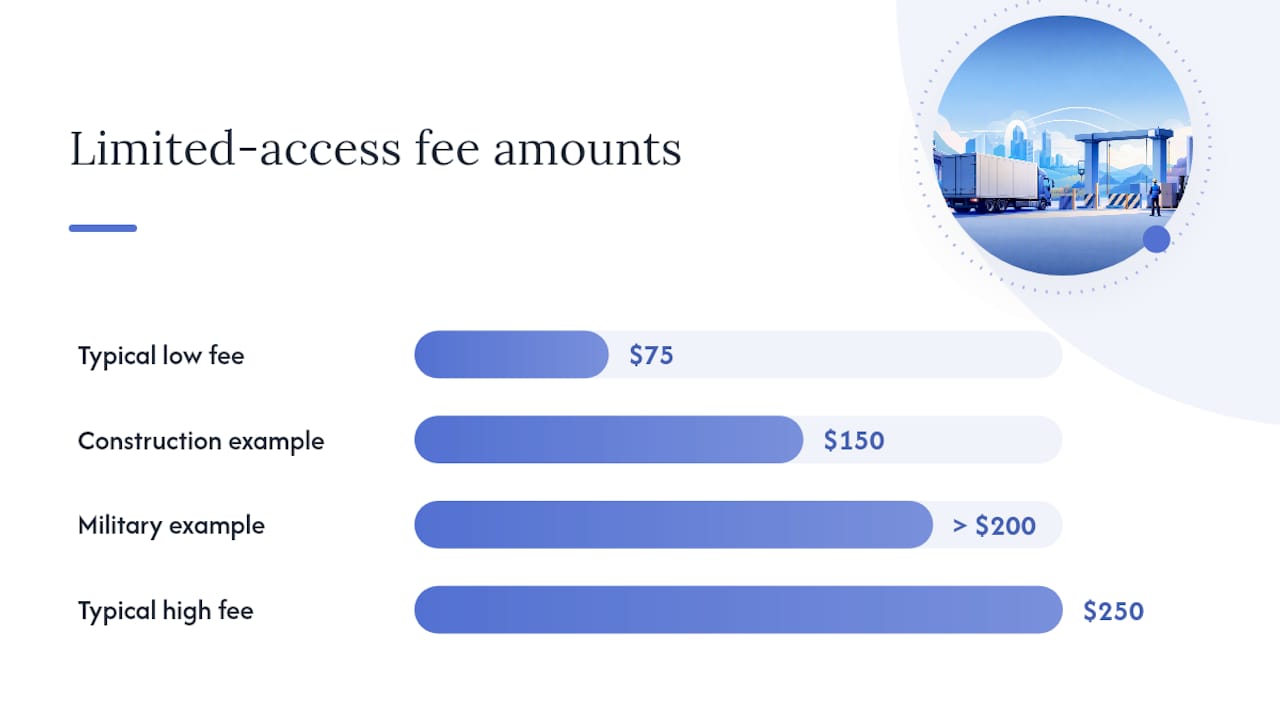
Limited access fees generally run $75 to $250 per occurrence, though some carriers publish higher rates for specialty or emergency access situations. The spread exists because carriers price the fee against their own labor and time cost, not a fixed national rate.
Several factors push you toward the top of that range:
- Security clearance requirements that delay the driver at a gate
- Extended wait time for an escort or site contact
- Equipment needs beyond a standard liftgate, like a pallet jack for unpaved ground
- Restricted delivery hours that don’t match the carrier’s normal route schedule
- Long drive distance from the main road into the actual drop point
Example one: A pallet delivered to a construction site trailer with no dock and a two-hour appointment window might run $150, plus a separate liftgate charge.
Example two: Freight bound for a military installation requiring gate clearance and an escorted drive to the receiving building could push past $200, especially if the driver waits on clearance approval.
Credentials and Site Rules You Need Before Tendering Freight
Some limited-access sites require documentation before a truck is even dispatched. Confirm these before booking:
- TWIC card requirements at ports, maritime terminals, and some secured industrial sites
- Gate passes or pre-registration for military bases and government facilities
- Visitor badges or driver escorts required by the receiving facility
- A confirmed appointment window matching the site’s access hours
Before you tender the shipment, run through this checklist: confirm the consignee can actually grant carrier access on delivery day, collect a working contact number and any badge or clearance requirements, schedule the appointment, and write those details directly onto the bill of lading. A driver who arrives at a secured gate with no notice and no contact name is a driver who either waits, reroutes, or triggers the accessorial on the spot.
How to Avoid Surprise Limited-Access Charges
Most limited-access fees are avoidable with basic front-end diligence; for detailed advice, see our guide on how to choose a same-day courier service. Work through this sequence for every shipment headed to a nonstandard site:
- Validate the delivery address in your TMS against known limited-access categories before quoting the customer.
- Prebook the appointment window directly with the carrier so the driver isn’t guessing at access hours.
- Offer an alternate, dock-equipped address when the consignee’s site genuinely can’t accommodate standard delivery.
- Tag repeat limited-access customers permanently in your system so the flag never gets missed twice.
- Negotiate carrier exceptions when you can prove a site is misclassified, using photo documentation and appointment history.
Pro Tip: If gate paperwork and appointment scheduling are eating your operations team’s time, an integrated logistics provider can manage that coordination directly with the carrier, so your staff isn’t chasing badge requirements on every restricted lane.
Use this quick decision framework: redirect when an accessible address exists nearby, prebook when the site is legitimately limited access but manageable with scheduling, and accept the fee only when neither option is realistic and the cost is small relative to the shipment value.
What to Expect From a Provider Handling Limited-Access LTL
A provider built for this kind of freight does more than book the carrier. Look for these capabilities:
- Address screening at quoting, so limited-access status is flagged before you commit to a rate
- Appointment scheduling handled directly with the carrier and the consignee
- Gate credential and access paperwork managed on your behalf
- Consolidated billing with a charge review step that catches misapplied accessorials before they hit your books
Universal Shipping builds these steps into its LTL and freight forwarding process rather than treating them as an afterthought once the truck is already at the gate. That matters most on repeat lanes to the same restricted site, where one misclassification can quietly repeat itself on every future invoice until someone catches it.
Common mistakes and quick wins
The mistake I see most often isn’t a bad carrier decision. It’s shippers who know a customer sits on a military base or a construction site but never flag it anywhere in their system, so the surprise repeats on every single shipment to that address.

Quick win: Add a limited-access flag directly in your TMS and make contact information mandatory during order entry. It’s a five-minute setup that pays for itself on the first avoided dispute.
Getting help with limited-access LTL shipments
Limited-access freight punishes shippers who treat every delivery like a standard dock drop. Universal Shipping screens addresses before quoting, coordinates appointment windows and gate credentials directly with carriers, and reviews accessorial charges before they land on your invoice unchallenged.
If you’re routing freight to construction sites, military installations, or any address without a standard dock, that upfront screening is the difference between a predictable freight bill and a monthly game of invoice whack-a-mole. Universal Shipping’s logistics and transportation services handle the coordination end to end, and the team also manages furniture and specialty deliveries where inside delivery and limited access often overlap. Request a quote through Usiship and tell the team about your restricted-site lanes before your next shipment ships.
Sources
Always confirm the specific accessorial code against your carrier’s current tariff before disputing a charge.