
Liftgate Delivery Meaning: What It Is, Costs and When You Need It
Liftgate delivery is a freight service in which a hydraulic platform on the back of the truck lowers your shipment from truck level to ground level when there is no loading dock or forklift at the delivery address. It is an add-on, not a default, and carriers bill it as an extra charge. If your freight is going to a home, a job site, a storefront or any place without a dock, you almost certainly need it. This guide explains what the term means, what is and is not included, what it costs, and how to decide.
TL;DR
- A liftgate is a powered platform on the rear of a truck that raises or lowers freight between the truck bed and the ground.
- You need it when the pickup or delivery site has no dock or forklift. Residential addresses, construction sites and many small businesses fall into this group.
- Carriers charge it as an accessorial fee, commonly somewhere between about $40 and $250 per stop depending on the carrier, so request it at booking.
- Liftgate service gets the pallet to the ground. It does not carry freight inside, up stairs or into place.
- Blanket wrap is a different thing: a handling method for awkward items, not an equipment service.
Table of Contents
- What a liftgate is and what the term means
- How liftgate service works step by step
- Do you need liftgate delivery?
- What liftgate service costs
- Liftgate limits: weight, size and access
- Liftgate vs forklift
- Liftgate vs blanket wrap
- What is a common carrier with liftgate?
- How to avoid problems on delivery day
- How Usiship can help
- FAQ
- Sources
What a liftgate is and what the term means
A liftgate is a platform attached to the back of a freight truck that moves freight up or down between truck level and ground level. You will also see it written “lift gate” or called a tailgate lift. The driver stands beside it and works the controls. The platform lowers to the pavement, the pallet is rolled on with a pallet jack, the platform rises to bed height, and the pallet rolls off at the other end of the movement.
When a shipping document says “liftgate delivery” or “liftgate at delivery,” it means the carrier has been told to use that platform at the drop-off address. “Liftgate at pickup” means the same for the origin. The two are separate requests, and a shipment can need one, the other or both.
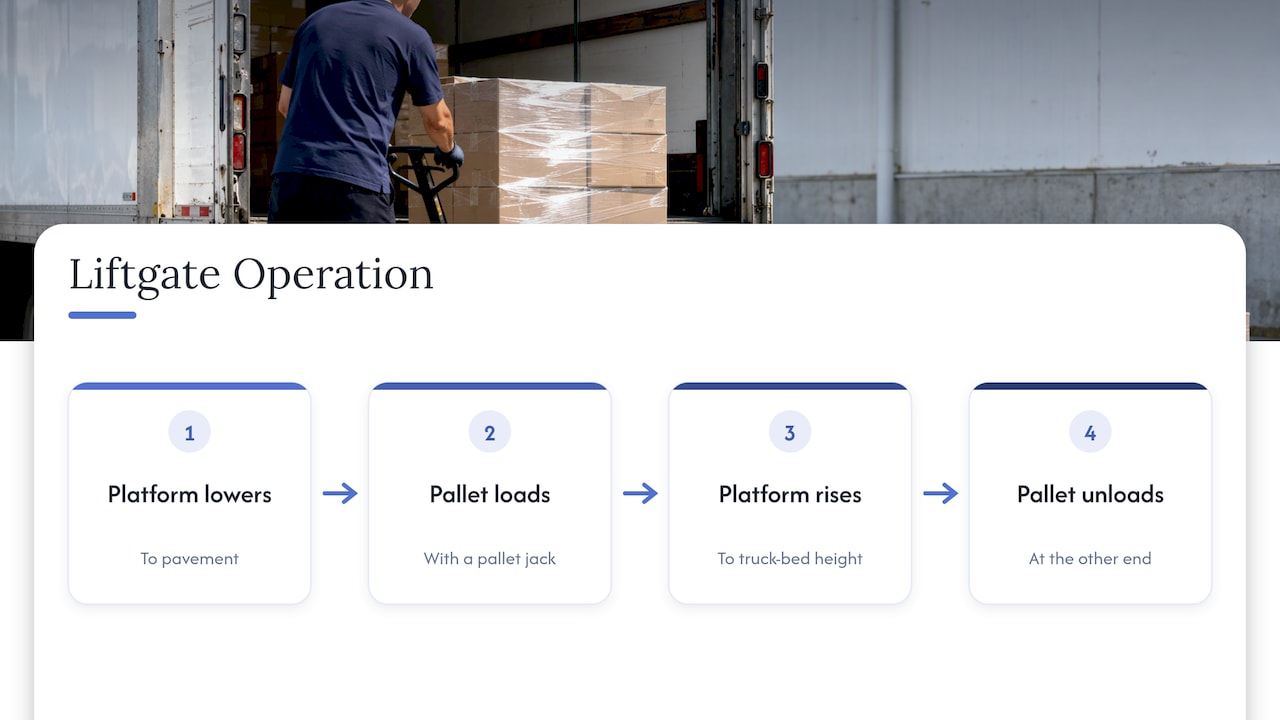
The reason the service exists is simple. Standard freight trucks are built to back up to a dock where the floor of the trailer sits level with the floor of the building. Remove the dock and you have a trailer bed roughly four feet in the air with a 500-pound pallet on it and nothing to bring it down safely. The liftgate is the fix.
How liftgate service works step by step
- You request it at booking. Liftgate is flagged on the quote or bill of lading as pickup, delivery or both. Carriers plan trucks around it, because not every truck has a gate.
- The truck arrives and the driver positions it. The driver needs enough clear space behind the trailer to open the doors and lower the platform flat.
- The platform is lowered to the ground. The driver loads the pallet with a pallet jack, or unloads it from the truck onto the platform.
- The platform moves the freight. It raises or lowers smoothly and the pallet is rolled off.
- The driver hands off the freight at the curb or the truck’s edge. Someone on your side signs for it and takes it from there.
That last step matters. Liftgate service typically covers lowering eligible freight to the ground and the driver running the platform. It does not usually cover bringing freight inside the building, moving it to its final location, unpacking or assembling it, or carrying it up or down stairs. If you need that, you are looking at a different service, usually called inside delivery or white glove, and it is booked and priced separately.
Do you need liftgate delivery?
The test is one question: can the receiving location take a pallet directly off the truck bed? If there is a dock at the right height and a forklift or dock-level pallet jack, you probably do not need a liftgate. If either is missing, you do.
Situations that usually call for one
- Residential addresses. Homes and apartments rarely have docks. If you are shipping freight to a customer’s house, plan on it. Our residential freight delivery guide covers how those shipments are set up.
- Construction and job sites. Material is dropped at ground level in a yard or driveway, with no dock in sight.
- Small retail storefronts and offices. Street-level shops without a rear dock often receive freight at the curb.
- Trade shows, farms and remote locations. Anywhere freight lands on gravel or grass instead of concrete at dock height.
- Pickup from a location with no dock. A home-based seller or a small workshop shipping out a pallet needs liftgate at pickup, not delivery.
Situations where you can skip it
- A warehouse or distribution center with dock doors and handling equipment.
- A business that has a forklift and a driveway or yard where the truck can park, which is covered below.
Getting this wrong is costly in a few ways. If you do not request a liftgate and the driver arrives at a site with no dock, the carrier may be unable to unload. That can mean a failed delivery, a reschedule, or an extra charge added after the fact. Telling the carrier up front is almost always cheaper and faster.
What liftgate service costs
Carriers treat liftgate as an accessorial, meaning an extra line item on top of the base freight rate. There is no single national price, and published figures differ because carriers, regions and contracts differ.
Here is what the published ranges look like:
| Source | Typical liftgate charge | Notes |
|---|---|---|
| CargoTools LTL accessorial estimator (2026) | About $40 to $160 | Billed per end, so pickup and delivery can each carry a charge |
| President Container Group | $50 to $150 per delivery | Varies by carrier and shipment weight |
| LegalClarity (May 2026) | $50 to $200 | Flat fee per shipment at most LTL carriers |
| FreightCourse | About $100 to $250 | Depends on carrier, truck type and cargo |
Take these as ballparks, not quotes. Across the sources the pattern is consistent: expect roughly $50 to $200 for a single stop in many cases, and double that if you need the gate at both ends.
What moves the price
- The carrier. Each carrier publishes its own accessorial tariff.
- Region. Metro areas and remote areas are not priced alike.
- Contract terms. Shippers with negotiated agreements often pay different accessorial rates than one-off shippers.
- Shipment weight and size. Heavier or larger loads can raise the charge.
- Which end needs it. Pickup, delivery or both.
If you ship regularly, liftgate is one of several accessorials that add up. Pair this with a look at the LTL minimum charge and the freight class rules so you see the full cost of a shipment rather than the base rate alone.
Liftgate limits: weight, size and access
Liftgates are rated equipment. Published figures put typical capacity between 2,500 and 4,000 pounds, and up to around 3,500 pounds is another commonly quoted number. The actual limit depends on the truck and the carrier, so confirm it when you book.
A few practical limits sit alongside weight:
- Platform size. A pallet that overhangs the platform or stands too tall can be refused. Stack height and overhang matter. Our guide to palletizing freight so it passes LTL shows how to build a pallet that fits standard handling. If you are shipping a very different cargo, such as bagged goods built for distribution center delivery, the same principle applies: a stable, compact load.
- Ground conditions. The gate needs a flat, hard, reasonably level surface. Soft dirt, steep slopes and tight cul-de-sacs can block it.
- Overhead and side clearance. Trees, wires and parked cars can stop the gate from opening or the truck from positioning.
- Oversized or very heavy loads. Machinery and project loads often exceed what a liftgate can lift. See oversized freight shipping and project cargo logistics for how those moves are planned with other equipment.
Liftgate vs forklift
Both tools do one job, moving a pallet between truck bed and ground. They differ in who owns them and when they are available.
| Liftgate | Forklift | |
|---|---|---|
| Where it is | On the carrier’s truck | At the shipper’s or receiver’s site |
| Who runs it | The driver | Your trained operator |
| Cost to you | Accessorial fee per stop | Equipment and staff you already have or rent |
| Best for | Sites with no dock or equipment | Docks, yards and warehouses with handling gear |
| Limiting factors | Rated weight, platform size, flat ground | Operator training, access, how the load is built |
If you have a forklift on site and the truck can reach it, you may not need a liftgate. A forklift can often lift a pallet directly off a trailer bed from the side or rear without a platform. But the carrier needs to know that is the plan and that your operator is trained and ready when the truck arrives. Where the carrier’s driver cannot count on that, a liftgate is the dependable option.
If you are not sure, ask yourself who will physically be at the delivery site and what they will be using. Then say so when you book.
Liftgate vs blanket wrap
These two terms show up in the same conversations but describe different things. A liftgate is equipment that moves freight between truck and ground. Blanket wrap, sometimes called pad wrap, is a handling method in which trained handlers fold and wrap items in thick moving blankets or quilted pads, then strap the bundle inside a dedicated truck or trailer. It is widely used for large, awkward items that do not fit standard boxes or crates.

So they do not compete. A blanket-wrapped item can still need a liftgate to reach the ground at a site without a dock. If you are shipping furniture, fixtures or other bulky goods, look at furniture shipping services. If you are shipping delicate, unusual parts, packaging that keeps odd-shaped parts intact is a good example of thinking through protection first and handling second.
What is a common carrier with liftgate?
People often search this phrase when a retailer or marketplace listing says “common carrier with liftgate.” In plain terms, it means the shipment moves on a standard LTL freight carrier, not a dedicated truck, and the carrier will use its truck’s liftgate at the address. It is the usual way heavy parcels and furniture reach homes and small businesses. Confirm that the listing includes the liftgate fee in the shipping price, or whether it will be billed to the receiver.
How to avoid problems on delivery day
- Request liftgate at booking, for the right end. Pickup, delivery or both.
- Describe the site accurately. Say if it is residential, a job site, or a business with no dock. Carriers use that to assign the right truck.
- Give accurate weight and dimensions. An under-declared pallet can exceed the gate rating or trigger a correction fee.
- Book a delivery window if the site needs it. Some receivers require scheduled deliveries. Our delivery appointment freight guide explains how booking works and how to avoid fees.
- Make sure someone is there to receive it. The driver will not carry freight inside, so have a person and a pallet jack or hand truck ready.
- Inspect before you sign. Note visible damage on the delivery receipt before the driver leaves.
Our view on liftgate delivery
Most liftgate problems we see are not about the equipment. They are about information that never reached the carrier: a residential address booked as a business, a pallet heavier than the form said, no one at the site to take the freight off the curb. Each one turns a routine drop into a rescheduled one.
That is why we treat liftgate as part of planning the whole shipment, not a box ticked at the end. Our approach is built around bringing transportation, warehousing and shipping together on one platform, with real-time tracking and personalized service. When the same team handles how your freight is palletized, how it is booked and how it arrives, the details that decide a delivery stay consistent from first mile to last.
If you ship to homes, job sites or small storefronts, tell us what the destination looks like and we will help you set up the right service at the right end.
Akbar
How Usiship can help
If you ship freight to addresses without docks, or you want a team to handle pickup, warehousing, fulfillment and delivery in one place, our freight forwarding services cover domestic and international moves by air, ocean and land, including FTL and LTL. We serve businesses across all 50 states.
For sellers who want freight stored and shipped from one location, our warehousing and fulfillment solutions handle receiving, storage, picking and outbound shipping. Storage is published at 5 to 6 USD per month per bin and 17 to 19 USD per month per pallet, and you can see the full list on our pricing page. To talk through a specific shipment, start at usiship.com.
FAQ
What does liftgate delivery mean?
It means the carrier uses the hydraulic platform on the back of its truck to lower your freight to the ground at the delivery address. It is used when there is no loading dock or forklift. The driver operates the gate, but the service usually ends at the curb or truck edge.
How much is a liftgate fee?
Published estimates vary by source, from about $40 to $160 per end up to $100 to $250. The carrier, region, contract and shipment weight all affect it. A shipment that needs a gate at both pickup and delivery can carry two charges, so ask for both in your quote.
Do residential deliveries need a liftgate?
Usually yes. Homes and apartments rarely have a dock or a forklift, so the freight has to be lowered to the ground from the truck bed. Tell the carrier the address is residential when you book so it sends a truck with a gate and prices it correctly.
Does liftgate service include bringing freight inside?
No. It covers lowering freight to ground level and the driver running the platform. Moving freight indoors, up stairs, unpacking or assembly is a separate service. Plan for people and equipment on your side or book inside delivery.
Sources
- What Is Liftgate Service & Do I Need It? (Katom)
- LTL Accessorial Charge Estimator 2026 (CargoTools)
- Liftgate Delivery: What It Means for Corrugated Packaging (President Container Group)
- What Is a Liftgate Fee and How Much Does It Cost? (FreightCourse)
- Liftgate Delivery Service: When It’s Needed and What It Costs (LegalClarity)
- Shipping Inflatables: Crating vs Blanket Wrap (Jump High Rentals)