
Last Free Day at the Port: What It Means and How to Beat It
The last free day (LFD) is the final day your import container can sit at the port or terminal before demurrage charges begin. Miss it and the meter starts running daily. The date is not the same everywhere, it is not always the one printed on your booking, and more than one clock can be ticking on the same box. This guide explains how the LFD is set, where to confirm it, and how to plan pickup so the date never costs you money.
TL;DR
- The LFD is the last day of your free time. After it, demurrage accrues on a container still sitting at the terminal (FMC report).
- Free time rules are not standardized. They sit in a carrier tariff, a terminal schedule, or your service contract, and they differ by carrier and port.
- Up to three clocks can run at once (ocean line, terminal, rail). Plan around the earliest date you can find.
- Book trucking and a delivery appointment before the container is even discharged, not on the day it is available.
- Keep a written record of every pickup attempt and refused appointment. It is your evidence if you dispute a charge.
Table of Contents
- What “last free day” means
- Free time, demurrage and detention: three words, three charges
- Why you can have three different LFDs
- Where to find and verify your LFD
- Calendar days or working days?
- Why free time differs from port to port
- What happens when you miss the LFD
- A practical plan to beat the last free day
- Cost control for importers of all sizes
- Perspective
- How Usiship can help
- FAQ
- Sources
What “last free day” means
When a loaded import container is discharged from the vessel, a grace period begins. The Federal Maritime Commission (FMC) defines free time as the grace period in which no demurrage or detention charges apply for use of a container or terminal space. The LFD is the date that grace period ends. The FMC’s review of detention and demurrage practices describes the period as ending at an appointed time on that day, after which charges start to accrue (FMC, 2015).
Two details trip people up:
- It is a deadline, not a target. Pickup is meant to happen on or before the LFD, not on it. Gate hours, appointment availability and chassis supply can all eat the last day.
- The cutoff has a time. The free period ends at a stated time, so “I arrive Friday” can still be too late if the terminal closes its gates or its appointment slots earlier.
If you searched “LFD” as a shipping term, this is it: shorthand used by brokers, dispatchers and drayage companies for the last day a container can leave the terminal without storage charges.
Free time, demurrage and detention: three words, three charges
These terms get mixed up on invoices. The FMC’s definitions keep them apart: demurrage is charged for cargo that remains in or on terminal facilities after free time expires, and detention is charged by the ocean carrier for use of its equipment after free time expires (FMC, 2015).
| Term | What it covers | Who bills it | What starts it |
|---|---|---|---|
| Free time | Grace period with no charge | Nobody | Typically discharge from the vessel |
| Demurrage | Loaded container still inside the terminal | Terminal or ocean carrier | The day after the LFD |
| Detention | Carrier’s container or chassis outside the terminal | Ocean carrier | Expiry of its own free time |
In practice the same box can pick up demurrage first and detention second: the first for staying at the port too long, the second for keeping the equipment too long after you pull it out. For a deeper look at how per diem charges are built and when they can be challenged, see our guide on per diem charges and the FMC 30-day rule.
Why you can have three different LFDs
One import container can have several free-time clocks running at the same time. A tracking guide from Lunar describes three independent clocks, one for the ocean line, one for the terminal, and one for the rail provider if the box moves inland by train. The earliest one determines when charges actually start (Lunar, 2026).
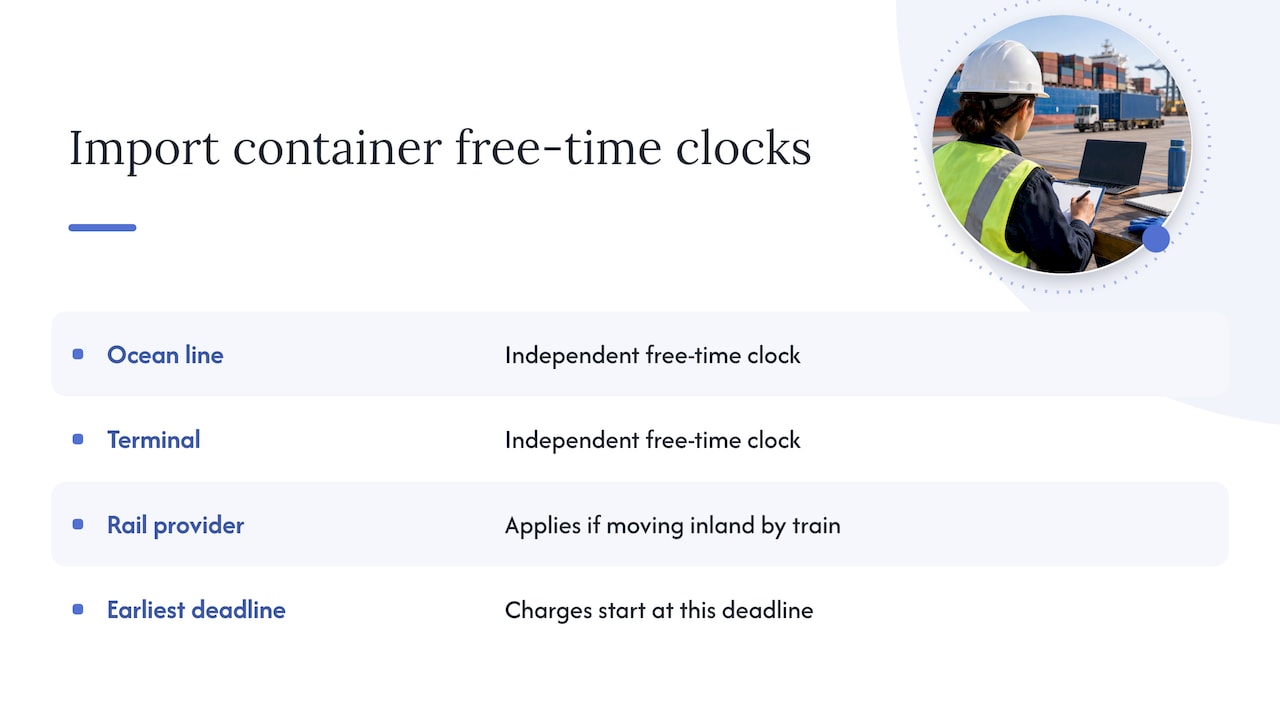
This is why the date on your carrier’s arrival notice may not match what the terminal website shows. Terminal49’s help documentation notes that LFD data can come from the carrier, the terminal or a rail provider, and advises planning toward the earliest relevant date when sources conflict (Terminal49).
A simple rule: if two dates disagree, the earlier one is your real deadline until someone with authority confirms otherwise in writing.
Where to find and verify your LFD
Free time rules and rates are typically set in one of three places: a carrier’s public tariff, a marine terminal operator’s schedule, or a private service contract between the shipper and the carrier (FMC, 2015). That tells you where the rule lives. To find the actual date for your container, check in this order:
- The carrier’s arrival notice and portal. It usually states the free days allowed and often a calculated LFD.
- The terminal’s container availability page. Terminals publish the status of each container, including holds and the last free day they apply.
- The rail provider’s portal, if the container is moving by rail to an inland ramp.
- Your broker or forwarder. Customs holds, freight release and terminal fees all affect whether a container can leave, so someone should be watching them together.
An API-based tracking tool can pull these dates together, but the principle stays the same: compare every source and work from the earliest date. Lunar’s guide recommends checking relevant LFDs daily and arranging drayage early (Lunar, 2026).
If your cargo starts in southern China, the origin side matters as well. A Shenzhen prototype shipping playbook shows how surprise costs appear before the box ever reaches a US port, which is a good reason to settle your free-time terms with the carrier at booking.
Calendar days or working days?
How free days are counted changes the LFD by as much as several days. According to Lunar’s guide, MSC and Maersk generally count calendar days, while CMA CGM excludes weekends at certain ports (Lunar, 2026). Tariffs change, so treat that as an example of the variation, not a rule for your shipment. Confirm the counting method in your own contract or the carrier’s current tariff.
Here is an illustration with made-up dates. A container is discharged on a Wednesday and has five free days:
| Counting method | Free days run through | LFD |
|---|---|---|
| Calendar days, starting day after discharge | Thursday to Monday | Monday |
| Working days (weekends excluded) | Thursday, Friday, Monday, Tuesday, Wednesday | The following Wednesday |
That is a 2-day gap on the same container. If you assume the longer count and the contract says the shorter one, you pay demurrage on days you thought were free.
Why free time differs from port to port
There is no single national standard. The FMC found little standardization among carriers, with free-time rules, terminology and the application of charges all varying across carriers and ports (FMC, 2015). In that same report, the FMC noted that five working days of free time remained the standard at most US ports as of 2015, while New York/New Jersey, Los Angeles and Long Beach had cut it to four days.
Those figures are a snapshot from 2015, and terminals have changed their schedules many times since. Use them to understand that the numbers vary, not as today’s allowance. Look at the current tariff for the specific port, carrier and container type, and also check whether your contract grants extra days.
Three other things can change the effective deadline:
- Container type. Reefers, hazardous cargo and oversize equipment often have shorter free time than standard dry boxes.
- Negotiated terms. A private service contract can give more days than the public tariff.
- Congestion rules. Terminals sometimes shorten free time temporarily to clear yard space. The FMC has noted that pushing returns ahead of scheduled closures can itself add to congestion rather than easing it (Liskow), so read any notice carefully.
What happens when you miss the LFD
Once the LFD passes, demurrage starts accruing on any container still at the terminal (Terminal49 glossary). Charges are typically daily and many tariffs raise the rate in steps the longer the box stays. Exact rates depend on the tariff, so check yours before you plan around a figure.
The bill is rarely the only cost. A late box can also mean:
- a missed delivery slot at your warehouse or your customer’s dock
- trucker waiting time or a second dispatch
- a chassis charge on top of demurrage
- knock-on delays for the next shipment in your pipeline
One point matters for disputes. Cargohold explains that the free-time clock often keeps running even when delays are not your fault, such as a chassis shortage or warehouse problem. It stresses keeping a record of pickup attempts and refused appointments so you can contest charges later (Cargohold). Screenshots of appointment pages, dispatcher emails and timestamps are cheap to keep and valuable if you need them. Our per diem charges guide walks through how to build that file.
A practical plan to beat the last free day
A good LFD process starts before the vessel arrives.
- Read the free-time terms at booking. Ask the carrier or your forwarder how many days apply, whether they are calendar or working days, and what the daily rate steps are.
- Line up trucking early. Pre-arranging drayage is the single most-recommended step for avoiding missed deadlines (Lunar, 2026). Do not wait for the “available” status.
- Clear customs and fees in advance. A container cannot leave while a hold or unpaid fee sits on it. Our port to door checklist lays out the entry steps in order.
- Check every LFD source daily once the vessel is within a few days of arrival, and work from the earliest date.
- Rank containers by soonest LFD. If you are moving several boxes, the earliest deadline goes to the front of the queue.
- Book the delivery appointment. Warehouse receiving slots are often the real bottleneck. See how to book a delivery appointment and avoid fees.
- Have a fallback. If your warehouse cannot receive on time, a transload or cross-dock lets the container leave the terminal and frees the equipment. We explain how in our guide to transloading.
- Document everything. Save each attempt, each refusal and each reply.
If you will miss it anyway
Contact the carrier or terminal before the LFD, not after. Ask whether extra free days can be granted, whether the container can move to an off-dock yard, and what the daily rate will be. A dated email asking for options is better evidence than a phone call you cannot prove.
Cost control for importers of all sizes
Small and mid-sized importers feel LFD charges most because they often have a single container and no yard of their own. A few habits help:
- Treat the LFD as a hard internal deadline two days ahead of the real one.
- Ask your forwarder for a single shared view of all the dates, so nobody works from an outdated notice.
- If your goods come from China, read about duty exposure and timing in our guide to China to U.S. shipping, since customs delays are a common reason a container misses its window.
- Keep storage ready. If the warehouse is full, the container waits and meters run.
Perspective
We see the same pattern with importers every season: the container is not late, the plan is. The free-time clock begins when the vessel discharges, yet most teams start thinking about trucking, appointments and warehouse space when the “available” notice lands. By then, a day or two of free time is already gone.
We built our approach around closing that gap. Transportation, warehousing and customs sit under one platform, so the person watching your LFD can also see the customs status, the drayage booking and the dock slot. Our clients get real-time tracking and personalized service around the clock, because a deadline that falls on a Saturday does not wait for Monday.
Our advice is simple: pick the earliest date from any source, book the truck before the ship arrives, and have a warehouse or transload plan ready. If you use a forwarder, ask that it owns the LFD, not just reports it.
Akbar
How Usiship can help
If last free day deadlines keep catching you off guard, the fix is usually one team coordinating the whole move: ocean freight, customs brokerage, drayage and warehouse receiving. Usiship provides freight forwarding and customs brokerage, along with warehousing and fulfillment across the United States, so the container leaves the port and lands at a ready dock.

See our freight forwarding and customs brokerage services, explore warehousing and fulfillment, or review storage rates on the pricing page. Published storage starts at 5-6 USD per month per bin and 17-19 USD per month per pallet, and additional services are billed at 37 USD per hour.
FAQ
What does last free day (LFD) mean?
It is the final day a container can remain at the port or terminal without demurrage. After the LFD, charges accrue daily on containers still there. The free period ends at a set time, so check the cutoff as well as the date.
Is the LFD the same at every port?
No. The FMC found little standardization, with free-time rules and charges varying across carriers and ports (FMC, 2015). Check the current tariff for your carrier, terminal and container type, or the terms in your service contract.
Why does my carrier show a different LFD than the terminal?
The line, the terminal and a rail provider can each run their own clock. The earliest one controls when charges begin, so plan toward the earliest date until the other sources are confirmed in writing.
Does the LFD count weekends?
It depends on the carrier and port. Some count calendar days, while others exclude weekends at certain ports. Ask for the counting method in writing and confirm it against the current tariff or your contract before you plan your pickup.
Can I dispute demurrage if I could not pick up the container?
You can try, and your odds improve with evidence. Keep records of pickup attempts, refused appointments and chassis or terminal problems. The clock often runs regardless of the cause, so documentation is what supports a dispute. Our per diem guide explains the process.
Sources
- FMC report on rules, rates and practices relating to detention and demurrage
- Last Free Day (LFD) Tracking Guide for Freight
- Understanding Last Free Day sources
- Last Free Day (LFD) glossary entry
- What Is the Last Free Day (LFD)?
- The FMC’s latest ruling on detention charges
- Shenzhen prototype shipping playbook