
How to Calculate Landed Cost for U.S. Importers
Landed cost is the total all-in price to move an imported product from a foreign supplier’s dock to your U.S. warehouse. Miss a single component and your margin math is wrong before the container even clears customs.
The formula:
Per-unit landed cost = Total shipment landed cost ÷ Units in shipment
Three entities shape every U.S. import cost calculation:
- HTSUS (Harmonized Tariff Schedule of the United States): the classification system that determines your duty rate
- CBP (U.S. Customs and Border Protection): the agency that enforces valuation rules, collects duties, and issues binding rulings
- Incoterms (FOB, CIF, DDP): the contractual terms that define which party pays which cost bucket
Key Takeaways
Accurate landed cost calculation requires modeling every cost from supplier dock to U.S. warehouse, applying FOB-based customs valuation, stacking all applicable tariff layers, and reconciling actuals against estimates after every entry.
| Point | Details |
|---|---|
| Use the full formula | Landed cost = Product cost + Freight + Insurance + Duties + Brokerage fees + Domestic transport + Other costs. |
| U.S. uses FOB valuation | Customs duties are assessed on the FOB value only; freight and insurance are excluded from the dutiable base. |
| Stack all tariff layers | MFN base duty, Section 301, Section 232, and AD/CVD can all apply to the same shipment and add up fast. |
| Document your allocation method | Pick weight, value, or unit-count allocation and apply it consistently across every shipment for comparable per-unit data. |
| Usiship for end-to-end accuracy | Usiship’s licensed customs clearance and freight forwarding services cover every landed-cost component with a single audit trail. |
Table of Contents
- What does landed cost actually include?
- Landed cost formula: a component-by-component breakdown
- How to calculate landed cost step by step
- How to estimate U.S. import duties and taxes
- Which tools help you calculate landed cost accurately?
- Common mistakes importers make in landed cost models
- How to use landed cost for pricing and inventory valuation
- The real cost of “close enough” landed cost estimates
- Usiship handles the complexity so your landed cost stays accurate
- Sources
What does landed cost actually include?
Landed cost covers every dollar spent getting goods from a supplier’s facility to your receiving dock. The full component list runs deeper than most importers model on their first attempt.
Cost buckets:
- Product cost: the supplier invoice price (FOB or EXW)
- International freight: ocean, air, or land freight charges to the U.S. port of entry
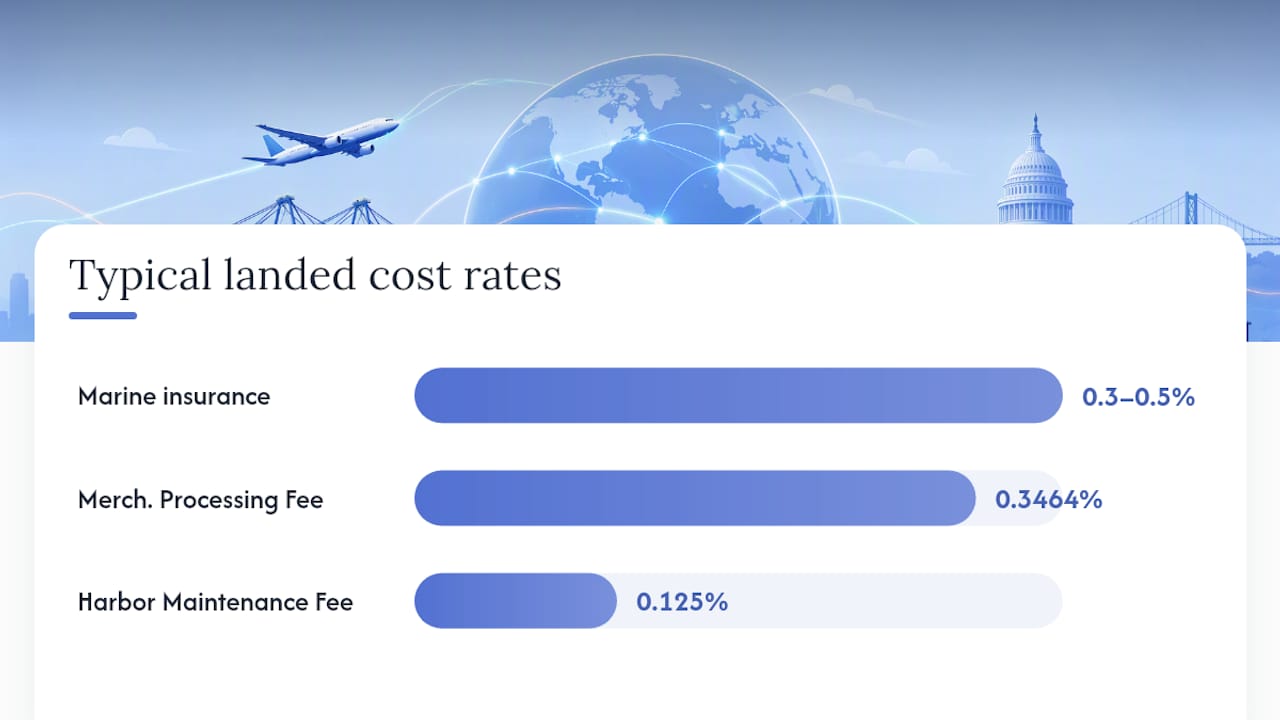
- Insurance: marine cargo insurance, typically 0.3%–0.5% of CIF value for standard goods
- Customs duties and tariffs: calculated on declared customs value using the HTSUS code
- Brokerage and government fees: customs broker fees, Merchandise Processing Fee (MPF), Harbor Maintenance Fee (HMF)
- Domestic transport: drayage from port to warehouse, inland trucking, last-mile delivery
- Packaging and handling: special packing, palletization, white-glove requirements
- Other: demurrage, detention, currency conversion costs, compliance testing
Getting this wrong has real consequences. Understated landed cost inflates apparent margins, leads to mispriced products, and can trigger inventory write-downs when actuals land. For accounting, it distorts COGS. For cash planning, it creates surprise outflows at entry. For compliance, an incorrect customs value can draw CBP scrutiny.
Incoterms shift which party pays what. Under FOB (Free On Board), the buyer pays freight, insurance, and all destination costs. Under CIF (Cost, Insurance, and Freight), the seller covers freight and insurance to the destination port, so those line items come bundled into the invoice price. Under DDP (Delivered Duty Paid), the seller handles duties and delivery, meaning the buyer’s landed cost is essentially the DDP price. Knowing your Incoterm tells you which buckets you need to add separately versus which are already embedded in the price you paid.
Landed cost formula: a component-by-component breakdown
The expanded formula for U.S. imports, with the source document for each line:
| Component | Typical Unit | Common Source Document |
|---|---|---|
| Product cost | Per unit / per shipment | Supplier commercial invoice |
| International freight | Per container / per kg | Freight forwarder quote or bill of lading |
| Marine insurance | % of CIF value (0.3%–0.5%) | Insurance certificate / premium invoice |
| Customs duties | % of FOB customs value (HTSUS rate) | CBP entry summary (CF-7501) |
| Section 301 / 232 / AD/CVD surcharges | % stacked on customs value | CBP notice / broker entry worksheet |
| Merchandise Processing Fee (MPF) | 0.3464% of value, min/max per entry | CBP fee schedule |
| Harbor Maintenance Fee (HMF) | 0.125% of value (ocean only) | CBP fee schedule |
| Customs broker fee | Flat or per-entry | Broker invoice |
| Domestic drayage / inland freight | Per mile / per container | Carrier or drayage invoice |
| Packaging / handling | Per unit or per pallet | Supplier or 3PL invoice |
| Demurrage / detention | Per day | Terminal or carrier invoice |
| FX conversion cost | Spread or fee | Bank or payment provider statement |
A note on valuation basis. The U.S. uses an FOB-based customs valuation, meaning freight and insurance are excluded from the dutiable value. Many other jurisdictions use CIF valuation, where freight and insurance are included in the customs value, which raises both the duty and any VAT calculated on top. This distinction matters when you are comparing landed cost across sourcing markets or modeling a supplier switch from a CIF-default country.
Insurance deserves more attention than most models give it. On a $200,000 shipment, that is $600–$1,000 per container. Underestimate it consistently across 50 shipments a year and you have a real gap.
Pro Tip: Consolidating multiple purchase orders into a single customs entry can reduce your per-shipment MPF exposure, because MPF is capped per entry. Run the math before splitting shipments.
How to calculate landed cost step by step
A defensible pre-order estimate needs four minimum inputs: HTS code, FOB unit price, country of origin, and shipping mode with a freight estimate. Missing any one of these produces a guess, not a model.
Step-by-step procedure:
- Confirm the HTS code. Use the HTSUS lookup at USITC or request a binding ruling from CBP. The code determines your base MFN duty rate and flags any Section 301 or AD/CVD exposure.
- Establish the FOB customs value. Multiply FOB unit price by units ordered. This is the figure CBP uses to calculate duties.
- Estimate international freight. Get a carrier or forwarder quote. For planning, use your freight forwarder’s rate card by mode and lane.
- Calculate insurance. Apply 0.3%–0.5% to the CIF value (FOB value + freight). Use your actual insurance premium when available.
- Apply duty rates. Multiply the FOB customs value by the HTSUS duty rate, then stack any applicable Section 301, Section 232, or AD/CVD rates.
- Add government fees. Calculate MPF (0.3464% of value, subject to per-entry minimum and maximum) and HMF (0.125% of value, ocean only).
- Add broker fees and domestic transport. Use actual broker invoices or estimates from your broker. Add drayage, warehousing intake, and last-mile costs.
- Sum all components. This is your total shipment landed cost.
- Allocate to SKUs. Divide by units for a per-unit figure, or allocate shared costs (freight, duties) by weight, value, or unit count. Document which method you use and apply it consistently.
- Reconcile after clearance. Compare estimated vs. actual for each line item. Log variances. This shipment ledger approach ties every invoice line to a shipment reference and is the foundation of an auditable model.
Worked example
Shipment: 500 units of ceramic cookware from China, shipped FOB Shanghai by ocean.

| Line Item | Amount |
|---|---|
| Product cost (500 units × $40 FOB) | $20,000 |
| International ocean freight | $2,200 |
| Marine insurance, calculated as a small percentage of the CIF value | $89 |
| Base MFN duty (0% for this HTS) | $0 |
| Section 301 tariff applied on FOB value | $5,000 |
| MPF calculated as a percentage of shipment value with applicable minimum | $69 |
| HMF calculated as a small percentage of shipment value | $25 |
| Customs broker fee | $350 |
| Drayage to warehouse | $600 |
| Total shipment landed cost | $28,333 |
| Per-unit landed cost | $56.67 |
The supplier’s FOB price was $40. The actual per-unit cost to your dock is higher due to additional landed cost components. That gap is what landed cost calculation exists to surface.
Incoterms and who pays what:
Pro Tip: When comparing supplier quotes under different Incoterms, normalize everything to a DDP equivalent before comparing prices. A CIF quote that looks cheaper than an FOB quote may not be once you add duties and drayage.
How to estimate U.S. import duties and taxes
Finding the right duty rate is a four-step process:
- Classify your product. Use the HTSUS online lookup at USITC. Search by product description or material. The 10-digit HTS code is what CBP uses; the first 6 digits align with the international Harmonized System.
- Identify the base MFN rate. The General rate in the HTSUS schedule applies to most trading partners. Some goods carry a 0% rate; others run 5%–20% or higher.
- Check for special measures. Look up whether your HTS code carries a Section 301 (China-origin goods), Section 232 (steel/aluminum), or AD/CVD order. These stack on top of the MFN rate and can dwarf the base duty.
- Apply the correct valuation basis. U.S. duties are assessed on the FOB customs value. Freight and insurance are excluded from the dutiable value, unlike CIF-based systems.
Tariff stacking in 2025–2026 is the single biggest source of underestimated landed cost for China-origin goods. These layers stack additively.
CBP policy changes frequently. Section 301 exclusions, Section 122 temporary measures, and AD/CVD rates are subject to administrative review, court rulings, and executive action. Before finalizing a landed-cost model for a major purchase, check the CBP website and the Federal Register for the most current rates. A rate that was accurate three months ago may have changed.
Zonos and Avalara both offer tariff-data APIs that pull live HTSUS rates and flag Section 301 exposure by HTS code and country of origin. These are worth evaluating if you are running high-volume imports or managing a large SKU catalog where manual lookups become a bottleneck.
Which tools help you calculate landed cost accurately?
Tool types available:
- Free online calculators: useful for quick estimates on single SKUs; most use static or infrequently updated tariff tables
- Tariff-enabled calculators: tools like iCustoms and the Supply Chain Stack landed-cost calculator pull live tariff data and can auto-fill duty rates by HTS code and origin country
- Broker-provided entry systems: your customs broker’s platform often includes a landed-cost worksheet tied directly to your entry data
- ERP integrations: platforms like Zonos and Avalara offer API-based duty and tax calculation that feeds directly into purchase order workflows
What to look for in a tool:
- Live tariff data with update frequency disclosed
- HTS code lookup built in (not just a rate lookup by description)
- Multi-currency support with a stored rate and value date
- Multiple allocation methods (weight, value, units)
- Audit trail showing which rate version was used and when
- Bulk import or API access for high-volume SKU catalogs
Online calculators provide useful planning estimates, but most use industry-average freight and brokerage assumptions. For a $500,000 purchase order, those averages can be off by enough to matter. Get actual carrier and broker quotes before committing.
When to use a broker instead of a calculator: complex tariff exposure (AD/CVD, multiple Section 301 layers), high-value or regulated goods (food, electronics, textiles), first-time imports from a new origin country, or any situation where a classification error would trigger a penalty. A calculator tells you what the rate is; a broker tells you whether your classification is defensible.
Pro Tip: When a calculator auto-fills a duty rate, verify the HTS code it used and confirm the country-of-origin rule it applied. A single digit off in the HTS code can shift the duty rate by 10–25 percentage points.
Common mistakes importers make in landed cost models
-
Omitting origin and destination charges. Port handling fees, terminal handling charges (THC), and origin documentation fees are real costs that rarely appear on a freight quote but show up on the final invoice. Add a line for “origin charges” in every model and populate it from your forwarder’s actual billing.
-
Misclassifying the HTS code. Using a broad or approximate code to save time is the most expensive shortcut in importing. A wrong code can mean a missed Section 301 surcharge you did not budget for, or a higher base rate than necessary. Fix: assign a single internal owner for the SKU-to-HTS mapping and review it annually or after any product change.
-
Ignoring bonded warehouse and duty deferral options. For goods that will be re-exported or processed before domestic sale, a bonded warehouse or Foreign Trade Zone can defer or eliminate duty. Most small importers never model this option. For repeat importers, a continuous customs bond is usually more cost-effective than single-entry bonds and should be modeled as an annualized per-shipment cost.
-
Inconsistent allocation rules across shipments. Allocating shared costs by weight on one shipment and by value on the next makes per-unit comparisons meaningless. Document your allocation method and apply it every time. Per the Tijara operational guide, locking a single internal definition of “landed” and a documented allocation rule is the difference between a model and a spreadsheet.
-
Poor FX handling. Paying a supplier in RMB or EUR and booking the cost in USD at the invoice date, then settling at a different rate, creates a silent variance. Store the exchange rate and value date for every conversion in your shipment ledger.
-
Skipping post-clearance reconciliation. Estimated landed cost and actual landed cost diverge on almost every shipment. Running a reconciliation after each entry closes catches classification errors, missed fees, and freight overcharges before they compound across dozens of shipments.
How to use landed cost for pricing and inventory valuation
Landed cost vs. COGS: landed cost is the input to COGS, not the same thing. COGS also includes warehousing, fulfillment labor, and any processing costs after the goods arrive. For cash planning, landed cost is the number that matters at the point of import. For P&L, COGS is what hits the income statement when the unit sells.
Pricing formula:
Price below that and you are subsidizing the customer with margin you do not have.
Accounting and month-end checklist:
- Book landed cost to inventory at receipt, not at invoice date, using the actual entry summary figures.
- Record each cost component separately in your chart of accounts (freight, duties, brokerage) to enable variance analysis.
- Reconcile the customs entry summary (CF-7501) against your internal landed-cost ledger within 30 days of entry.
- Adjust inventory valuation for any post-entry corrections (duty drawback, protest outcomes, broker credit notes).
- Review FX rates used in the period and book any realized gains or losses separately from product cost.
On VAT and import VAT: U.S. imports do not carry a federal VAT, so import VAT is not a factor for domestic U.S. sales. If you are importing into the EU or UK for onward sale, import VAT is typically recoverable as input tax, making it a cash-timing issue rather than a true cost. Model it as a cash outflow at entry and a recovery in the subsequent VAT period.
For domestic transport cost benchmarks and how specialized handling requirements affect per-unit landed cost, the commercial move cost factors guide from Move Craft covers the variable drivers worth modeling in your drayage and last-mile estimates.
The real cost of “close enough” landed cost estimates
Most importers I work with at Universal Shipping Inc. underestimate landed cost not because they are careless, but because they model the costs they can see on a quote sheet and treat the rest as rounding error. The problem is that the invisible costs, origin charges, demurrage, FX slippage, and stacked tariffs, are often where the real margin lives.
The conventional wisdom is that a landed-cost model is a finance exercise. It is not. It is a sourcing tool. The moment you can compare two suppliers on a true per-unit landed cost basis, including their typical transit times, origin port charges, and tariff exposure by HTS code, you are making a sourcing decision with actual data instead of a gut feel about FOB price.
The other thing most guides underplay: tariff volatility in 2025–2026 has made the “set it and forget it” model genuinely dangerous. Section 301 rates have changed multiple times. Section 122 temporary surcharges appeared with short notice windows. An importer who built a landed-cost model in early 2025 and did not update it before a major Q3 purchase order may have absorbed a tariff increase that wiped out the quarter’s margin on that product line.
The fix is not a better spreadsheet. It is a process: a monthly tariff check against your active HTS codes, a documented owner for that check, and a trigger to re-run your landed-cost model before any purchase order above a defined threshold. That is the operational discipline that separates importers who know their margins from those who discover them after the fact.
Usiship handles the complexity so your landed cost stays accurate
Landed cost accuracy depends on getting the customs entry right the first time. Usiship’s licensed customs clearance team manages the full entry process, from HTS classification review to duty payment and post-entry reconciliation, so the figures that feed your landed-cost model reflect actual CBP-assessed costs, not estimates.
Beyond customs, Usiship covers the full cost chain: international freight forwarding by ocean, air, and land; bonded and standard warehousing; drayage and last-mile delivery across all 50 states. That means every component in your landed-cost formula, from port to warehouse door, can run through a single provider with a single audit trail. For importers managing high-volume SKU catalogs or navigating Section 301 exposure, that visibility is worth more than a lower line-item rate from a fragmented provider network.
Request a landed-cost review or get a customs clearance quote to see exactly what your next shipment will cost before it ships.
Sources
Keeping your landed-cost model current means checking these sources regularly, not just at setup:
- How to Calculate Landed Cost: The Complete Guide for US Importers (2026) — FreightFigures
- How to Estimate Landed Cost for U.S. Imports | GingerControl
- How to Calculate Landed Cost for Imports (Step-by-Step) | Tijara
For tariff-volatile categories (China-origin goods, steel, aluminum, textiles), run a CBP check monthly. For stable categories, quarterly is sufficient.
This article is general information, not a substitute for advice from a qualified financial advisor. Consult a qualified financial professional about your own circumstances before acting on anything here.