
ISPM 15 Wood Packaging: Rules, Stamp and Treatments
ISPM 15 is the international standard that requires raw wood packaging, such as pallets, crates and dunnage, to be heat-treated or fumigated and permanently stamped before it crosses a border. For U.S. shippers it is not optional in practice: wood packaging entering or transiting the United States must be pest-free, debarked, treated and marked with an ISPM 15 logo, and the same is expected by most of the countries you export to. This guide explains what is covered, which treatments count, how to read the stamp, and how to avoid a refused container.
TL;DR
- ISPM 15 covers raw wood packaging (pallets, crates, boxes, dunnage, skids, drums) used in international trade. Manufactured wood such as plywood and wood pieces under 6 mm thick are outside the definition.
- Three treatments qualify: heat treatment (HT), methyl bromide fumigation (MB) and dielectric heating (DH).
- A compliant unit carries a permanent stamp with the IPPC symbol, a two-letter country code, a unique facility number and the treatment code.
- Repaired or remanufactured wood packaging must be treated and marked again. An unmarked pallet is a risk to your whole shipment.
- Check the packaging before the cargo is loaded. Fixing it at the port costs far more than getting it right at origin.
Table of Contents
- What ISPM 15 is and why it exists
- Is ISPM 15 mandatory?
- What is covered and what is exempt
- The three approved treatments
- How to read an ISPM 15 stamp
- Repaired, reused and remanufactured pallets
- Where to get compliant wood packaging
- What happens when wood packaging fails
- A pre-shipment checklist
- Our perspective
- Let us handle the handoff
- FAQ
- Sources
What ISPM 15 is and why it exists
ISPM stands for International Standard for Phytosanitary Measures. Number 15 is titled Regulation of wood packaging material in international trade and is administered under the International Plant Protection Convention (IPPC). Its purpose is simple: raw lumber can carry insects and pathogens, and a pallet under a container of electronics is just as capable of moving a beetle from one continent to another as a load of logs.
U.S. Customs and Border Protection states that the primary objective is to protect domestic agriculture, forests and ecosystems from quarantine pests and pathogens. That is why the rule applies to the packaging, not the goods. A shipment of sealed machine parts can be refused because of the pallet it sits on.
Two points from the IPPC’s own explanatory document are worth knowing. First, the standard does not give absolute protection against all pests; it reduces the majority of risk. Second, it was designed to balance risk reduction against the least restrictive trade measures. That balance explains why the rules are strict about marking but accept several treatment methods.
Is ISPM 15 mandatory?
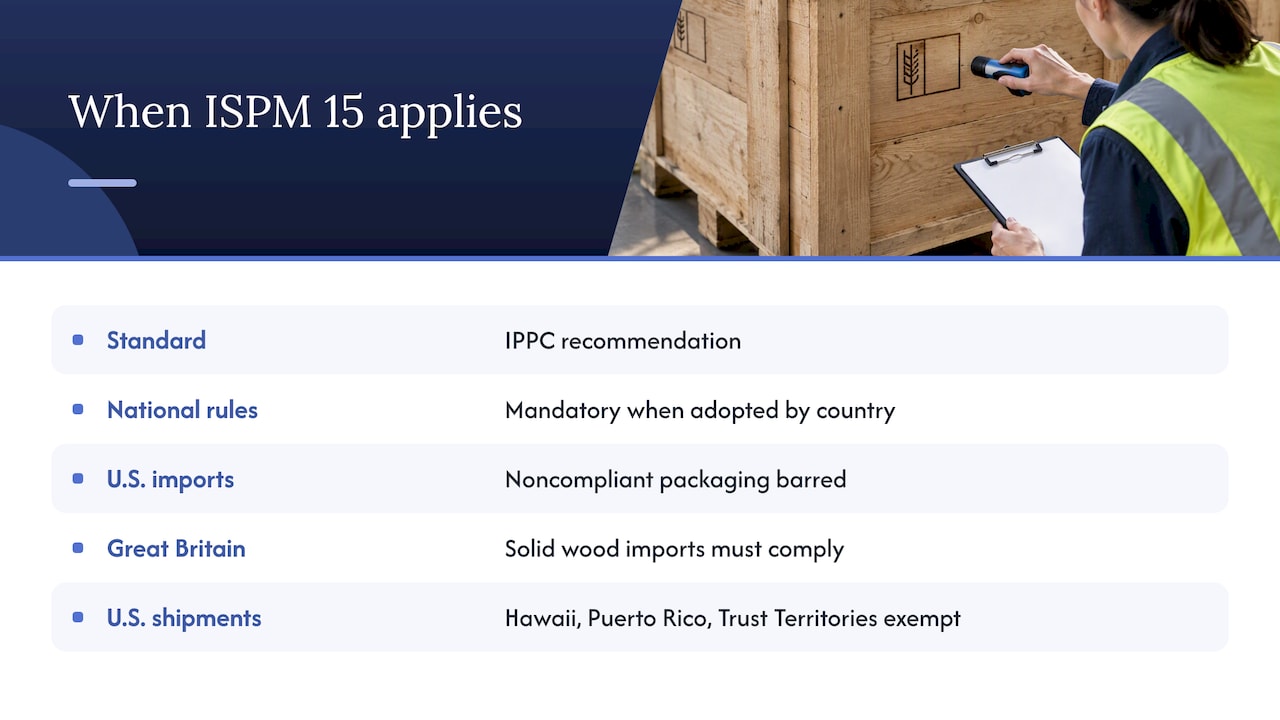
The standard itself is a recommendation adopted by IPPC members. It becomes mandatory when a country writes it into its import rules, and most major trading partners have. In the United States, the Animal and Plant Health Inspection Service (APHIS) states that noncompliant wood packaging will not be allowed to enter the country. Great Britain applies the same logic: solid wood packaging imported from any country must meet ISPM 15, and noncompliant material can be rejected or destroyed.
For exports, the U.S. rule works the other way. U.S. exporters must meet the import requirements of the destination country. One carve-out matters for domestic-leaning supply chains: shipments of wood packaging from the U.S. to Hawaii, Puerto Rico and U.S. Trust Territories do not require ISPM 15 treatment or marking. Australia’s agriculture department also advises exporters to confirm the importing country’s requirements before shipping, because national rules can add conditions on top of the standard.
The practical answer: if the cargo crosses an international border on or in raw wood, assume you need ISPM 15 compliance and verify the specifics for the destination.
What is covered and what is exempt
CBP describes most wood packaging as covered, including pallets, crates, boxes, dunnage, packing blocks, drums, cases and skids. That list is broader than people expect. Dunnage, the loose lumber used to brace cargo inside a container, is covered even though it never appears on a packing list.
The definition excludes:
- manufactured wood materials (plywood, particleboard, oriented strand board, veneer made with glue, heat or pressure);
- loose wood packing materials such as sawdust, shavings and wood wool;
- wood pieces less than 6 mm thick.
The practical use of these exemptions is design. If a lightweight product ships on a plywood or plastic pallet, or in a corrugated and plywood crate, you remove the stamp question completely. Many exporters of low-value goods switch for that reason alone. Be careful with mixed builds, though: a plywood crate on raw-lumber skids is still a covered unit, because the skids are solid wood.
The three approved treatments
CBP lists three treatments that meet the standard:
| Treatment | Code | Requirement |
|---|---|---|
| Heat treatment | HT | Minimum core temperature of 56°C for at least 30 minutes |
| Methyl bromide fumigation | MB | At least 16 hours of fumigation, followed by aeration |
| Dielectric heating | DH | Minimum core temperature of 60°C for one continuous minute |
The figures are from CBP’s wood packaging page. Heat treatment is by far the most common method for pallets and crates. Methyl bromide remains approved under ISPM 15, even though it has been phased out in some regions for environmental reasons, so some destination countries or buyers restrict or discourage it. If your customer has a preference, ask for HT and confirm it in the purchase order.
Note that the temperature is measured at the core of the wood, not the air in the kiln. That is why treatment has to be done by a facility that is supervised under an official program. The IPPC says national plant protection organizations should supervise or audit approved facilities to verify compliance. You cannot self-certify a pallet by baking it in your own oven.
How to read an ISPM 15 stamp
The stamp is the only evidence an inspector looks at, so it has to be complete and legible. A compliant mark includes four elements, according to CBP:
- The IPPC symbol, a stylized wheat ear, usually on the left of the mark.
- The two-letter ISO country code, such as US for the United States.
- A unique facility number that identifies the producer or treatment provider.
- The treatment abbreviation: HT, MB or DH.
In the United States, export marks carry one more feature. APHIS says the quality mark also includes an agency trademark, the logo or name of the accredited inspection agency, applied outside the ISPM 15 mark itself. That is how a mark can be traced back through the American Lumber Standard Committee system.
A quick field check
Walk the load and look at the stamp on at least two opposite sides of each unit. You are looking for:
- all four elements present, not just a symbol or a country code;
- a mark that is clear, permanent and not smudged, painted over or handwritten;
- the same mark on every pallet in the shipment, or at least no unmarked ones mixed in;
- no signs of repair, such as mismatched boards, new nails or fresh-cut lumber on an old stamped pallet.
A stamp in a photo from your supplier is not enough. Ask for photos of the actual pallets on the day they are loaded.
Repaired, reused and remanufactured pallets
This is where most compliance problems begin. The IPPC notes that wood packaging is frequently reused, repaired or remanufactured, which makes its true origin and phytosanitary status hard to determine. A pallet that has been treated, marked and never altered does not need retreating. A pallet with replaced boards is a different object, and APHIS is explicit that repaired or remanufactured wood packaging must be retreated and marked again.
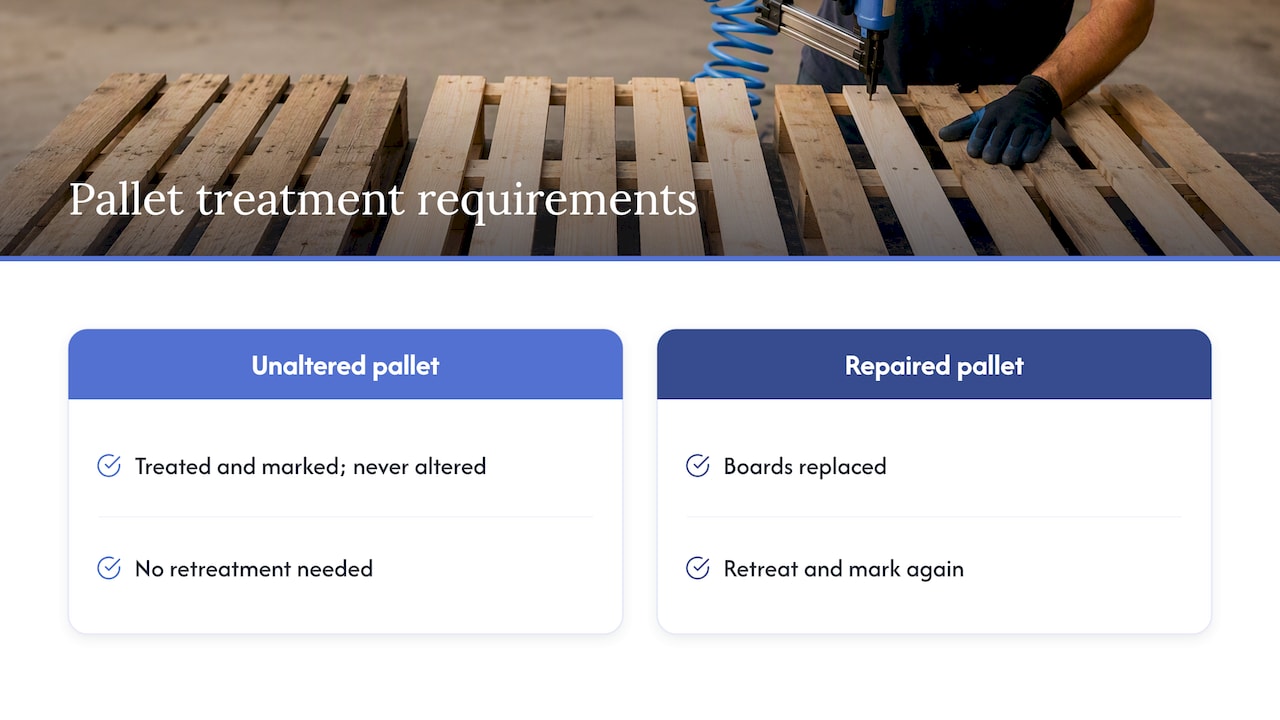
In a warehouse, that means two habits. Do not send a repaired pallet out on an international order unless the repairer is an approved facility that re-marks it. And keep a separate stock of domestic-only pallets, so a worn pallet never drifts into an export lane. When pallets are finally retired, reuse, recycling or removal options keep the damaged ones from sneaking back into circulation.
Where to get compliant wood packaging
APHIS describes three routes for U.S. exporters: buy marked material from accredited sources, become a certified manufacturer, or use registered treatment and marking facilities overseen by the American Lumber Standard Committee. For most small and mid-sized shippers the first route is the only realistic one. Buy from a supplier that can show its facility number and treatment type, and keep the invoice with the lot.
If your goods are palletized overseas by a supplier, the burden shifts. APHIS tells importers to inform their exporters of the requirement, and it publishes import requirements by commodity in its ACIR database. Put the requirement in the purchase order: treated and marked to ISPM 15, with the treatment type named, and photos of the stamped pallets before the container is sealed.
Also design the packaging at the start. If you are palletizing freight for LTL, our guide to palletizing freight for LTL covers load build, and a compliant pallet is the first step of that build. The packing list requirements page explains what to declare about the packaging itself, so the paperwork matches what the inspector finds.
What happens when wood packaging fails
A marked, clean pallet passes unnoticed. A failed one can stop everything. DAFF notes that when wood packaging is unmarked or shows infestation on arrival in an implementing country, the consignment may be refused entry or ordered for treatment or disposal. In the U.S., the stated rule is that noncompliant material will not be allowed to enter, and APHIS runs a noncompliant-WPM reporting process for importers. CBP and APHIS also describe an Emergency Action Notification that an importer can receive when material fails.
The cost does not sit in the fine. It sits in the time: a container held at the port accrues demurrage and storage, the cargo may need to be re-exported or treated, and your customer’s delivery date moves. For ecommerce sellers with Amazon inbound windows, that delay can matter more than the direct charge.
The fix is cheap before departure and expensive after. Compliance checks belong with the other pre-arrival steps in an import: the ISF filing deadline, the customs bond and the broker’s power of attorney. Our port to door shipping checklist puts those steps in order.
A pre-shipment checklist
- Decide whether you need solid wood at all. Plywood, OSB or plastic pallets avoid the issue.
- Confirm the destination country’s rules. Do not assume it matches U.S. rules.
- Order pallets and crates marked HT unless your buyer says otherwise.
- Ask the supplier for its facility number and a photo of the stamp.
- Inspect on loading day: four stamp elements, clear and permanent, no repairs.
- Check dunnage and bracing, not just pallets.
- Keep invoices and photos on file with the shipment records.
- Tell your freight forwarder the packaging type so the booking and the declarations are consistent.
Our perspective
We handle freight, warehousing and fulfillment under one roof, and in our experience wood packaging problems rarely come from a lack of knowledge. They come from a gap between who buys the pallet and who ships the cargo. The supplier palletizes, the warehouse re-palletizes, and nobody owns the stamp.
Our advice is to treat the pallet as part of the product. Specify it in the purchase order, inspect it at receiving, and keep a clear rule on repaired pallets. If a warehouse is re-palletizing inbound goods, it should know which pallets are cleared for export and which are domestic only. That is a process question more than a lumber question, and it is cheaper to solve once than shipment by shipment.
— Akbar
Let us handle the handoff
If you import or export on wood pallets and want one team to coordinate the packaging, the booking and the customs paperwork, our freight forwarding and customs brokerage services cover air, ocean and land moves across the U.S. For goods that are staged or re-palletized before shipping, our warehousing and fulfillment solutions include receiving and storage, and you can see our published storage rates of 5-6 USD per bin and 17-19 USD per pallet per month on the pricing page.
FAQ
Is ISPM 15 mandatory for shipments to the United States?
Yes. APHIS requires wood packaging entering or transiting the U.S. to be pest-free, debarked, treated and marked with an ISPM 15 logo. Noncompliant material will not be allowed to enter. Check the ACIR database for requirements specific to your commodity.
Where can I buy ISPM 15 pallets?
Buy from a supplier that can show its facility number and treatment code on the stamp. U.S. exporters can also use registered treatment and marking facilities overseen by the American Lumber Standard Committee. Ask for HT-marked pallets unless your destination or customer requires something else.
Does plywood need an ISPM 15 stamp?
No. Manufactured wood materials such as plywood and wood pieces under 6 mm thick fall outside the definition used by CBP. A pallet or crate that is only partly plywood, with solid wood skids or bracing, still needs the stamp.
What must an ISPM 15 stamp include?
The IPPC symbol, the two-letter ISO country code, a unique facility number and the treatment code (HT, MB or DH). U.S. export marks also carry the logo or name of the accredited inspection agency outside the ISPM 15 mark itself.
Can I reuse a stamped pallet?
Yes, as long as it has not been repaired or remanufactured. If boards are replaced, the pallet must be treated and marked again. Keep repaired pallets out of international shipments unless they have been re-marked by an approved facility.
Sources
- Wood Packaging Materials, U.S. Customs and Border Protection
- Import ISPM 15-Compliant Wood Packaging Material into the U.S., APHIS
- Export ISPM 15-Compliant Wood Packaging Material From U.S., APHIS
- Explanatory document for ISPM 15, IPPC
- Regulation of wood packaging material in international trade, IPPC
- Wood packaging material for import and export, GOV.UK
- ISPM 15 for Export frequently asked questions, DAFF