
Intermodal Shipping: 6 Steps, One Lane to Test First
Intermodal shipping moves cargo in one sealed container across two or more transport modes, with no re-handling of the goods inside, a definition the Intermodal Association of North America uses. It fits best when your freight is non-urgent, dense or high-volume and travels long distances, where a rail or vessel line-haul lowers your cost. Truck and rail together carry most of North America’s cross-border trade, according to the Bureau of Transportation Statistics.
TL;DR:
- Terminal cutoffs, appointment windows, and free time govern whether containers catch departures; confirm each before loading, since missed windows can add days and fees.
- Rail plus truck suits long lanes with repeat volume, while ocean plus truck serves imports; barge requires waterway access, and air fits urgent, expensive freight.
- Compare total landed cost, including both drays, terminal fees, accessorials, and inventory carrying costs for extra transit days, because transport savings alone can mislead.
- Test one repeat lane, set cost per container and delivery time targets, track every accessorial, then compare results with the truck baseline before expanding.
Table of Contents
- How does an intermodal shipment actually move?
- Which modal combinations are most common?
- What are the benefits and typical use cases for shippers?
- What operational constraints should you plan around?
- What happens at terminals, transload facilities and chassis pools?
- How do cost and transit time compare with direct truckload?
- How do you decide, and how do you run a pilot?
- What does the industry data say?
- Why we recommend starting with one lane
- How we help you run an intermodal pilot
- FAQ
- Sources
How does an intermodal shipment actually move?
The container is the whole idea. Because the box is standardized, it can ride on a truck chassis, a railcar or a vessel without anyone opening it. The goods stay sealed from the moment they are loaded until the consignee breaks the seal, which removes the handling steps where damage and pilferage tend to happen. The IRU describes the same logic: standardized containers let freight change modes smoothly and let each leg use the mode that suits it best.
A typical move runs through these steps:
- Pickup: the container is loaded at your dock or at a transload facility and sealed.
- Origin dray: a local motor carrier hauls it to the nearest rail ramp or port.
- Origin terminal: the box is gated in, stored and lifted onto a railcar or vessel.
- Line-haul: rail or vessel carries it the long distance.
- Destination terminal: the container is lifted off and held until it is picked up.
- Destination dray: another motor carrier delivers it to the consignee.
Several parties touch that flow. Motor carriers handle the dray on both ends. A rail or ocean carrier runs the line-haul. Terminal operators control gate access, lifts and storage. A 3PL or freight forwarder usually ties these together under one booking, so you deal with a single point of contact instead of coordinating with each vendor separately.
The handoffs are where timing gets rigid. Terminals publish cutoffs, the last time a container can arrive and still make a specific train or sailing. Many also require appointments for pickups and returns. Miss a window and the box sits until the next departure, which turns a small scheduling slip into days of delay.
- Where delays hide: dray availability and terminal dwell cause far more slippage than the line-haul itself.
- Where you gain control: booking early, confirming appointments in writing and keeping flexible delivery windows on the consignee side.
- Where costs hide: storage and detention begin accruing the moment a container overstays its free time.
Pro Tip: Ask your forwarder for the terminal cutoff and the free-time clock for each lane before you commit, and build your loading schedule backward from those two dates.
Our logistics transportation services cover this coordination so your team does not have to chase each handoff by hand.
Which modal combinations are most common?
Not every intermodal lane looks the same. The pairing depends on geography, cargo and what infrastructure sits near your origin and destination.
Rail plus truck is the workhorse for continental land moves. Rail handles the long middle stretch, where steel wheels on steel track cost less per mile than a truck on the highway, and trucks handle the short ends. The longer the line-haul, the more the dray cost gets spread thin, which is why this pairing shines on cross-country lanes.
Ocean plus truck is how most imported and exported containers move. The vessel crosses the water, then a drayage carrier takes the box from the port to a warehouse or store. Port-to-door dray changes both cost and timing, since port congestion, chassis supply and gate hours all shape what the final leg costs. Our guide to port-to-door shipping walks through the timeline and entry checklist importers should plan around.
Barge plus truck makes sense where inland waterways connect shippers to ports or industrial hubs. It suits heavy, low-value bulk and containerized cargo that is not in a hurry, and it only works where a navigable waterway actually reaches your origin or destination.
Air plus truck is the odd one out. It exists, and it can be the right call for urgent, high-value goods that need a ground connection at each end, but it is expensive and not what most people mean when they say intermodal.
Here is how common lane types usually line up:
- Cross-country domestic freight: rail plus truck.
- Overseas imports to inland distribution centers: ocean, then rail, then truck.
- Port-adjacent deliveries: ocean plus a short dray.
- Inland waterway corridors: barge plus truck for heavy, patient cargo.
- Urgent high-value parcels and components: air plus truck, as an exception.
Matching your lane to the right pattern is the first filter. If your freight moves a few hundred miles on a mid-week schedule, intermodal may not pencil out. If it moves coast to coast on a steady cadence, it probably deserves a closer look.
What are the benefits and typical use cases for shippers?
The headline benefit is cost on the long haul. A Federal Highway Administration modal-shift study finds that rail rates are generally lower than truck rates, and it models how changes in truck weight limits shift freight between modes and alter total logistics costs. That savings shows up in the line-haul portion of your landed cost. The catch is that you add dray and terminal handling, so the advantage depends on distance and volume.
Beyond price, several other benefits matter to decision-makers:
- Lower handling risk: sealed containers are not repacked between modes, so there are fewer chances for damage or theft.
- Volume efficiency: one train or vessel carries enormous container counts, which helps when you ship the same lane repeatedly.
- Predictable capacity: contracted or booked space can smooth out the spot-market swings that hit truckload buyers.
- Sustainability: moving miles off the highway and onto rail is widely understood to cut emissions per ton moved, and EPA’s SmartWay program gives shippers a way to quantify it.
The EPA SmartWay Online Shipper Tool documentation describes the dataset and method shippers can use to estimate freight emissions and compare modal choices and carriers.
Federal modal-shift analysis shows rail rates are generally lower than truck rates. That gap is the economic engine behind intermodal, and it is largest where the line-haul is longest.
Certain shipper profiles gravitate to intermodal again and again. Retailers replenishing distribution centers from distant ports run steady container flows. Manufacturers with inbound parts or raw materials on fixed schedules value the predictability. Importers who ship full containers on a regular rhythm can plan around the transit time instead of fighting it. In each case the common thread is volume, patience on timing and a lane long enough to reward the rail or vessel leg.
What operational constraints should you plan around?
Intermodal rewards planning and punishes improvisation. A handful of operational realities drive most of the variance in cost and lead time.
Drayage can dominate short lanes. On a shorter move, the dray at each end can eat the line-haul savings. That is why distance matters so much. You manage dray cost by consolidating loads, booking capacity ahead of time and avoiding last-minute pickups that force premium pricing.
Terminals have limits. Appointment windows, lift rates and chassis availability all cap how fast a box can move through a ramp or port. Seasonal peaks make it worse, when congestion stretches dwell times and pushes up accessorial charges.
Container type shapes the economics. Standard 20-foot and 40-foot containers, high-cube containers and refrigerated units each have their own payload and cube limits. Dense cargo can hit a weight limit before it fills the space, while light cargo fills the space long before it reaches the limit. Knowing which constraint binds first tells you whether intermodal suits your product.
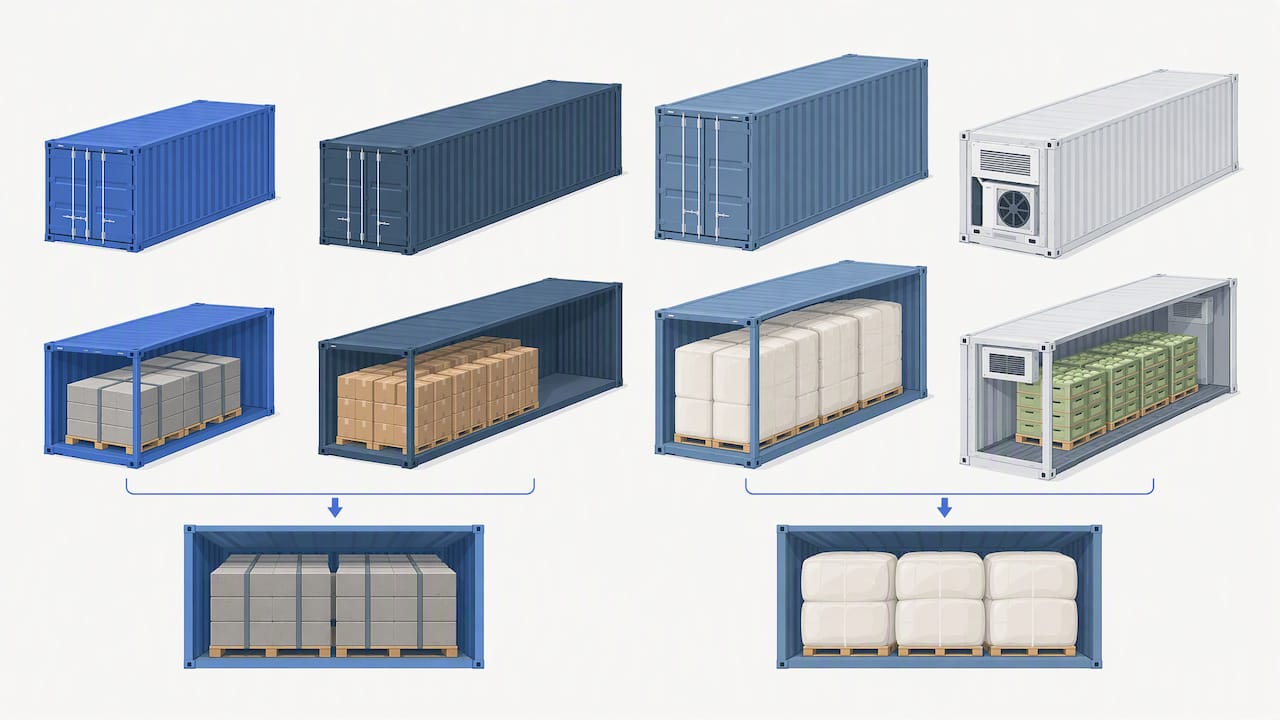
Packaging decides your claims. A well-built load maximizes cube and survives the vibration of a long rail or sea leg. Poorly palletized freight shifts, crushes and generates claims. Our walkthrough on how to palletize freight covers the practices that keep loads stable and efficient.
Practical mitigations include:
- Consolidating smaller shipments into full containers.
- Keeping delivery windows flexible where the consignee allows it.
- Transloading when a container cannot go straight to the final dock.
- Using a 3PL to coordinate dray, appointments and documentation.
Pro Tip: Weigh a sample loaded pallet before you finalize your container plan. Knowing whether you cube out or weigh out saves you from paying for space you cannot use.
What happens at terminals, transload facilities and chassis pools?
The transfer points are where intermodal either runs smoothly or stalls, so it pays to understand them.
At a terminal, containers are gated in, inspected, stored and lifted onto the next mode. Lift activity, yard storage and security procedures all influence how long a box dwells, and dwell is what triggers fees once free time expires. Appointment systems add predictability but also rigidity.
Transloading is the alternative to delivering the container intact. A transload facility opens the box, sorts or repackages the freight and reloads it onto local trucks, often as pallets. It adds a handling step and some cost, but it can shorten the last mile and let you ship to destinations that cannot accept a full container. We cover where it fits in our guide to transloading and turn time.
Chassis are the wheeled frames that carry containers on the road. They are usually drawn from shared pools with interchange rules, and when supply tightens, shippers feel it as delays and surcharges. A container with no chassis available is a container going nowhere.
Before you book, run through this sequence:
- Confirm the required lead time with your forwarder.
- Gather documentation: bill of lading, commercial invoice and any customs paperwork for border moves.
- Check the terminal cutoff for your intended train or sailing.
- Reserve dray and confirm appointment windows at both ends.
- Ask which accessorials are likely and who pays for them.
Common accessorials to anticipate:
- Chassis usage and split fees.
- Terminal storage and detention beyond free time.
- Pre-pull or redelivery charges when appointments shift.
- Transload handling and sorting.
Understanding these costs up front is what separates a clean quote from a surprising invoice.
How do cost and transit time compare with direct truckload?
Intermodal is usually cheaper and slower than a direct truckload, and the whole decision turns on whether that trade works for your inventory and customers. The Federal Highway Administration notes that choosing a mode is a balance of cost, speed and reliability, and that intermodal tends to be compelling for non-urgent, high-volume, long-distance freight where rail’s cost efficiency outweighs the added dray and terminal handling.
Build your price picture from these components:
- Rail or vessel line-haul.
- Origin and destination dray.
- Terminal handling and lift charges.
- Accessorials such as chassis, storage and detention.
- Transloading, if you need it.
- Fuel and any surcharges.
On time, a truck goes door to door in one continuous move. An intermodal shipment adds handoffs, terminal waits and train schedules, so the door-to-door clock runs longer. The rail leg itself can be efficient, but the dwell and dray around it add up. For a baseline on what direct moves look like, our guide to ZIP-to-ZIP LTL transit times shows how to set and pad domestic expectations.
A simple landed-cost comparison looks like this:
Total landed cost = line-haul + origin dray + destination dray + terminal fees + accessorials + inventory carrying cost for the extra transit days.
That last term is the one people forget. Slower transit means inventory spends longer in the pipeline, and that has a carrying cost. If the transport savings outweigh it, intermodal wins.
Rules of thumb that tend to hold:
- Longer lanes favor intermodal because dray gets spread across more line-haul miles.
- Steady, repeatable volume beats one-off moves.
- Flexible delivery windows protect you from terminal timing.
- Urgent or fragile freight usually belongs on a truck.
Pro Tip: Price the same lane both ways, then add a realistic inventory carrying cost for the extra days. The comparison often looks different once that line is on the page.
How do you decide, and how do you run a pilot?
Start with an honest audit of the freight. Score each factor as favoring intermodal or favoring truck:
- Urgency: can the shipment tolerate extra days?
- Distance: is the line-haul long enough to absorb dray?
- Weight and density: does the load fit container limits efficiently?
- Container readiness: can you load, seal and palletize properly?
- Delivery windows: can the consignee flex around terminal timing?
- Access: is there a terminal and available dray near both ends?
A simple rule works well: if most factors lean toward intermodal and urgency is low, test it. If urgency is high or distance is short, stay with truck. You do not need to invent precise thresholds. A clear majority across these questions is enough to justify a trial.
Then run a small pilot:
- Pick one lane with repeat volume.
- Set targets for cost per container and door-to-door lead time.
- Run it for a trial period, consolidating loads where you can.
- Track every accessorial so nothing hides in the averages.
- Compare results against your truck baseline and decide whether to expand.
Bring in a 3PL or freight forwarder when you need help with appointments, dray and transloading. Our freight consolidation pilot checklist lays out a pilot approach you can adapt.
What does the industry data say?
A few sourced facts help when you build an internal business case. The Intermodal Association of North America defines intermodal as freight moved in a single sealed container across multiple modes, which removes re-handling, and notes that the industry measures volume in TEUs. The Bureau of Transportation Statistics reports transborder freight with modal shares and dollar values, and shows truck and rail together facilitating most U.S. trade with Canada and Mexico.
Truck and rail together move the majority of North American transborder freight, per the Bureau of Transportation Statistics’ August 2025 update. That makes modal choice a mainstream operational decision, not a niche one.
Why we recommend starting with one lane
Most shippers talk themselves out of intermodal by imagining the whole network at once. The better move is smaller: pick a single lane, measure landed cost and accessorials honestly, and let the numbers decide. A good pilot should show whether line-haul spend drops and whether sealed containers reduce handling on your freight. Pairing that with a 3PL that manages the handoffs keeps your team out of the appointment chase.
— Akbar
How we help you run an intermodal pilot
We coordinate the pieces an intermodal move depends on: freight forwarding and customs brokerage, dray and transloading coordination, and warehousing and fulfillment on either end. To request a pilot quote, have your origin and destination, commodity, pallet counts, target cadence and timing ready. Start with our freight forwarding services or our warehousing and fulfillment solutions, and we will build the pilot with you.
FAQ
What is intermodal shipping?
Intermodal shipping moves freight in one sealed container across two or more transport modes, such as rail and truck. The goods are not unpacked between legs, which reduces handling. The Intermodal Association of North America uses this definition.
Is intermodal cheaper than truckload?
Often, on long lanes, yes. Rail line-haul is generally cheaper than trucking, as the FHWA modal-shift analysis indicates, but dray and terminal fees reduce the gap on shorter moves. Compare total landed cost, not just line-haul.
Is intermodal slower than trucking?
Usually, because of terminal handoffs, train schedules and dray at both ends. It works best for non-urgent freight where the extra days cost less than the transport savings.
How can I estimate the emissions of my modal choices?
EPA’s SmartWay program provides a shipper tool and dataset for this. The technical documentation explains how to compare modal choices and carriers.
Sources
- What is Intermodal?
- North American Transborder Freight Shows Estimated 2.5% Decrease in August 2025 from August 2024 | Bureau of Transportation Statistics
- CTS&W Limits Study: Modal Shift Comparative Analysis Technical Report – Chapter 4: Scenario Impacts on Transportation and Logistics Costs and Rail Contribution
- 2024 SmartWay Online Shipper Tool: Technical Documentation U.S. Version 1.0 (Data Year 2023)