
Avoid Costly Delays: 11 Incoterms Explained and How to Write Them
Incoterms are the 11 standardized three-letter rules that spell out who arranges and pays for transport, who bears risk of loss or damage at each stage, and who handles customs paperwork on an international shipment. They don’t set price or transfer ownership. The current rulebook is Incoterms 2020, published by the International Chamber of Commerce, and every contract should cite the term, the exact location, and that edition name together.
TL;DR:
- Incoterms allocate risk and costs at specific delivery points but do not transfer ownership or govern payment, requiring clear contract language.
- The most common mistakes involve omitting the exact named place, the correct edition, or assuming CIF covers full insurance, which it does not.
- Using the wrong rule, such as FOB instead of FCA for container freight, can cause delays and legal disputes due to misinterpreted responsibilities.
- The current and only valid edition is Incoterms 2020, which must be explicitly cited along with a precise delivery location to avoid ambiguity.
- First-time importers should prefer DAP or DDP for simplicity, but only after verifying if the seller can legally act as importer of record and handle import duties.
Table of Contents
- What Incoterms Explained Actually Cover (and What They Don’t)
- The 11 Incoterms 2020 Rules, Grouped by Mode
- When Risk Transfers, and Why CIF Isn’t the Same as Full Coverage
- How to Write an Incoterm Correctly in a Contract
- A Practical Checklist for Choosing the Right Incoterm
- Common Mistakes That Cost Shippers Money
- How Incoterm Obligations Play Out in a Real Shipment
- Where to Verify the Official Rules
- Why Precision on Incoterms Pays for Itself
- Sources
- FAQ
What Incoterms Explained Actually Cover (and What They Don’t)
Incoterms standardize three things: who arranges transport, who pays which costs along the route, and the precise point where risk passes from seller to buyer. That’s it. They function as a shared vocabulary so a manufacturer in Vietnam and a retailer in Ohio don’t have to renegotiate freight logistics from scratch on every purchase order.
What they skip is just as important. According to the ICC’s own Incoterms Q&A library, Incoterms don’t govern contract law, don’t set the sale price, don’t transfer legal title to the goods, and don’t touch payment terms or dispute resolution. Those live in the sales contract itself, separate from the shipping term.
That gap causes real confusion. A buyer might assume “DDP” means the seller owns the goods until delivery, when title transfer is actually determined by whatever the underlying sales agreement says, often independent of the Incoterm entirely.
Three practical boundaries worth remembering:
- Incoterms allocate cost and risk, not ownership.
- They say nothing about currency, financing, or when payment is due.
- If a dispute lands in court, the Incoterm tells a judge who was responsible for what, not who wins.
Because the rules only work when both parties read them the same way, the U.S. International Trade Administration recommends exporters treat the named place and edition as part of the deal terms, not boilerplate.
The 11 Incoterms 2020 Rules, Grouped by Mode
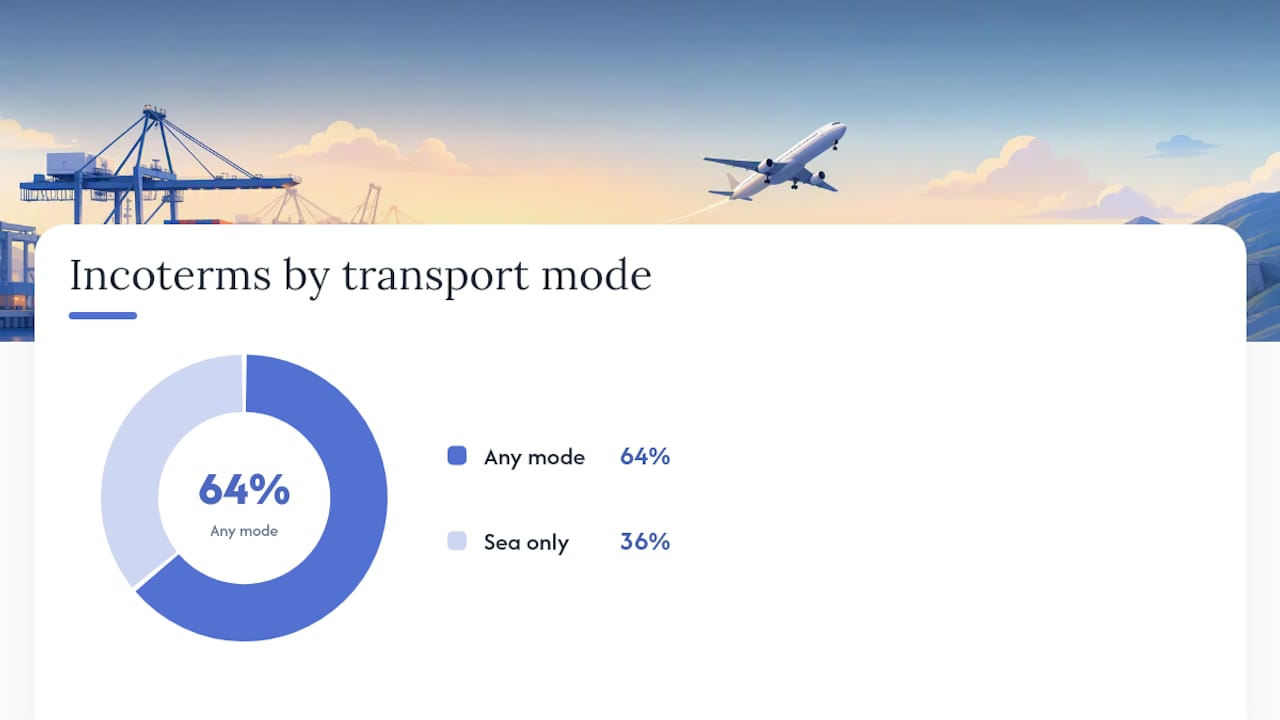
Incoterms 2020 contains 11 rules split into two families: seven that work for any transport mode, including multimodal shipments, and four reserved strictly for sea and inland waterway transport, according to the ICC’s official Incoterms rules page. Picking from the wrong family is one of the most common contract errors in freight.
Any-mode rules (use these for air, rail, truck, or mixed transport):
- EXW (Ex Works) — Seller makes goods available at their own premises; buyer handles everything from there, including export clearance.
- FCA (Free Carrier) — Seller delivers goods to a carrier or named location; risk transfers once loaded or handed off.
- CPT (Carriage Paid To) — Seller pays freight to a named destination, but risk passes at origin once goods reach the first carrier.
- CIP (Carriage and Insurance Paid To) — Same as CPT, but seller must also insure the goods to a higher minimum level.
- DAP (Delivered at Place) — Seller delivers, risk included, to a named destination, ready for unloading.
- DPU (Delivered at Place Unloaded) — Like DAP, but seller also unloads the goods at destination.
- DDP (Delivered Duty Paid) — Seller handles everything, including import duties and taxes, up to the buyer’s door.
Sea and inland waterway only:
- FAS (Free Alongside Ship) — Seller delivers goods alongside the vessel at the port; risk passes there.
- FOB (Free on Board) — Risk passes once goods are loaded onto the ship.
- CFR (Cost and Freight) — Seller pays freight to destination port; risk still passes at loading.
- CIF (Cost, Insurance, and Freight) — Same as CFR, but seller also provides minimum insurance coverage.
If your cargo moves in a shipping container that gets handed to a carrier before it ever reaches the ship, FCA almost always fits better than FOB, even though FOB gets misused for container freight constantly.
When Risk Transfers, and Why CIF Isn’t the Same as Full Coverage
Every Incoterm defines a specific delivery point, and that point is exactly where risk moves from seller to buyer, regardless of who’s still paying for freight afterward. Under CPT and CIP, for instance, the seller pays for carriage to the destination, but risk actually passes back at the origin, the moment goods are handed to the first carrier. That mismatch surprises a lot of first-time buyers.
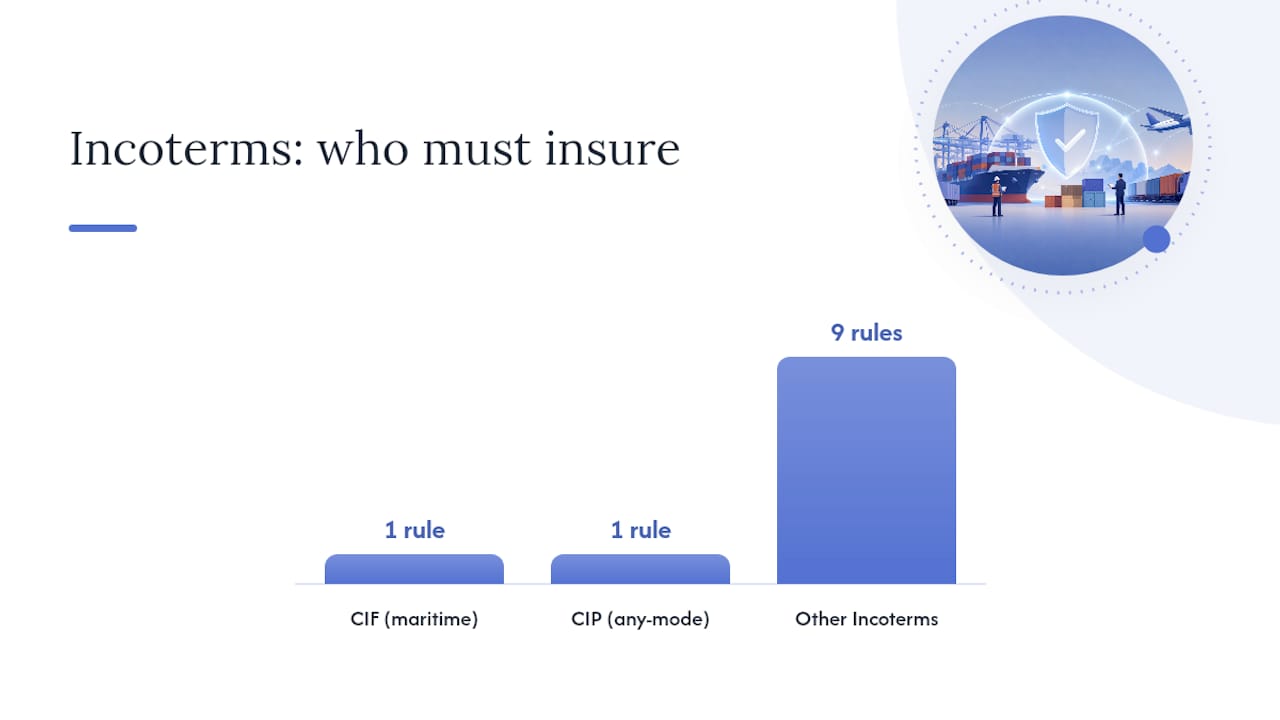
Insurance obligations only exist under two of the 11 rules. CIF, the maritime-only term, requires just minimum coverage, traditionally Institute Cargo Clauses C. CIP, its any-mode counterpart, was revised in the 2020 edition to require a substantially higher insurance minimum, closer to Institute Cargo Clauses A.
- CIF: minimum coverage only, historically Clause C.
- CIP: higher minimum required since the 2020 revision, closer to Clause A.
- Neither term guarantees the buyer’s full replacement value is covered.
Pro Tip: Even when your seller is contractually required to insure the cargo under CIF or CIP, buy supplemental cargo insurance for high-value freight. Minimum coverage under CIF often excludes theft, water damage, and rough handling, exactly the claims that show up most often on ocean freight.
How to Write an Incoterm Correctly in a Contract
The correct format is always: term, named place, edition. For example: “FCA Shenzhen Terminal, Incoterms 2020.” Drop any one of those three pieces and you’ve created ambiguity that can cost real money when a shipment gets damaged or delayed.
The named place matters more than most contracts treat it. It’s not a shipping address, it’s the exact delivery and risk transfer point, according to guidance from ovrseas. “FOB China” tells nobody anything useful; “FOB Ningbo Port, Berth 12, Incoterms 2020” does.
- Always name a specific terminal, warehouse door, or port berth, not just a city.
- Match the Incoterm to what’s written in the bill of lading and letter of credit; mismatches trigger bank rejections.
- Confirm which party is the importer of record before finalizing customs paperwork, since that role isn’t automatic even under DDP.
There’s no such thing as “Incoterms 2026.” The current and only valid edition remains Incoterms 2020, and citing anything else on a contract or bill of lading creates a legal ambiguity nobody wants to litigate.
A Practical Checklist for Choosing the Right Incoterm
Four questions decide almost every Incoterm negotiation: who arranges the main carriage, who clears customs on each end, who buys insurance, and who’s listed as importer of record. Answer those first, then match the situation to a term.
- First-time importer with no freight forwarder relationship — Ask for DAP or DDP so the seller handles the complexity you don’t have infrastructure for yet.
- Experienced importer working with a forwarder — FOB or FCA gives you control over ocean or air freight rates and carrier selection.
- Sample shipments or small parcels — DAP simplifies things since the value rarely justifies negotiating a customs bond structure.
- Door-to-door B2B contracts with a trusted supplier — DDP works, but only after confirming the seller genuinely has import compliance capability in your country.
Pro Tip: Before signing, ask your supplier directly: “Who is listed as the importer of record under this term, and do you already have a customs bond in our destination country?” A hesitant answer is a sign the term is wrong for the relationship.
Working through this decision with a partner who handles freight forwarding and customs brokerage daily catches mismatches before they become an expensive lesson.
Common Mistakes That Cost Shippers Money
Most Incoterm disputes trace back to a handful of repeatable errors. Omitting the named place or the edition tops the list, since both create ambiguity about exactly where risk transferred and which rulebook applies.
- Using FOB for container freight when FCA is the correct any-mode equivalent.
- Assuming CIF means the seller carries full insurance, when it only guarantees a minimum.
- Agreeing to DDP without checking whether the seller can legally act as importer of record in your country.
- Accepting EXW on an international sale, which leaves the buyer responsible for export clearance in a country where they have no local presence or license.
If contract language is already ambiguous, fix it before the shipment moves: confirm the named place in writing, state the edition explicitly, and get written confirmation of who holds the customs bond.
How Incoterm Obligations Play Out in a Real Shipment
Under FOB, the seller delivers the goods on board the vessel and handles export clearance; the buyer then arranges the ocean carriage, insurance, and import formalities from that point forward. Under DDP, the seller carries that responsibility all the way to the buyer’s door, which means either registering as importer of record or hiring an agent and securing a customs bond in the destination country, a step that trips up sellers who underestimate the compliance load.
A seller agreeing to DDP into the United States without a customs bond or licensed broker lined up isn’t offering a service. They’re creating a shipment that can sit at port indefinitely.
Each Incoterm obligation maps to a concrete service: export documentation and carrier booking sit with freight forwarding, import duty and bond management sit with customs clearance, and any dispute over cargo condition on arrival runs through a freight claims process that depends entirely on which party held risk at the time of damage.
- FOB: seller handles export clearance; buyer owns carriage, insurance, and import duties.
- DDP: seller owns the entire chain, including import compliance and duty payment.
- Damage disputes get resolved fastest when the contract’s named place and risk point are unambiguous.
Where to Verify the Official Rules
- The ICC’s Incoterms rules page carries the official text and edition history, the only place to confirm exact rule wording.
- The International Trade Administration’s Incoterms guide translates the rules into practical terms for U.S. exporters and importers.
- The ICC’s Incoterms Q&A library answers edge cases the main rulebook doesn’t spell out directly.
Why Precision on Incoterms Pays for Itself
Most Incoterm disputes I’ve seen trace back to laziness, not complexity. Someone wrote “FOB” without a port name, or picked DDP because it sounded convenient without checking if the seller could actually clear customs. The rules themselves aren’t hard. Getting specific about the named place and confirming who’s importer of record is what separates a smooth shipment from a container stuck at port for three weeks. When a deal involves DDP into unfamiliar territory or a customs bond you don’t already have, that’s the moment to call a forwarder instead of guessing. Usiship’s customs brokerage and freight forwarding services exist for exactly that gap.
— Akbar
Sources
- Incoterms® Q&A — ICC library
- Incoterms® rules – ICC
- Know Your Incoterms – International Trade Administration
FAQ
What Does “Incoterms 2020” Mean on a Contract?
It means the contract is using the current, official rulebook published by the ICC, effective since January 2020. There is no “Incoterms 2026” edition, so citing 2020 explicitly avoids ambiguity about which version of the rules applies.
Do Incoterms Determine Who Owns the Goods?
No. Incoterms allocate cost, risk, and logistics obligations, but title transfer is governed separately by the underlying sales contract, not the shipping term itself.
Is CIF the Same as Full Insurance Coverage?
No. CIF requires only minimum insurance, traditionally Institute Cargo Clauses C, while CIP requires a higher minimum closer to Clause A under the 2020 edition. Buyers often add supplemental coverage under either term for high-value cargo.
Which Incoterm Is Best for a First-Time Importer?
DAP or DDP generally work best for importers without an existing customs or logistics setup, since the seller retains most of the delivery responsibility. Confirm the seller can legally act as importer of record before agreeing to DDP specifically.
Why Does the Named Place Matter So Much in an Incoterm?
The named place defines the exact point where risk transfers from seller to buyer, not just a shipping destination. A vague location like “FOB China” creates disputes, while a specific terminal or berth removes that ambiguity entirely.