
Inbound Freight Management: A Practical Guide for Shippers
Inbound freight management is the work of planning, controlling and paying for everything that moves from your suppliers to your dock. It starts with the terms on the purchase order and ends when the goods are received and counted. The businesses that do it well decide who books the truck, who pays, which carrier is used and how the shipment is received. The businesses that do it badly let suppliers decide all of that. At Usiship we run freight forwarding, customs brokerage, warehousing and receiving on one platform, so the inbound chain has one owner from pickup to putaway.
TL;DR
- Inbound freight is a planning and control job, not a scheduling job. Decide the terms, carriers and rules before the supplier ships.
- “Prepaid” and “collect” say who pays and who controls the carrier. They are separate from when ownership of the goods passes.
- A routing guide, advance pickup notice and chargeback rules turn supplier behavior into something you can measure.
- Receiving is part of the freight process: the shipment is not finished until quantities are posted to inventory.
- One partner covering transport, customs and warehousing removes the handoffs where inbound freight loses time and money.
Table of Contents
- What inbound freight management covers
- Why inbound freight is so often left uncontrolled
- Prepaid vs collect: who pays, who controls
- The inbound freight process, step by step
- Routing guides and supplier compliance
- Where inbound freight costs leak
- What to look for in a transportation management system
- Receiving: where inbound freight becomes inventory
- Start with one lane
- How Usiship handles inbound freight
- Our perspective
- FAQ
- Sources
What inbound freight management covers
Inbound freight is anything coming into your business from a supplier, manufacturer or another facility: raw materials, components, finished goods for resale, or stock headed for a warehouse. Outbound freight is what you ship to your own customers.
The two are managed differently. Supply Chain Management Review’s authors Jack Ampuja and Ray Pucci point out that outbound is largely an operational scheduling exercise driven by customer service, while inbound is a planning and control process. The tools and habits that run your outbound shipping do not automatically carry over.
Inbound management usually includes:
- Setting freight terms with each supplier (who pays, who picks the carrier).
- Choosing mode and carrier: full truckload (FTL), less-than-truckload (LTL), air, ocean or intermodal.
- Telling suppliers how to ship: a routing guide.
- Tracking shipments in transit and handling customs on imports.
- Scheduling delivery appointments and receiving the goods.
- Auditing freight invoices and chargebacks.
For a small-to-mid sized business, the practical question is which of these you can run well in-house and which you hand to a partner that already moves freight every day.
Why inbound freight is so often left uncontrolled
Most companies do not see inbound freight as its own cost. According to the same Supply Chain Management Review article, companies often bury inbound freight expense in product cost, and purchasing managers may leave control to suppliers. The authors report 5 to 8% savings from active management in joint work with more than 10 large companies, and they estimate inbound freight at about 10% of material cost.
That last figure explains the neglect. Ten percent of material cost is rarely the first line on a budget review, so it does not get a named owner. But if your material spend is large, a few percentage points of savings on that ten percent is real money, and the work to capture it is mostly administrative: agreeing terms, writing rules, and checking invoices against them.
If you are a smaller shipper, the gains are less about negotiating with giant carriers and more about avoiding waste: shipments booked at the wrong mode, partial loads that could have been combined, and fees that appear after delivery because nobody set expectations.
Prepaid vs collect: who pays, who controls
This is the most searched part of the topic, and the one most often misread. Two things get mixed up: who pays the carrier, and who owns the goods in transit.
Prepaid means the seller pays the freight bill up front, usually folding it into the invoice or absorbing it. Collect means the buyer is billed by the carrier on delivery, or arranges the carrier directly.
Payment is separate from the point at which title passes. Supply Chain Management Review describes freight collect FOB destination as the buyer’s most advantageous starting point: the buyer controls freight cost while the seller holds title until the goods reach your dock. Freight prepaid FOB origin is the seller’s preferred starting position: the seller controls the freight and title passes when the shipment leaves.
| Term | Who arranges the carrier | Who pays the carrier | Who controls cost |
|---|---|---|---|
| Freight collect | Buyer (or buyer’s designated provider) | Buyer | Buyer |
| Freight prepaid | Seller | Seller, usually recovered in price | Seller |
A worked example: you buy 8 pallets of goods at a delivered price of $10,000. The supplier’s freight is baked in at a level you cannot see. If you switch the purchase order to collect and book the freight yourself, you pay a lower product price and a separate freight bill. If the freight bill plus the lower price comes in under $10,000, you have saved money. If it does not, you have learned what the supplier’s embedded freight really costs. Either way, you now have the number.
Collect is not automatically better for everyone. It gives you control, but control needs someone to book the truck, track it and handle the paperwork. That is the job we do for importers, manufacturers and retailers through our freight forwarding services.
The inbound freight process, step by step
The flow below is the same whether you run it yourself or with a provider. The receiving steps follow the inbound load process described in Microsoft’s Dynamics 365 warehousing documentation.
1. Confirm the purchase order and terms
The supplier confirms the order. This is the moment to state the freight terms, prepaid or collect, and the carrier rules. Anything not written here becomes an argument later.
2. Create the inbound shipment record
An inbound load record is created, often automatically from the order data or from the vendor’s advance shipment notice (ASN), an electronic message that tells you what is shipping and when. Without it, your dock is guessing.
3. Confirm dispatch
The vendor confirms the load has left. From here you need tracking, because a late truck means idle labor at the dock or a stockout on the shelf. Our platform is built around real-time tracking, and our control tower logistics approach is about giving shippers one view of shipments in motion.
4. Handle customs on imports
For goods from abroad, the shipment must clear customs before it can move inland. Customs brokerage is part of what we offer, together with air, ocean and land forwarding. For air shipments, our guide to avoiding customs holds on air freight explains what delays cargo at the border.
5. Book the delivery appointment
Many warehouses and retailers require an appointment slot. Missing it can mean fees or a rebooked delivery. See how to book delivery appointment freight and avoid those charges. The wider principle is the same as in loading dock scheduling: the dock is a limited resource, and arrivals planned around it move faster.
6. Receive and register quantities
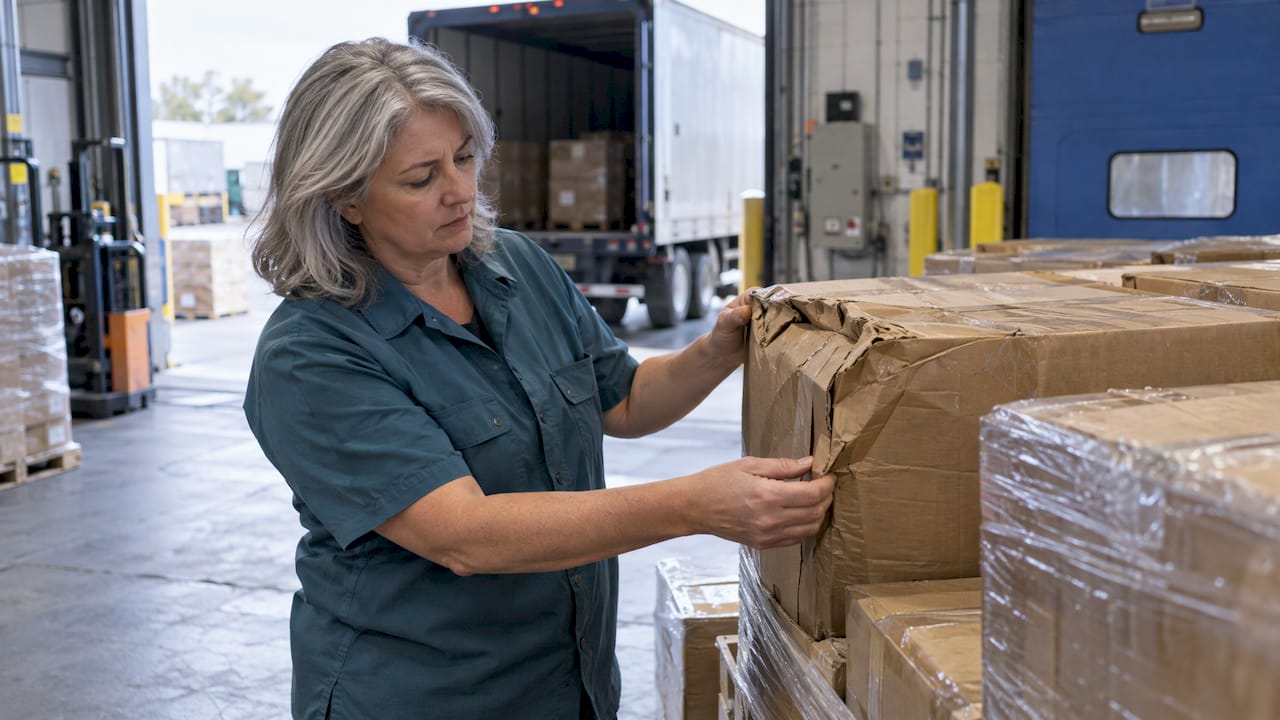
Workers register the quantities that actually arrived, using handheld devices at the dock. The load is marked receiving completed, and the quantities are posted against the purchase order in the inventory ledger. This is where shortages and damage are found, so it is also where claims start.
7. Audit the invoice
Compare the freight bill with the agreed terms. Check the carrier, the mode, accessorial charges and any fees tied to the shipment. Unexpected charges are far easier to dispute when your terms were written down in step 1.
Routing guides and supplier compliance
A routing guide is a document that tells suppliers exactly how to ship to you. It is the main control tool for collect freight. Large buyers publish theirs openly, and they show what a working one contains.
Notice and shipment data. Mead Johnson’s guide requires suppliers to ship freight collect unless the purchase order says prepaid. Vendors release purchase orders in a portal with the shipper, consignee, PO number, carrier PRO number, ship date, freight class, pieces, weight and pallet count. The buyer’s logistics contact must be told at least 48 hours before pickup, and failing to notify or using a non-preferred carrier may bring noncompliance charges.
Escalation. Hyster-Yale’s 2018 instructions set a stepped consequence for non-compliance: a warning first, then a debit memo for 100% of the cost difference if it continues. The count resets each January 1 or when the guide is updated. Non-compliance includes the wrong carrier, the wrong mode, and several same-day shipments not combined on one bill of lading.
Chargebacks. Rite Aid’s 2017 guide states that prepaid purchase orders shipped collect face a full freight chargeback plus a $100 administrative fee per occurrence.
Weight thresholds. Woodstream’s 2024 guide splits shipments by size: LTL for loads over small-parcel limits and under 10,000 lbs or 12 linear feet, and TL above that. Collect vendors must obtain their carrier through the buyer’s TMS website, while prepaid vendors may use any carrier. Violations can lead to refused shipments, fines and recovery of extra freight charges.
These are enterprise examples, and a small business does not need a forty-page document. But the pattern is worth copying at your scale. A one-page routing guide should cover:
- Whether the supplier ships prepaid or collect.
- Which carrier or forwarder to use, and how to book it.
- How much notice before pickup you need.
- What data must go on the shipment documents.
- The label and pallet standards your dock expects.
- What happens when the rules are not followed.
The rules only work if someone enforces them. That is the real cost of a routing guide: a person has to watch for violations every week. When a provider handles the booking, the supplier is simply told where to send the pickup request, and the rules are applied at the booking stage instead of being chased afterward.
Where inbound freight costs leak
Most avoidable cost sits in a handful of places.
- Wrong freight class. LTL carriers price by class, and a wrong class gets corrected later with a reclassification fee. Our U.S. freight class guide walks through how to get it right at booking.
- Uncombined shipments. Several small orders from the same supplier area, shipped separately, cost more than one consolidated load. A 60 to 90 day freight consolidation pilot is a practical way to test this on one lane.
- Wrong mode. Air when ocean would do, or LTL when a full truckload is cheaper per pound. Intermodal shipping is worth testing on one long lane.
- Appointment and detention fees. Trucks that arrive without a slot, or wait at a dock that is not ready.
- Unplanned handling. Pallets that need to be broken down and rebuilt on arrival. Transloading moves cargo from one container or trailer to another near the port or hub, which can shorten turn time.
- Embedded freight. Prepaid prices that hide transport cost, which you cannot negotiate because you cannot see it.
For any business moving trucks of parts and equipment, the same discipline applies to what happens after delivery. A look at managing heavy truck parts inventory shows why inbound freight is the link between suppliers and the stock you hold.
What to look for in a transportation management system
A transportation management system (TMS) is software that plans, books and tracks freight. For inbound work, judge any TMS or provider platform on a short list of practical questions:
- Can it show every inbound shipment, from supplier pickup to dock, in one view?
- Can it apply your routing rules automatically when a purchase order is released?
- Does it flag late or non-compliant shipments, so you do not find them by phone call?
- Does it match the freight invoice to the agreed rate?
- Does it connect to the warehouse where the goods are received?
The last question matters most for growing businesses. A system that stops at the truck leaves you reconciling the dock by hand. Our approach joins transportation, warehousing and shipping on one platform, with real-time tracking and predictive route systems, so the inbound record carries through to receiving.
Receiving: where inbound freight becomes inventory
Freight management does not end when the truck is unloaded. Until quantities are counted and posted to your inventory, you cannot sell the goods, and you cannot dispute a shortage with confidence.
If you import containers, receiving is often priced per container. Our warehousing pricing lists receiving per container, storage at $5 to $6 per bin per month, storage at $17 to $19 per pallet per month, and additional services at $37 per hour. The remaining receiving, order processing, pick, returns and packaging items are quoted on request. See the full list on our pricing page.
For ecommerce sellers, the inbound leg often feeds a fulfillment center or an Amazon prep workflow, so the choices you make at the supplier, such as labeling and carton marking, decide how fast stock becomes sellable. Our 3PL onboarding checklist covers what to prepare before your first inbound shipment arrives.
Start with one lane
You do not need to redesign every supplier relationship at once. A workable first project looks like this:
- Pull the last 90 days of freight bills and list the suppliers that ship prepaid.
- Pick the one or two with the largest volume.
- Ask each for a delivered price and an ex-works price so you can see the embedded freight.
- Move the best candidate to collect with a one-page routing guide.
- Book that lane through a single provider and compare cost, transit time and receiving accuracy after a quarter.
The result is a number you can defend, and a template for the next supplier.
How Usiship handles inbound freight
We are a U.S. logistics provider covering international and domestic freight by air, ocean and land, FTL and LTL, customs clearance, warehousing, fulfillment, cross-docking and transloading across all 50 states. That means a collect shipment from a supplier can be booked, cleared through customs, delivered and received into storage inside one engagement, rather than split between a carrier, a broker and a warehouse.
Our freight forwarding services handle the movement, and our warehousing and fulfillment solutions handle what comes after the dock. If you want to see how a shipment flows from quote to delivery, our 12-step freight forwarding process lays it out.
Our perspective
Inbound freight is where a business either owns its supply chain or rents it from its suppliers. When the supplier picks the carrier and hides the cost in a delivered price, you inherit their habits and their margins.
We built Usiship around the opposite idea: transportation, warehousing and logistics on one platform, so the shipment you book is the shipment your warehouse expects. Real-time tracking, transparent pricing and personalized 24/7 service are how we aim to make that practical for ecommerce brands, retailers, manufacturers and importers.
Our advice to any shipper starting out: move one supplier to collect, write down the rules, and put the booking, the customs and the receiving with one team. The savings come from control, and control is easier with fewer handoffs.
Akbar
FAQ
What is the difference between prepaid and collect freight?
Prepaid means the seller pays the carrier and usually recovers the cost in the price. Collect means the buyer pays the carrier, or the buyer arranges it. Collect gives the buyer control of carrier choice and cost, while prepaid gives that control to the seller.
Is inbound freight the same as inbound logistics?
Not quite. Inbound freight is the transportation of goods to you. Inbound logistics is wider: it includes ordering, transport, receiving, storage and inventory control. Freight management is one part of the larger inbound logistics process.
Who is responsible for inbound freight in a company?
It is often split between purchasing, which sets the terms, and logistics or operations, which handles the shipment. Splitting it without a named owner is how costs go unnoticed. Assign one person or one provider to own the whole inbound flow.
How do I stop suppliers from using the wrong carrier?
Put the carrier rules in a routing guide and attach them to the purchase order. State the consequence, such as a chargeback for the freight cost difference, and apply it consistently. Booking collect freight through one provider also makes the rule easy for suppliers to follow.
Sources
- Inbound freight: Often a missed opportunity, Supply Chain Management Review
- Warehouse handling of inbound loads, Microsoft Learn
- Mead Johnson inbound routing instructions (2022)
- Hyster-Yale inbound freight routing instructions (2018)
- Rite Aid routing guide (2017)
- Woodstream Vendor Routing Guide (2024)
- How to manage heavy truck parts inventory effectively
- Loading dock scheduling