
Importer of Record USA: Guide for Businesses and Foreign Sellers
Under U.S. law, only three parties can legally serve as the Importer of Record (IOR) for a shipment entering the United States: the owner of the goods, the purchaser, or a licensed customs broker appointed by either of those parties via power of attorney. That designation carries real weight. The IOR is legally responsible to U.S. Customs and Border Protection (CBP) for accurate classification, correct valuation, payment of all duties and fees, and long-term record retention — and CBP makes clear that hiring a broker does not shift that liability away from you.
Before you ship, three things need to be confirmed:
- Check your contract and Incoterm. The sales contract determines who is expected to clear the goods. DDP means the seller handles it; EXW means the buyer does. If the contract is silent, CBP will look to whoever files the entry.
- Confirm bonded status. The IOR must post a customs bond before entry can be filed.
- Appoint a licensed customs broker or engage Usiship if you need a compliant IOR who can file in ACE, manage bonds, and handle post-entry support.
Table of Contents
- What is an Importer of Record and how does it differ from related roles?
- What are the core legal duties of a U.S. Importer of Record?
- What documents and identifiers does every IOR need?
- How do you appoint an Importer of Record step by step?
- Can a foreign company act as Importer of Record in the U.S.?
- How do Incoterms and your sales contract determine who becomes the IOR?
- What does U.S. customs clearance typically cost and how long does it take?
- How do you vet an IOR or customs broker before appointing them?
- How Usiship handles Importer of Record services
- Key Takeaways
- The part of IOR compliance most businesses get wrong
- Usiship makes IOR compliance straightforward for importers
- Useful sources for IOR and U.S. customs compliance
What is an Importer of Record and how does it differ from related roles?
The Importer of Record is the party legally responsible for the import transaction under 19 U.S.C. § 1484 and 19 CFR Part 141. When CBP processes an entry, it holds the IOR accountable for everything on that entry: the HTS classification, the declared value, the country of origin, and the payment of duties. If something is wrong, the IOR answers for it.
Several roles get confused with the IOR, and the confusion creates real liability gaps:
- IOR vs. consignee. The consignee is the party named on the bill of lading or air waybill as the recipient of the goods. Being named as consignee does not automatically make a party the IOR. Industry practitioners consistently flag this as one of the most common operational errors: a company receives the goods but never formally accepted IOR responsibility, yet CBP holds them liable because their name is on the entry.
- IOR vs. ultimate consignee. The ultimate consignee is the final recipient of the merchandise in the U.S. Again, receiving goods and being the IOR are separate legal facts.
- IOR vs. Exporter of Record (EOR). The EOR is the party responsible for export compliance in the origin country. On a U.S. import, the EOR is the foreign seller’s problem; the IOR is the U.S. import problem. They are never the same party on the same transaction.
- IOR vs. freight forwarder. A freight forwarder arranges transportation. Unless a forwarder is also a licensed customs broker and has been explicitly appointed by POA, they cannot legally be the IOR. Assuming your forwarder will handle customs entry is a frequent and costly mistake.
- IOR vs. customs broker. A licensed customs broker can be appointed as IOR by the owner or purchaser. The broker then files the entry on behalf of the IOR — but if the broker is not formally appointed as IOR, they are acting as agent, and the importer remains the responsible party.
The practical takeaway: whoever signs the entry summary (CBP Form 7501) as IOR owns the legal exposure. Get that assignment in writing before the shipment moves.
What are the core legal duties of a U.S. Importer of Record?
The IOR’s obligations are not vague. CBP expects specific, documented performance on every entry, and the consequences for falling short range from liquidated damages to criminal referral in serious cases.
Statutory and regulatory duties include:
- Filing a complete and accurate entry within a specified period after the shipment’s arrival, and submitting the entry summary shortly after release, per DHS procedural guidance.
- Correct HTS/HTSUS classification of every line item, using the USITC Harmonized Tariff Schedule.
- Accurate declared value, consistent with CBP’s transaction value rules under 19 CFR Part 152.
- Correct country of origin declaration, which affects duty rates, trade agreement eligibility, and antidumping/countervailing duty applicability.
- Payment of all applicable duties, taxes, harbor maintenance fees (HMF), and merchandise processing fees (MPF).
- Submission of Partner Government Agency (PGA) data in ACE for regulated commodities (FDA, USDA, EPA, FWS, and others depending on product type).
- Five-year record retention for all entry documents, including commercial invoices, packing lists, and correspondence related to the transaction.
The “reasonable care” standard is where many importers get caught. CBP does not require perfection, but it does require that the IOR take affirmative steps to get the classification and valuation right — consulting the HTSUS, using a licensed broker, or obtaining a binding ruling when classification is uncertain. Claiming ignorance is not a defense. CBP’s published guidance frames reasonable care as an active obligation, not a passive one.
Penalty exposure under 19 U.S.C. § 1592 runs from negligence through fraud, with penalties scaled to the unpaid duties or the dutiable value of the merchandise. Negligent violations can result in penalties up to the domestic value of the goods. Fraud carries penalties up to four times the unpaid duties. 2026 rulemaking signals that CBP is tightening enforcement on foreign IORs specifically, so the cost of getting this wrong is rising.
Statistic callout: CBP’s reasonable care standard is codified in the Customs Modernization Act; violations under 19 U.S.C. § 1592 can result in penalties up to four times the unpaid duties for fraudulent entries.
What documents and identifiers does every IOR need?
Getting the paperwork right before the shipment arrives saves days of delay and avoids holds at the port. Here is what the IOR needs to have in place.
Core entry documents:
- Commercial invoice (seller-issued, showing price, quantity, description, country of origin, and buyer/seller details)
- Bill of lading (ocean) or air waybill (air freight)
- Packing list
- Arrival notice (issued by the carrier)
- Certificate of origin (required for trade agreement claims or antidumping scope)
- Permits, licenses, or certificates for regulated goods (FDA prior notice, USDA phytosanitary certificate, EPA import form, etc.)
- PGA-specific data submitted electronically in ACE before or at arrival
Importer identifiers — the IOR must have one of the following on file with CBP:
- EIN (Employer Identification Number): Standard for U.S. businesses; issued by the IRS.
- SSN: Used by individual importers with no business entity.
- CBP-assigned importer number: Obtained via CBP Form 5106, used by foreign entities or parties without an EIN/SSN. This is the route for non-resident importers.
Customs bonds are mandatory for formal entries (shipments valued over $2,500 or subject to federal agency requirements). Two types apply:
- Single-transaction bond: Covers one shipment. The minimum is $100, but the bond amount must equal the total entered value plus duties and fees, so it is usually much higher in practice.
- Continuous bond: Covers all entries for a 12-month period. The amount is set at the greater of $50,000 or 10% of duties, taxes, and fees paid in the prior 12 months. For frequent importers, a continuous bond is almost always more cost-effective.
| Document | Purpose | Who typically provides it |
|---|---|---|
| Commercial invoice | Establishes value, description, and parties | Seller/exporter |
| Bill of lading / air waybill | Proves title and transport contract | Carrier |
| Packing list | Details contents, weights, dimensions | Seller/exporter |
| Certificate of origin | Supports duty rate or trade agreement claim | Seller or chamber of commerce |
| CBP Form 5106 | Establishes importer identity with CBP | Buyer/IOR (filed with CBP) |
| Customs bond | Guarantees duty payment to CBP | IOR via surety company or broker |
| PGA-specific permits | Satisfies federal agency requirements | Seller, IOR, or licensed importer |
A practical customs clearance checklist confirms that the importer number, manufacturer details, tariff classification, commercial invoice, and packing list are the core inputs CBP requires at entry.
How do you appoint an Importer of Record step by step?
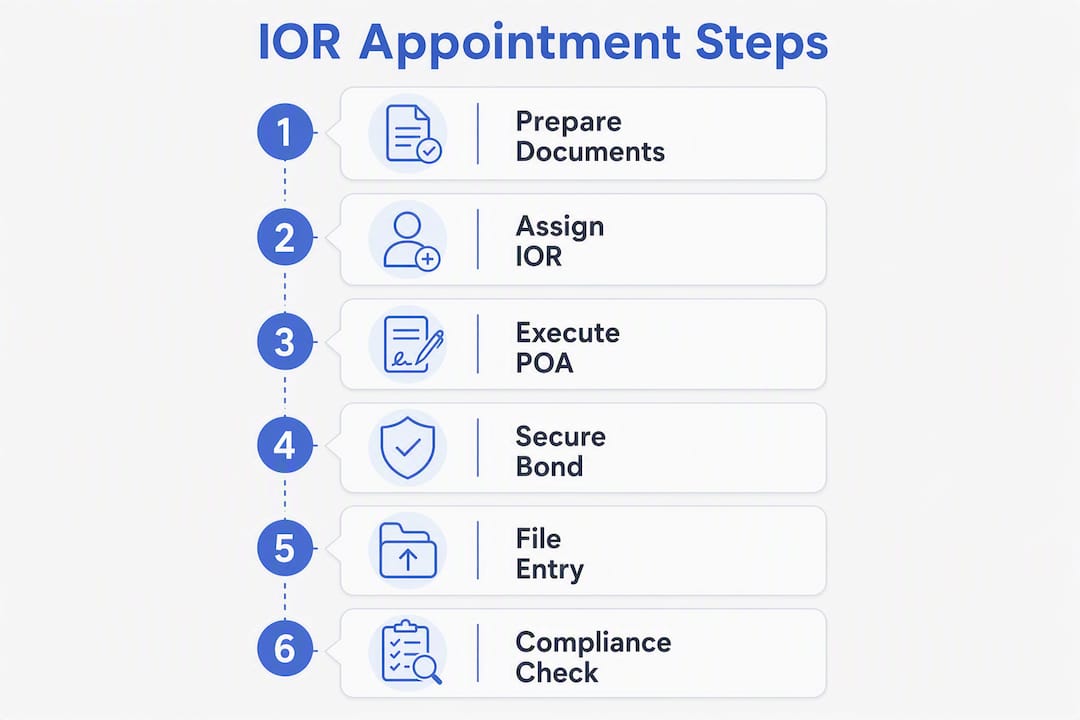
The appointment process is straightforward when you follow it in order. Skipping steps — especially the POA or bond — is the most common cause of clearance delays.
- Secure the importer identifier — U.S. businesses use their EIN. Individuals use their SSN. Foreign entities file CBP Form 5106 to obtain a CBP-assigned importer number.
For domestic IORs, steps 3 through 8 are standard. The EIN is usually already on file, and the bond can be set up in advance with a surety.
For non-resident IORs, step 3 requires Form 5106, step 5 requires a U.S. agent authorized to accept service of process (typically the customs broker), and the bond requirements are stricter. See the next section for the full non-resident path.

Pro Tip: The single most common delay at the port is a missing or incorrectly executed POA. The wrong EIN on CBP Form 7501 — even a transposition error — will trigger a hold. Verify the importer number on the POA matches the number on the entry summary exactly before the shipment arrives.
Can a foreign company act as Importer of Record in the U.S.?
Yes, but the path is narrower than it used to be, and it is getting narrower still. Foreign entities can legally serve as IOR, but they must meet specific requirements that go beyond what a domestic importer faces.
Core requirements for a non-resident IOR:
- CBP-assigned importer number via Form 5106. Foreign entities without a U.S. EIN must file this form to establish an identity with CBP.
- Customs bond posted through a U.S.-licensed surety. Foreign IORs typically need a continuous bond, and the bond amount is set at the greater of $50,000 or 10% of prior-year duties.
- A U.S. agent — almost always a licensed customs broker — who is authorized to accept service of process on behalf of the foreign IOR. This is not optional; CBP requires a domestic point of contact for enforcement purposes.
- Power of attorney executed in favor of the U.S. agent/broker, authorizing them to file entries and act on the IOR’s behalf.
- Corporate certification or POA filings confirming the foreign entity’s legal existence and the authority of the signatory.
The 2026 policy shift is significant. Industry reporting from mid-2026 documents executive direction to CBP and DHS to tighten the foreign IOR route. The changes being implemented or signaled include:
- Additional validation requirements, including CTPAT (Customs-Trade Partnership Against Terrorism) certification or equivalent vetting.
- Restrictions on the default use of continuous bonds for foreign IORs with limited U.S. import history.
- Limits on informal entries (shipments under $2,500) that foreign IORs previously used to avoid formal entry requirements.
Confirm current rules before you ship. The regulatory environment is moving fast enough that guidance current in early 2026 may not reflect what CBP is enforcing by the time your shipment arrives. A licensed customs broker with active ACE access is the most reliable way to stay current.
Sample document list for a foreign IOR:
- Completed CBP Form 5106 (importer identity)
- Continuous bond confirmation from U.S. surety
- Signed customs POA in favor of U.S. broker/agent
- Corporate registration documents (translated to English if needed)
- Commercial invoice, packing list, and bill of lading for the first shipment
- PGA-specific permits or registrations for regulated product categories
For context on how comparable non-resident programs work in practice, the Canada Non-Resident Importer Program offers a useful model — the U.S. version is structurally similar but currently more restricted and under active revision.
How do Incoterms and your sales contract determine who becomes the IOR?
The Incoterm in your sales contract is not just a shipping instruction. It is the primary tool that allocates import responsibility, and getting it wrong creates liability surprises that are expensive to unwind after the fact.
Here is how the most common Incoterms play out for IOR purposes, per LegalClarity’s analysis:
- EXW (Ex Works): The buyer takes responsibility from the seller’s loading dock. The buyer arranges export clearance, freight, and U.S. import clearance. The buyer is the IOR.
- FOB / CFR / CIF: The seller handles export; the buyer handles U.S. import. The buyer is the IOR.
- DAP (Delivered at Place): The seller delivers to a named place in the U.S. but does not clear customs. The buyer handles import clearance and is the IOR.
- DDP (Delivered Duty Paid): The seller delivers cleared goods to the buyer’s door, paying all duties. The seller must either be the IOR or appoint a licensed customs broker to act as IOR on their behalf. This is the Incoterm that most often surprises foreign sellers who agree to it without understanding the U.S. customs obligations it creates.
The DDP trap is real. A foreign seller who agrees to DDP without a U.S. entity, an EIN, and a customs bond in place cannot legally fulfill that obligation. The options are: (1) appoint a licensed customs broker as IOR via POA, (2) establish a U.S. legal presence, or (3) renegotiate the Incoterm before the shipment moves.
Contract clause guidance: If the Incoterm does not make the IOR assignment unambiguous, add an explicit clause. A workable example:
When the contract is silent on IOR and the Incoterm is ambiguous, CBP will hold the party that filed the entry. That is usually whoever the broker had a POA from — which may not be the party that intended to bear the liability.
What does U.S. customs clearance typically cost and how long does it take?
Budgeting for a U.S. import requires understanding five distinct cost components, not just the duty rate. Underestimating any one of them can throw off landed cost calculations significantly.
Cost components:
- Merchandise Processing Fee (MPF): — 0.3464% of the entered value, with a minimum of $31.67 and a maximum of $614.35 per entry (rates subject to periodic adjustment by CBP).
Illustrative example for a $20,000 ocean shipment with a 5% duty rate:
| Cost item | Calculation | Approximate amount |
|---|---|---|
| Customs duty | $20,000 × 5% | — |
| MPF | $20,000 × 0.3464% | — |
| HMF | $20,000 × 0.125% | $25 |
| Single-transaction bond | ~1% of ($20,000 + —) | — |
| Broker filing fee | Varies | — |
Timeline milestones for an ocean shipment:
Common delay triggers: missing PGA data (FDA, USDA), misclassification that triggers a CBP query, missing or unsigned POA, unpaid prior duties on the importer’s account, or a random or targeted exam. Exams add 3–10 business days on average and can run longer for intensive inspections.
How do you vet an IOR or customs broker before appointing them?
Appointing the wrong IOR or broker is not just an operational inconvenience. If they file incorrectly, you pay the penalties. Here is a practical vetting checklist.

Confirm licensed broker status. CBP maintains a public database of licensed customs brokers. Verify the broker holds an active individual or corporate license. A freight forwarder without a broker license cannot legally file entries as IOR.
Check bond number and surety. Ask for the bond number and the name of the surety company. Verify the bond is active and covers the shipment type and value you need.
Confirm ACE access and PGA handling. Not all brokers have experience with every PGA. If your goods are FDA-regulated, USDA-regulated, or subject to EPA or FWS requirements, confirm the broker has filed those specific PGA data sets before.
Request proof of continuous bond or single-transaction bond capability. For high-volume importers, a broker who can help you set up a continuous bond is preferable to one who files single-transaction bonds for every shipment.
Sample questions to ask before signing a POA:
- What is your process if CBP issues a CF-28 (Request for Information) or CF-29 (Notice of Action) on one of my entries?
- Do you provide audit support if CBP initiates a focused assessment?
- How do you handle record retention, and can I access my entry records on demand?
- What are your fees for post-entry amendments and protests?
- Have you handled entries for my specific product category (HTS chapter)?
Documents to request from the broker or IOR service:
- POA template (review before signing)
- Surety bond confirmation letter
- Copy of CBP broker license
- EIN or CBP-assigned importer number confirmation
- Sample entry summary (Form 7501) from a comparable filing
How Usiship handles Importer of Record services
Usiship (Universal Shipping Inc.) operates as a licensed customs brokerage with full customs clearance capabilities, including ACE filing, bond management, PGA data submission, and post-entry support. For businesses that need an IOR but lack the U.S. entity, the EIN, or the internal compliance infrastructure to file entries themselves, Usiship provides an end-to-end path.
Service flow:
- Discovery and scoping: Usiship reviews the shipment details, HTS classification, and PGA requirements to confirm what the entry will need.
- Documentation and POA: The client provides commercial documents; Usiship prepares and executes the customs POA.
- Bond and account setup: Usiship arranges the appropriate bond (single-transaction or continuous) through its surety relationships and establishes the importer account in ACE.
- Entry filing: Usiship files the entry in ACE, submits ISF for ocean shipments, and handles PGA data submissions.
- Post-entry support and record retention: Usiship manages CBP queries, entry amendments, and five-year document retention on the client’s behalf.
Who Usiship serves in this capacity:
- Foreign sellers who need a non-resident IOR to fulfill DDP obligations without establishing a U.S. entity.
- U.S. buyers who prefer to delegate entry filing and compliance management to a licensed broker.
- Ecommerce sellers importing inventory for fulfillment and FBA prep who need IOR services bundled with warehousing.
- Importers of specialized or regulated goods who need PGA-experienced filing support.
Trust signals: Licensed customs brokerage, active continuous bond, ACE filing access, integrated logistics and transportation services, and fulfillment infrastructure across all 50 U.S. states.
Key Takeaways
Acting as or appointing a compliant Importer of Record requires confirming the right party, securing the correct bond and POA, and filing accurate entry documents in ACE before or at arrival.
| Point | Details |
|---|---|
| Who can be IOR | Only the owner, purchaser, or a licensed customs broker appointed by either via POA. |
| IOR liability is non-delegable | Even with a broker filing the entry, the IOR remains legally responsible to CBP for accuracy and duty payment. |
| Bond and POA are mandatory | A customs bond and signed POA must be in place before entry is filed; missing either triggers a hold. |
| Foreign IOR rules are tightening | 2026 rulemaking signals added validation requirements and bond restrictions for non-resident importers; confirm current rules before shipment. |
| Usiship provides full IOR support | Usiship offers licensed customs brokerage, ACE filing, bond management, and fulfillment integration for domestic and foreign importers. |
The part of IOR compliance most businesses get wrong
The compliance conversation around Importer of Record tends to focus on documentation checklists. That is useful, but it misses the more expensive problem: most IOR mistakes happen before a single document is prepared, in the contract negotiation.
A foreign seller agrees to DDP because the buyer asked for it and it seemed like a straightforward concession. Three weeks later, the shipment arrives at a U.S. port and the seller has no EIN, no bond, no POA, and no licensed broker on file. The goods sit in a bonded warehouse accumulating storage fees while everyone figures out who is actually going to file the entry. That scenario plays out constantly, and it is entirely preventable by reading the Incoterm implications before signing the contract.
The second most common mistake is assuming the freight forwarder is handling customs. Forwarders arrange transportation. Unless they are also a licensed customs broker and you have signed a POA appointing them as your agent, they are not filing your entry. The entry does not file itself. Someone has to be the IOR, and if no one has been formally appointed, CBP will find the party whose name is most prominent on the documents and hold them responsible.
The third mistake is underestimating the 2026 policy shift for foreign IORs. The informal entry exemption and the light-touch bond arrangements that made non-resident importing relatively accessible are being tightened. If your supply chain depends on a foreign entity acting as IOR, get current CBP guidance now, not after the shipment is on the water.
For readers who want to confirm their IOR setup is compliant, Usiship’s customs clearance services are a practical starting point.
Usiship makes IOR compliance straightforward for importers
Most businesses that run into IOR problems are not careless. They are busy, and the compliance requirements are genuinely complex. Usiship exists to remove that complexity for importers who need a licensed, bonded, ACE-capable IOR without building an internal customs compliance team from scratch.
The onboarding process is direct: submit your shipment details and commercial documents, execute the POA, and Usiship handles bond setup, entry filing, PGA submissions, and post-entry support. Foreign sellers fulfilling DDP obligations, U.S. buyers delegating compliance, and ecommerce importers needing IOR bundled with warehousing and fulfillment all work with Usiship through the same integrated platform.
Usiship covers all 50 U.S. states, with particular depth at major import ports. For specialized cargo, the same team that manages customs clearance also handles freight forwarding and transportation from origin to final destination.
Ready to confirm your IOR setup or hand it off entirely? Get started with Usiship’s customs clearance services and have a licensed broker review your shipment before it moves.
Useful sources for IOR and U.S. customs compliance
Primary legal and regulatory sources carry the most authority for IOR questions. Practical guides are useful for operational context but should always be checked against CBP’s current published guidance.
Primary legal and regulatory sources:
- U.S. Customs and Border Protection: Tips for New Importers and Exporters — CBP’s official overview of importer responsibilities, ISF requirements, and broker use.
- CBP Customs Directive No. 3530-002A — The primary regulatory basis for who may serve as Importer of Record under 19 U.S.C. § 1484 and 19 CFR Part 141.
- Department of Homeland Security: Find Import/Export Forms — Official source for CBP Form 5106, Form 7501, and other required entry forms with filing timelines.
- USITC Harmonized Tariff Schedule — The authoritative source for HTS classification and applicable duty rates.
- Bureau of Industry and Security (BIS) — Governs export controls and dual-use goods; relevant when the IOR must confirm import eligibility for controlled items.
Practical guidance and comparative context:
- International Trade Administration: Canada Non-Resident Importer Program — Comparative model for how non-resident importer programs work; useful context for understanding U.S. non-resident IOR mechanics.
Usiship service pages:
- Usiship Customs Clearance Services — Licensed brokerage, ACE filing, and bond management for domestic and foreign importers.
- Usiship Omnichannel and Ecommerce Fulfillment — IOR services bundled with fulfillment and FBA prep for ecommerce importers.
This article provides general informational guidance on U.S. import compliance. It is not legal advice. Confirm current CBP requirements, duty rates, and regulatory obligations with a licensed customs broker or qualified trade attorney before making import decisions.